Industry Analysis: Business Supplies


Consolidate scale in distribution and specialize in facility solutions rather than compete on catalog price. The business supplies and equipment industry, spanning office products, printers and copiers, furniture and janitorial goods, generates several hundred billion dollars in annual revenue globally, yet organic demand for its core paper and stationery lines is shrinking as hybrid work and digitization take hold. Margin has migrated away from single-item retail and toward maintenance, repair and operating [MRO] distribution, managed print services and contract furniture design, where technical service and logistics reliability replace price as the basis of competition. Buyers, armed with e-commerce price transparency and platforms such as Amazon Business, have gained bargaining power that manufacturers and generalist retailers have largely ceded. The decision facing executives is whether to defend a broad, low-margin catalog or to concentrate capital in high-touch, solution-based segments where switching costs and technical trust still command a premium.
Is business supplies and equipment attractive for new entrants?
Attractiveness depends heavily on the segment chosen. Commodity office products carry thin margins and are dominated by scaled distributors with negotiated freight rates and private-label programs, making direct entry unattractive. Maintenance, repair and operating [MRO] distribution and specialized facility solutions remain more open, particularly for entrants who can serve underpenetrated regional or vertical niches that national players find too small to prioritize.
Which parts of the value chain are most profitable?
Distribution and the customer-facing service layer capture the largest share of margin, ahead of manufacturing. A distributor that bundles inventory management, technical specification support and next-day fulfillment earns a service premium that a pure manufacturer selling through intermediaries cannot access directly. Managed print services and contract furniture design follow a similar pattern, where the wrap-around service, not the physical product, is what customers pay extra for.
How is technology changing this industry?
E-commerce marketplaces have compressed pricing on standardized items and shifted purchasing decisions to procurement software rather than catalogs. At the same time, Internet of Things [IoT] enabled inventory sensors, predictive replenishment algorithms and cloud-based print fleet management are creating new recurring-revenue service layers that did not exist a decade ago. Digitization of paperwork continues to erode demand for paper-based products, forcing manufacturers to diversify into adjacent facility categories.
What capabilities are table stakes vs differentiators?
Reliable fulfillment, broad catalog breadth and competitive freight terms are table stakes that every scaled competitor must offer just to stay in a procurement consideration set. Differentiation now comes from vertical-specific technical expertise, such as safety compliance consulting for industrial MRO buyers, from data-driven replenishment that reduces a customer's total inventory carrying cost and from design services that embed a furniture or facility vendor into a client's real estate planning process.
How should investors or consultants evaluate opportunities here?
Evaluate targets on customer concentration, private-label penetration and the share of revenue tied to service contracts rather than one-time product sales, since recurring service revenue is far stickier than transactional catalog sales. Assess exposure to secular headwinds, particularly paper and print volume decline and the shrinking office footprint from hybrid work, against exposure to durable tailwinds such as industrial reshoring and warehouse expansion, which sustain MRO demand independent of office occupancy trends.
What is driving consolidation among distributors?
Fragmentation among thousands of regional wholesalers has made acquisition the fastest way for national players to add density in a given metro area or vertical, since local delivery routes and warehouse footprint are expensive and slow to build organically. Consolidation also lets acquirers rationalize duplicate distribution centers and negotiate better terms with shared suppliers, compounding scale advantages that smaller independents cannot match.
Why are office furniture makers merging?
Post-pandemic demand for office furniture has stayed volatile as employers resize footprints for hybrid attendance patterns and scale has become the clearest lever left for margin protection. Combining design, manufacturing and dealer networks, as seen in HNI Corporation's acquisition of Steelcase, lets the combined company spread fixed factory and research costs over a larger unit base while consolidating a fragmented dealer channel.
How exposed is this industry to raw material and freight cost swings?
Meaningfully exposed. Paper pulp, steel, aluminum and plastics are the primary inputs across furniture, print equipment and packaging supplies and all are subject to commodity cycles and tariff policy shifts. Freight, whether parcel, less-than-truckload or ocean container, is a second major variable cost that can swing operating margin by a percentage point or more within a single fiscal year.
Does sustainability regulation matter for this industry?
It matters increasingly for large enterprise and government buyers, who now build recycled content, take-back programs and carbon disclosure into procurement scoring for furniture, paper and janitorial categories. Manufacturers that can document circularity credentials win preferred-vendor status with big institutional accounts, while smaller suppliers without compliance infrastructure risk exclusion from those bids.
What separates winners from laggards in this industry over the next five years?
Winners will be the distributors and manufacturers that shift their revenue mix toward services, data and specification-led relationships while using scale to defend commodity categories at acceptable margin. Laggards will be single-category catalog sellers with no logistics or service differentiation, who will keep losing share to marketplaces on price and to specialized MRO or facility-solutions competitors on relationship depth.
Business supplies and equipment is one of the oldest B2B categories in commerce, yet it is undergoing one of the more consequential restructurings of any mature industry, as digitization, hybrid work and e-commerce price transparency simultaneously shrink its traditional core and expand its adjacent service opportunities. Executives evaluating this space need a clear map of where volume is shrinking, where margin is migrating and which capabilities will still command a premium once the dust settles.
Industry at a glance
The business supplies and equipment industry covers the manufacturing, distribution and resale of the physical goods organizations need to run offices, facilities and light industrial operations. Its scope includes traditional office products such as paper, writing instruments and filing systems, printers, copiers and their consumables, office and institutional furniture and janitorial and facility maintenance supplies, along with the maintenance, repair and operating [MRO] goods that keep industrial and commercial facilities functioning, from fasteners to safety equipment. It excludes core information technology hardware such as computers and servers, which sit in a separate technology hardware category and it excludes raw construction materials, which belong to building products.
Customers span all three demand types found in B2B markets. Corporate and small-business buyers make up the largest share of demand, purchasing through procurement departments or, for smaller firms, through general merchandise or e-commerce channels. Government agencies form a distinct and sizable buyer segment, procuring office and facility supplies through contract vehicles that prioritize compliance and total cost of ownership over unit price. Consumer purchases, largely of stationery and home-office goods, represent a smaller but not trivial channel, particularly since remote work normalized home-office equipment spending.
The industry's economic role is defined by dependence on the health of the broader services and industrial economy rather than by any dynamic of its own. Office supply demand correlates with white-collar employment and office occupancy, while MRO and janitorial demand correlates with industrial production, warehouse square footage and facility headcount. Because the goods themselves are largely non-discretionary but low-cost per unit, revenue models in this space rely on transaction volume and repeat purchase frequency rather than on high average order values, which places a premium on distribution efficiency and account retention over one-time sales.
Capital intensity in the industry is moderate and concentrated in distribution infrastructure and, for manufacturers, in factory tooling, rather than in the products themselves. Grainger's 2025 revenue of 17.9 billion dollars was generated substantially through the operating leverage of its distribution network rather than through manufacturing assets it owns outright, since a broad-line distributor sources from thousands of suppliers rather than producing goods itself.1 Labor intensity is highest in warehousing, last-mile delivery and technical sales, all functions that resist full automation because of the fragmented, small-batch nature of orders. Regulatory intensity is generally light relative to other industrial sectors, though it is rising in specific areas, including product safety standards for furniture and equipment, environmental compliance for paper sourcing and packaging and increasingly, corporate sustainability disclosure requirements that large institutional buyers now factor into vendor selection.
Industry segmentation
The industry organizes naturally into segments defined by product category and, within each, by the customer relationship model used to reach the buyer. Office products and stationery forms the traditional core, covering paper, writing instruments, filing and organizational goods, sold through big-box retail, e-commerce and contract wholesale channels; this segment carries the lowest average margin because products are largely undifferentiated commodities. Printers, copiers and imaging equipment constitute a second segment, spanning hardware sales, consumables such as toner and ink and an increasingly important managed print services layer that bundles equipment, supplies and fleet management into a single contract; margin here has shifted decisively from hardware toward the service and consumables tail.
Office and institutional furniture forms a third segment, ranging from mass-market seating and desking sold through retail to highly customized contract furniture specified by architects and facility managers for corporate campuses, healthcare and education, where design services and dealer relationships create meaningfully higher margins than commodity furniture retail. Janitorial and facility maintenance supplies, sometimes bundled with broader facility solutions, make up a fourth segment focused on consumables such as cleaning chemicals, paper hygiene products and safety equipment, typically sold on recurring replenishment contracts rather than one-time purchase.
MRO distribution constitutes a fifth and increasingly central segment, covering the tools, fasteners, safety gear and maintenance supplies that keep industrial, warehouse and commercial facilities operating; this segment overlaps with but extends beyond traditional office supplies into a broader industrial distribution category and it has become the primary growth engine for scaled players such as Grainger. A sixth cross-cutting dimension worth tracking separately is channel model, since within any product segment, competitors split between high-touch models offering technical sales support and account management and low-touch or endless-assortment e-commerce models offering broad catalog access at lower service cost, a distinction Grainger itself uses to organize its own reporting.2
Market structure
Porter's Five Forces framework clarifies why margin in this industry has concentrated so heavily in distribution and service rather than in manufacturing. Buyer power has risen sharply as digital price transparency lets procurement teams benchmark every commodity line against marketplace pricing, while supplier power remains moderate and concentrated among branded furniture, print engine and paper manufacturers. Rivalry is intense in commodity categories and fragmented but consolidating in specialty segments, the threat of new entry is low for full-line distribution but meaningful for private-label imports and niche e-commerce sellers and the threat of substitution is structural, driven by digitization of paper-based workflows and the shrinking office footprint under hybrid work.
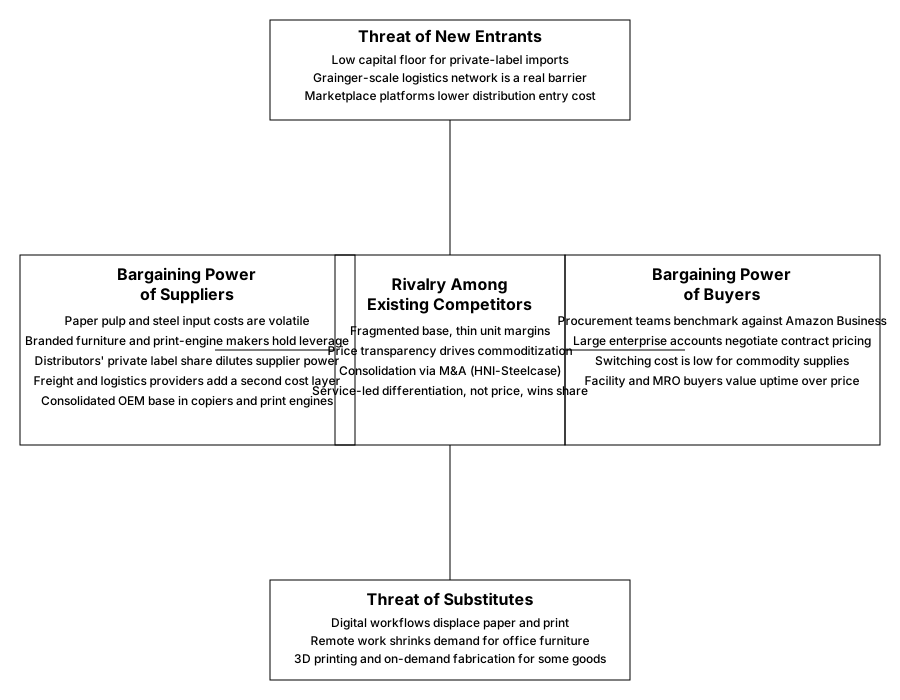
Bargaining power of buyers
Buyer power in this industry has grown substantially over the past decade as procurement moved from paper catalogs and single-vendor relationships to digital marketplaces that make cross-vendor price comparison nearly instant. Large enterprise and government accounts, which represent the bulk of volume in office products and MRO categories, negotiate contract pricing directly and can credibly threaten to shift spend to a competing distributor or to a marketplace such as Amazon Business, which has captured a meaningful share of online office supply purchasing.3 Small-business buyers, while individually less powerful, aggregate through the same marketplaces and benefit from the same price discovery, further compressing the pricing power that suppliers once held over fragmented, less-informed purchasers.
The dynamic differs by category. Commodity paper, stationery and basic janitorial supplies face the highest buyer power because products are functionally interchangeable across brands, leaving price and delivery speed as the only differentiators a buyer weighs. Specified categories such as contract furniture, safety-critical MRO components and managed print fleets face comparatively lower buyer power because switching involves redesign costs, technical requalification or the operational risk of an unproven vendor, which gives incumbent suppliers negotiating leverage that transactional categories lack.
Facility and industrial buyers increasingly weight total cost of ownership and uptime over unit price, particularly for MRO goods where a stockout can halt production, which somewhat offsets the general upward trend in buyer power for that segment. Government buyers occupy a distinct position, since they wield significant volume leverage but operate under procurement rules that favor established, compliant vendors over the lowest bidder alone, moderating the price pressure a purely commercial buyer could otherwise apply.
| Buyer segment | Switching ease | Primary leverage |
|---|---|---|
| Small business, e-commerce | High | Marketplace price comparison |
| Large enterprise, commodity spend | High | Contract renegotiation, dual-sourcing |
| Facility and industrial MRO buyers | Moderate | Uptime and technical specification risk |
| Government and institutional | Low | Compliance and contract-vehicle lock-in |
| Contract furniture and design clients | Low | Redesign and specification switching cost |
Bargaining power of suppliers
Suppliers to this industry split into two distinct groups with very different leverage profiles. Commodity raw material suppliers, providing pulp, steel, aluminum and plastics resin, hold moderate power driven by global commodity cycles rather than by any relationship-specific leverage, since distributors and manufacturers can typically source these inputs from multiple regions and adjust formulations or specifications to manage cost volatility. Branded finished-goods suppliers, particularly in print engines, premium furniture and specialized safety equipment, hold considerably more power because their products carry end-customer brand preference that a distributor cannot easily substitute away from.
Distributors have worked systematically to offset supplier power by building private-label programs across commodity categories, which both improves their own margin and gives them a credible substitution threat to hold over branded suppliers during price negotiations. Grainger and similar broad-line distributors also aggregate purchase volume across tens of thousands of stock-keeping units [SKUs] from thousands of suppliers, which dilutes any single supplier's leverage even in categories where individual brands are strong, since no single supplier represents a large enough share of total purchase volume to dictate terms.
Freight and logistics providers function as a second, less obvious supplier category whose bargaining power has grown as parcel and less-than-truckload rates have become more volatile, adding a cost variable that sits outside the direct manufacturer-distributor relationship but materially affects delivered cost and, therefore, competitive pricing. In the printer and copier segment, supplier concentration is comparatively high, since a small number of original equipment manufacturers control the print-engine technology that even competing hardware brands often license, giving those technology owners disproportionate influence over industry economics.4
| Supplier type | Concentration | Leverage source |
|---|---|---|
| Commodity raw material producers | Low to moderate | Global commodity price cycles |
| Branded furniture and equipment makers | Moderate to high | End-customer brand preference |
| Print engine and imaging technology owners | High | Patented technology, licensing |
| Freight and logistics carriers | Moderate | Capacity constraints, fuel cost |
| Private-label contract manufacturers | Low | Distributor-controlled, interchangeable |
Rivalry among existing competitors
Competitive intensity varies sharply by segment but trends toward consolidation almost everywhere. In commodity office products, rivalry has historically been severe, culminating in the collapse of Staples' 2015 attempt to merge with Office Depot after regulators blocked the deal on antitrust grounds, a decision that left both companies to compete independently through a decade of shrinking demand and store closures rather than benefiting from the scale the merger would have created.5 The ODP Corporation's revenue fell from 11.7 billion dollars in 2015 to roughly 7 billion dollars in 2024, illustrating how severely commodity rivalry combined with channel shift has compressed the traditional retail segment.
In MRO distribution, rivalry is more disciplined because the segment rewards service depth and technical relationship over price alone, letting scaled players such as Grainger post organic growth even as adjacent office categories contract; Grainger's 2025 results showed 4.5 percent daily organic growth on a constant-currency basis, with its lower-touch Endless Assortment e-commerce arm growing considerably faster than its high-touch core.6 In office furniture, rivalry pressure has pushed the segment toward direct consolidation, exemplified by HNI Corporation's agreement to acquire Steelcase for 2.2 billion dollars in cash and stock, a deal explicitly framed around achieving the scale needed to weather volatile post-pandemic demand for office space.
The printer and copier segment shows a different rivalry pattern, where traditional hardware original equipment manufacturers compete not only against each other but against a growing cohort of independent software vendors offering vendor-agnostic, cloud-based fleet management platforms that erode the hardware makers' traditional service lock-in. Across all these segments, the common thread is that rivalry on price alone destroys value, while rivalry through consolidation, service differentiation and channel specialization preserves or expands it.
| Segment | Rivalry intensity | Dominant competitive response |
|---|---|---|
| Commodity office products retail | Severe | Store closures, B2B pivot |
| MRO distribution | Moderate, disciplined | Service depth, digital channel expansion |
| Office and contract furniture | High, consolidating | Merger and acquisition for scale |
| Managed print and imaging | Moderate, shifting | Software and cloud fleet management |
| Janitorial and facility supplies | Moderate | Regional roll-up acquisitions |
Threat of new entrants
Direct entry into full-line, national office supply or MRO distribution carries formidable barriers, since replicating a warehouse network, delivery fleet and supplier relationship base comparable to Grainger's or the ODP Corporation's would require years of capital investment before reaching competitive delivery speed and cost. These barriers explain why the scaled incumbents that survived the last decade of consolidation have faced little direct threat from newly founded, broad-catalog competitors, even as their addressable market has shrunk.
The more credible entry threat comes from narrower angles. E-commerce marketplaces and private-label importers can enter specific commodity categories with comparatively low capital by sourcing directly from overseas manufacturers and selling through existing platforms rather than building proprietary logistics, which is precisely how Amazon captured meaningful share of online office supply volume without operating a traditional distribution network of its own. Specialized MRO or facility-solutions entrants can also carve out defensible niches by focusing on an underserved vertical or region that national players deprioritize because the addressable revenue is too small relative to their overhead structure.
Regulatory and safety certification requirements create a modest additional barrier in categories such as furniture, safety equipment and certain janitorial chemicals, since new entrants must clear compliance testing before large institutional buyers will consider them, a process that favors established manufacturers with existing certification infrastructure. Capital requirements for manufacturing, as opposed to distribution, are higher still, particularly in furniture and print equipment, where factory tooling and design capability represent meaningful fixed investment that a new entrant must fund before generating any revenue.
| Entry pathway | Capital requirement | Realistic barrier level |
|---|---|---|
| National full-line distribution | Very high | Near-prohibitive without acquisition |
| Marketplace-based private label | Low to moderate | Moderate, growing |
| Niche vertical or regional MRO | Moderate | Moderate, defensible |
| Furniture or equipment manufacturing | High | High, tooling and certification |
| Managed print software platform | Low to moderate | Moderate, technology-led |
Threat of substitutes
Substitution is the most structurally significant force acting on this industry, because the shift is not competitive but behavioral, driven by how organizations work rather than by which vendor they choose. Digitization of documentation, approvals and record-keeping has steadily reduced the volume of paper, printing and filing supplies a typical office consumes, a trend that predates but has been accelerated by remote and hybrid work adoption, which also reduces aggregate office square footage and, with it, demand for desking, seating and printing infrastructure calibrated to a fully in-office workforce.
Managed print services face a particularly direct substitution threat from cloud-based collaboration and document workflow tools that eliminate the need to print at all for many routine business processes, a dynamic reflected in Xerox's reported declines in outsourcing, print service and supplies revenue even as the broader managed print services market grows through consolidation and diversification into adjacent IT services.7 Office furniture faces a milder but still material substitution pressure from the home-office furniture category, which captures spending that would otherwise have gone toward corporate furnishing budgets as employees furnish home workspaces instead.
MRO and janitorial supplies face comparatively limited substitution threat, since physical facilities still require physical maintenance regardless of how digitized an organization's paperwork becomes, which is part of why this segment has become the industry's most reliable growth engine. Additive manufacturing and on-demand fabrication represent an early-stage substitution vector for certain specialized parts and fixtures, though the cost and speed of traditional distribution still outcompete on-demand production for the vast majority of standard MRO items.
| Substitute | Category affected | Maturity of threat |
|---|---|---|
| Digital document workflows | Paper, print, filing supplies | Mature, ongoing |
| Cloud collaboration tools | Print and copier services | Mature, ongoing |
| Home-office furnishing spend | Corporate office furniture | Moderate, growing |
| On-demand and additive manufacturing | Specialized MRO parts | Early stage |
| Facility outsourcing bundled services | Standalone janitorial supply purchase | Early to moderate |
Value chain and profit pools
The value chain begins with upstream input production, covering the paper pulp, steel, aluminum, plastics resin and electronic components that feed into finished goods, an activity dominated by large commodity producers operating largely outside this industry's direct competitive dynamics. Manufacturing and assembly follow, where branded and private-label producers convert those inputs into finished office products, furniture, print equipment and facility supplies, a stage where fixed factory investment rewards scale but where product design and technical specification create pockets of differentiation, particularly in contract furniture and imaging technology.
Distribution and logistics form the pivotal stage in this industry's value chain, encompassing warehousing, inventory management and last-mile delivery and it is here that the industry's most durable competitive advantages reside, since replicating a dense, reliable distribution network is far harder and slower than replicating a product. Wholesale and specialty distributors add a further layer by aggregating supply from thousands of manufacturers into a single catalog and relationship for the buyer, a service that becomes more valuable, not less, as product breadth increases.
The customer interface stage covers sales, account management and, increasingly, digital procurement platforms, where the shift from field sales representatives to e-commerce and self-service ordering has changed the cost structure of customer acquisition and retention across the industry. Installation and service, most relevant in furniture and managed print, forms a distinct stage where labor-intensive, high-touch delivery creates switching costs that pure product sales cannot replicate on their own.
Enabling infrastructure, spanning enterprise resource planning systems, inventory forecasting software and increasingly Artificial Intelligence-driven demand prediction, has become a quietly important final stage, since the distributors that most accurately predict replenishment needs and optimize inventory placement capture both a cost advantage and a service-quality advantage over less sophisticated competitors.
Profit pool
Profit concentration in this industry has moved decisively toward distribution and service, away from manufacturing and away from single-item retail. A commodity paper or stationery product manufactured with thin margin passes through a distributor who adds inventory management, credit terms and delivery reliability, capturing a markup that frequently exceeds the manufacturer's own margin on the same item, a pattern that explains why Grainger's distribution-centric model has sustained growth even as several manufacturer-centric segments have contracted.
Within distribution itself, the profit pool splits further between high-touch and low-touch models. High-touch models, which pair technical sales expertise with curated catalogs for complex or safety-critical MRO purchases, earn premium margin because customers pay for the assurance that the right product, correctly specified, will arrive on time. Low-touch, endless-assortment e-commerce models earn thinner unit margin but compensate through higher volume and lower cost to serve and Grainger's own segment reporting shows this low-touch arm growing considerably faster than its traditional high-touch core, suggesting the profit pool is shifting toward efficient digital fulfillment even within a single company's portfolio.
Managed print services illustrate a similar shift within the imaging segment, where profit has moved away from one-time hardware sales, historically the primary revenue source for printer and copier manufacturers, toward recurring service and consumables contracts and now further toward the software layer that manages multi-vendor print fleets, a layer increasingly captured by independent software vendors rather than the original hardware makers. Contract furniture shows the clearest example of service capturing profit from product, since the design, specification and installation services wrapped around a furniture sale routinely generate margin that the underlying manufactured goods alone could not sustain in a commoditized retail channel.
Industry economics and business models
Four business models dominate this industry's economics. The transactional retail and e-commerce model, historically the industry's largest by volume, sells discrete products at point of sale or through online checkout, generating revenue through unit markup and depending heavily on volume and supply chain cost control to remain profitable as price transparency compresses margin. The contract distribution model, used extensively in MRO and janitorial supply, sells through negotiated multiyear agreements with committed volume and service levels, generating more predictable revenue and higher account retention than transactional retail, at the cost of requiring dedicated account management infrastructure.
The managed services model, most developed in printing and increasingly emerging in facility supply, bundles equipment, consumables and ongoing service into a single recurring contract, shifting revenue recognition from one-time hardware sale to a subscription-like stream that improves revenue predictability and, when executed well, deepens customer lock-in through integrated technology and reporting. The design and specification model, dominant in contract furniture, generates revenue through a combination of product sale and fee-based design services, embedding the vendor early in a client's real estate or facility planning process in a way that transactional retail cannot replicate.
Asset intensity differs meaningfully across these models. Transactional retail and distribution carry moderate asset intensity concentrated in warehousing and inventory, contract manufacturing carries the highest asset intensity through factory and tooling investment and managed services and design models carry comparatively lower physical asset intensity but higher intensity in skilled labor and, increasingly, in the software platforms that manage service delivery.
Cost drivers and scalability
Fixed costs in this industry center on distribution infrastructure, including warehouse leases, automated fulfillment equipment and enterprise software systems, alongside, for manufacturers, factory and tooling investment that must be amortized over production volume. Variable costs are dominated by cost of goods sold, freight and, for high-touch models, field sales and service labor that scales roughly with account count rather than with revenue per account, creating a cost structure where growth from existing accounts is considerably more profitable than growth from new account acquisition.
Economies of scale operate powerfully in this industry, primarily through purchasing leverage and distribution density. A distributor that adds volume in an existing metro area can spread fixed warehouse and delivery route costs over more orders, improving unit economics without proportional cost increase, which is precisely the logic behind the wave of regional distributor acquisitions that scaled players have pursued rather than building density organically. Purchasing scale similarly lets larger distributors negotiate better supplier terms and fund deeper private-label programs than smaller competitors can match, compounding the advantage over time.
Economies of scope also matter, particularly for full-line distributors that can serve a customer's entire facility supply need, from office products to MRO to janitorial goods, through a single account relationship, reducing the customer's total vendor management burden and increasing switching cost in a way that single-category competitors cannot replicate. Unit economics in the high-touch service segments hinge on technical sales productivity, measured roughly as revenue managed per account representative, while low-touch e-commerce segments hinge on fulfillment cost per order and delivery density, both of which improve with scale and with better demand forecasting technology.
Moats, advantages and strategic levers
Cost advantage in this industry is built primarily through distribution scale and purchasing leverage rather than through manufacturing efficiency, since the largest distributors can negotiate input costs and freight rates that smaller competitors structurally cannot match. Differentiation is built through technical service depth, particularly in MRO categories where correct product specification prevents costly downtime and through design and specification services in contract furniture, where the vendor becomes embedded in a client's planning process well before any product is purchased.
Switching costs represent one of the industry's more durable moats, particularly in managed print services and MRO contracts, where a customer that has integrated a vendor's inventory management or fleet monitoring technology into its own operations faces real friction and real risk, in switching to a competitor, even if that competitor offers marginally lower price. Data and learning advantages are an emerging but increasingly important moat, since distributors with years of purchase history across millions of accounts can forecast replenishment needs and optimize inventory placement in ways that a new entrant, lacking that history, cannot replicate quickly.
Regulatory moats remain modest in this industry relative to more heavily regulated sectors, though compliance certification for safety equipment and sustainable sourcing credentials for paper and furniture products increasingly function as a soft barrier, since large institutional buyers now exclude non-certified vendors from consideration regardless of price. Network effects are largely absent in this industry's traditional segments, though managed print and facility-management software platforms are beginning to exhibit mild multisided effects as more original equipment manufacturers and service providers integrate with the same fleet-management platforms.
Strategic levers
Incumbents and entrants alike can pull several distinct levers to build position in this industry. Customer segment focus, choosing to concentrate on a specific vertical such as healthcare facilities, education or industrial manufacturing rather than serving all buyers generically, lets a competitor build technical expertise and account density that broad-line competitors cannot match in that niche. Product scope expansion, moving from a single category such as office products into adjacent categories like janitorial or MRO supply, increases the share of a customer's total facility spend a vendor can capture and raises switching costs through account consolidation.
Vertical integration versus partnering represents a genuine strategic choice, particularly for distributors deciding whether to develop private-label manufacturing capability, capturing more margin but requiring manufacturing expertise, or to remain purely a distribution and service layer, preserving flexibility but ceding margin to branded suppliers. Geographic expansion through acquisition rather than organic build has become the dominant approach for adding distribution density, since acquiring an existing regional distributor delivers immediate warehouse footprint, customer relationships and delivery routes that would otherwise take years to build.
Ecosystem orchestration, particularly relevant in managed print and facility-management software, involves positioning as the vendor-agnostic platform that integrates multiple original equipment manufacturers' products rather than competing purely as a single-brand hardware seller, a strategy that independent software vendors have used to gain share from traditional print original equipment manufacturers.
Structural risks, regulation and trends
The industry faces several structural risks that extend beyond normal cyclical demand fluctuation. Regulatory risk centers on environmental compliance for paper sourcing, packaging waste and chemical content in cleaning products, an area where requirements are tightening in major markets and where compliance cost falls disproportionately on smaller manufacturers lacking dedicated regulatory affairs capability. Technology disruption risk is centered on the continued digitization of paper-based workflows, which structurally shrinks demand for the industry's historically largest product category regardless of how well any individual competitor executes.
Commodity and price risk stems from the industry's dependence on volatile inputs, including pulp, steel and plastics resin, whose price swings can compress margin faster than distributors can pass costs through to contracted customers, particularly in multiyear agreements negotiated before a cost spike. Geopolitical and supply chain risk has grown more salient as tariff policy shifts affect the cost of imported furniture components, electronics for printers and copiers and private-label goods sourced from overseas manufacturers, forcing distributors to weigh nearshoring against cost.
Secular demand trends run in two directions simultaneously. Office-centric categories, including paper, traditional office furniture and printing, face sustained headwinds from hybrid work and digitization that show no sign of reversing. Facility and industrial-centric categories, including MRO supplies, safety equipment and janitorial goods, benefit from tailwinds tied to warehouse expansion, industrial reshoring and rising facility maintenance standards, sustaining demand independent of office occupancy trends. Supply-side trends favor consolidation, as scaled distributors acquire regional independents to add density and disruptive models continue to emerge at the margins, particularly vendor-agnostic software platforms in managed print and early-stage additive manufacturing for specialized parts.
For entrants, the more credible strategic playbook favors a narrow niche over a broad catalog, since broad-line distribution scale advantages are close to insurmountable without acquisition capital, while a focused vertical or regional MRO play, or a specialized managed-services platform, can build defensible position with considerably less capital. Partnering with, or acquiring into, an existing distribution network typically outperforms building logistics infrastructure from scratch, given how long warehouse density and delivery route optimization take to replicate. Regulatory strategy for entrants should treat sustainability and safety certification not as a compliance cost to minimize but as a credential to invest in early, since large institutional buyers increasingly gate vendor consideration on exactly those credentials.
For incumbents, the playbook centers on three motions that reinforce each other. Defending commodity categories requires continued investment in private-label programs and purchasing scale to protect margin against marketplace price pressure, since retreating from commodity categories entirely cedes the account relationship that anchors cross-selling into higher-margin categories. Expanding into adjacent, higher-margin categories, particularly the MRO and facility-solutions space that has proven resilient to the secular headwinds facing traditional office products, offers the clearest path to offsetting core category decline. Deepening moats through data and service investment, particularly predictive replenishment technology and vendor-agnostic service platforms, protects account relationships against both marketplace disintermediation and specialized niche competitors that might otherwise erode share one account at a time.
Grainger: distribution discipline as the durable moat
W.W. Grainger, founded in 1927 and headquartered in Lake Forest, Illinois, offers the clearest illustration of how a business supplies and equipment company has converted distribution scale into sustained profitability while the broader industry's traditional core has weakened. The company operates as a broad-line distributor of maintenance, repair and operating [MRO] products, serving businesses and institutions across North America, Japan and the United Kingdom and it reported 17.9 billion dollars in revenue for 2025, with 4.5 percent daily organic growth on a constant currency basis, a trajectory that stands in sharp contrast to the shrinking revenue reported by traditional office-products retailers over the same period.8
Grainger's operating model splits deliberately into two segments that mirror the industry-wide tension between high-touch service and low-touch scale. The High-Touch Solutions segment, which generated roughly 14 billion dollars in North American revenue in 2025, pairs a broad product catalog with technical specialists, local branch presence and account management, targeting customers for whom correct product specification and fast turnaround prevent costly operational downtime. This segment grew a modest 2 percent in reported sales, reflecting the maturity of its core customer base rather than any loss of competitive position. The Endless Assortment segment, encompassing Grainger's Zoro and MonotaRO e-commerce brands, generated about 3.6 billion dollars in 2025 revenue but grew 15.7 percent, a rate more than seven times faster than the high-touch core, illustrating how digitally native, low-touch distribution has become the industry's fastest-growing channel even within a single parent company's portfolio.
Grainger's strategic aspiration for 2026, framed around becoming the preferred partner for safe, sustainable and productive operations, reflects a broader repositioning underway across the industry's more successful players: away from being a passive catalog of interchangeable products and toward being an embedded operational partner whose data, technical expertise and delivery reliability customers cannot easily replace. The company's 2026 outlook projects 6.5 to 9 percent daily organic constant-currency sales growth, a figure predicated substantially on expanding its data center vertical, deepening customer productivity tools and continuing to invest in distribution network density, according to reporting on the company's recent strategy shifts.9
The company's history offers a useful counterpoint to the retail side of the industry. Where Staples and Office Depot built their scale around consumer-facing and small-business office products, categories that have proven acutely vulnerable to e-commerce price transparency and shrinking office footprints, Grainger built its scale around industrial and facility maintenance categories that remain necessary regardless of how many employees work from an office on any given day. That structural choice, made decades before hybrid work or e-commerce disrupted the industry, now looks less like luck and more like a durable positioning advantage:
facilities still break, machines still need parts and warehouses still need to be maintained, independent of how much paper a company still buys
Grainger's experience also illustrates a broader lesson about where defensibility resides in this industry. The company does not manufacture the vast majority of what it sells and it does not rely on owning proprietary product technology for its core moat. Its advantage rests instead on distribution density, technical sales expertise embedded with customers and increasingly, the data generated by decades of purchase history across a vast account base, all of which compound with scale in ways a new entrant, however well-capitalized, cannot replicate quickly. That combination, more than any single product or brand, is what has let Grainger keep growing while much of the rest of the traditional business supplies industry has contracted.
Executives assessing opportunities across this industry would do well to treat Grainger's segment split, high-touch relationship depth paired with a genuinely fast-growing low-touch digital arm, as a template rather than an outlier, since it demonstrates that the industry's future does not require choosing between service depth and digital scale, but rather building both under a single distribution infrastructure that can serve either motion efficiently.
- 1Grainger Reports Results For The Fourth Quarter And Full Year 2025
- 2Grainger Investor Presentation
- 3Iconic National Business Retailer Staples Closing Stores
- 4Managed Print Services Market Size And Trends
- 5Does A Staples Office Depot Merger Now Make More Sense
- 6Grainger Reports Results For The Fourth Quarter And Full Year 2025
- 7Xerox Holdings Corp Form 10-K
- 8Grainger Reports Results For The Fourth Quarter And Full Year 2025
- 9Grainger Strategy Shifts Toward Data Centers, Customer Productivity And Distribution Network Expansion
Business supplies and equipment sits at the unglamorous but persistent intersection of every company's operating overhead, converting raw materials such as pulp, steel and plastics into the goods that keep offices, warehouses and factories running. Revenue has bifurcated: commodity categories compress toward zero margin under e-commerce price transparency, while MRO distribution, contract furniture and managed print services retain pricing power through service depth, technical specification and logistics density. The companies capturing disproportionate value are not the ones with the broadest catalog but the ones that own the last mile to the customer's facility and the data that predicts what that facility needs next. Incumbents that convert transactional accounts into embedded, specification-driven relationships and that consolidate fragmented regional distribution through acquisition, will keep compounding share while pure catalog retailers continue to shrink.
Citation
Cite this article
Sridharan, M. A. (2023, July 11). Industry Analysis: Business Supplies. Think Insights. https://thinkinsights.net/strategy/industry-analysis-business-supplies (Accessed [[ACCESS_DATE]])
Sridharan, Mithun A. "Industry Analysis: Business Supplies." Think Insights, 11 July 2023, https://thinkinsights.net/strategy/industry-analysis-business-supplies. Accessed [[ACCESS_DATE]].
Mithun A. Sridharan, "Industry Analysis: Business Supplies," Think Insights, July 11, 2023, https://thinkinsights.net/strategy/industry-analysis-business-supplies. Accessed [[ACCESS_DATE]].
Sridharan, M.A. (2023) 'Industry Analysis: Business Supplies', Think Insights. Available at: https://thinkinsights.net/strategy/industry-analysis-business-supplies (Accessed: [[ACCESS_DATE]]).
M. A. Sridharan, "Industry Analysis: Business Supplies," Think Insights, 2023. [Online]. Available: https://thinkinsights.net/strategy/industry-analysis-business-supplies. [Accessed: [[ACCESS_DATE]]].
Sridharan MA. Industry Analysis: Business Supplies. Think Insights. Published July 11, 2023. Accessed [[ACCESS_DATE]]. https://thinkinsights.net/strategy/industry-analysis-business-supplies
Test Your Knowledge
Industry Analysis: Business Supplies
Challenge yourself on the concepts from this article and see how well you understood them.
Subscribers get weekly quizzes and insights — subscribe free
Sponsor this article
Partner with Think Insights
Reach 50,000+ business leaders, consultants, and strategists. Feature your brand alongside expert articles on strategy, leadership, and digital transformation.
Become a Sponsor