Uber's Platform Business Model


Uber runs one of the largest two-sided platforms in the world, matching riders and couriers with drivers rather than owning any of the vehicles that move them. In 2025, the company generated $52.02 billion in revenue across three segments, mobility, delivery and freight, on gross bookings of roughly $193 billion. Ten million active drivers and couriers work through the app across 70 countries and 15,000 cities, completing an average of 42 million trips and orders every day. Uber earns money by taking a share of each transaction rather than owning inventory, a structure that scales without the capital burden of a traditional transportation company. That structure explains both the profitability Uber has posted since 2023 and the regulatory fights it continues to face over how it classifies its workforce.
How does Uber make money?
Uber earns revenue by charging a service fee on each mobility, delivery or freight transaction that moves through its platform. Riders and diners pay a fare or order total, drivers and couriers keep most of that amount, and Uber keeps the remainder as its commission. The company also earns money from advertising placements inside the app and from Uber One subscription fees. In 2025, those combined streams produced $52.02 billion in revenue across mobility, delivery and freight.
Why doesn't Uber own the cars it uses?
Uber operates as a marketplace rather than a fleet owner, matching independent drivers who supply their own vehicles with riders who need a trip. Owning millions of cars would require enormous capital investment, insurance liability and maintenance overhead that would slow expansion into new cities. Keeping drivers as independent partners rather than employees shifts vehicle costs, fuel and most insurance onto the driver side of the marketplace, letting Uber grow into new markets with comparatively little fixed investment.
How is Uber's revenue split between rides, delivery and freight?
Mobility remains Uber's largest segment, generating $29.67 billion in 2025, about 57% of total revenue. Delivery, anchored by Uber Eats, produced $17.25 billion, roughly a third of revenue, while Uber Freight contributed $5.10 billion. Delivery grew faster than mobility in percentage terms during the year, helped by Uber One subscription growth, while freight revenue stayed close to flat compared with 2024.
A marketplace born from a Paris taxi shortage
Uber traces its origin to a 2008 technology conference in Paris. Travis Kalanick and Garrett Camp spent a frustrating night unable to find a cab, and they started discussing an app that could summon a car with one tap. Camp bought the domain UberCab.com after returning to San Francisco. The company launched a black-car service in San Francisco in 2010, before evolving into the ride-hailing platform it is today1. Both founders had already sold earlier startups before turning to transportation, which gave them capital and credibility when they began raising money for the new venture. Uber expanded to Paris within a year of its United States launch. It then spent the next decade raising large funding rounds, going public through an initial public offering [IPO] in 2019, and pushing into food delivery, freight and advertising. The company frames its purpose in a short mission statement that has stayed consistent since 2021.
We reimagine the way the world moves for the better
That phrase replaced an earlier version centered on igniting opportunity, and it reflects a company that positions itself as infrastructure for movement rather than a taxi alternative.
How the app matches riders, drivers and couriers
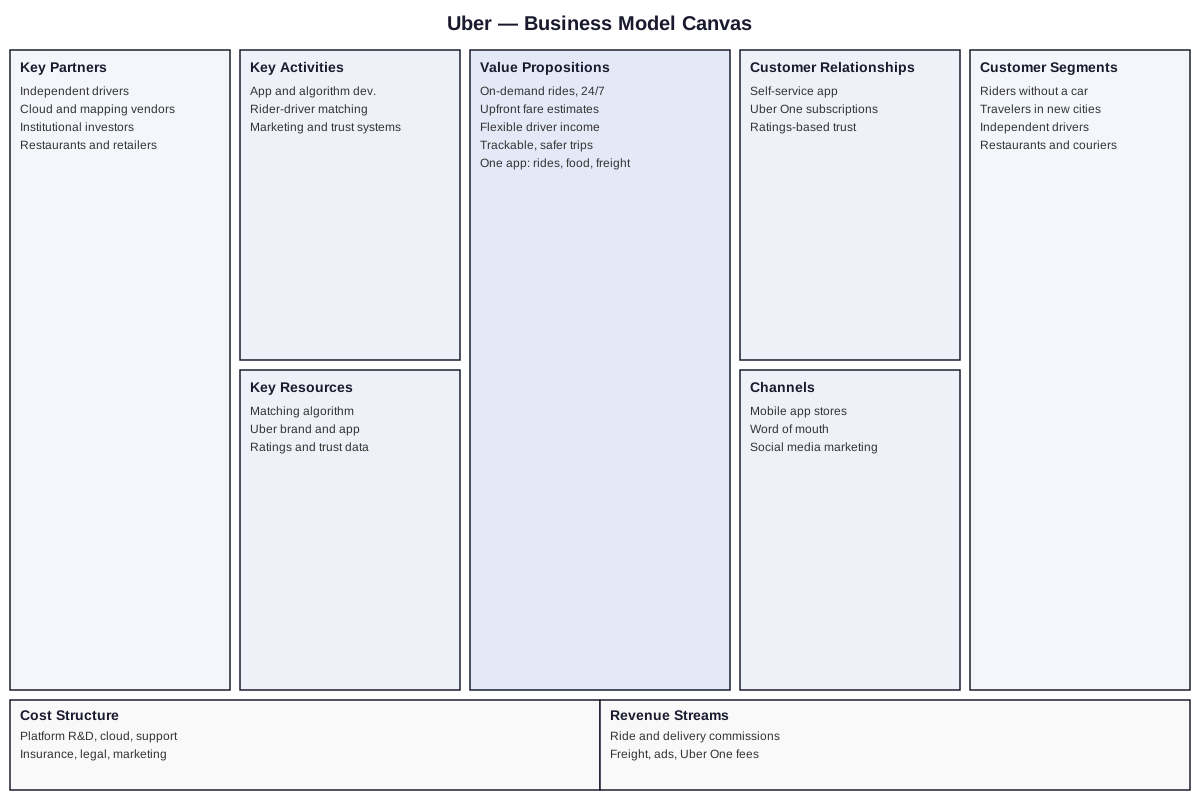
A rider opens the Uber app and enters a destination. The platform then locates the nearest available driver using satellite positioning data from the Global Positioning System [GPS]. That location data lets Uber's pricing algorithm estimate the fare upfront, weighing distance, expected trip time and current demand in the area. Drivers follow the same in-app navigation to the pickup point and then to the destination, which removes the need for either side to know the city well. A two-way rating system lets riders score drivers and drivers score riders after each trip. That builds a reputation record on both sides, shaping future matches and flagging problem accounts. The same matching logic runs underneath Uber Eats, where the app pairs a hungry customer with a nearby restaurant and an available courier. It also runs underneath Uber Freight, where the app pairs shippers with available truck capacity.
Where Uber's revenue actually comes from
Uber's core mechanism is commission. On every ride, delivery or freight shipment, Uber keeps a service fee and passes the remainder to the driver, courier or carrier. Revenue moves with transaction volume rather than with any vehicle or warehouse Uber owns. Mobility remained the largest segment in 2025, producing $29.67 billion, about 57% of total revenue, from fares, surge pricing during high-demand periods and cancellation charges. Delivery revenue reached $17.25 billion, roughly a third of the total. That figure combines delivery fees, a share of restaurant and retailer sales, and advertising placements inside the Uber Eats app. Uber Freight, which matches shippers with truck carriers rather than passengers with drivers, added $5.10 billion, though that segment stayed close to flat as freight demand softened industry-wide. Total revenue across the three segments reached $52.02 billion in 2025, on gross bookings of about $193 billion, according to the company's annual report filed with the Securities and Exchange Commission [SEC]2. That means Uber converted roughly a quarter of everything spent on the platform into company revenue.
What Uber offers riders and drivers
The value proposition splits cleanly by side of the marketplace. Riders get an on-demand car available around the clock, an upfront fare estimate before they commit to the trip, and a trackable route they can share with someone else for safety. Drivers get access to income they can start earning almost immediately, and they set their own flexible hours. They also gain a built-in customer base without needing to build their own dispatch business or find riders independently. Neither side needs to negotiate a price, since the app calculates the fare before the trip starts and settles payment automatically once the ride ends. Uber's underlying resources supporting that exchange are mostly intangible. They include the matching algorithm, the accumulated ratings data that makes strangers trust each other enough to get in a car together, and the brand recognition that makes the app the default choice in most cities where it operates.
Who Uber serves and how it reaches them
Riders fall into a few recognizable groups:
people without a car, travelers outside their home city, and anyone who prefers not to drive after a night involving alcohol
Drivers tend to be people looking for income they can start earning quickly, whether as a primary job or to supplement other work. Most do not need to interview for a position or commit to fixed hours. Uber reaches both groups mostly through word of mouth and app store listings rather than traditional advertising. Its Uber One subscription program, a flat monthly fee that discounts rides and delivery orders, has become a deliberate tool for locking in repeat use. Membership crossed 30 million subscribers in 2025, up sharply from the year before, and subscribers consistently spend more and order more often than customers who use only one Uber product3. That growth shows Uber shifting part of its business from one-off transactions toward a subscription relationship it can count on renewing every month.
Partners, costs and the advertising business
Drivers and couriers are Uber's most important partners, since they represent the supply side of the marketplace. Without enough of them online in a given city, riders wait longer, prices rise and the app loses its core appeal. Technology vendors supply the mapping, cloud storage and payment processing that keep millions of daily transactions running smoothly. Investors have financed everything from early growth rounds to newer bets like autonomous vehicle partnerships. Advertising has become a meaningful new revenue category too. Uber's ad business crossed a $2 billion annualized revenue run rate in 2025, growing more than 50% year over year, as restaurants and brands pay to appear higher in the Uber Eats app4. On the cost side, Uber spends heavily on platform engineering, insurance, customer support and the marketing needed to keep both riders and drivers coming back. Legal and regulatory costs add another layer of expense, and they vary sharply from one country to the next.
Competitive pressure in every market Uber enters
Uber holds a dominant position in the United States, controlling roughly three-quarters of the ride-hailing market against Lyft's remaining share. That dominance looks different market by market around the world5. In China, Didi Chuxing operates a comparable app spanning taxi-hailing, chauffeured cars and car rental. In India, Ola Cabs still holds a substantial share of local rides. In Southeast Asia, Grab combines ride-hailing with messaging and payments in ways Uber has had to match rather than dictate. Regional players such as Bolt in Europe and Africa, Cabify in Latin America and Yandex Taxi in Russia and neighboring markets show that ride-hailing rarely consolidates into a single global winner the way some other platform categories have. Traditional taxi companies remain a competitor too, particularly in cities where local regulation favors licensed cabs or where a driver can negotiate a fare directly with a rider.
Strengths, weaknesses and the regulatory tightrope
Uber's biggest strength is structural. It owns no vehicles and employs almost none of its drivers, so it can expand into a new city without the capital outlay a taxi fleet would require. It can also flex driver supply up or down with demand rather than carrying fixed labor costs. That same structure creates its biggest weakness, since regulators in multiple jurisdictions have challenged the classification of drivers as independent contractors rather than employees. The European Union [EU] adopted a Platform Work Directive in 2024 that presumes platform workers are employees when the platform exercises enough control over their work. Member states must apply the rules by December 20266. If that presumption spreads to more markets, Uber's cost structure would shift meaningfully, since employee status typically brings minimum wage guarantees, benefits and other obligations that contractor status avoids. Low margins compound that risk. Uber has historically kept fares low enough to fend off competitors, which limits how much room it has to absorb higher labor costs without raising prices or losing riders to a cheaper alternative.
Uber's business model works because it converts everyday friction, waiting for a cab, coordinating a food order, moving freight across a border, into a fee-based transaction it never has to fulfill with its own assets. That asset-light structure lets Uber scale into new verticals such as advertising and freight without the capital intensity of owning trucks or fleets, while still carrying real exposure to regulatory reclassification of its workforce and margin pressure from competitors willing to undercut on price. Executives evaluating platform strategies should study how Uber balances three audiences at once, riders, drivers and regulators, since satisfying only one of them has repeatedly proven insufficient for durable growth. The company's next phase will test whether advertising, subscriptions and freight can offset the low margins that still define its core rides business.
Citation
Cite this article
Sridharan, M. A. (2023, July 12). Uber's Platform Business Model. Think Insights. https://thinkinsights.net/strategy/ubers-platform-business-model (Accessed [[ACCESS_DATE]])
Sridharan, Mithun A. "Uber's Platform Business Model." Think Insights, 12 July 2023, https://thinkinsights.net/strategy/ubers-platform-business-model. Accessed [[ACCESS_DATE]].
Mithun A. Sridharan, "Uber's Platform Business Model," Think Insights, July 12, 2023, https://thinkinsights.net/strategy/ubers-platform-business-model. Accessed [[ACCESS_DATE]].
Sridharan, M.A. (2023) 'Uber's Platform Business Model', Think Insights. Available at: https://thinkinsights.net/strategy/ubers-platform-business-model (Accessed: [[ACCESS_DATE]]).
M. A. Sridharan, "Uber's Platform Business Model," Think Insights, 2023. [Online]. Available: https://thinkinsights.net/strategy/ubers-platform-business-model. [Accessed: [[ACCESS_DATE]]].
Sridharan MA. Uber's Platform Business Model. Think Insights. Published July 12, 2023. Accessed [[ACCESS_DATE]]. https://thinkinsights.net/strategy/ubers-platform-business-model
Test Your Knowledge
Uber's Platform Business Model
Challenge yourself on the concepts from this article and see how well you understood them.
Subscribers get weekly quizzes and insights — subscribe free
Sponsor this article
Partner with Think Insights
Reach 50,000+ business leaders, consultants, and strategists. Feature your brand alongside expert articles on strategy, leadership, and digital transformation.
Become a Sponsor