Future Cone


The concept of the Future Cone is a cornerstone of strategic foresight, offering a powerful, yet elegant, framework for thinking systematically about the future. It moves the conversation beyond mere prediction to explore a spectrum of possibilities, helping organizations and individuals navigate uncertainty and actively shape their desired outcomes.
Who created the Future Cone?
The Future Cone was popularized by foresight expert Joseph Voros, building on earlier work by the Institute for the Future [IFTF].
What are the main zones of the Future Cone?
The core zones are: Projected [baseline], Probable, Plausible, Possible, and Preposterous. The Preferable Future is a normative overlay applied across these zones to define a desired target state.
What is the difference between a probable and a plausible future?
A probable future is statistically likely given current trends. A plausible future could happen based on known science and human behavior but requires a greater degree of change or a higher-impact event.
What is backcasting in the context of the Future Cone?
Backcasting means starting from a defined Preferable Future and working backward to identify the actions, innovations, and policy changes needed in the present to move toward that desired outcome.
Why is the Future Cone useful for organizations beyond traditional planning?
Traditional planning focuses mainly on probable futures, leaving organizations exposed to disruptive surprises. The Future Cone expands strategic vision to include plausible and possible futures, helping identify blind spots, emerging risks, and opportunities for innovation.
At its heart, the Future Cone is a visual metaphor—a graphical model that maps out the relationship between the present (the apex of the cone) and the array of potential futures that spread out over time. It was famously popularized by the foresight expert Joseph Voros and builds upon earlier work by the Institute for the Future [IFTF].
The Cone is structured into several distinct zones, each representing a different degree of probability or possibility relative to our current understanding and trajectory. As you move further out from the present, the cone widens, signifying the increasing number of possibilities and the decreasing certainty we have about any specific outcome.
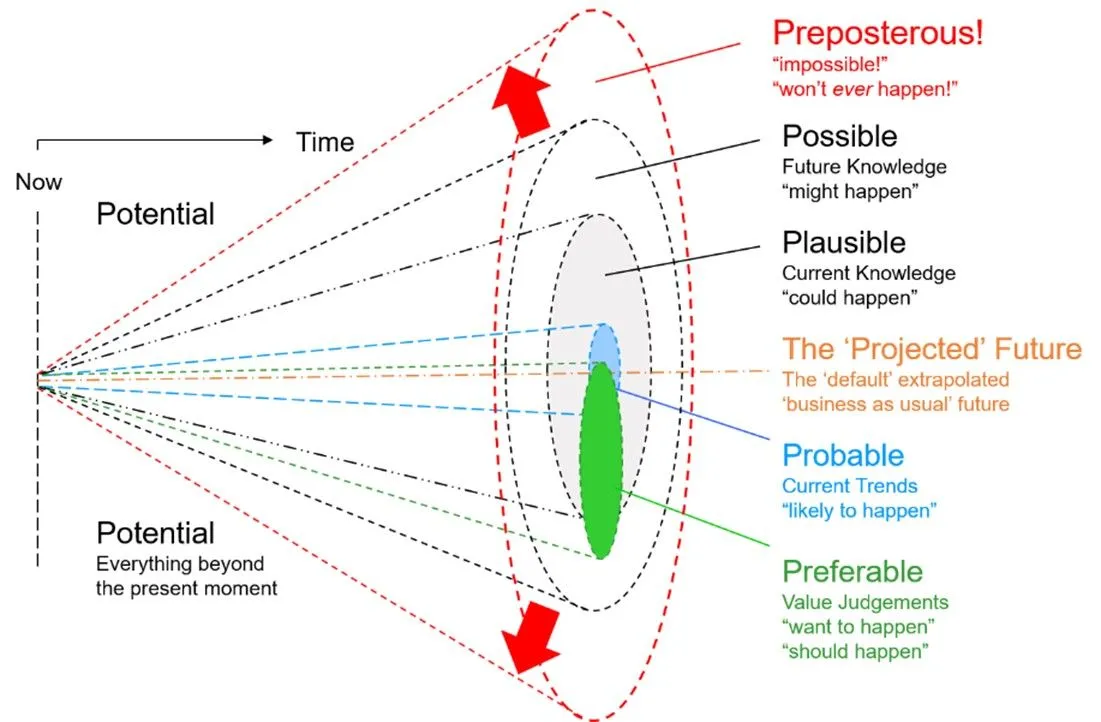
The Zones of Possibility
Understanding the core zones is crucial to applying the Future Cone effectively:
The Projected Future (The Center Line)
This is often referred to as the "Business-as-Usual" or "Baseline" future. It represents the outcome that is most likely to occur if current trends, policies and momentum continue unchecked. It's the future that analysts and traditional planners often default to, assuming no major disruptions or significant changes in behavior.
The Probable Future
This is the space immediately surrounding the projected future. It includes futures that are statistically more likely to happen, even if they involve minor shifts from the baseline. This zone is shaped by known risks, established technological roadmaps and quantifiable demographic or economic trends. For instance, the likely market share for an existing product category in five years falls within this probable space.
The Plausible Future
Moving outward, this zone encompasses futures that could happen based on what we currently know about the world—its laws of nature, technology and human nature. A plausible future requires a greater degree of change or a higher-impact event than a probable one, but it doesn't break any fundamental rules. For example, a major shift to personalized medicine driven by established AI and genomics is plausible, even if not highly probable right now.
The Possible Future
This wider region includes futures that are limited only by the laws of physics and science. Anything that is theoretically or technologically possible sits here. These are often the product of radical breakthroughs or "wild card" events. While highly uncertain, these possibilities—like the development of self-sustaining colonies on Mars—must be considered because their impact, if realized, would be immense.
The Preposterous / Wildcard Future (Sometimes called Impossible)
This space sits outside the cone's main body and is reserved for outcomes that fundamentally defy our current scientific understanding or accepted reality. While largely ignored in practical planning, recognizing the existence of the boundary helps define the limits of the possible.
The Preferable Future
The most crucial element of the Future Cone and what elevates it beyond a mere academic exercise, is the identification of the Preferable Future.
The Preferable Future is not a zone of possibility; rather, it is a normative filter applied to all the possible, plausible and probable futures. It is the future that an organization, community or individual wants to achieve. It defines a target state based on values, aspirations and goals.
The act of defining a preferable future—for example, a carbon-neutral energy grid by 2040 or a completely decentralized governance structure—allows an organization to work backward. By establishing this desired point in the Cone, strategists can identify the necessary innovations, policy changes and actions required in the present to pull that future toward the probable or even the projected path. This intentional effort to move the current trajectory towards the desired outcome is the essence of "futuring".
Why The Future Cone Is Indispensable For Strategy
Traditional planning often focuses exclusively on the Probable Future, which leaves organizations vulnerable to surprises—often called "black swans"—that emerge from the Plausible or Possible zones. The Future Cone forces planners to expand their field of vision and embrace complexity.
Disrupting "Business As Usual"
The Cone's primary value is in challenging the inertia of the Projected Future. By mapping out a wide range of alternatives, it prevents leaders from becoming trapped in linear, incremental thinking. It highlights that the most likely future (the baseline) is rarely the most desirable one and often, not even the most resilient one.
Identifying Blind Spots And Risks
By exploring the Plausible and Possible zones, organizations can identify emerging risks and disruptive innovations before they become immediate threats.
A company focused only on probable market growth might miss the plausible threat of a completely new business model emerging from an adjacent sector.
A government focusing on probable population growth might miss the possible strain on resources resulting from a climate-driven mass migration event.
The Cone acts as a mental defense against "surprise".
Promoting Innovation and Resilience [Antifragility]
The exercise of exploring distant futures encourages creativity. The Possible and Plausible zones are where truly transformative ideas — "moonshots" — are born. If an organization can clearly articulate its Preferable Future, it can back-cast (work backward from the desired future to the present) to identify the crucial steps and innovations needed now.
Moreover, by considering a range of non-preferable but plausible futures (e.g., economic collapse, extreme regulatory changes), an organization can build strategies that are resilient across multiple scenarios. This shift from focusing on one single prediction to building strategies robust enough to handle a range of outcomes makes the organization more antifragile—it can gain from disorder.
Future Cone In Action
To bring this abstract model to life, let's look at how the Future Cone might be applied in three distinct areas: Technology, Urban Planning and Education.
Automotive Industry
The automotive industry is currently undergoing a massive disruption, making the Future Cone an essential tool.
| Future Cone Zone | Example Scenario (Year 2035) | Strategic Implication |
|---|---|---|
| Projected [Baseline] | Gradual adoption of Electric Vehicles [EVs] in urban centers; continued reliance on hybrid powertrains globally; incremental improvements in driver assistance systems [ADAS]. | Continue optimizing existing EV production and supply chains; maintain legacy engine manufacturing capacity. |
| Projected [Baseline] | Gradual adoption of Electric Vehicles [EVs] in urban centers; continued reliance on hybrid powertrains globally; incremental improvements in driver assistance systems [ADAS]. | Continue optimizing existing EV production and supply chains; maintain legacy engine manufacturing capacity. |
| Probable | EV dominance in developed nations (75%+ new sales); successful mass-market Level 3 self-driving (limited conditions); market shift to Vehicle-as-a-Service [VaaS] subscription models. | Invest heavily in battery R&D and charging infrastructure; acquire VaaS platform companies; restructure sales/dealer network. |
| Plausible | Energy Tipping Point: Decentralized, ultra-fast charging networks (e.g., dynamic wireless) make range anxiety obsolete; private car ownership collapses in major cities (50% reduction) due to universally available, cheap, safe Level 5 autonomous ‘Robotaxis'; flying drone-delivery logistics replace ground transport for retail. | Develop entirely new profit centers outside of car manufacturing (e.g., operating the Robotaxi fleet); pivot R&D focus from vehicle performance to passenger experience (office, entertainment). |
| Possible | Material Science Revolution: The invention of a solid-state, energy-dense battery that is 90% cheaper and 10x faster to charge than lithium-ion; self-assembling vehicle components printed on-demand; widespread individual vehicle ownership returns due to near-zero cost/maintenance. | Establish deep R&D partnerships with material science startups; develop entirely new vehicle architectures optimized for additive manufacturing. |
| Preferable | Net Zero Mobility: A world where all vehicles are shared, zero-emission, dynamically routed to minimize traffic and integrated with public transport to create a seamless, congestion-free urban environment. | Advocate for policy changes (e.g., congestion taxes, public transport integration); invest in AI-driven traffic management software; build strategic partnerships with city governments. |
By mapping these possibilities, an automotive executive avoids simply making better gasoline cars or more current-generation EVs (the baseline) and instead plans for multiple, dramatically different scenarios that could redefine the entire industry.
Higher Education
A university facing declining enrollment and technological pressure can use the Cone to plot its survival and success.
| Future Cone Zone | Example Scenario (Year 2030) | Implication |
|---|---|---|
| Projected [Baseline] | Slow but steady enrollment decline in traditional degrees; slight increase in online and short certificate programs; tuition increases continue to outpace inflation. | Focus on cost-cutting and optimizing existing physical infrastructure. |
| Probable | AI-driven personalized tutoring becomes standard; major employers bypass degrees for credential-based hiring; specialized, global "Mega-Universities" dominate the market. | Invest in AI courseware; create a robust micro-credential system recognized by corporate partners. |
| Plausible | The University De-Bundled: The "campus experience," lectures and credentialing become separate, purchasable services; a student might buy lectures from Institution A, mentorship from Institution B and a verified credential from Institution C (a tech company). | Transform the business model: Focus on the institution's unique value (e.g., world-class research or hands-on experience); sell "services" rather than "degrees." |
| Possible | Neuro-Linguistic Interface: Direct brain-to-computer interfaces allow for instantaneous knowledge transfer of basic facts/skills; human effort shifts entirely to creativity, ethics and complex problem-solving. | Fundamental curriculum redesign: Eliminate rote memorization; shift teaching to focus on critical thinking, emotional intelligence and interdisciplinary synthesis. |
| Preferable | The Lifelong Learning Hub: The institution becomes a community-centric resource for continuous reskilling and ethical debate; it serves people from age 18 to 80, integrating research, career services and social enrichment seamlessly. | Invest in community outreach and alumni engagement; redesign physical space for flexible, collaborative adult learning; create a subscription model for lifelong access. |
The Future Cone pushes the university leadership to recognize that the plausible scenario—the de-bundling of their core offering—is the real threat, not just a small dip in enrollment. Their strategy must, therefore, target the preferable future by embracing a new identity as a "Lifelong Learning Hub".
The Future Cone is more than a brainstorming tool; it is a call to action. By mapping the vast landscape of possibilities, it empowers leaders to make conscious, deliberate choices about which future they will actively work to create.
It teaches three essential lessons:
- The Probable is Not Inevitable: The most likely outcome is merely one potential path, shaped by current forces. It is not destiny
- Possibility is a Resource: The Plausible and Possible zones are not sources of fear, but reservoirs of radical innovation and opportunity
- Strategy is Shaping, Not Predicting: The core task of foresight is not to guess what will happen, but to identify the desired future (the Preferable) and take the necessary steps today to ensure it becomes the probable reality tomorrow
In a world defined by exponential change and constant disruption, the Future Cone provides the structural clarity needed to transform anxiety about the unknown into a powerful strategic advantage. It shifts the perspective from:
What will the future bring to us?
to the far more empowering question:
What future will we bring into being?
This is the ultimate power of this compelling foresight framework.
Citation
Cite this article
Sridharan, M. A. (2023, July 10). Future Cone. Think Insights. https://thinkinsights.net/strategy/future-cone (Accessed [[ACCESS_DATE]])
Sridharan, Mithun A. "Future Cone." Think Insights, 10 July 2023, https://thinkinsights.net/strategy/future-cone. Accessed [[ACCESS_DATE]].
Mithun A. Sridharan, "Future Cone," Think Insights, July 10, 2023, https://thinkinsights.net/strategy/future-cone. Accessed [[ACCESS_DATE]].
Sridharan, M.A. (2023) 'Future Cone', Think Insights. Available at: https://thinkinsights.net/strategy/future-cone (Accessed: [[ACCESS_DATE]]).
M. A. Sridharan, "Future Cone," Think Insights, 2023. [Online]. Available: https://thinkinsights.net/strategy/future-cone. [Accessed: [[ACCESS_DATE]]].
Sridharan MA. Future Cone. Think Insights. Published July 10, 2023. Accessed [[ACCESS_DATE]]. https://thinkinsights.net/strategy/future-cone
Test Your Knowledge
Future Cone
Challenge yourself on the concepts from this article and see how well you understood them.
Subscribers get weekly quizzes and insights — subscribe free
Sponsor this article
Partner with Think Insights
Reach 50,000+ business leaders, consultants, and strategists. Feature your brand alongside expert articles on strategy, leadership, and digital transformation.
Become a Sponsor