GE McKinsey Matrix


The GE-McKinsey Matrix (a.k.a. GE Matrix, General Electric Matrix, Nine-box matrix) is a portfolio analysis tool used in corporate strategy to analyze strategic business units or product lines.
What is the GE McKinsey Matrix?
A strategic framework developed by McKinsey for General Electric in 1970 to help manage a complex portfolio of business units by evaluating each unit across two dimensions: industry attractiveness and competitive strength.
How does the GE McKinsey Matrix differ from the BCG Matrix?
Unlike the BCG Matrix, which uses a single dimension for analysis, the GE McKinsey Matrix uses multiple variables to assess both industry attractiveness and competitive strength, providing a more nuanced evaluation.
What are the three strategic options in the GE McKinsey Matrix?
The matrix identifies three strategies: Invest/Grow for units in attractive industries with strong competitive positions, Selectivity/Earnings for units in mixed positions, and Harvest/Divest for units with weak positions in unattractive industries.
What factors determine industry attractiveness in this matrix?
Factors include long-term growth potential, industry size, profitability, entry and exit barriers, supplier and buyer power, pricing, and other environmental influences affecting the industry's profit potential.
What does a Harvest/Divest strategy involve?
It involves either selling the business unit to a buyer who can better leverage it, or harvesting by providing minimal investment to keep it operational while extracting remaining cash before eventual liquidation.
This matrix combines two dimensions: industry attractiveness and the competitive strength of a business unit into a matrix. Correspondingly, a business can direct its business units. It can then determine where to invest, to hold their position, harvest or divest.
Origins
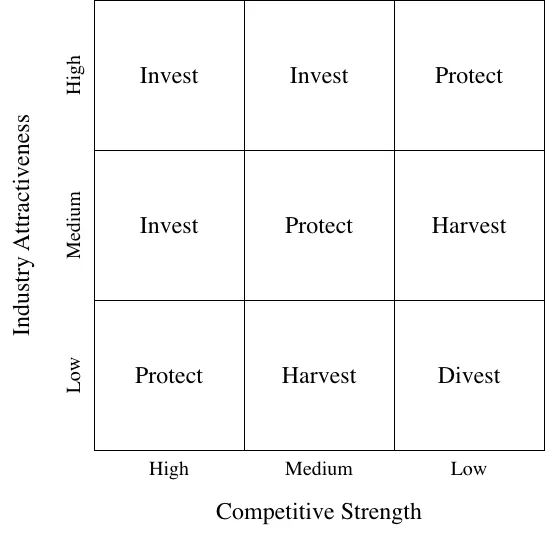
In 1970, General Electric [GE] engaged McKinsey & Company to consult GE in managing its large and complex portfolio of strategic business units. McKinsey (not GE) created this framework to help GE cope with its strategic decisions on a corporate level.
GE-McKinsey Matrix
Unlike the BCG Matrix The BCG Matrix has been criticized a lot on its use of only one single dimension for analysis., the GE-McKinsey Matrix uses multiple variables to determine the two dimensions:
Industry Attractiveness
This factor refers to the ease with which the business unit will be able to accrue profit in the industry. When evaluating the business along this dimension, consider the long term growth potential, industry size, industry profitability, entry and exit barriers, etc. Furthermore, evaluate the power of suppliers and buyers as well as any other environmental factors that could influence industry attractiveness. In addition, consider your product or service, how they change over time, pricing and labor requirements. It is important to consider all these dimensions, focusing on the distant future. This is because investments require a long-term, rather than a short-term, commitment. The vertical axis of this matrix - Industry Attractiveness - is divided into High, Medium and Low. Industry attractiveness represents the profit potential of the industry for a business to enter and compete in that industry. The higher the profit potential, the more attractive is the industry. An industry's profitability is affected by the current level of competition and future changes in the competitive landscape. When evaluating industry attractiveness, evaluate how an industry will change in the long run rather than in the short-term.
Competitive Strength
When evaluating a business unit along this dimension, consider how it fares relative to its competitors within the industry. Some factors that can help a business assess its competitive advantage in an industry are:
- Market share it commands
- Market share growth potential
- Brand awareness
- Profit margins of the business
- Customer loyalty and satisfaction
- Uniqueness of its products or services
If the business has a competitive edge, consider whether its competitiveness is sustainable in the long-term or only temporary. Finally, if the business has a sustainable competitive advantage, determine the duration that it can leverage its position in the industry. The horizontal of this matrix - Competitive Strength - is divided into High, Medium and Low. This dimension measures the business's competitiveness among its rivals. This dimension indicates the business's ability to compete in that industry. A business's strengths give it an advantage over its rivals. These strengths are often referred to as unique selling points (USP's), firm-specific advantages (FSA's) or as sustainable competitive advantages. In addition to a business's competitive position today, it's important to look its sustained competitiveness in the long run.
Strategic implications
The three degrees (High, Medium and Low) of Industry Attractiveness and Competitive Strength provide 9 different strategic postures for a business. The strategic actions to choose from are:
- Invest / Grow strategy
- Selectivity / Earnings strategy, and
- Harvest/Divest strategy
Invest/Grow strategy
The best position for a business to be in is the Invest/Grow section. A business can reach this scenario if it is operating in a moderate to highly attractive industry while having a moderate to highly competitive position within that industry. In such a situation, there is a massive growth potential. However, to grow, a business needs resources, such as assets and capital. These investments are necessary to increase capacity, reach new customers through marketing or improve products through Research & Development. A business can also choose to grow externally via Mergers & Acquisitions (M&A), in addition to organic growth. Again, it will require investments to execute M&A activities. The most notable challenges for a business in these sections are resource constraints that block it from growing bigger and becoming / maintaining market leadership.
Selectivity/Earnings strategy
This strategy is also referred to as Hold strategy. A business in the selectivity / earnings section is a bit more tricky. The business is either in a low - moderate competitive position in an attractive industry or in an extremely high competitve position in a less attractive industry. Deciding whether to invest or not to invest largely depends on the business's outlook. It could expect to, either improve its competitive position or shift to a more attractive industry. The business should carefully decide its competitive move. As a business, you want to use most of your investments in the Invest/Grow section. Then, use the remaining investments in the selectivity / earnings section to improve your competitive position. You should closely monitor the progress and improvements and correct course as necessary.
Harvest/Divest strategy
This strategy is most appropriate for a business that:
- has a low competitive position
- is active in an unattractive industry, or
- a combination of the two
These businesses do not have too many promising outlooks. The strategic responses to consider are:
- Divest the business units by selling it to an interested buyer for a reasonable price. This also known as a carve-out, or
- Choose a harvest strategy
Selling the business unit to another player in the industry that has a better competitive position is not a strange idea at all. The buyer might have better competences to make it a success. Or, the buyer can create value by combining activities i.e. leverage synergies. The business can use the cash it results from divestment in Invest/Grow section elsewhere in its portfolio. Harvesting means that the business unit gets just enough investments to keep it operational. In other words, the business cashes whatever is left. This is a very short-term perspective that allows a business to subtract as much remaining cash as possible. However, such businesses are eventually liquidated and exit the industry.
While industry attractiveness is about competition level in an industry, a business's competitive strength is about its ability to sustainably compete in the future. The GE McKinsey Matrix is a good alternative for the BCG Matrix and has the advantage that the two variables used consist of multiple factors combined. However, it is challenging to quantify such factors as brand equity and industry structure, and combine them into a single number that can be plotted on the nine-box matrix. Nevertheless, for corporate strategist in portfolio management, this model serves as a great starting point to base their investment decisions.
Citation
Cite this article
Sridharan, M. A. (2019, July 28). GE McKinsey Matrix. Think Insights. https://thinkinsights.net/strategy/ge-mckinsey-matrix (Accessed [[ACCESS_DATE]])
Sridharan, Mithun A. "GE McKinsey Matrix." Think Insights, 28 July 2019, https://thinkinsights.net/strategy/ge-mckinsey-matrix. Accessed [[ACCESS_DATE]].
Mithun A. Sridharan, "GE McKinsey Matrix," Think Insights, July 28, 2019, https://thinkinsights.net/strategy/ge-mckinsey-matrix. Accessed [[ACCESS_DATE]].
Sridharan, M.A. (2019) 'GE McKinsey Matrix', Think Insights. Available at: https://thinkinsights.net/strategy/ge-mckinsey-matrix (Accessed: [[ACCESS_DATE]]).
M. A. Sridharan, "GE McKinsey Matrix," Think Insights, 2019. [Online]. Available: https://thinkinsights.net/strategy/ge-mckinsey-matrix. [Accessed: [[ACCESS_DATE]]].
Sridharan MA. GE McKinsey Matrix. Think Insights. Published July 28, 2019. Accessed [[ACCESS_DATE]]. https://thinkinsights.net/strategy/ge-mckinsey-matrix
Test Your Knowledge
GE McKinsey Matrix
Challenge yourself on the concepts from this article and see how well you understood them.
Subscribers get weekly quizzes and insights — subscribe free
Sponsor this article
Partner with Think Insights
Reach 50,000+ business leaders, consultants, and strategists. Feature your brand alongside expert articles on strategy, leadership, and digital transformation.
Become a Sponsor