Competitive Profile Matrix [CPM]

![Competitive Profile Matrix [CPM]](/sites/default/files/images/article/Competitive-Profile-Matrix-CPM.webp "Competitive Profile Matrix [CPM]")
Competitive profile matrix is an essential strategic management tool to compare the firm with the major players of the industry. Competitive profile matrix show the clear picture to the firm about their strong points and weak points relative to their competitors.
What is a Competitive Profile Matrix?
A CPM is a strategic tool that identifies key competitors and compares them against critical success factors, revealing relative strengths and weaknesses within an industry.
How are weights assigned in a CPM?
Weights range from 0.0 to 1.0 and reflect each factor's importance to company success. All weights must sum to 1.0, and no single factor should typically exceed 0.3.
What do the ratings in a CPM represent?
Ratings range from 1 to 4: 4 indicates a major strength, 3 a minor strength, 2 a minor weakness, and 1 a major weakness. Ratings are assigned subjectively or through benchmarking.
How is the total score calculated?
Each factor's weight is multiplied by its rating to produce a score. All individual scores are summed to produce a total score. The firm with the highest total score is considered relatively stronger.
What are critical success factors in a CPM?
Critical success factors are key areas that determine success in an industry. They should include both internal and external factors and vary across industries and strategic groups.
The Competitive Profile Matrix [CPM] is a tool that compares the firm and its rivals and reveals their relative strengths and weaknesses1. In order to better understand the external environment and the competition in a particular industry, firms often use CPM2. The profile matrix identifies a firm's key competitors and compares them using industry's critical success factors. The analysis also reveals company's relative strengths and weaknesses against its competitors. As a result, a company can easily identify the areas it should improve and the areas it should protect.
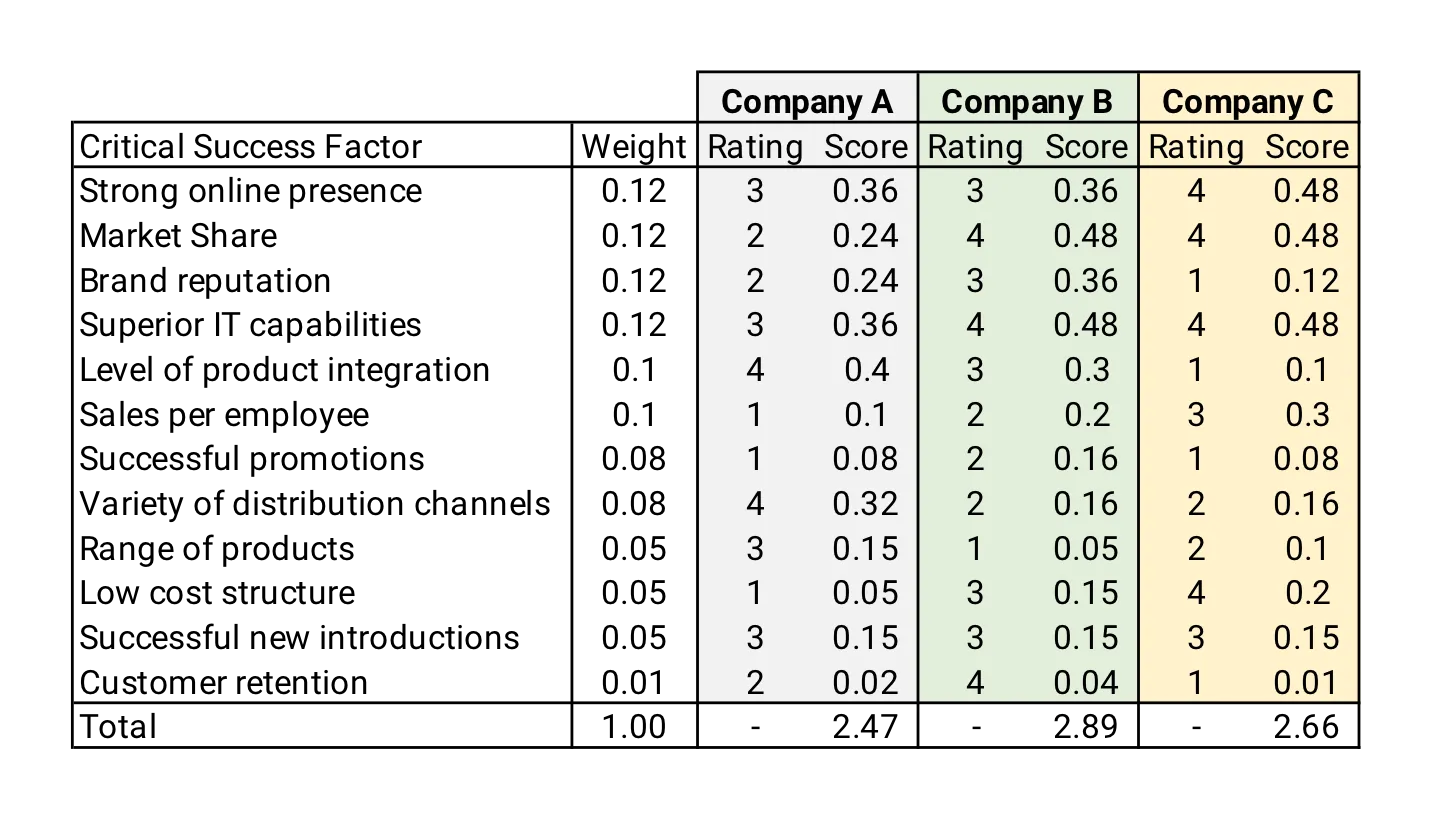
Critical Success Factors
Critical success factors [CSF] are the key areas that determine a company's success in the industry. To succeed in its industry, a company must perform at the highest possible level of excellence. These factors vary among industries or even strategic groups. CSF should include both internal and external factors for analysis. Therefore, if you want a more robust and accurate analysis, include more, relevant factors.
Weight
Assign a weight ranging from 0.0 (low importance) to 1.0 (high importance) to each critical success factor. The weight indicates the importance of that factor in the company's success. If you don't assign weights, then all factors would be equally important. This is an impossible scenario in the real world. The sum of all the weights must equal 1.0. You should not emphasise separate factors too much by assigning a weight of 0.3 or more. This is because a company's success is rarely determined by just one or few factors.
Rating
The ratings in CPM refer to how well companies are doing in each area. They range from 4 to 1:
- 4 means a major strength
- 3 – minor strength
- 2 – minor weakness, and
- 1 – major weakness.
Subjectively assign the ratings and weights to each company. However, this process can be done easier through benchmarking. Benchmarking reveals how well companies are doing compared to each other or industry's average. Note that firms can have equal ratings for the same factor.
Score
The score is the result of weight multiplied by rating. Each company receives a score on each factor. Total score is simply the sum of all individual score for the company. The firm that receives the highest total score is relatively stronger than its competitors.
The benefits to using Competitive Profile Matrix [CPM] for rivals analysis are:
- The same factors are used to compare the firms. This makes the comparison more accurate
- The analysis displays the information on a matrix, which makes it easy to compare the companies visually
- The results of the matrix facilitate decision-making. Companies can easily decide which areas they should strengthen, protect or what strategies they should pursue.
- 1Bhattacharjee, Dipanwita. (2015). Competitive Profile Matrix: A Theoretical Review. ABAC Journal. 35. 61-70.
- 2Sohel, Shanewaz & Mohammad Atiqur Rahman, Abu & Uddin, Md. (2014). Competitive Profile Matrix [CPM] as a Competitors' Analysis Tool: A Theoretical Perspective. International Journal of Human Potential Development. 3. 40-47.
Citation
Cite this article
Sridharan, M. A. (2018, July 21). Competitive Profile Matrix [CPM]. Think Insights. https://thinkinsights.net/strategy/competitive-profile-matrix-cpm (Accessed [[ACCESS_DATE]])
Sridharan, Mithun A. "Competitive Profile Matrix [CPM]." Think Insights, 21 July 2018, https://thinkinsights.net/strategy/competitive-profile-matrix-cpm. Accessed [[ACCESS_DATE]].
Mithun A. Sridharan, "Competitive Profile Matrix [CPM]," Think Insights, July 21, 2018, https://thinkinsights.net/strategy/competitive-profile-matrix-cpm. Accessed [[ACCESS_DATE]].
Sridharan, M.A. (2018) 'Competitive Profile Matrix [CPM]', Think Insights. Available at: https://thinkinsights.net/strategy/competitive-profile-matrix-cpm (Accessed: [[ACCESS_DATE]]).
M. A. Sridharan, "Competitive Profile Matrix [CPM]," Think Insights, 2018. [Online]. Available: https://thinkinsights.net/strategy/competitive-profile-matrix-cpm. [Accessed: [[ACCESS_DATE]]].
Sridharan MA. Competitive Profile Matrix [CPM]. Think Insights. Published July 21, 2018. Accessed [[ACCESS_DATE]]. https://thinkinsights.net/strategy/competitive-profile-matrix-cpm
Test Your Knowledge
Competitive Profile Matrix [CPM]
Challenge yourself on the concepts from this article and see how well you understood them.
Subscribers get weekly quizzes and insights — subscribe free
Sponsor this article
Partner with Think Insights
Reach 50,000+ business leaders, consultants, and strategists. Feature your brand alongside expert articles on strategy, leadership, and digital transformation.
Become a Sponsor