Apple's Ecosystem Business Model


Apple sells premium hardware and turns that hardware into a subscription business. The iPhone remains the company's largest revenue source, but services such as iCloud, Apple Music, Apple TV+ and the App Store now generate more than $100 billion a year and carry far higher margins than physical products. This dual structure, premium devices sold at scale feeding a growing services layer, helped push Apple's market value past $5 trillion in July 2026, only the second company to reach that mark after Nvidia. The model rests on tight integration between hardware, software and services that raises the practical cost of switching to a competing platform. Regulatory pressure on App Store commissions and slowing hardware upgrade cycles remain the clearest risks to the structure going forward.
What is Apple's core business model?
Apple designs premium hardware, sells it through its own stores and a network of retail partners, then layers a growing set of subscription services on top of the resulting installed base. Product sales still generate most of the company's revenue, but services carry higher margins and grow faster year over year.
How does Apple's App Store generate revenue?
Apple charges developers a standard commission of 30% on paid apps, in-app purchases and digital subscriptions sold through the App Store, dropping to 15% for smaller developers earning under $1 million a year and for subscriptions that pass their first annual renewal. This commission structure turns most third-party digital transactions on Apple devices into a direct revenue line for the company.
Why is Apple shifting toward services revenue?
Hardware sales cycles have slowed as fewer customers upgrade devices every year, while services revenue keeps climbing because it draws on an installed base of billions of active devices rather than a fresh purchase decision. Services also carry gross margins well above hardware, which makes the segment increasingly central to Apple's earnings growth.
From a garage workshop to a five-trillion-dollar company
Steve Jobs and Steve Wozniak founded Apple on April 1, 1976, building the company's first product, the Apple I, in the Jobs family garage in Los Altos, California, alongside a third co-founder, Ronald Wayne, who sold his 10% stake back to the pair within two weeks1. The Apple I shipped as a bare circuit board with no case, keyboard or monitor, aimed at hobbyists willing to assemble their own machine. The follow-up Apple II added expansion slots for disk drives and other peripherals and turned Apple into a mainstream consumer brand, lifting sales from $7.8 million in 1978 to $118 million in 1980, the year the company went public through an initial public offering [IPO]. The next two decades brought boardroom conflict: Wozniak left in 1983, and Jobs was pushed out in 1985 after a power struggle with then chief executive officer [CEO] John Sculley. Jobs spent the following twelve years running NeXT and buying Pixar from filmmaker George Lucas, and Apple bought NeXT in 1997 largely to bring Jobs back into the company he had founded. The products that followed his return, capped by the iPhone in 2007, rebuilt Apple into one of the most valuable companies investors had ever tracked. Apple crossed a $1 trillion market valuation in 2018, doubled that figure by 2020, and in July 2026 briefly touched $5 trillion, becoming only the second company after Nvidia to reach that level2.
Two revenue engines under one roof
Apple's business model runs on two connected engines:
a hardware business that still generates most of its revenue and a services business that generates most of its margin growth
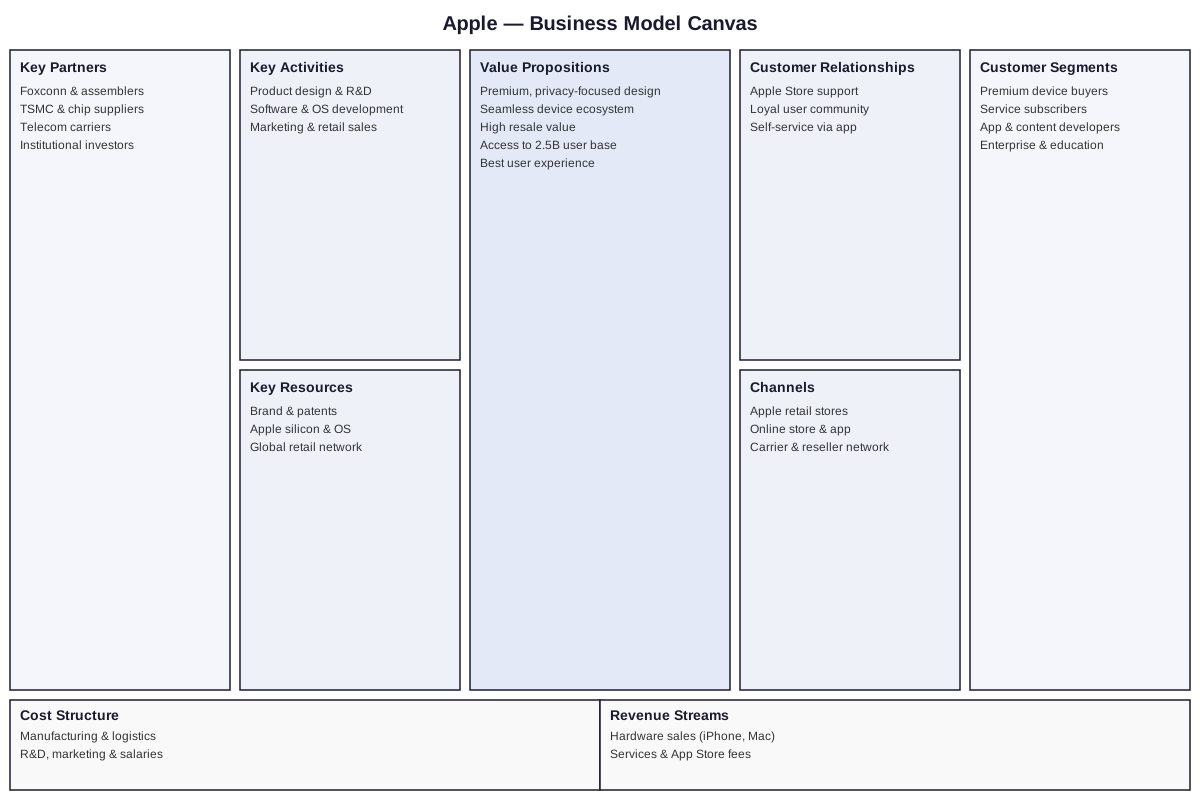
In fiscal 2025, Apple reported total net sales of $416.16 billion, with the iPhone alone contributing $209.59 billion, or just over half of that total, according to the company's annual report filed with the Securities and Exchange Commission [SEC]3. Mac, iPad and wearables, home and accessories products made up most of the remainder, while Services, covering the App Store, iCloud, Apple Music, Apple TV+, AppleCare and Apple Pay, crossed $100 billion in annual revenue for the first time. The gap between the two engines shows up clearly in profitability: Apple's products carried a gross margin near 37% in fiscal 2025, while Services carried a gross margin above 75%, up from roughly 55% less than a decade earlier. That spread means every dollar shifted from a one-time device sale to a recurring subscription adds disproportionately to Apple's bottom line, which explains why the company keeps expanding what it sells as a service rather than a one-off purchase.
An ecosystem designed to keep customers close
Apple's products and services do not operate as separate purchases. They operate as one connected system that becomes progressively more expensive to leave. A customer who buys an iPhone gets steered toward iCloud storage for photos and backups, Apple Music for streaming, Apple Pay for transactions and eventually a Mac, iPad or Apple Watch that shares the same account, notifications and files. Tim Cook told investors in January 2026 that Apple's installed base had surpassed 2.5 billion active devices spanning iPhone, iPad, Mac, Apple Watch, AirPods, Apple TV and HomePod across more than 175 countries4.
Apple's installed base is a testament to incredible customer satisfaction for the very best products and services in the world
Every additional device or subscription added to that base raises the practical cost of switching to a rival platform, since photos, messages, passwords and purchased content do not move cleanly between Apple and Android. That effect is what allows Apple to charge premium prices while still growing its customer count rather than losing share to cheaper alternatives.
The App Store as a recurring toll
The App Store puts Apple in the position of collecting a share of most digital transactions that happen on an iPhone or iPad. Apple charges a standard commission of 30% on paid app downloads, in-app purchases and digital subscriptions sold through the store, a rate it has kept in place since the store launched in 2008. Smaller developers earning up to $1 million a year in App Store proceeds pay a reduced 15% commission under the App Store Small Business Program, introduced in 2021, and any developer's subscription commission drops from 30% to 15% once a subscriber completes one year of paid service5. Physical goods, ride-hailing, food delivery and advertising sit outside this commission structure entirely, which is why the fee applies mainly to games, streaming apps and digital content rather than the broader app economy. This commission line, small on any single transaction, adds up across billions of devices and forms a meaningful share of Apple's Services revenue.
Who owns Apple and what drives it
Apple's shareholder base looks much like that of any large index-heavy stock, with passive institutional managers dominating the register. The Vanguard Group and BlackRock rank as the two largest holders, each owning close to a tenth of outstanding shares, largely because Apple carries a heavy weighting in the S&P 500 and Nasdaq-100 index funds those firms manage. Company insiders, including Cook and the rest of the executive team, hold a comparatively small direct stake, and Apple's board includes figures such as former Vice President Al Gore alongside veteran technology and finance executives. The company frames its purpose in a single sentence that has stayed largely consistent for years.
To bring the best user experience to customers through innovative hardware, software and services
That mission statement explains why Apple treats hardware, software and services as one design problem instead of three separate business lines, and it lines up with the company's public commitments on privacy and environmental practices as part of its broader corporate social responsibility program.
A supply chain Apple does not own
Apple designs its products in-house but manufactures almost none of them directly, relying instead on a network of contract manufacturers led by Foxconn, which assembles most iPhones, and Taiwan Semiconductor Manufacturing Company [TSMC], which produces the custom processors that power iPhones, iPads and Macs. Final assembly remains concentrated in China, though Apple has spent several years diversifying that footprint, moving a growing share of iPhone production to India and expanding component sourcing in Vietnam. This arrangement lets Apple avoid the capital cost of owning factories while still controlling product design, software and the customer relationship, the parts of the business that generate the highest returns. It also exposes Apple to real risk, since any disruption at a small number of assembly sites, whether from trade policy, natural disaster or labor unrest, can delay product launches the company depends on for a large share of annual revenue.
The customers behind the value proposition
Apple sells to three distinct groups that reinforce one another. Product buyers purchase iPhones, Macs, iPads and wearables for their performance, design and resale value, and a portion of that group buys specifically for the brand rather than any single feature. Service subscribers, who mostly overlap with product buyers, pay for Apple Music, Apple TV+, Apple Arcade, iCloud+ storage and extended warranty coverage through AppleCare. App developers and content creators make up the third group, building products for Apple's user base and monetizing through the App Store and its in-app purchase system. Apple's pitch to each group centers on the same idea:
carefully designed products with a consistent focus on privacy, paired with an ecosystem that makes using several Apple devices together easier than mixing brands
Competitive pressure and structural risk
Apple's biggest hardware rival remains Samsung, which held roughly 22.6% of global smartphone shipments against Apple's 20.1% in the second quarter of 2026, with Xiaomi trailing in third place6. Samsung and Chinese manufacturers such as Xiaomi, Oppo and Vivo compete mainly on price and hardware flexibility, offering more configurable operating systems at lower price points than Apple's devices. That pricing gap becomes a real weakness in developing markets, where Apple's premium pricing puts its devices out of reach for a large share of middle-income and lower-income buyers, limiting growth in some of the world's fastest-growing smartphone markets. Regulators in the European Union and the United States have also pushed Apple to open the App Store to alternative payment systems and sideloaded apps, a shift that could erode the commission revenue described earlier if it spreads to other markets. None of these pressures have slowed Apple's overall growth so far, but they mark the clearest limits on how far the current model can extend without changes to pricing or platform rules.
Apple's business model works because the company treats hardware and services as one connected system rather than two separate businesses. A customer who buys an iPhone becomes a candidate for iCloud storage, Apple Music, AppleCare and eventually a Mac or Apple Watch, and each additional purchase deepens the difficulty of leaving the platform. That structure explains why Apple can charge premium prices in a market full of cheaper alternatives and still hold the largest profit pool in the smartphone industry. The approach carries real exposure: antitrust scrutiny of App Store commissions, slower replacement cycles for mature product lines and rising costs tied to supply chain diversification. Executives studying Apple's model should focus less on individual products and more on how tightly the company links purchase, ownership and subscription into one continuous customer relationship.
Citation
Cite this article
Sridharan, M. A. (2023, May 26). Apple's Ecosystem Business Model. Think Insights. https://thinkinsights.net/strategy/apples-ecosystem-business-model (Accessed [[ACCESS_DATE]])
Sridharan, Mithun A. "Apple's Ecosystem Business Model." Think Insights, 26 May 2023, https://thinkinsights.net/strategy/apples-ecosystem-business-model. Accessed [[ACCESS_DATE]].
Mithun A. Sridharan, "Apple's Ecosystem Business Model," Think Insights, May 26, 2023, https://thinkinsights.net/strategy/apples-ecosystem-business-model. Accessed [[ACCESS_DATE]].
Sridharan, M.A. (2023) 'Apple's Ecosystem Business Model', Think Insights. Available at: https://thinkinsights.net/strategy/apples-ecosystem-business-model (Accessed: [[ACCESS_DATE]]).
M. A. Sridharan, "Apple's Ecosystem Business Model," Think Insights, 2023. [Online]. Available: https://thinkinsights.net/strategy/apples-ecosystem-business-model. [Accessed: [[ACCESS_DATE]]].
Sridharan MA. Apple's Ecosystem Business Model. Think Insights. Published May 26, 2023. Accessed [[ACCESS_DATE]]. https://thinkinsights.net/strategy/apples-ecosystem-business-model
Test Your Knowledge
Apple's Ecosystem Business Model
Challenge yourself on the concepts from this article and see how well you understood them.
Subscribers get weekly quizzes and insights — subscribe free
Sponsor this article
Partner with Think Insights
Reach 50,000+ business leaders, consultants, and strategists. Feature your brand alongside expert articles on strategy, leadership, and digital transformation.
Become a Sponsor