Industry Analysis: Data Center Services


The physical data center industry now behaves like a power and land business wearing a technology label. Vacancy sits near record lows across major metros, rents are climbing double digits annually and the constraint has shifted from construction to grid interconnection, which can take three to seven years to secure. Operators who control energized land, long-dated utility contracts and interconnection-dense campuses capture disproportionate margin, while pure landlords without power access get squeezed. Boards weighing exposure to this industry should prioritize deals structured around secured power and pre-leased hyperscale capacity over speculative land banking and treat interconnection rights as the primary due-diligence item, ahead of building specifications. Investors and operators who move now, in already-constrained markets, lock in scarcity value; those who wait face a multi-year queue that is only lengthening as transformer and turbine supply remains tight.
Is data center services an attractive industry for new entrants?
Attractiveness depends entirely on power access rather than capital availability. A newcomer with an energized substation and a hyperscale anchor tenant can earn strong returns, while one without a secured power interconnection is effectively locked out regardless of balance sheet size, because utility queues in constrained metros now run three to seven years.
Which parts of the value chain are most profitable?
Interconnection and cross-connect services carry the highest margins, often exceeding 80%, because they monetize network density rather than square footage. Retail colocation with rich ecosystem services also outperforms commodity wholesale leasing, where margin compresses toward the cost of power and capital.
How is technology changing this industry?
Artificial Intelligence workloads have roughly tripled rack power density, forcing a shift from air cooling toward liquid and direct-to-chip cooling and from uniform floor plans toward high-density, purpose-built halls. This is rewriting facility design standards faster than at any point since the industry adopted raised-floor computer rooms.
What capabilities are table stakes versus differentiators?
Physical security, redundant power distribution and basic uptime guarantees are table stakes that every credible operator must meet. Differentiators are secured long-term power contracts, interconnection density with network and cloud partners and the ability to deliver gigawatt-scale campuses on a predictable schedule.
How should investors or consultants evaluate opportunities in this space?
Evaluation should center on the power interconnection queue position and contract structure of the underlying land, the tenant concentration and credit quality of anchor leases and the operator's ability to execute multi-year build programs on budget, ahead of generic metrics like square footage or stated capacity.
Why are hyperscalers building their own data centers instead of leasing everything?
Hyperscale cloud providers self-build when they can secure power and land faster or cheaper than colocation operators can supply it, particularly for dedicated, single-tenant campuses. They still lease from colocation operators in markets where the operator's utility relationships and permitting track record beat what the hyperscaler could achieve alone.
What role do data center REITs play in industry economics?
Real estate investment trusts, structured to distribute most taxable income to shareholders, provide the industry with access to lower-cost, long-duration capital that funds multi-year construction cycles. This financing structure explains why REITs such as Equinix and Digital Realty have grown into the largest global operators rather than private operators without REIT status.
Is colocation being displaced by cloud computing?
No, the two are complementary rather than competing layers. Cloud computing sells compute and software services, while colocation supplies the physical shell, power and cooling that cloud providers themselves lease when self-building is slower or costlier than renting from an established operator.
What is driving the current wave of capital into data center construction?
Artificial Intelligence training and inference workloads are the primary driver, requiring far more power-dense infrastructure than the cloud-era data centers built over the past decade. This has triggered a construction cycle in which announced capacity additions now regularly exceed what regional power grids can currently support.
How exposed is this industry to interest rate and financing risk?
Highly exposed, because most operators fund construction with a mix of debt and equity against long-dated leases and higher borrowing costs directly compress development yields. Operators with investment-grade credit and pre-leased capacity are shielded more effectively than speculative developers building ahead of signed tenants.
Every digital transaction, from a card swipe to an Artificial Intelligence model generating a paragraph of text, ultimately resolves into electrons moving through a physical building. The data center services industry supplies that building: the land, the power, the cooling and the physical security that turn a warehouse-sized shell into a facility capable of running thousands of servers continuously. It is easy to mistake this industry for a subset of technology, but its economics run closer to those of regulated utilities and industrial real estate than to software. The people who win in this business are not necessarily the best engineers; they are the ones who secure energized land, long-term power contracts and interconnection rights years before a rack of servers ever gets installed.
Industry at a glance
Data center services encompass the design, construction, ownership and operation of purpose-built facilities that house servers, storage and networking equipment on behalf of enterprises, cloud providers and government agencies. The scope includes wholesale leasing of large, dedicated data halls to hyperscale cloud and Artificial Intelligence companies, retail colocation that houses multiple smaller tenants within a shared facility and interconnection services that let tenants exchange data directly rather than routing traffic over the public internet. It excludes the software and platform layer, meaning cloud computing services such as compute instances, storage APIs and managed databases, which sit one layer above the physical facility and are typically analyzed as a separate industry.
Customers span three categories. Hyperscale cloud and Artificial Intelligence companies represent the largest and fastest-growing segment, leasing multi-hundred-megawatt campuses under decade-long contracts. Enterprises across financial services, healthcare, media and manufacturing lease retail colocation space to house core systems, disaster recovery infrastructure or hybrid cloud connectivity points. Government and defense agencies lease specialized, often security-cleared capacity for sovereign and classified workloads. The industry is overwhelmingly business-to-business and business-to-government; there is essentially no direct consumer transaction, though consumers depend on it indirectly every time they stream video or use a banking app.
The industry is capital intensive to a degree few other services businesses match. A single hyperscale campus can require capital outlays exceeding a billion dollars before a single tenant moves in, split roughly between land, building shell and power and cooling infrastructure. Revenue is generated through long-term leases, typically 10 to 15 years for wholesale hyperscale capacity and 1 to 3 years for retail colocation, plus metered power pass-through and interconnection fees charged per cross-connect. Labor intensity is comparatively low relative to capital; a fully built hyperscale facility might employ only a few dozen technicians on-site. Regulatory intensity is high and rising, covering land use and zoning, electrical grid interconnection approval, water use permits for cooling and in some jurisdictions carbon and energy efficiency reporting mandates.
Industry segmentation
The industry divides along several dimensions and the most useful lens for executives is position on the wholesale-to-retail spectrum combined with ownership structure. Hyperscale wholesale colocation involves leasing entire buildings or large dedicated suites, typically 10 megawatts or more, to a single cloud or AI tenant under a long-term contract; margins here are driven by power procurement efficiency and construction cost discipline rather than service richness. Retail colocation leases cabinets, cages or small suites to many tenants within a shared facility, commanding higher per-kilowatt pricing because it bundles security, connectivity and support services that smaller customers cannot replicate on their own.
Interconnection and network-dense colocation forms a distinct segment centered on facilities where carriers, cloud providers and enterprises physically cross-connect, generating high-margin recurring fees independent of raw power consumption; Equinix built its entire strategy around this segment. Edge and regional data centers form a smaller but growing segment, positioned in secondary cities and closer to population centers to reduce latency for content delivery and localized AI inference, trading scale economics for proximity value. Build-to-suit and self-build capacity, where hyperscalers develop and own their own campuses rather than leasing, sits adjacent to the industry rather than fully inside it, but increasingly competes for the same land and power resources as third-party operators. Finally, data center REITs and private infrastructure funds represent an ownership-based segmentation cutting across the others, distinguishing publicly traded, income-distributing vehicles from privately held operators and sovereign wealth-backed platforms.
Market structure
Industry structure has shifted decisively over the past three years as the constraint moved from capital and construction capacity to power availability. Buyer power remains concentrated in the hands of a small number of hyperscale tenants who can dictate lease terms, but even they now compete for scarce energized land rather than simply choosing among willing landlords. Supplier power, historically modest, has risen sharply because utilities, transformer manufacturers and land owners in constrained metros now hold the pivotal approval that determines whether a project proceeds at all. Rivalry among operators is intensifying in absolute terms as more capital enters the sector, yet is tempered by genuine scarcity, since operators with secured power rarely need to compete aggressively on price. The threat of new entrants is muted for undifferentiated players but real for well-capitalized sovereign wealth funds and hyperscalers willing to self-develop. Substitution risk comes less from a rival technology than from hyperscale customers internalizing the function themselves.
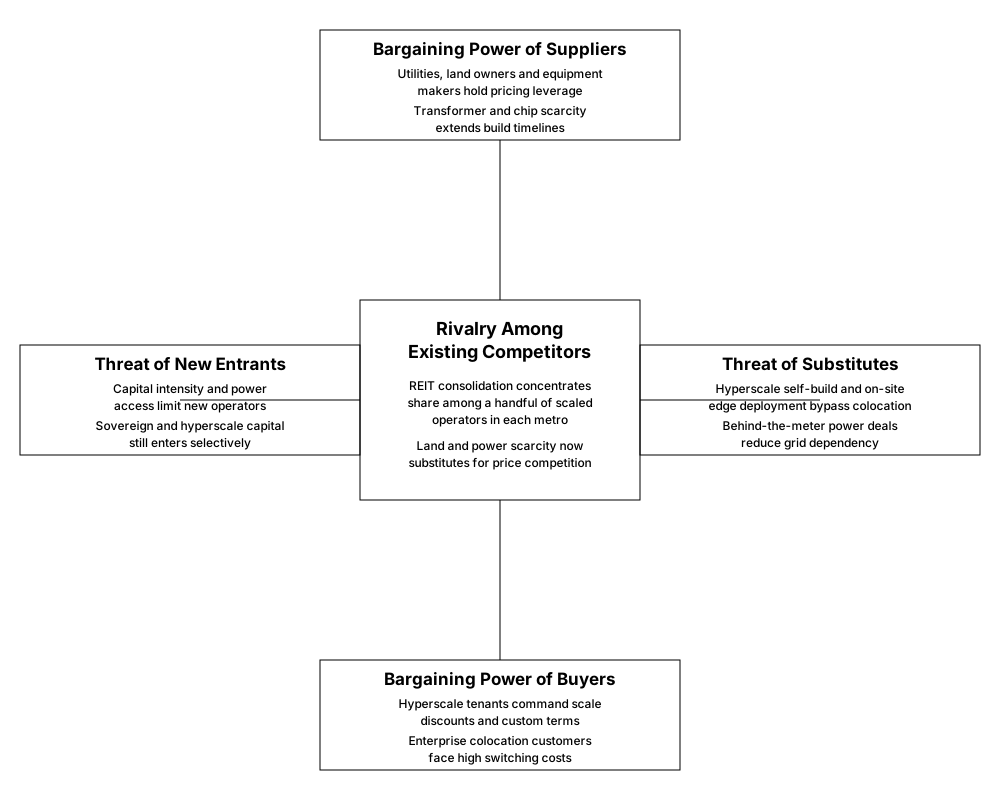
Bargaining power of buyers
Buyer power in data center services diverges sharply by segment. Hyperscale cloud and Artificial Intelligence tenants, who now account for the majority of new capacity absorption globally, can negotiate favorable pricing, power cost pass-through terms and even influence facility design because a single lease can represent hundreds of megawatts and a decade of committed revenue for an operator. Their scale gives them leverage that smaller customers simply cannot match and several have used that leverage to push operators toward built-to-suit arrangements that shift construction risk onto the landlord. At the other end, retail colocation customers, typically enterprises leasing a handful of cabinets, have comparatively little negotiating power individually, because their volume is small relative to a facility's total capacity and because switching providers involves costly, risky physical migration of servers and network connections.
What tempers buyer power industry-wide is the current supply-demand imbalance. Vacancy rates in primary markets such as Northern Virginia have fallen to fractions of a percentage point, which means even hyperscale tenants increasingly must accept the operator's terms, timeline and pricing rather than dictate them, a reversal from the buyer-favorable conditions that prevailed for much of the 2010s. Interconnection-dependent enterprise tenants face particularly high switching costs once cross-connects to specific network and cloud on-ramps are established, since relocating means rebuilding that entire ecosystem of relationships. This asymmetry, powerful hyperscale buyers but locked-in enterprise buyers, defines much of the pricing dynamic operators navigate today.
| Buyer segment | Typical contract length | Relative leverage |
|---|---|---|
| Hyperscale cloud and AI tenants | 10 to 15 years | High, but declining as vacancy tightens |
| Large enterprise colocation customers | 3 to 7 years | Moderate |
| Small and mid-size enterprise tenants | 1 to 3 years | Low, high switching cost once installed |
| Government and defense agencies | Multi-year, often sole-source | Low, prioritizes compliance over price |
Bargaining power of suppliers
Suppliers to this industry fall into three groups whose leverage has grown substantially: utilities and grid operators, land owners in power-rich locations and equipment manufacturers, particularly transformer, generator and cooling system producers. Utilities now sit at the center of nearly every major development decision, because interconnection approval, not permitting or financing, has become the binding constraint on new capacity. Large power transformer lead times have stretched past two years in some markets and utilities in constrained regions such as Northern Virginia and parts of Texas have begun rationing new large-load connections, effectively giving them veto power over which projects proceed and when.
Land owners holding parcels with existing or readily obtainable grid capacity have captured windfall value as operators bid up prices for genuinely power-ready sites, a marked change from a decade ago when land was a commodity input. Equipment suppliers for generators, switchgear and liquid cooling systems, facing surging demand from the same construction wave, have extended lead times and, in some cases, prioritized their largest hyperscale customers over smaller developers, reinforcing scale advantages for well-capitalized operators. Fiber and network suppliers retain moderate leverage, important for interconnection-dense facilities but less binding than the power constraint that now dominates site selection decisions across the industry.
| Supplier type | Constraint today | Trend |
|---|---|---|
| Electric utilities and grid operators | Interconnection queues of years, not months | Tightening further |
| Power-ready land owners | Premium pricing for energized parcels | Prices rising |
| Transformer and switchgear manufacturers | Lead times exceeding two years | Gradually easing with new capacity |
| Generator and cooling system makers | Elevated demand from AI-driven builds | Stable to tightening |
| Fiber and carrier network providers | Adequate in established metros | Stable |
Rivalry among existing competitors
Competitive intensity has taken an unusual shape: capital is flooding into the industry, yet outright price competition has softened because scarcity, not customer acquisition, now governs outcomes in most primary markets. A handful of scaled operators, led by Equinix and Digital Realty globally, alongside regional leaders such as NTT Global Data Centers, QTS, AirTrunk and STT GDC in Asia-Pacific, together control a substantial share of installed capacity in the markets that matter most and their scale advantages in power procurement, construction expertise and balance sheet strength are compounding rather than eroding. Consolidation has accelerated through acquisitions, with larger players buying regional and mid-size operators to gain footholds in constrained metros faster than they could build organically.
Where rivalry remains sharp is in secondary and emerging markets, where land and power are less constrained and operators compete more conventionally on price, service quality and speed to market. It also persists in the fight for anchor hyperscale tenants, where operators compete aggressively on their ability to deliver committed power and timelines, since a missed delivery date can cost a hyperscaler dearly in a market with essentially no spare capacity elsewhere. Differentiation increasingly centers on execution certainty, namely who can actually deliver energized capacity on the promised date, rather than on brand or marginal pricing, because in a supply-constrained market a facility that opens on time commands a premium over one that slips by even a few months.
| Competitive dimension | Primary markets | Secondary markets |
|---|---|---|
| Price competition | Limited, demand exceeds supply | Moderate to significant |
| Basis of differentiation | Delivery certainty and power access | Price and service flexibility |
| Consolidation activity | High, scale operators acquiring share | Emerging, still fragmented |
| New capacity additions | Constrained by grid interconnection | Constrained mainly by capital |
Threat of new entrants
Entry barriers have risen rather than fallen despite the surge of capital targeting the sector. The capital required to develop a competitive, scaled facility now runs into hundreds of millions or billions of dollars and that capital alone no longer guarantees entry because the binding constraint is grid interconnection approval, which utilities grant on a queue basis regardless of a developer's balance sheet. A newcomer without an existing relationship with the local utility, without prior permitting experience in that jurisdiction and without a signed anchor tenant faces a multi-year wait even after committing capital, which discourages opportunistic entry.
That said, entry is not closed to everyone. Sovereign wealth funds, pension funds and infrastructure-focused private equity have entered the industry at scale over the past several years, attracted by long-duration, inflation-linked cash flows that resemble other infrastructure asset classes they already hold. Hyperscale cloud and AI companies represent the other credible entrant category, increasingly self-developing campuses rather than leasing, which functions as both new entry and a substitution threat to incumbent operators simultaneously. What remains genuinely difficult is entering as a generalist, undifferentiated colocation provider without a specific power, land or capital advantage, because that positioning offers no defensible answer to the industry's binding constraint.
| Entrant type | Barrier severity | Realistic pathway |
|---|---|---|
| Undifferentiated new operator | Very high | Limited without a power or land edge |
| Infrastructure fund or sovereign capital | Moderate | Acquire existing platforms or land banks |
| Hyperscale self-developer | Low to moderate | Build dedicated campuses directly |
| Regional utility-adjacent developer | Moderate | Leverage existing grid relationships |
Threat of substitutes
The most consequential substitute for third-party colocation is not a competing technology but a competing ownership model: hyperscale self-build. When a cloud or AI company can secure land and power on its own terms, it frequently chooses to own and operate its campus directly rather than lease from a colocation provider, particularly for massive, single-tenant deployments where the economics of self-ownership outweigh the convenience of leasing. This has been the single largest substitution force reshaping the industry over the past five years and it explains why several colocation operators have pivoted toward build-to-suit and joint-venture structures that blend leasing with elements of self-build.
Edge computing and on-premises deployment represent a smaller substitution vector, relevant mainly for latency-sensitive or data-sovereignty-driven workloads that cannot tolerate the round trip to a centralized facility, but this segment remains a fraction of overall capacity demand. Behind-the-meter power arrangements, where a data center connects directly to a dedicated power plant rather than the public grid, function as a substitute for conventional utility interconnection rather than for colocation itself, but they matter strategically because operators who master this approach can bypass the grid queue entirely and undercut competitors still waiting years for utility approval. No substitute currently threatens the fundamental need for physical, power-dense, cooled space; the competition is over who owns and operates that space.
| Substitute | Relevance today | Trajectory |
|---|---|---|
| Hyperscale self-build campuses | High and growing | Continuing to expand |
| On-premises enterprise data centers | Low and declining | Shrinking steadily |
| Edge and micro data centers | Moderate, workload-specific | Growing slowly |
| Behind-the-meter dedicated power plants | Emerging | Increasing rapidly in constrained metros |
Value chain and profit pools
The value chain begins with land acquisition and power procurement, the stage that now determines whether a project is viable at all; developers scout parcels near substations with spare capacity or negotiate directly with utilities and, increasingly, independent power producers for dedicated generation. Design and construction follows, covering the building shell, electrical distribution, cooling systems and physical security, typically executed by specialized data center construction contractors working to exacting redundancy standards. Equipment procurement and fit-out, covering generators, uninterruptible power supplies, switchgear and cooling hardware, forms a capital-intensive stage that has become a bottleneck in its own right given transformer and generator lead times.
Facility operations and management constitute the ongoing stage, involving 24-hour monitoring, maintenance and energy management, typically staffed leanly relative to the capital deployed. Leasing and customer relationship management, the commercial interface with tenants, ranges from transactional wholesale deals with hyperscalers to consultative retail sales cycles for enterprise colocation. Interconnection and ecosystem services, the layer where tenants physically cross-connect to networks, cloud on-ramps and each other, generates the industry's highest-margin recurring revenue and functions almost as a separate business embedded within the facility. Financing and capital markets access underpins the entire chain, since the ability to raise low-cost, long-duration debt and equity, often through REIT structures, determines how much capacity an operator can build ahead of demand.
Profit pool
Margin concentration has shifted decisively toward two points in the chain: power procurement and interconnection services, while pure shell leasing has become closer to a commodity. Operators who secured long-term, below-market power contracts years ago, before the current demand surge, now enjoy a durable cost advantage over later entrants forced to buy power at today's tighter, pricier terms and that gap shows up directly in development yields. Interconnection revenue, generated from cross-connect fees that can carry gross margins exceeding 80%, has become disproportionately valuable because it monetizes network density rather than raw square footage, rewarding operators who built genuine ecosystem hubs rather than generic warehouses.
Wholesale hyperscale leasing, by contrast, has thinner margins on a percentage basis because power costs, which the operator often passes through with only modest markup, represent such a large share of total revenue; the profit here comes from scale and construction cost discipline rather than pricing power. Construction and equipment suppliers have captured an outsized and arguably temporary share of industry economics during the current build-out, as transformer and generator scarcity let them push through price increases that would not persist in a normalized supply environment. Over a multi-year horizon, the durable profit pool sits with operators who combine secured, low-cost power with high interconnection density, a combination Equinix in particular has pursued deliberately since its founding rather than as a later strategic pivot.
Industry economics and business models
Three business models dominate. The wholesale hyperscale model is asset-heavy and contract-driven, resembling industrial real estate leasing more than a technology business: an operator builds or acquires large-format capacity, signs a single tenant to a decade-long triple-net-style lease with power pass-through and earns a return primarily through the spread between financing cost and lease yield. The retail colocation model is also asset-heavy but layers in meaningfully more service revenue, bundling power, cooling, physical security, remote-hands support and interconnection into per-cabinet or per-kilowatt pricing that commands a premium over bare wholesale rates because it serves customers too small to negotiate directly with utilities or build their own facilities.
The interconnection and ecosystem model, pursued most aggressively by Equinix, is comparatively asset-light in incremental terms once a facility is built, since additional cross-connects and network ports generate high-margin revenue without proportional new capital outlay, functioning almost like a subscription or usage-based software model layered on top of the physical facility. A fourth, increasingly important pattern is the joint-venture or build-to-suit model, where an operator partners with a hyperscale tenant to co-develop a dedicated campus, sharing construction risk and often bringing in a financial partner to fund the build, which lets the operator scale faster than its own balance sheet would otherwise allow while the tenant secures capacity without owning the underlying asset itself.
Cost drivers and scalability
Fixed costs dominate this industry's economics: land, building shell, power infrastructure and long-term debt service are locked in well before a single tenant generates revenue, which means utilization, or occupancy in real estate terms, drives profitability far more than incremental service costs do. Power itself, while often passed through to tenants, represents the largest variable cost component and the one most exposed to commodity price swings, particularly in deregulated electricity markets. Economies of scale are substantial and compounding:
larger operators negotiate better rates from utilities, equipment suppliers and construction contractors and they can spread fixed overhead, from security staffing to compliance functions, across a larger revenue base than smaller competitors can
Economies of scope also matter, particularly for interconnection-focused operators, because each additional network or cloud provider that joins a facility increases its value to every other tenant already present, creating a network effect that reinforces the largest, most connected facilities' advantage over newer, less-connected ones. Unit economics center on occupancy and power utilization efficiency, commonly measured through power usage effectiveness, the ratio of total facility energy consumption to energy delivered to computing equipment; operators who run tighter power usage effectiveness ratios extract more billable capacity from the same physical footprint. The flywheel in this industry runs from secured power to built capacity to anchor tenants to interconnection density to further tenant demand and each turn of that cycle makes the next parcel of land and the next power contract easier to secure on favorable terms.
Moats, advantages and strategic levers
The most durable moat in this industry is control over energized land, meaning parcels with either an existing grid connection or a credible, near-term path to one, because that scarcity cannot be replicated by capital alone once a region's interconnection queue is saturated. Long-term, below-market power contracts signed before the current demand surge constitute a related and equally durable cost advantage, effectively locking in a structural edge over any competitor entering the same market today. Interconnection density creates a genuine network effect:
the more carriers, cloud providers and enterprises that cross-connect within a facility, the more valuable that facility becomes to every other tenant and this advantage compounds over time in a way that is extremely difficult for a new facility to replicate quickly
Switching costs protect incumbent operators serving enterprise colocation tenants, since migrating physical servers and rebuilding network connections is disruptive and risky enough that customers tolerate meaningful price increases before relocating. Regulatory and permitting expertise functions as a quieter but real moat, since operators with a track record of successfully navigating zoning, environmental and utility approval processes in a given jurisdiction move faster than newcomers learning that process for the first time. Scale itself, in procurement, financing and construction execution, reinforces all of the above, which is why the largest operators have continued gaining share even as more capital enters the industry overall.
The scarce resource in this industry stopped being capital or even land years ago; it is now an executed interconnection agreement with a utility that has spare capacity to sell
Strategic levers available to operators fall into several categories. Power procurement strategy, including direct negotiation with utilities, behind-the-meter generation partnerships and renewable power purchase agreements, has become the single highest-leverage decision an operator makes, often determining project viability before design or financing questions even arise. Geographic diversification into secondary metros and international markets, where land and power remain more available, offers growth capacity that primary markets like Northern Virginia can no longer easily provide. Vertical integration versus partnership represents a genuine strategic choice: operators can build construction and power development capabilities in-house, as the largest players increasingly do, or partner with specialized developers and independent power producers to move faster with less capital at risk. Ecosystem orchestration, deliberately curating which network and cloud providers anchor a facility, remains the clearest path to the interconnection-driven margin that distinguishes the industry's most profitable operators from commodity landlords.
Structural risks, regulation and trends
Structural risk in this industry centers overwhelmingly on power. Grid capacity constraints, transformer and generator supply shortages and utility interconnection queues that now stretch several years in the most constrained metros represent the binding risk to growth, more consequential than any technology disruption or demand-side uncertainty. Regulatory risk compounds this: several jurisdictions have begun scrutinizing data center water and energy consumption more closely and some utilities have proposed cost-allocation rules that would shift more of the grid upgrade burden directly onto data center developers rather than spreading it across all ratepayers, which would materially change project economics if broadly adopted. Interest rate sensitivity is significant given the industry's reliance on debt-financed, long-duration construction, meaning a sustained rate increase raises development yields required to justify new projects and can slow speculative building even amid strong tenant demand.
Geopolitical and supply chain risk shows up in equipment procurement, since transformers, generators and specialized cooling components draw on globally concentrated manufacturing bases vulnerable to trade restrictions or tariff shifts. On the demand side, the dominant secular trend is the Artificial Intelligence-driven surge in power density per rack, which is forcing a wholesale redesign of facilities toward liquid and direct-to-chip cooling and toward campuses sized in the hundreds of megawatts rather than tens. Supply is responding with unprecedented construction activity, yet announced capacity in several major pipelines already exceeds what regional grids can plausibly support on the announced timelines, which points toward continued scarcity pricing for operators with secured power rather than a near-term supply glut.
The strategic playbook for new entrants depends heavily on capital profile. Infrastructure funds and sovereign capital should pursue a build-or-acquire strategy centered on securing land with existing power access or acquiring platforms that already hold it, rather than attempting to compete on service differentiation against established interconnection hubs. Specialist entrants without deep capital should target underserved secondary metros or specific verticals, such as government and defense colocation requiring security clearances, where competition from scaled operators is thinner. Regulatory strategy matters as much as site selection; developers who engage utilities and permitting authorities early and who bring credible renewable or behind-the-meter power solutions to the table, consistently move through queues faster than those relying solely on capital to force progress.
Incumbent operators face a different set of choices. Defending existing positions means locking in long-term power contracts now, before prices rise further and renewing anchor tenant leases on terms that preserve pricing power rather than simply maximizing near-term occupancy. Expanding means following hyperscale and AI demand into new geographies, including international markets where power remains comparatively available, while resisting the temptation to overbuild speculative capacity in already-saturated primary metros. Deepening the moat means investing further in interconnection density and ecosystem services, the layer of the business least exposed to power scarcity and most defensible against hyperscale self-build, since a hyperscaler can replicate a data hall far more easily than it can replicate a decade of accumulated network relationships within a facility.1 point to sustained double-digit growth through the early 2030s, driven by Artificial Intelligence workloads. Analysis from2 confirms vacancy has fallen to record lows across primary markets while rents climb at double-digit annual rates. Reporting from3 details how demand continues to outstrip new supply. Coverage from4 outlines how interconnection queues and transformer shortages have become the industry's binding constraint. Market positioning detail comes from5, which identifies Equinix, Digital Realty, NTT Data Centers, QTS and KDDI as the leading global operators. JLL's6 provides additional context on capital flows and regional demand patterns shaping site selection decisions across the industry.
Equinix and the interconnection-first strategy
Equinix began in 1998 as a neutral internet exchange point built to let early internet service providers physically connect their networks to one another, rather than as a conventional real estate landlord chasing square-footage growth. That founding premise, that the value of a facility grows with the number and diversity of networks present inside it, has remained the company's organizing strategy for more than two decades and now defines an approach that differs meaningfully from wholesale-focused competitors. Rather than optimizing primarily for megawatts under lease, Equinix has optimized for what it calls interconnection density, the number of carriers, cloud providers, enterprises and content networks that physically cross-connect within its facilities and it prices a meaningful share of its revenue around that density rather than around raw power consumption alone.
The company operates several hundred International Business Exchange facilities across dozens of countries on six continents, a footprint that gives it a genuine claim to being the most globally distributed operator in the industry, ahead of rivals whose international presence remains comparatively concentrated in fewer markets. This global reach matters commercially because multinational enterprises and cloud providers value the ability to replicate the same interconnection ecosystem across regions under a single commercial relationship, which reduces the operational complexity of managing many local vendor relationships instead. Equinix has pursued this global build-out partly through organic construction and partly through acquisition, buying regional operators to gain immediate footholds in markets where building from scratch would have taken years longer.
Financially, the company's interconnection and managed services revenue carries materially higher gross margins than its colocation space rental revenue and this mix has been central to its ability to sustain premium valuation relative to more wholesale-oriented data center REITs. That said, Equinix has not been immune to the industry's central power constraint; like its peers, it has had to secure long-term power agreements and pursue renewable energy contracts at scale to keep pace with rising demand, particularly as its enterprise and cloud tenants push more Artificial Intelligence-related workloads into its facilities. The company has responded by expanding its build-to-suit and joint-venture activity, including partnerships with financial investors to co-fund large-scale developments, a departure from its historically more capital-light, densification-focused growth model of adding capacity within existing metro campuses.
The strategic lesson from Equinix's trajectory is that a facility's defensibility comes less from its physical specifications than from the durability of the relationships it hosts. A generic warehouse with power and cooling can be replicated by any well-capitalized entrant within a few years; a facility that has spent two decades accumulating hundreds of network relationships and thousands of cross-connects cannot be replicated on the same timeline, regardless of how much capital a rival is willing to deploy. That is the essence of the interconnection moat and it explains why Equinix has continued commanding premium pricing and tenant retention even as capital-rich new entrants, including hyperscalers themselves, have flooded into the broader industry.
Executive takeaways
The physical data center industry rewards operators who treat power procurement as the central strategic discipline rather than a construction line item, because every other advantage, from tenant relationships to interconnection density, depends on first securing energized capacity in a market where utilities, not developers, now control the pace of growth. Boards evaluating exposure to this sector should weight power contract quality and interconnection position more heavily than headline capacity figures and should recognize that the industry's current scarcity, while lucrative for incumbents, also raises the execution risk of any new commitment that has not already cleared the utility queue.
- 1Global Data Center Colocation Market Projections
- 2CBRE's Global Data Center Trends Research
- 3Data Center Dynamics On Rental Rate And Construction Cost Trends
- 4Data Center Knowledge On Grid Power Constraints
- 5MarketsandMarkets Research On Leading Colocation Providers
- 62026 Global Data Center Market Outlook
Physical data center infrastructure supplies the land, power and cooled shell that every digital service ultimately runs on top of, sitting one layer beneath cloud computing rather than competing with it. Its economics resemble regulated infrastructure more than technology: long-duration leases, heavy upfront capital and returns that depend on securing energized land ahead of competitors. Margin has migrated toward operators who control interconnection density and utility relationships, away from generic landlords. The strategic levers that matter now are power procurement, geographic diversification into secondary and international markets and vertical bundling of colocation with interconnection and managed services. Capital keeps flowing in, but the winners will be decided less by who builds fastest and more by who secures energy first.
Citation
Cite this article
Sridharan, M. A. (2023, May 25). Industry Analysis: Data Center Services. Think Insights. https://thinkinsights.net/strategy/industry-analysis-data-center-services (Accessed [[ACCESS_DATE]])
Sridharan, Mithun A. "Industry Analysis: Data Center Services." Think Insights, 25 May 2023, https://thinkinsights.net/strategy/industry-analysis-data-center-services. Accessed [[ACCESS_DATE]].
Mithun A. Sridharan, "Industry Analysis: Data Center Services," Think Insights, May 25, 2023, https://thinkinsights.net/strategy/industry-analysis-data-center-services. Accessed [[ACCESS_DATE]].
Sridharan, M.A. (2023) 'Industry Analysis: Data Center Services', Think Insights. Available at: https://thinkinsights.net/strategy/industry-analysis-data-center-services (Accessed: [[ACCESS_DATE]]).
M. A. Sridharan, "Industry Analysis: Data Center Services," Think Insights, 2023. [Online]. Available: https://thinkinsights.net/strategy/industry-analysis-data-center-services. [Accessed: [[ACCESS_DATE]]].
Sridharan MA. Industry Analysis: Data Center Services. Think Insights. Published May 25, 2023. Accessed [[ACCESS_DATE]]. https://thinkinsights.net/strategy/industry-analysis-data-center-services
Test Your Knowledge
Industry Analysis: Data Center Services
Challenge yourself on the concepts from this article and see how well you understood them.
Subscribers get weekly quizzes and insights — subscribe free
Sponsor this article
Partner with Think Insights
Reach 50,000+ business leaders, consultants, and strategists. Feature your brand alongside expert articles on strategy, leadership, and digital transformation.
Become a Sponsor