How Costco Makes Money


Costco Wholesale Corporation runs on a simple split: sell goods near cost, then earn the real profit from an annual membership fee. In fiscal 2025, the warehouse retailer generated $269.9 billion in net sales and $8.1 billion in net income, with membership fees supplying most of that bottom line even though they made up less than 2% of total revenue. The company caps merchandise markups far below a typical grocer, stocks a deliberately narrow assortment and pushes members toward Kirkland Signature, its private label, which alone generated an estimated $90 billion in sales. This overview breaks down the warehouse format, the membership structure, the private-label engine and the international expansion that together explain why Costco keeps growing while carrying some of the thinnest margins in retail.
How does Costco make most of its profit?
Costco caps merchandise margins near 11% and earns a large share of its net income from membership fees, which totaled roughly $5.3 billion in fiscal 2025 and cost almost nothing to service once a shopper joins.
What is Kirkland Signature and why does it matter?
Kirkland Signature is Costco's private label, generating an estimated $90 billion in sales in 2025, close to a third of total merchandise revenue. It lets Costco capture the margin a manufacturer would normally keep, control quality and often price below national brands.
How many countries does Costco operate in?
Costco ran 914 warehouses across the United States, Canada, Mexico, Japan, the United Kingdom, Korea, Australia, Taiwan, China, Spain, France, Sweden, Iceland and New Zealand as of the end of fiscal 2025.
The membership-funded model
Costco Wholesale Corporation, listed on the Nasdaq exchange as COST, built its business on a structural split that most retailers avoid: it separates the cost of goods from the source of profit. Merchandise sells close to cost, with a gross margin capped near 11%, roughly half of what a typical grocery or general merchandise retailer earns. The membership fee, not the checkout markup, funds most of the profit that follows. In fiscal 2025, net sales reached $269.9 billion and total revenue, including membership fees, reached $275.2 billion, producing net income of $8.1 billion.1 Because a membership costs almost nothing to service once a shopper joins, nearly all of that fee revenue converts directly into profit.
Costco does not need to profit from the goods on the shelf. It needs the membership to feel worth renewing every year
That structure explains nearly every other decision inside the company, from the size of its stores to the number of products it carries.
A warehouse format built for volume
Costco operates 914 warehouses worldwide as of the end of fiscal 2025, each built around the same principle: fewer products, larger quantities, faster turnover.2 A typical Costco carries roughly 4,000 stock keeping units [SKUs], compared with tens of thousands at a conventional supermarket. That narrow assortment lets the company buy far deeper on each item, negotiate harder with suppliers and clear inventory before it ties up cash. Warehouses skip most of the merchandising costs a department store carries, since goods often stay on the pallet they arrived on rather than moving to individual displays. The format keeps operating costs low enough to support the thin merchandise margin without eroding profit, which is the entire point of the exercise.
Kirkland Signature as a margin lever
Kirkland Signature, Costco's private label, turned 30 in 2025 and generated an estimated $90 billion in sales that year, close to a third of total merchandise revenue.3 When a shopper picks Kirkland over a national brand, Costco captures the margin a manufacturer would normally keep, gains more control over its supply chain and typically prices the product below the branded equivalent. Members see a lower price; the finance department sees a wider margin and better protection against tariff swings on imported goods. Kirkland now outsells many of the national brands sitting on the same shelf, which gives Costco negotiating leverage even over its largest suppliers.
Treasure hunt merchandising
Costco intentionally rotates a portion of its inventory: electronics, apparel, jewelry and seasonal goods appear, sell through and disappear, often without returning. Employees and shoppers call this the treasure hunt and it serves a purpose beyond novelty. A shopper who assumes an item will not be there next month buys it today rather than waiting, which speeds turnover and creates a reason to visit the warehouse even when nothing is on the weekly list. The tactic also lets Costco test new categories, from large televisions to fine jewelry, without committing shelf space permanently. It keeps the shopping trip closer to discovery than routine restocking, a dynamic that is difficult for a pure e-commerce competitor to replicate.
International expansion
Costco operates in more than a dozen countries, with warehouse counts led by Canada at 110, Mexico at 42, Japan at 37 and the United Kingdom at 29.4 China remains the newest growth story: the company opened its first mainland warehouse in 2019 and had grown to seven locations by the end of fiscal 2025, each drawing crowds large enough to require crowd control on opening day. Executives have said the company intends to keep opening new warehouses globally at a steady pace, with international markets taking a larger share of that total over time. Membership economics travel reasonably well across borders because the format, few products, deep discounts, a fee at the door, does not require much adaptation to local retail habits.
Revenue mix and digital channels
Merchandise sales still account for the overwhelming majority of Costco's top line, with membership fees supplying a smaller but far more profitable slice. E-commerce has become the fastest-growing piece of that mix: online comparable sales grew close to 15% year over year through fiscal 2025, outpacing the roughly 8% growth in total comparable sales.5 Costco has leaned into same-day delivery partnerships with Instacart, Uber and DoorDash rather than building its own last-mile delivery network, a choice that trades some margin for speed without the capital cost of a private delivery fleet. Digital sales still trail Amazon and Walmart in absolute terms, but the growth rate suggests the channel is no longer an afterthought.
Competitive pressure and risk
Costco's closest rival runs an identical playbook under a different owner: Sam's Club, Walmart's warehouse chain, charges a lower membership fee, draws on Walmart's logistics network and plans to keep opening new locations at a steady pace over the next several years.6 Amazon and Walmart pose a broader threat by pouring capital into bulk shipping and faster delivery, categories Costco has historically ceded in exchange for lower prices inside the warehouse itself. Costco's response has been to protect what a warehouse trip offers that a delivery truck cannot: price certainty, bulk value and the treasure hunt, rather than trying to out-ship its rivals on speed.
The warehouse business keeps compounding. The stock price is the part that leaves little room for a stumble
That inventory of risk sits mostly outside the operating business: a membership renewal rate that has to stay high, tariff exposure on imported goods and a valuation that assumes the model keeps performing at its current pace.
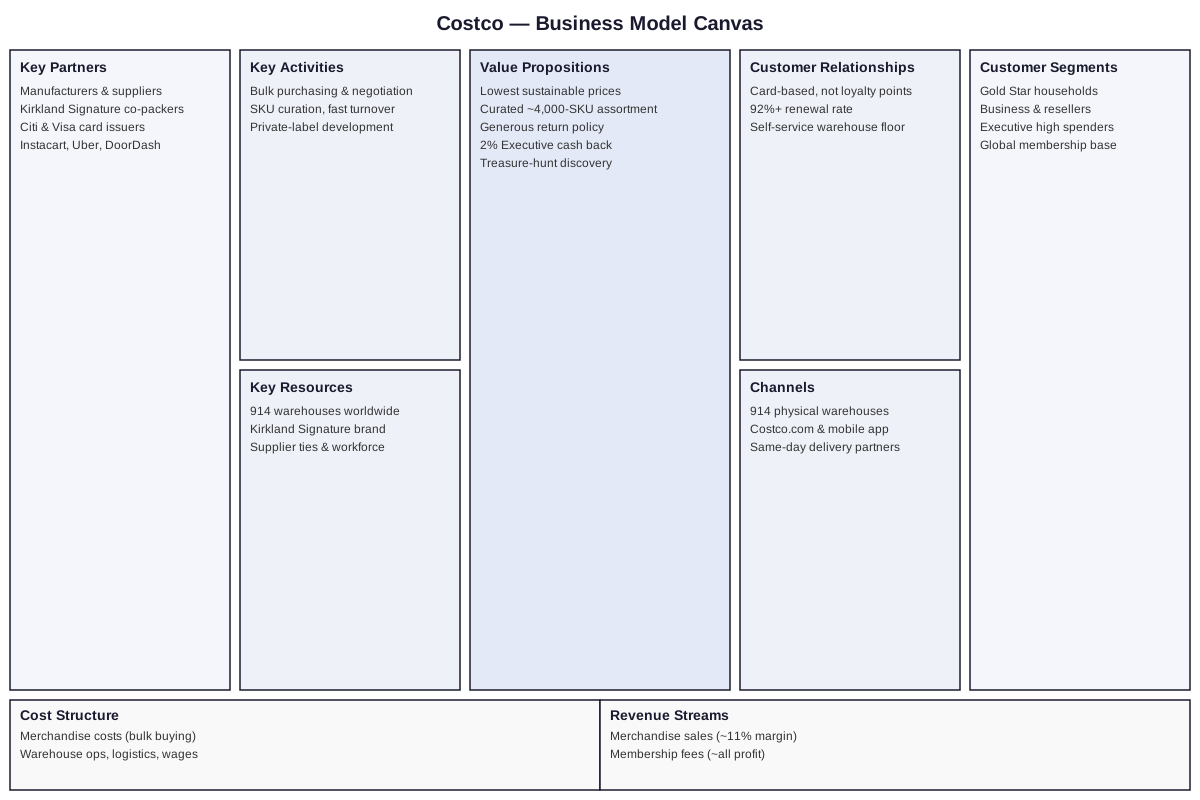
Key Partners
Manufacturers and suppliers produce the goods Costco sells, including contract co-packers that manufacture Kirkland Signature products to Costco's specifications. Citi and Visa issue the co-branded credit card that drives a portion of Executive member spending and rewards. Instacart, Uber and DoorDash handle same-day delivery, extending Costco's reach without requiring it to build a delivery fleet. These partnerships let Costco stay focused on merchandising and warehouse operations rather than logistics infrastructure.
Key Activities
Bulk purchasing negotiated directly with manufacturers sits at the center of Costco's operating model, supported by disciplined SKU curation that keeps the assortment near 4,000 products. Fast inventory turnover reduces holding costs and keeps cash moving through the business rather than sitting on shelves. Continuous development of new Kirkland Signature products across categories extends the private label further into the assortment each year. Sourcing rotating treasure-hunt merchandise adds a further activity, since limited-run goods create urgency without committing permanent shelf space.
Key Resources
The global warehouse network, 914 locations across more than a dozen countries, forms the physical backbone of the model. The Kirkland Signature brand functions as a resource in its own right, generating close to a third of merchandise revenue. Supplier relationships built over decades give Costco buying terms smaller retailers cannot match. A stable, experienced workforce rounds out the resources that competitors struggle to replicate quickly.
Value Propositions
Costco offers the lowest price it can sustain on a curated set of products, backed by a return policy more generous than most retailers offer. Executive members earn 2% cash back on purchases, up to an annual cap. The treasure-hunt assortment adds discovery to a shopping trip built primarily around value. Membership itself signals access to pricing regular shoppers cannot get elsewhere, which reinforces why members keep renewing.
Customer Relationships
The relationship runs through the membership card rather than through loyalty points or personalized offers. Renewal, not repeat purchase, is the metric that matters most and the United States and Canada renewal rate has held above 90% for years. Self-service shopping, with minimal staff interaction on the floor, keeps operating costs low. The rotating assortment gives members a reason to keep the relationship active even between planned purchases.
Channels
Costco reaches members primarily through its physical warehouses, supplemented by Costco.com and a mobile app for online orders. Same-day delivery through Instacart, Uber and DoorDash extends the warehouse's reach without requiring Costco to build its own delivery fleet. Digital channels are growing faster than the store base but still represent a modest share of total sales. The warehouse remains the default channel for the large majority of transactions.
Customer Segments
Gold Star members represent value-conscious households buying for personal and family use. Business members include small businesses and resellers who need bulk quantities at wholesale pricing. Executive members, who pay a higher fee in exchange for cash-back rewards, make up roughly half the paid base but drive the majority of total sales. Membership tiers give Costco a way to segment spending behavior without changing the underlying warehouse format.
Cost Structure
Merchandise costs make up the largest expense given the sheer volume Costco moves through its warehouses. Warehouse operations, logistics and distribution add a second major cost layer, alongside wages that run above the retail industry average. Real estate and construction costs for new warehouses represent a significant ongoing capital commitment as the company keeps expanding. Marketing spend stays low relative to peers because the membership model reduces the need for constant promotional advertising.
Revenue Streams
Merchandise sales generate the large majority of total revenue but carry a thin margin capped near 11%. Membership fees make up a small share of revenue, under 2%, yet supply a disproportionate share of net income because they cost almost nothing to collect and renew. The mix of high-volume, low-margin goods and high-margin membership fees defines the entire revenue model. Ancillary income from the co-branded card and travel and business services adds a smaller third stream.
Costco's business model separates where it creates value from where it captures profit. It creates value at the shelf, selling merchandise close to cost so a membership pays for itself within a few trips. It captures profit at the front desk, where annual fees flow to the bottom line with almost no cost to service. Every structural choice, the narrow product assortment, the Kirkland Signature private label, the treasure-hunt merchandising and the international expansion, exists to protect that loop. The model faces real tests: e-commerce rivals with far larger scale, tariff pressure on imported goods and a membership base that must keep renewing at a high rate to sustain the flywheel. None of that has slowed Costco yet and the underlying mechanics remain among the clearest examples of a membership-funded retail model in operation today.
Citation
Cite this article
Sridharan, M. A. (2023, May 28). How Costco Makes Money. Think Insights. https://thinkinsights.net/strategy/how-costco-makes-money (Accessed [[ACCESS_DATE]])
Sridharan, Mithun A. "How Costco Makes Money." Think Insights, 28 May 2023, https://thinkinsights.net/strategy/how-costco-makes-money. Accessed [[ACCESS_DATE]].
Mithun A. Sridharan, "How Costco Makes Money," Think Insights, May 28, 2023, https://thinkinsights.net/strategy/how-costco-makes-money. Accessed [[ACCESS_DATE]].
Sridharan, M.A. (2023) 'How Costco Makes Money', Think Insights. Available at: https://thinkinsights.net/strategy/how-costco-makes-money (Accessed: [[ACCESS_DATE]]).
M. A. Sridharan, "How Costco Makes Money," Think Insights, 2023. [Online]. Available: https://thinkinsights.net/strategy/how-costco-makes-money. [Accessed: [[ACCESS_DATE]]].
Sridharan MA. How Costco Makes Money. Think Insights. Published May 28, 2023. Accessed [[ACCESS_DATE]]. https://thinkinsights.net/strategy/how-costco-makes-money
Test Your Knowledge
How Costco Makes Money
Challenge yourself on the concepts from this article and see how well you understood them.
Subscribers get weekly quizzes and insights — subscribe free
Sponsor this article
Partner with Think Insights
Reach 50,000+ business leaders, consultants, and strategists. Feature your brand alongside expert articles on strategy, leadership, and digital transformation.
Become a Sponsor