Accenture Business Model


Accenture sells professional services split roughly evenly between consulting and managed services, working with governments and large enterprises across technology, financial services, health, products and resources industries. The firm traces its roots to a 1950s feasibility study Arthur Andersen conducted for General Electric, split from its accounting parent in 2000 and renamed itself Accenture ahead of a 2001 initial public offering. Fiscal 2025 revenue reached $69.67 billion, with generative and agentic AI work alone generating $2.7 billion in revenue and $5.9 billion in bookings. This article traces how Accenture built that scale, restructured around AI-driven reinvention and continues fending off both traditional strategy firms and large technology vendors.
How does Accenture make money?
Accenture earns revenue through two main service lines: consulting, which covers strategy, technology and systems integration work and managed services, which covers ongoing outsourcing of clients' business functions and IT systems. The two lines were nearly equal in fiscal 2025, with total revenue of $69.67 billion.
What is Accenture's reinvention services strategy?
In 2025, Accenture folded five previously separate business units into a single reinvention services group aimed at large-scale digital transformation projects tied to generative and agentic AI adoption. The change reflects the firm's push to sell AI-driven transformation as an integrated offering rather than as separate consulting, technology and operations engagements.
Who are Accenture's biggest competitors?
Accenture competes with strategy-focused firms such as McKinsey, Boston Consulting Group and Bain, audit-linked consultancies including Deloitte and PwC and large IT services providers such as IBM and Tata Consultancy Services. Each rival overlaps with a different part of Accenture's business, from high-level strategy work to large-scale technology outsourcing.
From an audit spinoff to an independent giant
Accenture's origins trace to a feasibility study Arthur Andersen's consulting arm conducted for General Electric in the early 1950s, work that led to one of the first commercial computer installations in the United States. The consulting practice, known as Andersen Consulting, split from its accounting parent in 1989 to operate under a joint umbrella structure, an arrangement that grew tense as Andersen Consulting objected to paying Arthur Andersen a share of its profits each year.1 Arbitration through the International Chamber of Commerce concluded the dispute in 2000 and Andersen Consulting paid $1.2 billion to fully separate before renaming itself Accenture and listing on the New York Stock Exchange in 2001 at $14.50 a share.
Consulting and outsourcing, still the core engine
Accenture's revenue splits close to evenly between consulting, which covers strategy and systems integration work and managed services, which covers long-term outsourcing of clients' technology and business functions. Fiscal 2025 revenue reached $69.67 billion, up 7 percent from the prior year, with the firm now employing roughly 779,000 people.2 That combination gives Accenture a revenue base that renews itself:
consulting engagements frequently convert into multi-year managed services contracts once a client has committed to a new system or process
One firm organized around client industries
Accenture historically organized its client-facing work around industry groups covering technology and communications, financial services, health and public service, consumer products and natural resources, each staffed with consultants who carry certified expertise in that sector. The firm, headquartered in Dublin, Ireland, operates in more than 120 countries, letting it deploy locally relevant teams while drawing on a shared global delivery network for execution work. In 2025 Accenture folded its formerly separate business units into a single reinvention services group, a restructuring aimed at selling large-scale digital transformation as one integrated offering rather than as separate consulting, technology and operations engagements.3
Betting the firm on generative AI
Generative and agentic AI work generated $2.7 billion in Accenture revenue during fiscal 2025, roughly triple the prior year, while bookings for that work nearly doubled to $5.9 billion. Chief executive Julie Sweet told analysts that data modernization projects now underpin much of that growth, noting that half of the firm's generative AI, agentic AI and physical AI projects carry a significant data component.4 The firm has roughly doubled its AI and data specialist headcount to 77,000 over two years and trained more than 550,000 employees in generative AI fundamentals, a buildout meant to prevent the firm from being outpaced by smaller AI-native consultancies.
Growth funded through acquisition
Accenture has invested billions of dollars acquiring smaller firms to fill specific capability gaps rather than building every skill internally. Recent deals include Imaginea Technologies and Infinity Works to strengthen its cloud practice, Trivadis and Cygni to add IT services and cloud-native development expertise and smaller data analytics firms such as Byte Prophecy.5 This acquisition pace lets Accenture add niche expertise, in cybersecurity, cloud engineering or industry-specific analytics, faster than it could train the same skills internally.
Competing against strategy firms and IT giants
Accenture sits at the intersection of two competitive markets that rarely overlap directly with each other. Strategy-focused firms including McKinsey, Boston Consulting Group and Bain compete for high-level advisory work, while audit-linked consultancies such as Deloitte and PwC and IT services providers including IBM and Tata Consultancy Services compete for the technology delivery and outsourcing contracts that make up the bulk of Accenture's revenue. Deloitte reported roughly $50.2 billion in revenue with about 334,800 employees in a recent fiscal year, a scale comparable to Accenture's but built on a different mix of audit, tax and consulting work.
Key Partners
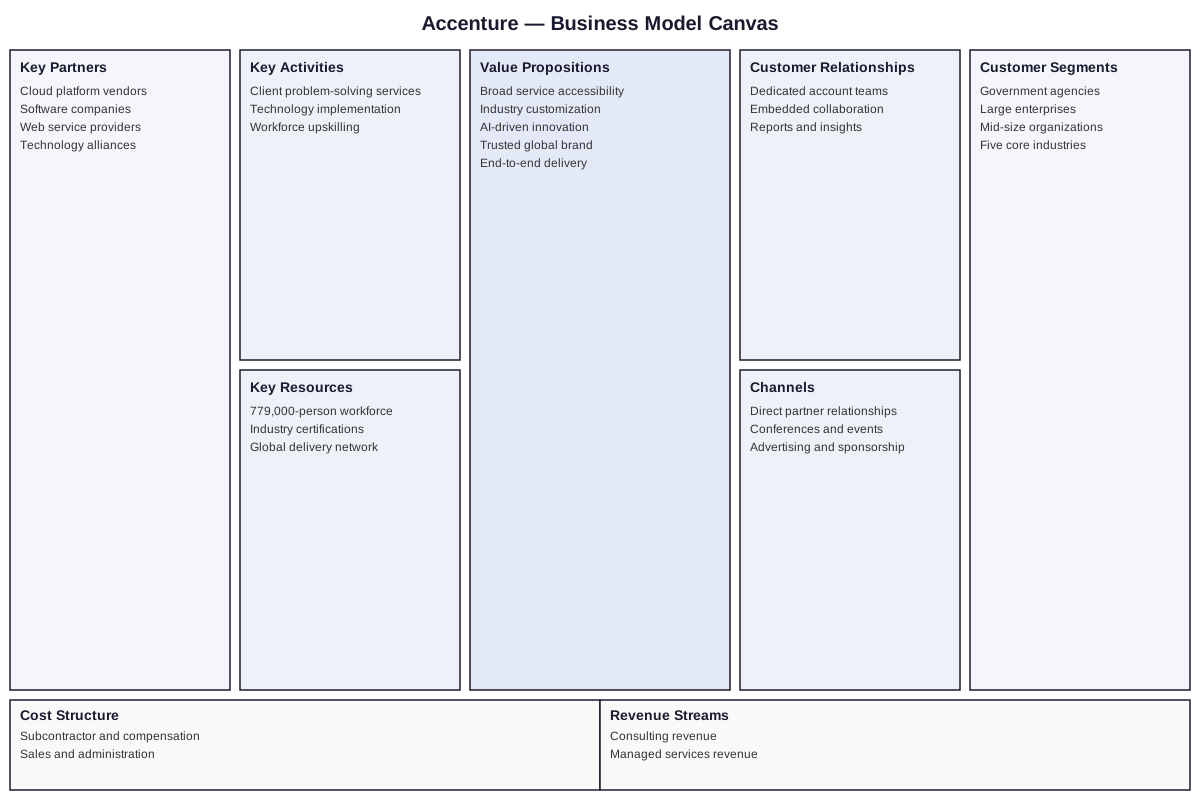
Accenture's partner ecosystem centers on major technology vendors and cloud platform providers whose products it implements for clients, alongside software companies whose tools it integrates into client systems. Web service providers round out this network, supporting the infrastructure behind the firm's managed services contracts. These partnerships let Accenture certify its consultants on specific platforms, a credential that clients look for when awarding large implementation contracts.
Key Activities
Accenture's central activity is developing problem-solving services tailored to each client's industry and technology stack, spanning strategy engagements, systems implementation and ongoing operations management. The firm continuously develops new offerings through its research arms, translating emerging technology trends into services it can sell before competitors catch up. Training its workforce on new platforms, most recently generative AI tools, has become a recurring activity given how quickly client demand shifts toward new technology categories.
Key Resources
Accenture's largest resource is its workforce, nearly 779,000 people including data scientists, web developers, digital marketers and big data specialists who staff client engagements across industries. Its industry-specific certifications and sector expertise, built over decades of client work, form a second resource that lets it price consulting work at a premium over generalist competitors. Its global delivery network, spanning offices in more than 120 countries, gives it the scale to staff projects that smaller consultancies cannot handle alone.
Value Propositions
Accenture offers clients accessibility to a wide range of capabilities built through billions of dollars in acquisitions and technology investment, letting one firm cover strategy, technology and operations under a single contract. Customization comes from its industry-aligned consultants, many holding sector-specific certifications that let the firm tailor advice to a client's particular market. Its innovation offering draws on internal research groups that develop new frameworks and technology applications, while its brand, built over decades as one of the largest consultancies globally, gives clients confidence in its ability to execute complex, multi-year engagements.
Customer Relationships
Accenture builds relationships through personalized customer assistance delivered by dedicated account teams assigned to each major client relationship. Customer-employee collaboration runs deep in its engagement model, with Accenture consultants often embedded alongside client staff for the duration of a project. Infographics and detailed reports supplement this direct collaboration, giving clients data-backed justification for the recommendations Accenture delivers.
Channels
Accenture's primary channel for winning new business is direct relationship-building between its partners and client executives, a sales approach suited to the scale and complexity of its typical engagements. Advertising and social media presence support brand visibility, while conference participation lets the firm showcase its expertise to industry audiences. Sponsorship of athletes and major sporting events rounds out its marketing mix, extending brand recognition beyond the corridors where consulting deals are typically won.
Customer Segments
Accenture's customer segments center on organizations large enough to fund multi-year consulting and outsourcing engagements. Government agencies make up one segment, using Accenture for public service delivery and technology modernization projects. Large enterprises and mid-size organizations across its five core industries, technology, financial services, health, products and resources, form the remaining segments, each requiring different regulatory knowledge and sector expertise.
Cost Structure
Accenture's largest cost categories are subcontractor payments and employee compensation, reflecting a workforce of nearly 779,000 people spread across delivery centers worldwide. Administration and sales and marketing costs round out the structure, funding the business development work needed to win and renew large client contracts.
Revenue Streams
Consulting revenue, drawn from strategy, technology and systems integration engagements, makes up close to half of Accenture's total revenue. Managed services, or outsourcing revenue, covers the other half, generated by running clients' technology systems and business functions on an ongoing contractual basis rather than a single project engagement.
Accenture's business model rests on a bet that clients will keep paying for outside help translating new technology into working systems, from mainframe computing in the 1950s to generative AI today. The firm's scale, nearly 779,000 employees operating in more than 120 countries, lets it staff projects that smaller consultancies cannot match, while its roughly even split between consulting and managed services gives it revenue that renews itself as consulting engagements convert into long-term outsourcing contracts. The 2025 reorganization into a single reinvention services group signals that Accenture expects generative AI to reshape how it delivers work, not just what it sells. Competition from Big Four firms, strategy boutiques and India-based IT services providers means Accenture cannot rely on brand alone and its acquisition strategy, absorbing smaller specialist firms, shows how it plans to keep pace with client demand.
Citation
Cite this article
Sridharan, M. A. (2026, July 15). Accenture Business Model. Think Insights. https://thinkinsights.net/digital-transformation/accenture-business-model (Accessed [[ACCESS_DATE]])
Sridharan, Mithun A. "Accenture Business Model." Think Insights, 15 July 2026, https://thinkinsights.net/digital-transformation/accenture-business-model. Accessed [[ACCESS_DATE]].
Mithun A. Sridharan, "Accenture Business Model," Think Insights, July 15, 2026, https://thinkinsights.net/digital-transformation/accenture-business-model. Accessed [[ACCESS_DATE]].
Sridharan, M.A. (2026) 'Accenture Business Model', Think Insights. Available at: https://thinkinsights.net/digital-transformation/accenture-business-model (Accessed: [[ACCESS_DATE]]).
M. A. Sridharan, "Accenture Business Model," Think Insights, 2026. [Online]. Available: https://thinkinsights.net/digital-transformation/accenture-business-model. [Accessed: [[ACCESS_DATE]]].
Sridharan MA. Accenture Business Model. Think Insights. Published July 15, 2026. Accessed [[ACCESS_DATE]]. https://thinkinsights.net/digital-transformation/accenture-business-model
Test Your Knowledge
Accenture Business Model
Challenge yourself on the concepts from this article and see how well you understood them.
Subscribers get weekly quizzes and insights — subscribe free
Sponsor this article
Partner with Think Insights
Reach 50,000+ business leaders, consultants, and strategists. Feature your brand alongside expert articles on strategy, leadership, and digital transformation.
Become a Sponsor