RVCE Prioritization


Most teams do not suffer from a shortage of ideas. They suffer from a shortage of disciplined prioritization. Projects, improvement initiatives, stakeholder requests, and urgent operational issues compete for the same limited time, capital, and attention. In that environment, leaders often default to the loudest request, the newest issue, or the project sponsored by the most influential stakeholder. That may create motion, but it rarely creates focus. The Risk-Value-Cost-Effort [RVCE] Prioritization Matrix offers a more structured approach. It gives decision-makers a way to assess competing tasks and projects against four practical criteria: the downside of inaction, the upside of completion, the cost of execution, and the effort or complexity required. When teams assign consistent scores and compare initiatives through the same lens, prioritization becomes less political, less reactive, and more aligned to business goals. The recommendation is simple. Use RVCE whenever the organization needs to compare diverse initiatives, break broad goals into sequenced actions, or justify why certain work should move first. Treat the matrix as a decision support tool rather than a rigid formula. Its purpose is not to eliminate judgment, but to improve it by forcing clearer trade-offs and making the reasoning behind priorities visible to everyone involved.
When should teams use the RVCE Prioritization Matrix?
Teams should use RVCE when they need to compare unrelated initiatives, sequence work across functions, or explain to stakeholders why one task deserves attention before another.
Is the RVCE matrix meant to replace managerial judgment?
No. RVCE improves judgment by introducing a consistent scoring structure, but leaders still need to interpret the output, review assumptions, and adjust for context, dependencies, and timing.
What is the biggest mistake when using RVCE?
The most common mistake is treating the score as mechanically correct without checking whether the criteria were defined clearly, applied consistently, and updated when priorities changed.
The Risk-Value-Cost-Effort [RVCE] Prioritization Matrix is a practical model for ranking tasks, projects, and initiatives against four criteria: risk, value, cost, and effort. It helps teams move beyond instinct and urgency by introducing a more deliberate way to compare competing demands. When used consistently, it creates a clearer view of which items deserve immediate attention and which can be delayed, delegated, or dropped.
Its appeal lies in its simplicity. Teams assign a score to each initiative for each criterion, often on a scale from 1 to 5, and then combine those scores to arrive at an overall priority view. This creates an evidence-backed structure for prioritization and helps leaders evaluate trade-offs that are otherwise difficult to compare across unrelated initiatives.
The matrix is particularly useful when an organization is overloaded. When everything appears urgent, leaders need a way to distinguish strategic importance from noise. RVCE provides that structure by translating both upside and downside into a common decision language.
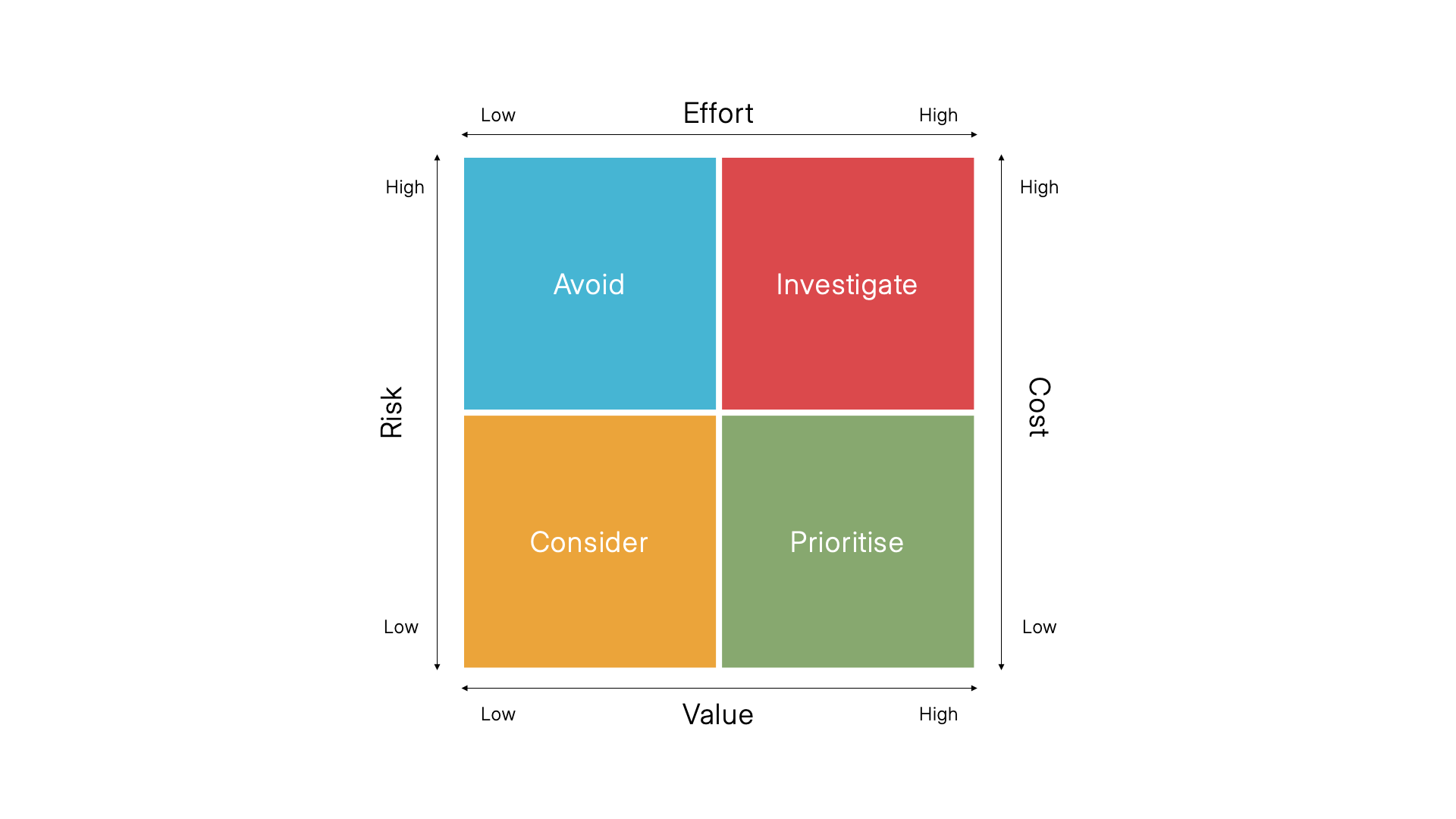
The four decision criteria
The framework starts with four criteria that capture both opportunity and constraint. Risk refers to the potential negative effect of not completing a task. If a missed action creates regulatory exposure, operational disruption, or customer dissatisfaction, its risk score should be higher.
Value captures the potential positive impact created by completing the work. This may include revenue improvement, customer retention, operational efficiency, quality gains, strategic positioning, or capability development. Value ensures that teams do not prioritize only based on fear of loss, but also on the upside of well-chosen action.
Cost refers to the resources required to deliver the work. That may include budget, people, technology, vendor support, or internal coordination. Effort, sometimes expressed in the source material as ease, reflects the degree of difficulty, complexity, and execution burden associated with the task. Together, cost and effort prevent teams from prioritizing attractive ideas without acknowledging the practical demands of delivery.
Why RVCE matters in real organizations
The RVCE matrix matters because most organizations do not choose among neatly comparable options. They choose among dissimilar requests with different sponsors, timelines, and business implications. One initiative may reduce compliance risk, another may support growth, and a third may improve customer experience. Without a shared framework, those decisions become inconsistent and political.
RVCE improves that situation by converting qualitative judgments into numerical scores. This does not make the process perfectly objective, but it does make it more transparent. Instead of saying one project simply “feels more important,” teams can explain that it carries higher downside risk, creates more value, or requires a more favorable cost-effort trade-off.
The framework also supports better conversations across levels of the organization. Executives can understand why certain items rise to the top. Functional teams can see how priorities were established. Stakeholders gain more confidence when trade-offs are visible and not hidden behind vague assertions about urgency.
When to use RVCE prioritization
RVCE is especially valuable when leaders must compare tasks across different projects or business areas. A portfolio manager may need to evaluate a process redesign, a market-facing campaign, a systems upgrade, and a compliance task at the same time. The matrix gives those unlike items a common structure for comparison.
It is also useful for breaking broad goals into actionable next steps. Large ambitions often remain vague because teams do not know where to begin. Scoring the possible work packages against risk, value, cost, and effort helps reduce that ambiguity and creates a more manageable sequence of action.
Another strong use case is stakeholder communication. When executives, boards, or cross-functional teams ask why certain items are prioritized first, RVCE provides a credible answer. Instead of relying on personal authority, leaders can point to the criteria and show how the decision was formed.
How to build the matrix
The first step is to list all tasks, projects, ideas, or initiatives that require prioritization. This stage matters more than it appears. If teams fail to capture the full workload, the matrix will optimize only part of the decision environment. It is often helpful to group items by strategic objective, functional area, or business capability so the scoring process stays manageable.
The second step is to define the criteria clearly. The source article notes that teams can adapt the framework, for example by using effort instead of cost, separating financial cost from resource cost, or replacing ease with time or speed. That flexibility is useful, but it also creates a discipline requirement: each term must be defined in advance so the scores remain comparable across items.
The third step is to score each task on a scale, often from 1 to 5, for every criterion. Teams should avoid over-engineering the process. Scoring works best when definitions are clear, judgments are consistent, and participants are willing to challenge weak assumptions. At this stage, the goal is not false precision, but credible differentiation.
From scores to priority ranking
Once the individual scores are assigned, teams combine them into an overall priority score. In the source article, this is done by multiplying the component scores to arrive at a single rating. The higher the resulting score, the higher the apparent priority.
This step gives the matrix its practical force. It takes several dimensions that are hard to compare in conversation and turns them into one sortable output. That output is not the final decision, but it is an effective starting point for sequencing work.
After the total scores are calculated, initiatives are sorted in descending order. The highest-ranked items are reviewed first for action, resourcing, and timing. If several tasks cluster closely together, managerial judgment still matters. Teams may need to sequence them based on dependencies, capacity constraints, or strategic timing even when the numerical differences are small.
Scoring discipline and practical judgment
Good RVCE output depends on disciplined scoring. A useful practice is to rely most often on anchor scores such as 1, 3, and 5, which create clearer distinctions between low, medium, and high ratings. This reduces false nuance and makes the model easier to apply consistently.
Teams should also accept ties where they are justified. Not every initiative needs to be artificially differentiated if two items genuinely carry similar value or risk. In those cases, the matrix should support rather than distort judgment. Logical sequencing can then be applied after scoring.
Periodic re-scoring is also essential. Priorities change as deadlines move, markets shift, stakeholders intervene, or new risks emerge. A matrix that is not updated will slowly lose credibility. The framework works best when it is treated as a living instrument rather than a one-time workshop exercise.
Strengths of the RVCE approach
One of the main strengths of RVCE is that it introduces structure without requiring elaborate systems. It is simple enough to use in a team workshop, yet robust enough to support portfolio discussions. That balance makes it accessible across management levels.
Another advantage is that it allows comparison across very different kinds of work. Strategic projects, operational improvements, and urgent issue-resolution tasks can all be assessed within the same model. This is particularly useful in organizations where capacity must be allocated across competing functions and time horizons.
The method also improves communication. Because the criteria are explicit, stakeholders can see how priorities were set. It fosters discussion when scoring is done collaboratively and often reveals dependencies, risks, or assumptions that were not visible at the start. In this way, the matrix contributes not only to ranking work, but also to sharpening shared understanding.
Limitations and common failure points
RVCE is not free from subjectivity. Even when scores are numerical, they still depend on human judgment. If people define criteria loosely or score inconsistently, the output will appear rigorous while masking weak assumptions. That is a common failure point.
Some dimensions are also difficult to quantify cleanly. Strategic value, political risk, or execution effort may resist simple scoring, especially early in an initiative. That does not make the framework useless, but it does mean leaders should interpret the output with caution and avoid pretending that the score is more exact than it is.
Another limitation is governance. If leaders manipulate criteria or scores to justify favored projects, the matrix will quickly lose trust. Transparency is therefore essential. Teams should share assumptions, discuss disagreements openly, and explain why particular scores were assigned when major choices depend on them.
RVCE versus other prioritization models
The source article distinguishes RVCE from models such as RICE (Reach, Impact, Confidence, Effort) and ICE (Impact, Confidence, Ease) by emphasizing the role of risk. That distinction matters. Many prioritization tools focus primarily on opportunity, while RVCE explicitly recognizes the cost of inaction.
This makes RVCE useful in environments where dependencies, regulatory obligations, customer commitments, or operational exposures are material. A task may not produce the largest upside, yet still deserve priority because failing to act creates unacceptable downside. The risk criterion surfaces that dynamic in a way some other models do not.
At the same time, RVCE should not be treated as universally superior. It is one tool among several. Its value depends on the business context and the nature of the portfolio being assessed. In many cases, its strength lies precisely in its practicality: it is straightforward enough to use consistently and flexible enough to adapt.
How teams should govern the matrix
In most organizations, the initial matrix is built by managers, team leads, or program owners because they have the clearest vantage point on the work. But the source article rightly notes that the broader team should be involved before priorities are finalized. That wider participation improves scoring quality and increases commitment to the final ranking.
Quarterly review is a sensible minimum governance cadence. Formal refreshes create a checkpoint for re-scoring major workstreams, reviewing assumptions, and introducing new tasks. But teams should also update the matrix in real time when urgent issues emerge or when key initiatives are deferred.
The matrix should be visible enough to be challenged. When stakeholders can see the criteria and the resulting ranking, the process becomes harder to manipulate and easier to trust. That transparency is what allows RVCE to become a practical management tool rather than just another prioritization template.
Applying RVCE in practice
Consider a team facing several simultaneous priorities: a system upgrade, a customer retention initiative, a compliance remediation task, and a product enhancement. Without a framework, the team may focus on whichever item has the loudest advocate. With RVCE, each initiative is scored across downside risk, expected value, resource cost, and delivery effort.
That exercise often changes the conversation. The customer initiative may look attractive from a growth standpoint, but the compliance remediation may rank higher because the downside of delay is severe. The product enhancement may promise value, but its cost and effort may make it a lower short-term priority. The system upgrade may emerge as a prerequisite for several downstream items, which lifts its importance.
That is the real contribution of the matrix. It does not remove complexity. It makes complexity discussable. And when complexity becomes discussable, prioritization becomes more disciplined, defensible, and aligned to business reality.
The Risk-Value-Cost-Effort Prioritization Matrix is effective because it translates competing demands into a structured set of trade-offs. Instead of asking only what feels urgent, teams ask what carries the highest downside if ignored, what creates the most value if completed, what it will cost to execute, and how difficult it will be to deliver. Those questions improve the quality of prioritization because they shift the discussion from opinion to explicit criteria. Its real strength is not mathematical precision. It is managerial clarity. The matrix helps teams compare unlike tasks, surface hidden dependencies, and communicate priorities in a way that stakeholders can follow. It also creates a more productive conversation when people disagree, because the disagreement becomes about scores and assumptions rather than personalities or politics. Used well, RVCE does not replace executive judgment, sequencing logic, or strategic context. It sharpens them. Leaders still need to revisit scores as conditions change, challenge distorted assumptions, and adjust priorities when new risks emerge. But with RVCE in place, those changes happen within a disciplined framework. That is what makes the method valuable in real organizations where competing priorities never disappear, but better decisions can still be made.
Citation
Cite this article
Sridharan, M. A. (2026, July 13). RVCE Prioritization. Think Insights. https://thinkinsights.net/consulting/rvce-prioritization (Accessed [[ACCESS_DATE]])
Sridharan, Mithun A. "RVCE Prioritization." Think Insights, 13 July 2026, https://thinkinsights.net/consulting/rvce-prioritization. Accessed [[ACCESS_DATE]].
Mithun A. Sridharan, "RVCE Prioritization," Think Insights, July 13, 2026, https://thinkinsights.net/consulting/rvce-prioritization. Accessed [[ACCESS_DATE]].
Sridharan, M.A. (2026) 'RVCE Prioritization', Think Insights. Available at: https://thinkinsights.net/consulting/rvce-prioritization (Accessed: [[ACCESS_DATE]]).
M. A. Sridharan, "RVCE Prioritization," Think Insights, 2026. [Online]. Available: https://thinkinsights.net/consulting/rvce-prioritization. [Accessed: [[ACCESS_DATE]]].
Sridharan MA. RVCE Prioritization. Think Insights. Published July 13, 2026. Accessed [[ACCESS_DATE]]. https://thinkinsights.net/consulting/rvce-prioritization
Test Your Knowledge
RVCE Prioritization
Challenge yourself on the concepts from this article and see how well you understood them.
Subscribers get weekly quizzes and insights — subscribe free
Sponsor this article
Partner with Think Insights
Reach 50,000+ business leaders, consultants, and strategists. Feature your brand alongside expert articles on strategy, leadership, and digital transformation.
Become a Sponsor