Pareto Principle


The Pareto Principle, or 80/20 Rule, helps identify the small fraction of actions that produce the majority of outcomes. Originally observed by economist Vilfredo Pareto, it is widely applied in business, consulting, and project management to prioritize effort effectively.
Who originated the Pareto Principle?
Vilfredo Pareto (1848–1923), an Italian economist and sociologist, observed that 80% of Italy's land was owned by 20% of the population. He found similar distributions in other countries and published mathematical formulas describing these patterns.
What does the 80/20 Rule mean in practice?
It suggests that roughly 20% of your actions or inputs generate approximately 80% of your results or outputs. It is a guide for prioritization, not a precise law.
How is the Pareto Principle used in consulting?
Consultants use it to identify where limited time can produce the highest positive impact, focusing efforts on the problems or solutions most likely to yield significant results.
Does the Pareto Principle mean you should ignore the other 80%?
No. While the principle helps prioritize, neglecting the remaining 80% of tasks or team members can lead to gaps. It is a framework for focus, not a reason to disregard details.
How does the Pareto Principle apply to project management?
Project managers recognize that roughly 20% of work—often the first and last 10% of a project—consumes 80% of time and resources, helping them plan and allocate effort accordingly.
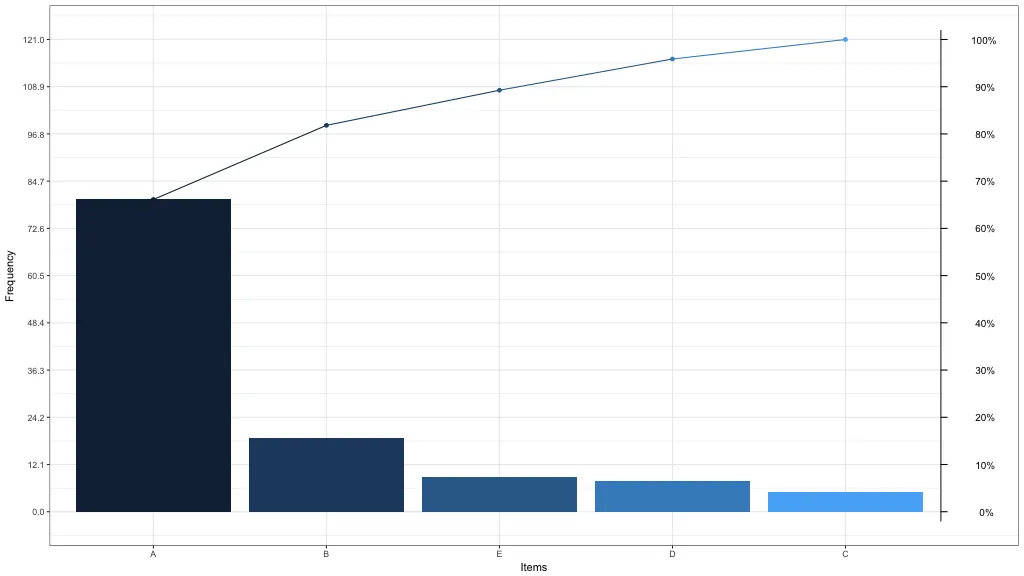
Pareto Principle states that roughly 20% of actions produce 80% of results, or 80% of effects come from 20% of causes. This is one of the most useful principles for finding the most important things to focus on. Identifying the 20% of your efforts that have the biggest impacts is a fundamental step in maximising your efficiency.
Historical context
Italian Economist and Sociologist Vilfredo Pareto (1848-1923) observed that 80% of the land in Italy was owned by 20% of the population. While investigating other countries he found the same unequal distribution of income and wealth in each. Pareto published his observations and mathematical formulas that described his findings1. After publication, researchers in other areas of science and business began to find the same unequal distribution in their fields.
Vital few, trivial many
In the late 1940s, business thinker, Joseph M. Juran described what he called the vital few and trivial many, attributing the concept to Pareto's findings2. Thus, Pareto's Principle became the name of one of the most significant of universal principles. The Pareto Principle highlights a common approach for consultants: focus on solving a problem where you can produce the highest positive impact with the lowest amount of effort because consultants usually have very limited time to work on a problem. Likewise, Project Managers know that 20% of the work consume 80% of your time and resources; these are usually the 1st and last 10% of the overall project scope.
Applications in business
You should not focus on just the 20% of top performers on your team at the expense of the other 80%. While 20% of the time invested in a project might generate the majority of the results, you cannot afford to ignore the details of the initiative. Pareto's Principle or the 80/20 Rule is a useful construct when analyzing our efforts and outcomes. It is priceless when applied to task or goal lists. This principle also provides a useful framework to tackle many problem situations. Use it liberally, but don't accept it as an absolute or you are likely to misstep.
The Pareto Principle, commonly known as the 80/20 rule, is a concept that suggests roughly 80% of effects come from 20% of causes. Named after Italian economist Vilfredo Pareto, who observed in 1906 that 80% of Italy's wealth was owned by 20% of its population, this principle has found applications across various fields. It's widely used in business, economics, and personal productivity to identify the most impactful factors in any situation. For instance, it might indicate that 80% of a company's profits come from 20% of its customers, or that 80% of productivity results from 20% of work tasks. While not a strict mathematical law, the Pareto Principle serves as a valuable tool for prioritization, helping individuals and organizations focus their efforts on the vital few factors that produce the majority of results, potentially leading to increased efficiency and productivity.
- 1V. Pareto, Cours d'Economie Politique. Droz, Geneva, 1896.
- 2Quality Control Handbook, New York, New York: McGraw-Hill, 1951, OCLC 1220529
Citation
Cite this article
Sridharan, M. A. (2018, August 23). Pareto Principle. Think Insights. https://thinkinsights.net/consulting/pareto-principle (Accessed [[ACCESS_DATE]])
Sridharan, Mithun A. "Pareto Principle." Think Insights, 23 Aug. 2018, https://thinkinsights.net/consulting/pareto-principle. Accessed [[ACCESS_DATE]].
Mithun A. Sridharan, "Pareto Principle," Think Insights, August 23, 2018, https://thinkinsights.net/consulting/pareto-principle. Accessed [[ACCESS_DATE]].
Sridharan, M.A. (2018) 'Pareto Principle', Think Insights. Available at: https://thinkinsights.net/consulting/pareto-principle (Accessed: [[ACCESS_DATE]]).
M. A. Sridharan, "Pareto Principle," Think Insights, 2018. [Online]. Available: https://thinkinsights.net/consulting/pareto-principle. [Accessed: [[ACCESS_DATE]]].
Sridharan MA. Pareto Principle. Think Insights. Published August 23, 2018. Accessed [[ACCESS_DATE]]. https://thinkinsights.net/consulting/pareto-principle
Test Your Knowledge
Pareto Principle
Challenge yourself on the concepts from this article and see how well you understood them.
Subscribers get weekly quizzes and insights — subscribe free
Sponsor this article
Partner with Think Insights
Reach 50,000+ business leaders, consultants, and strategists. Feature your brand alongside expert articles on strategy, leadership, and digital transformation.
Become a Sponsor