MoSCoW Principle


The MoSCoW Principle is a prioritization technique widely used in project management, business analysis, and software development to categorize and prioritize requirements, features, or tasks. Developed by Dai Clegg in 1994 while working at Oracle, this method helps teams and stakeholders reach a common understanding of the importance of different elements within a project.
What does MoSCoW stand for?
MoSCoW stands for Must have, Should have, Could have, and Won't have. The lowercase letters are fillers added to make the acronym pronounceable.
Who created the MoSCoW principle?
Dai Clegg developed the MoSCoW method at Oracle in the 1990s. It has since become widely adopted in software development and project management.
How does MoSCoW differ from a contract-based project approach?
In a contract-based project, every requirement is treated as a Must have with no prioritization. MoSCoW introduces structured prioritization to focus on delivering business value rather than fulfilling a fixed list.
How should resources be allocated across MoSCoW categories?
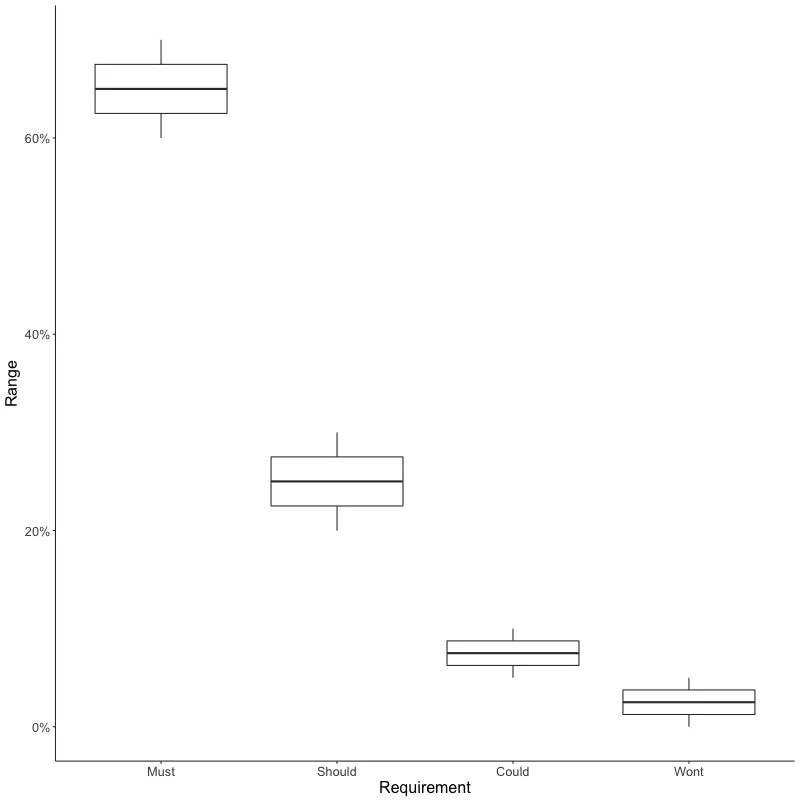
A common approach is to allocate roughly 60% of resources to Must haves, 30% to Should haves, and 10% to Could haves, leaving Won't haves out of the current scope.
What makes categorizing requirements difficult in practice?
Assigning features to categories requires comparing their relative business value, which can be politically sensitive. Stakeholders often view their own requirements as critical, making consensus-building a challenging but essential step.
The principle
The MoSCoW principle is a clever acronym that can help manage project scope and customer's expectations. It stands for features that you
- Must have
- Should have
- Could have, and
- Will not have (would be nice, but don't count on it)
The MoSCoW principle is the difference between a project focused on fulfilling a contract and a project focused on delivering business value. In a contract-based project every requirement is a Must-have. There is no prioritization, no compromise. You might as well figure out the order in which you will tackle the contract's objectives, build out your WBS and your Gantt chart, and get to it. A business value oriented project is driven by the MoSCoW principle. The features and requirements of such a project follow the following distribution.
Understanding the Principle
The MoSCoW principle is an acronym that stands for Must have, Should have, Could have, and Won't have. Developed by Dai Clegg at Oracle in the 1990s, this method has become a staple in various industries, particularly in software development and project management.
Breaking Down the Categories
Must Have
These are non-negotiable, critical requirements that are essential for the project's success. Without these elements, the project would fail or lose its core value.
Should Have
These are important but not critical requirements. They add significant value but can be delayed if necessary without jeopardizing the project's core functionality.
Could Have
These are desirable features that would enhance the project but are not essential. They can be included if time and resources permit.
Won't Have (this time)
These are features or requirements that are explicitly excluded from the current project scope. They might be considered for future phases or iterations.
You have to work with the client to figure out what they want to get done, and what will either become part of the next phase of the project, or not be done at all. Figuring it all out and setting these priorities is not a simple task; this exercise could be very painful and even politically charged, but extremely crucial. What could help in the process is to assign business value 1 to each feature. By itself, every feature is important and carries a high business value. The true value of a particular feature can only be understood in comparison. When you look at what is essential for your project to generate revenue, deciding between the must-haves and the could-haves becomes a little bit easier.
Example
You are planning to buy a white color car 4 –door with diesel which can hold maximum of 5 passenger to travel with family. You also like to have automatic functions in the car like auto-lock system, power windows, automatic seat belt, sun roof system, rear view camera, GPS and so on. Must have: car for 5 passengers, 4 door car Should have: Diesel car, white color Could have: auto-lock system, windshield Won't have: Extra features like sun roof system, rear view camera, GPS, power windows and so on.
MoSCoW approach enables to keep focused on the needs of the stakeholders in the project and deliver them at the target time.
Implementing the MoSCoW Principle
To effectively implement the MoSCoW principle, follow these steps:
Identify Stakeholders and Objectives
Begin by clearly defining the project's goals and identifying all relevant stakeholders. Understanding the overall purpose and who will benefit from the project is crucial.
Gather Requirements
Conduct thorough requirement analysis through interviews, workshops, and stakeholder engagement to capture all necessary requirements.
Categorize Requirements
Using the MoSCoW categories, classify each requirement. Ensure that each item is clearly defined and categorized based on its necessity and impact on project goals.
Review and Validate
Collaborate with stakeholders to review and validate the categorizations. Aim for consensus on prioritization to avoid conflicts later in the project.
Allocate Resources
Decide on the percentage of resources to allocate to each category. For example, you might assign 60% to Must-haves, 30% to Should-haves, and 10% to Could-haves.
Implement and Monitor
Execute the prioritized tasks and continuously monitor progress, making adjustments as needed throughout the project lifecycle.
This approach allows for a clear and structured way to organize project components based on their criticality and value. By using the MoSCoW Principle, teams can effectively manage scope, set realistic expectations, and focus on delivering the most essential features within given time and resource constraints. This method is particularly valuable in agile environments, where prioritization is crucial for delivering maximum value in each iteration or release.
- 1Mind Set!: Eleven Ways to Change the Way You See-and Create-the Future
Citation
Cite this article
Sridharan, M. A. (2018, April 23). MoSCoW Principle. Think Insights. https://thinkinsights.net/strategy/moscow-principle (Accessed [[ACCESS_DATE]])
Sridharan, Mithun A. "MoSCoW Principle." Think Insights, 23 Apr. 2018, https://thinkinsights.net/strategy/moscow-principle. Accessed [[ACCESS_DATE]].
Mithun A. Sridharan, "MoSCoW Principle," Think Insights, April 23, 2018, https://thinkinsights.net/strategy/moscow-principle. Accessed [[ACCESS_DATE]].
Sridharan, M.A. (2018) 'MoSCoW Principle', Think Insights. Available at: https://thinkinsights.net/strategy/moscow-principle (Accessed: [[ACCESS_DATE]]).
M. A. Sridharan, "MoSCoW Principle," Think Insights, 2018. [Online]. Available: https://thinkinsights.net/strategy/moscow-principle. [Accessed: [[ACCESS_DATE]]].
Sridharan MA. MoSCoW Principle. Think Insights. Published April 23, 2018. Accessed [[ACCESS_DATE]]. https://thinkinsights.net/strategy/moscow-principle
Test Your Knowledge
MoSCoW Principle
Challenge yourself on the concepts from this article and see how well you understood them.
Subscribers get weekly quizzes and insights — subscribe free
Sponsor this article
Partner with Think Insights
Reach 50,000+ business leaders, consultants, and strategists. Feature your brand alongside expert articles on strategy, leadership, and digital transformation.
Become a Sponsor