Business Plan


A business plan is a comprehensive document that outlines a company's goals, strategies, and operational details. It serves as a roadmap for entrepreneurs and established businesses alike, providing a clear vision of the company's future and the steps needed to achieve its objectives.
What is the recommended length for a business plan?
Business plans should be short and concise. A lengthy document of 50 to 100 pages is unlikely to be read and will often be set aside.
What skills are needed to write a good business plan?
Key skills include strategy analysis, market sizing, financial analysis, and valuation. Familiarity with tools like Microsoft Word, PowerPoint, and Excel is also important.
What is a Concept Paper in business planning?
A Concept Paper is a simple, one-page document used as a starting point before developing a more detailed plan covering all functional areas.
How should language be used in a business plan?
Use simple, direct language that your audience can understand. Avoid jargon and reserve technical details for the appendix if necessary.
Do you need to cover all functional areas in an initial business plan?
No. It is generally easier to begin with a simple one-page concept document and add detail progressively as the plan develops.
Developing a good business plan is among the core skills a good consultant should possess. A good business plan draws upon various skills, from strategy analysis and market sizing through financial analysis and valuation. No one is going to be an expert in all of these fields. However, a consultant will do well to enter this process with a working understanding of the fundamental areas. If you are completely new to this topic, start reading about strategy and the fundamentals of finance and accounting. Make sure you have working knowledge of an office programs, such as Microsoft Word, PowerPoint, and Excel.
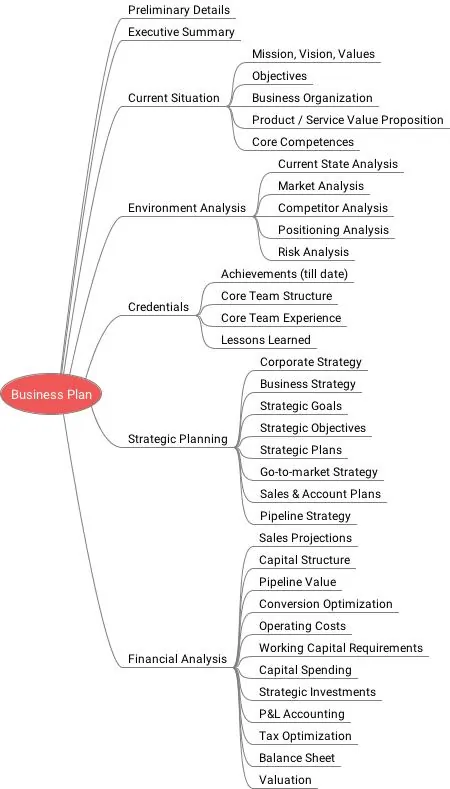
There are many excellent books focused on this topic 1, 2, 3. However, there are a couple of rules for writing a plan that actually gets read.
- Keep it short: Business plans should be short and concise. First, you want your collaterals to be read. Nobody would bother to read a 50 or 100 page document. An excessively long document is a hassle and will be shelved, never to be seen again.
- Know your audience: Write your business plan using a simple language. This ensures that your audience will understand your perspective. Keep explanations about your products or services simple and direct, Use terms that everyone understands. If required, use the appendix to provide more specific details.
Usually, you don't have to start with a detailed plan that covers all functional areas. It is much easier to start with a simple, one-page document — what I call a Concept Paper — and then delve into details at a later stage.
A well-crafted business plan not only demonstrates the viability of a business idea but also showcases the entrepreneur's understanding of the market, competition, and financial aspects of running a successful enterprise. Whether used for startup ventures or to steer existing companies towards growth, a business plan is an essential tool for strategic planning and communication with stakeholders.
Citation
Cite this article
Sridharan, M. A. (2018, June 30). Business Plan. Think Insights. https://thinkinsights.net/strategy/business-plan (Accessed [[ACCESS_DATE]])
Sridharan, Mithun A. "Business Plan." Think Insights, 30 June 2018, https://thinkinsights.net/strategy/business-plan. Accessed [[ACCESS_DATE]].
Mithun A. Sridharan, "Business Plan," Think Insights, June 30, 2018, https://thinkinsights.net/strategy/business-plan. Accessed [[ACCESS_DATE]].
Sridharan, M.A. (2018) 'Business Plan', Think Insights. Available at: https://thinkinsights.net/strategy/business-plan (Accessed: [[ACCESS_DATE]]).
M. A. Sridharan, "Business Plan," Think Insights, 2018. [Online]. Available: https://thinkinsights.net/strategy/business-plan. [Accessed: [[ACCESS_DATE]]].
Sridharan MA. Business Plan. Think Insights. Published June 30, 2018. Accessed [[ACCESS_DATE]]. https://thinkinsights.net/strategy/business-plan
Test Your Knowledge
Business Plan
Challenge yourself on the concepts from this article and see how well you understood them.
Subscribers get weekly quizzes and insights — subscribe free
Sponsor this article
Partner with Think Insights
Reach 50,000+ business leaders, consultants, and strategists. Feature your brand alongside expert articles on strategy, leadership, and digital transformation.
Become a Sponsor