Subscription Business Model


A subscription business model charges customers a recurring fee for ongoing access to a product or service, replacing the one-time sale with a continuing relationship. Adobe made this shift explicit in 2013, retiring boxed Creative Suite software in favor of Creative Cloud, and the change turned a hardware-cycle business into one of the most closely watched recurring-revenue franchises in technology. The model appeals to executives because it converts unpredictable sales into a plannable stream of cash, and it appeals to customers because it lowers the cost of entry. But the same mechanics that reward retention punish neglect: a subscriber who feels no ongoing value cancels within a billing cycle. This article breaks down how the model creates value, what its revenue mechanics look like in practice and why some subscription businesses scale while others stall.
What makes a subscription model different from a one-time sale?
A subscription model charges customers repeatedly for continued access instead of collecting the full price once, which shifts a company's focus from closing a transaction to sustaining a relationship. Revenue arrives in smaller increments spread over the life of the account rather than in a single upfront payment. The company only keeps that revenue if it keeps delivering value, so retention becomes as important as acquisition.
Why do so many software and streaming companies use subscriptions?
Software and streaming both carry high fixed costs to build the product and low marginal cost to serve an additional user, which makes recurring fees an efficient way to spread investment across a growing base. Subscriptions also let these companies release continuous updates instead of waiting for a new version to justify a new purchase. That steady cadence keeps the product current and gives the company a reason to keep charging.
What is the biggest risk in a subscription business model?
Churn is the biggest risk, because a subscription company's future revenue depends on customers renewing rather than a sale that is already complete. High customer acquisition cost combined with early cancellations can leave a business recovering its investment slower than it replaces departing subscribers. Companies manage this risk by tracking retention curves closely and investing in the parts of the product that keep customers engaged after the first month.
What the subscription model actually changes
A subscription business model charges a customer a recurring fee, usually monthly or annual, in exchange for ongoing access to a product or service rather than a single, complete transaction. The purchase decision moves from a single moment at checkout to a repeated decision every billing cycle, and that shift changes what a company has to manage. A retailer selling a one-time product finishes its job once the sale closes; a subscription company's job starts there. It has to keep proving the offer is worth the next payment, which means the relationship, not the transaction, becomes the asset the business protects.
This reframing touches every function inside the company. Marketing still has to bring in new customers, but product and support teams now carry equal weight because they determine whether those customers stay. Finance has to model revenue as a stream that compounds or erodes over many months instead of a single closed deal. Because subscribers can leave at any renewal point, a subscription company learns earlier than most whether its product is working, and it can adjust faster than a company that only hears from customers at the point of a repeat purchase.
Why customer acquisition cost and churn decide the outcome
Two numbers determine whether a subscription business is healthy: how much it costs to win a customer and how long that customer stays. Customer acquisition cost [CAC] covers the marketing, sales and onboarding spent to convert a prospect into a paying subscriber, and because subscription fees are usually kept low to avoid becoming a burden, a company often needs several months of payments just to recover that initial cost. Churn, the rate at which subscribers cancel, determines whether the company ever gets the chance to earn a profit on that customer once CAC is recovered.
Harvard Business Review has examined why some companies thrive on subscription pricing while others struggle to justify it, tying success to whether continued use creates continued value for the customer.1 A company that treats the free trial or entry tier only as a funnel, without investing in the experience that follows, sees subscribers cancel before CAC is recovered. A company that invests in onboarding, support and steady product improvement gives the subscriber a reason to renew, which lowers churn and extends the window in which the business earns back its acquisition spend and then profits from it.
Mapping the nine building blocks of the canvas
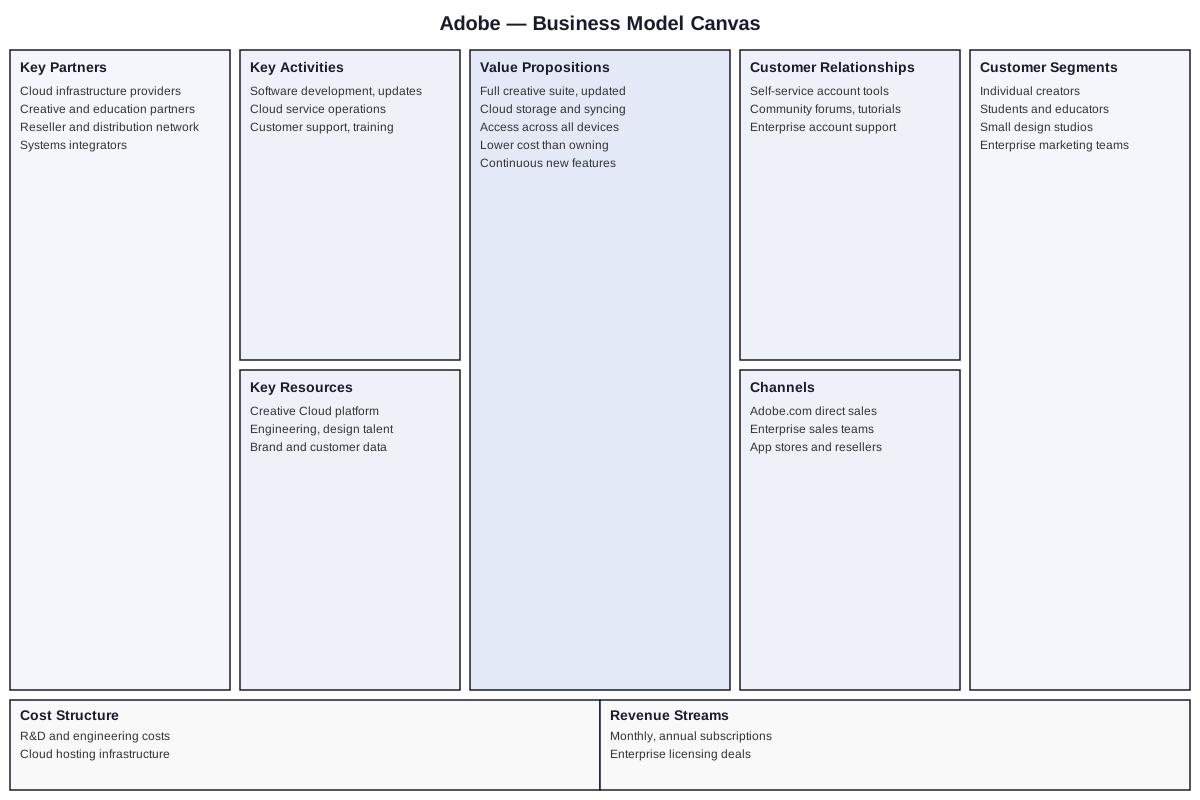
A subscription business model canvas breaks the company into nine linked parts, and mapping them clarifies where the recurring-revenue logic actually lives. Customer segments define who the company serves, whether individual consumers, small businesses or large enterprise accounts, because a plan built for one rarely transfers cleanly to another. The value proposition explains why continued access is worth continued payment, through convenience, cost savings against ownership, exclusive content or updates the customer could not get from a one-time purchase.
Channels and customer relationships describe how the company reaches subscribers and keeps them engaged, ranging from self-service accounts to dedicated support for higher-paying tiers. Revenue streams capture how the company charges, whether a flat fee, tiered plans or a free tier that funds itself through a smaller paying share. Key resources, key activities and key partners describe what the company needs to keep the product running and improving, from engineering talent and content licenses to the cloud infrastructure and distribution partners it depends on. Cost structure ties it together by showing where the money goes, typically product development, customer acquisition and the infrastructure needed to serve subscribers at scale.
McKinsey research groups most subscription offerings into three categories, curation, replenishment and access, and finds that companies using subscription models can generate two to five times the customer lifetime value of those that do not.2 That multiplier is the reason so many industries beyond software have tried to graft a subscription layer onto an existing product.
Common subscription formats across industries
Streaming services popularized the model for consumers by offering an entire content catalog for one recurring fee instead of paying per title. Subscription boxes and curated kits apply the same logic to physical goods, delivering food, wine or clothing on a schedule the customer does not have to manage themselves. Software vendors, the segment commonly called software as a service [SaaS], adopted subscriptions to fund continuous updates instead of selling a version that eventually goes stale. Usage-based subscriptions, common in cloud computing and car-sharing, charge customers according to consumption rather than a flat fee, which suits businesses whose usage swings widely from month to month.
The freemium variant lets customers use a limited version at no cost and charges for advanced features, and Spotify remains one of its clearest examples. In its fourth quarter of 2025, Spotify reported 290 million premium subscribers out of 751 million monthly active users [MAU], meaning a large share of its free listeners eventually convert to a paid tier.3 Zuora's 2025 Subscription Economy Index found that companies running subscription models grew unique subscribers by 25% over two years and outpaced broader market revenue growth by 11 percentage points, evidence that the format keeps expanding well beyond media and software.4
Adobe's shift from packaged software to recurring revenue
Adobe offers one of the clearest illustrations of a company rebuilding itself around subscriptions. In 2013, it stopped selling Creative Suite as a boxed, one-time purchase and moved its design and publishing tools into Creative Cloud, a subscription that gives customers ongoing access to the full application suite along with cloud storage and continuous updates. The change was disruptive at launch, since customers who had grown used to owning a version outright now had to pay indefinitely to keep using the software, but it aligned Adobe's revenue with how customers actually used the product over time.
The shift changed Adobe's financial profile. In its fiscal 2023 earnings, Adobe reported Digital Media segment revenue, the business built primarily on Creative Cloud, of $14.22 billion, up 11% year over year, compared with roughly $3 billion when the segment still relied on packaged software a decade earlier.5 Subscriptions also gave Adobe a direct, continuous view of how customers used its tools, feedback it could not collect from a customer who bought a disc once and never contacted the company again. That data now feeds directly into which features Adobe builds next, closing a loop that a one-time software sale never offered.
Benefits and trade-offs for companies and customers
For companies, the model's core advantage is predictability. Recurring fees smooth out the revenue swings that come with one-time sales, which makes it easier to forecast earnings, plan hiring and commit to longer-term investments. The same recurring relationship generates a steady flow of usage data that companies can use to personalize offers, reduce churn and identify which features actually keep customers engaged. Because serving an existing subscriber usually costs far less than acquiring a new one, subscription businesses can also scale without operating costs rising at the same pace as revenue, particularly in digital products where the marginal cost of an additional user is low.
Customers benefit too, mainly through lower upfront cost and continued access to a product that keeps improving. Spreading a large purchase into smaller recurring payments makes premium software, content or services affordable to a wider range of buyers who could not justify the full price at once. The trade-off runs in both directions. Companies take on the burden of continuously earning renewal, and customers take on an open-ended payment obligation that only makes sense if the product keeps delivering value worth the price.
Building a durable subscription strategy
Pricing is the lever that determines whether a subscription business converts its customer base into durable profit. Gartner's research on tiered, value-based pricing recommends aligning each pricing tier with a distinct customer segment's willingness to pay, rather than offering a single plan that either overcharges light users or undercharges heavy ones.6 A company that gets this structure right can upsell existing subscribers into higher tiers as their needs grow, generating revenue from the base it already has instead of relying solely on new acquisition.
Retention deserves the same rigor as acquisition in any subscription strategy. Tracking churn by cohort, measuring how long it takes to recover CAC and investing in onboarding and support all compound over time, because a subscriber retained for an additional year adds far more to lifetime value than one acquired at a lower cost but churned early. Companies that treat pricing, product updates and retention as one connected system, rather than separate initiatives run by separate teams, are the ones that turn the subscription model from a billing mechanism into a genuine source of competitive advantage.
- 1Is A Subscription Model Right For Your Business
- 2Sign Up Now: Creating Consumer And Business Value With Subscriptions
- 3Spotify Reports Fourth Quarter 2025 Earnings
- 4The 2025 Subscription Economy Index
- 5Adobe Reports Record Q4 And Fiscal 2023 Revenue
- 63 Steps To Enable Growth With A Tiered Value-Based Pricing Model
The subscription business model rewards companies that treat the sale as the beginning of the relationship rather than its conclusion. Adobe's transition from packaged software to Creative Cloud shows how a shift in pricing architecture can reshape revenue durability, customer insight and product velocity all at once. Spotify's freemium funnel shows a different discipline: converting free users into payers without alienating either group. Neither result happens by accident. It happens because the company measures churn, customer acquisition cost and lifetime value with the same rigor a manufacturer applies to unit economics. Executives evaluating a shift toward subscriptions should treat pricing, retention and product update cadence as one integrated system, not three separate initiatives, because a subscriber judges the whole experience every time a payment clears.
Citation
Cite this article
Sridharan, M. A. (2023, September 21). Subscription Business Model. Think Insights. https://thinkinsights.net/strategy/subscription-business-model (Accessed [[ACCESS_DATE]])
Sridharan, Mithun A. "Subscription Business Model." Think Insights, 21 Sep. 2023, https://thinkinsights.net/strategy/subscription-business-model. Accessed [[ACCESS_DATE]].
Mithun A. Sridharan, "Subscription Business Model," Think Insights, September 21, 2023, https://thinkinsights.net/strategy/subscription-business-model. Accessed [[ACCESS_DATE]].
Sridharan, M.A. (2023) 'Subscription Business Model', Think Insights. Available at: https://thinkinsights.net/strategy/subscription-business-model (Accessed: [[ACCESS_DATE]]).
M. A. Sridharan, "Subscription Business Model," Think Insights, 2023. [Online]. Available: https://thinkinsights.net/strategy/subscription-business-model. [Accessed: [[ACCESS_DATE]]].
Sridharan MA. Subscription Business Model. Think Insights. Published September 21, 2023. Accessed [[ACCESS_DATE]]. https://thinkinsights.net/strategy/subscription-business-model
Test Your Knowledge
Subscription Business Model
Challenge yourself on the concepts from this article and see how well you understood them.
Subscribers get weekly quizzes and insights — subscribe free
Sponsor this article
Partner with Think Insights
Reach 50,000+ business leaders, consultants, and strategists. Feature your brand alongside expert articles on strategy, leadership, and digital transformation.
Become a Sponsor