Square Business Model


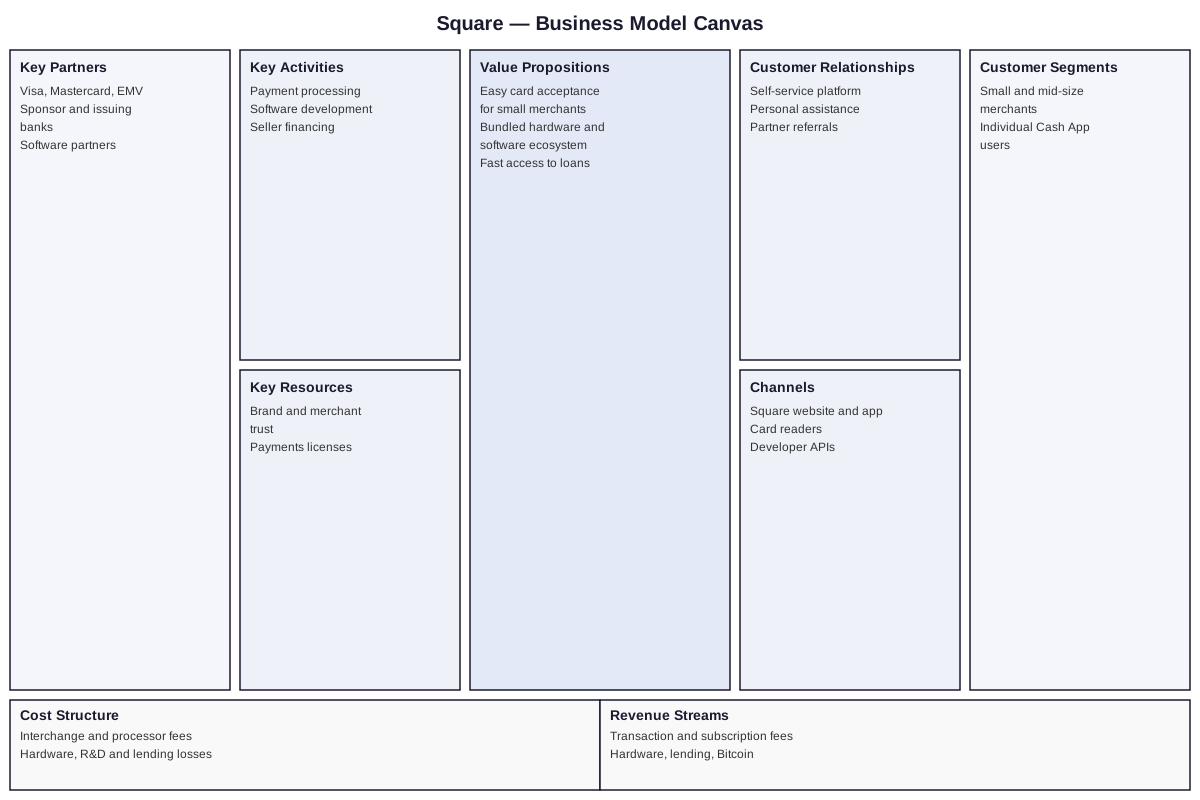
Square built a payments business by giving away money on hardware and making it back on every swipe that followed. Block, Inc, the parent company formerly named Square, now runs three connected units: the Square seller ecosystem, the Cash App consumer wallet and a Bitcoin-focused business. Processing fees on card swipes fund a growing menu of subscription software, lending and banking products that keep merchants inside the ecosystem long after they buy a card reader. Cash App extends the same pattern to individual consumers, while the Bitcoin business ties Block's results to a volatile asset that founder Jack Dorsey has championed publicly. Understanding how these pieces reinforce each other explains why Block trades a merchant's first card swipe for years of recurring revenue instead of a one-time hardware profit.
How does Square make money beyond swipe fees?
Square earns a percentage plus a flat fee on every card transaction, but it layers subscription software, payroll tools, lending and banking products on top of that base. Sellers who adopt more of these tools tend to spend more with Square overall, which explains why the company keeps expanding its product list instead of relying on transaction volume alone.
Why does Square sell card readers below cost?
Square treats hardware as an entry point rather than a profit center. Pricing terminals near or below production cost lowers the barrier for small merchants to join the platform, and Square recovers the difference through the processing fees and subscriptions that follow every transaction.
What role does Bitcoin play in Block's strategy?
Block holds Bitcoin on its balance sheet and builds products, including Cash App's trading feature, around the asset. Jack Dorsey has described the position as central to the company's long-term direction, though it also exposes Block's earnings to cryptocurrency price swings that a standalone payments business would not face.
From card reader to financial ecosystem
Jack Dorsey and Jim McKelvey founded Square in 2009. McKelvey had lost a sale because his glass-blowing studio could not accept credit cards, and the problem stuck with him. The pair built a small white card reader that plugged into a smartphone's headphone jack. They launched it in 2010, giving small merchants a way to accept card payments without a bank merchant account or an expensive terminal. That single product solved a real problem for hairstylists, food truck owners and market vendors that banks had largely ignored. Growth followed quickly. The company expanded into point-of-sale [POS] software, payroll, inventory management and small-business lending within a few years of launch. Square completed its initial public offering [IPO] in 2015 and began trading on the New York Stock Exchange [NYSE]. In December 2021, the company changed its corporate name to Block, Inc. Square kept its own name as the seller-facing business, while Cash App, Afterpay and the Bitcoin unit operated as separate brands under the same parent1. In January 2025, Block also swapped its stock ticker from SQ to XYZ. The change was meant to reflect the wider ecosystem of brands rather than the seller business alone2. The rebrand mirrored a broader ambition. Dorsey wanted a holding-company structure that let each unit grow on its own, while sharing Block's balance sheet, engineering talent and financial infrastructure.
Three engines of revenue
Block now organizes its business around three units. Square serves merchants, Cash App serves individual consumers, and a Bitcoin unit runs the company's cryptocurrency holdings and related products. These three units combined produced $10.4 billion in gross profit in 2025, according to the company's own financial disclosures. Square alone processed $250 billion in gross payment volume [GPV] across 5.9 billion transactions, drawing on more than 4.5 million sellers3. Cash App reached 59 million monthly transacting users in the same period and processed $316 billion in inflows. That scale shows the consumer side of the business now rivals the seller side. Block's fourth-quarter 2025 results showed gross profit growth accelerating to 24% year over year. The company attributed the pace to Square and Cash App gaining share at the same time4. Each unit earns money differently. Square collects a percentage of every transaction plus a flat fee, then adds subscription revenue from software and interest income from lending products. Cash App earns fees on instant transfers, business accounts and Bitcoin trades, alongside interchange revenue from its debit card. The Bitcoin unit contributes gains from Block's own cryptocurrency holdings, plus hardware and software sold to Bitcoin miners.
The hardware loss leader
Square's original card reader set a pattern the company still follows. Hardware earns little profit on its own, but every device sold opens a channel for higher-margin services later. Practitioners sometimes call this a razor-and-blade approach:
the durable product is priced to encourage adoption, and the recurring service carries the margin
Square still prices its card readers and its newer Handheld terminal near production cost. It earns money instead on every transaction that passes through the device, currently 2.6% plus 10 cents for a standard contactless swipe and a higher rate for manually keyed-in transactions. Layered on top of transaction fees, Square sells subscription software for appointments, payroll, loyalty programs and point-of-sale management. It also offers merchant cash advances [MCAs], giving small businesses upfront capital in exchange for a fixed share of future card sales. In October 2025, Square consolidated its collection of add-on products into three unified subscription tiers: Free, Plus and Premium. The move simplified the software side of the business for merchants weighing which tools to adopt. The subscription and lending layer has grown into a meaningful share of total revenue. It gives Square a recurring income stream that does not depend on selling a new device to every customer.
Cash App and the consumer side
Cash App started as a simple peer-to-peer payment tool. It has since grown into a broader financial account for individual users. People can receive direct deposits, buy stocks and Bitcoin, carry a debit card tied to their balance, and borrow small amounts through Cash App Borrow. Block folded Afterpay, the buy-now-pay-later service it acquired in 2022, into Cash App's checkout flow. That move extended short-term credit to the point of sale, not just inside the wallet. Consumer lending origination volume on Cash App reached $18.5 billion in the fourth quarter of 2025, up 69% year over year5. The company credited the jump to Cash App Borrow's growth and rising use of Afterpay at checkout. Cash App generates revenue from instant transfer fees, business account fees, interchange on its debit card, and the spread it earns on Bitcoin trades. That mix resembles a neobank more than the simple payment app Cash App started as.
Betting on Bitcoin
Block treats Bitcoin as more than a product feature bolted onto Cash App. The company holds Bitcoin on its own balance sheet and lets Cash App users buy and sell it directly. It has also invested in Bitcoin mining hardware and software through initiatives such as Proto and Bitkey. Dorsey has argued publicly that Bitcoin will eventually function as a global reserve currency. Block's strategy treats that possibility as a business opportunity, not a side project.
Empower people with economic tools to access and thrive in the economy
That mission statement comes from Block's own public materials. It extends past fiat currency in the company's telling, with Bitcoin framed internally as another tool for people the traditional banking system has excluded6. The financial exposure that comes with this bet is real. Bitcoin's price swings far more than the dollar, so gains or losses on Block's holdings can move reported earnings on their own. Those swings have nothing to do with how many sellers use Square or how many people open a Cash App account. Investors evaluating Block have to separate the payments business from the cryptocurrency position layered on top of it.
Partnerships and distribution
Square does not operate as a payments processor in isolation. Card transactions travel through networks run by Visa, Mastercard and other card brands. They settle through partner banks that hold the regulatory licenses Square itself does not carry. Square has also built a partner network of software and service providers, reaching nearly 1,000 companies by early 2026. The list includes Amazon, Apple, Intuit QuickBooks, Uber Eats and Wix, letting sellers connect Square to systems they already use7. Enterprise sellers already lean on this network heavily. Seventy-one percent of them use at least one partner integration rather than Square's native tools alone. Square shares referral revenue with partners who bring in new customers. That arrangement aligns outside developers' incentives with its own growth, instead of treating every partner as a competitor for the merchant relationship.
Competing against PayPal, Toast and Shopify
Square competes across several fronts rather than against one clear rival. PayPal offers a comparable mix of online payments, small-business loans and a consumer wallet in Venmo, competing with Square's dual seller-consumer structure directly. Shopify competes for online and omnichannel merchants who want an e-commerce platform bundled with payments. Toast, meanwhile, focuses specifically on restaurants, with POS hardware and software tuned to that industry. Traditional processors and community banks still handle a large share of small-business payments. Many now bundle their own card-processing and lending products to keep customers from switching to Square. Square differentiates itself through the breadth of its seller software, spanning appointment booking to payroll. It also leans on the consumer reach of Cash App, which most rivals cannot match at the same scale. The company keeps releasing new hardware, including the compact Handheld terminal, to keep its device lineup current against competitors that mostly sell software without proprietary hardware of their own.
Risks on the horizon
Block's model carries risks that mirror its growth drivers. The company depends on interchange rates set by card networks and banks, so any change to those rates affects the margin on every transaction Square processes. Consumer lending through Cash App Borrow and Afterpay exposes Block to credit losses if borrowers default at a higher rate than expected. That risk grows alongside lending volume. Bitcoin's price volatility can swing reported profit in either direction, regardless of how the underlying payments and Cash App businesses perform on their own. Competition from PayPal, Shopify, Toast and a growing list of fintech entrants pressures pricing. It forces continued investment in new products just to hold market position. Regulators in the United States and other markets are also paying closer attention to buy-now-pay-later lending and cryptocurrency products. New rules in either area could change how Block prices or offers some of its services.
- 1Square Changes Name To Block Doubling Down On Crypto Focus
- 2Block Announces Ticker Symbol Change To XYZ
- 3Block Inc SEC Filing On Fourth-Quarter And Full-Year Results
- 4Block Q4 2025 Slides Gross Profit Growth Accelerates To 24%
- 5Blocks Third Quarter Puts Spotlight On Fintech Realities
- 6Block Extending Our Impact
- 7Square Expands Partner Ecosystem In 2026
Block's business model rewards patience over quick returns. Selling card readers near cost recovers little on its own, but it opens a channel for processing fees, software subscriptions, lending and banking services that pay out over years. Cash App repeats that pattern for individual consumers, turning a peer-to-peer payment app into a wallet that handles deposits, investing and borrowing. The Bitcoin business adds a speculative layer that ties company results to cryptocurrency markets, a bet few payments companies have matched at the same scale. Competition from PayPal, Shopify, Toast and traditional banks keeps pressure on pricing and pushes Block to keep expanding its partner network and product lineup. The company's next phase depends on whether recurring software and lending revenue can grow faster than the transaction fees that built its original base.
Citation
Cite this article
Sridharan, M. A. (2023, April 8). Square Business Model. Think Insights. https://thinkinsights.net/strategy/square-business-model (Accessed [[ACCESS_DATE]])
Sridharan, Mithun A. "Square Business Model." Think Insights, 8 Apr. 2023, https://thinkinsights.net/strategy/square-business-model. Accessed [[ACCESS_DATE]].
Mithun A. Sridharan, "Square Business Model," Think Insights, April 8, 2023, https://thinkinsights.net/strategy/square-business-model. Accessed [[ACCESS_DATE]].
Sridharan, M.A. (2023) 'Square Business Model', Think Insights. Available at: https://thinkinsights.net/strategy/square-business-model (Accessed: [[ACCESS_DATE]]).
M. A. Sridharan, "Square Business Model," Think Insights, 2023. [Online]. Available: https://thinkinsights.net/strategy/square-business-model. [Accessed: [[ACCESS_DATE]]].
Sridharan MA. Square Business Model. Think Insights. Published April 8, 2023. Accessed [[ACCESS_DATE]]. https://thinkinsights.net/strategy/square-business-model
Test Your Knowledge
Square Business Model
Challenge yourself on the concepts from this article and see how well you understood them.
Subscribers get weekly quizzes and insights — subscribe free
Sponsor this article
Partner with Think Insights
Reach 50,000+ business leaders, consultants, and strategists. Feature your brand alongside expert articles on strategy, leadership, and digital transformation.
Become a Sponsor