Industry Analysis: Chemicals


Chemicals manufacturing converts hydrocarbons, minerals and biomass into the inputs that every other industry depends on, from plastics and fertilizers to coatings and battery materials. The industry generates several trillion dollars in annual revenue, yet margin capture has drifted decisively away from commodity producers toward formulators who own application know-how, regulatory data packages and customer-specific chemistry. Executives weighing exposure to this sector should resist the temptation to compete on scale in cyclical, feedstock-linked segments unless they own advantaged feedstock or unmatched cost position. The more durable opportunity sits in specialty formulation, performance additives and services layered around molecules, where switching costs and reformulation risk protect pricing. Boards evaluating acquisitions or capital allocation should prioritize businesses with narrow, technically defensible niches over broad commodity exposure and should treat decarbonization and circularity not as compliance costs but as the next axis of competitive differentiation.
Is the chemicals industry attractive for new entrants?
Attractiveness depends entirely on where in the value chain an entrant plans to compete. Commodity petrochemicals require billions of dollars in upfront capital, decades-long asset lives and feedstock access that incumbents have already locked up through long-term contracts or vertical integration, which makes greenfield entry rare and usually state-backed. Specialty and performance chemical niches are far more approachable, since a technically differentiated formulation, a regulatory dossier and a handful of anchor customers can support a viable business without a world-scale plant.
Which parts of the value chain are most profitable?
Formulation and application-specific specialty chemistry consistently capture the highest margins, because customers pay for performance outcomes rather than tonnage and switching formulations carries qualification risk that buyers avoid. Distribution and technical service layers around specialty products also earn attractive returns, while base petrochemical cracking and commodity polymer production operate on thin, cyclical margins set largely by capacity utilization across the industry.
How is technology changing this industry?
Digital process optimization, predictive maintenance and Artificial Intelligence-assisted molecule discovery are compressing the time and cost of formulating new specialty products, while advanced process control is squeezing incremental yield out of mature commodity plants. Separately, biotechnology and carbon capture are beginning to alter feedstock economics, giving companies with early positions in bio-based or circular feedstocks a chance to reset cost curves that have been stable for decades.
What capabilities are table stakes versus differentiators?
Reliable, safe plant operations, environmental compliance and basic supply chain logistics are table stakes that every credible producer must have simply to stay in business. True differentiation comes from proprietary formulation science, regulatory and toxicology data assets that competitors cannot easily replicate, deep technical co-development relationships with customers and feedstock or energy cost advantages that lower the floor on commodity economics.
How should investors or consultants evaluate opportunities in this industry?
Evaluation should start with a clear map of where a target sits on the commodity-to-specialty spectrum, since that single variable predicts most of the volatility and margin profile an investor will experience. Beyond that, assess feedstock security, the durability of any regulatory or intellectual property moat, exposure to Chinese capacity additions and the credibility of a company's plan to manage the energy transition, since carbon cost and permitting risk are increasingly priced into valuations.
What role does China play in global chemical markets?
China has become both the largest chemical consumer and, increasingly, a major net exporter of commodity petrochemicals and polymers, following an aggressive capacity build-out over the past decade. This has structurally lowered global commodity chemical margins and pushed Western and Japanese producers further toward specialty and downstream segments where Chinese competition is less advanced.
Why do chemical company earnings swing so much between years?
Commodity chemical pricing follows the spread between feedstock cost and product price, known as the cracker margin, which narrows sharply whenever new capacity comes online faster than demand grows. Because plants cannot be idled and restarted cheaply, producers often keep running at a loss during troughs, which amplifies the swing between boom and bust years across the cycle.
How exposed is the chemicals industry to regulation?
Exposure is substantial and growing, spanning environmental permitting, chemical safety and registration regimes, carbon pricing and product-specific restrictions on substances such as per- and polyfluoroalkyl compounds. Regulatory compliance has become a genuine source of competitive advantage for companies that treat it as a data and science capability rather than a legal afterthought, since faster registration and cleaner toxicology profiles shorten time to market.
Is sustainability a cost burden or a growth opportunity for chemical producers?
It functions as both, depending on execution, since decarbonizing energy-intensive cracking and reducing the carbon footprint of products requires real capital that does not always earn an immediate return. At the same time, customers in packaging, automotive and construction increasingly specify recycled content or lower embodied carbon, which creates a genuine price premium for producers who can certify and deliver those attributes credibly.
What separates a resilient chemical company from a fragile one across a downturn?
Resilience tends to come from a diversified portfolio spanning multiple end markets, feedstock flexibility that lets a producer switch inputs as relative prices move and a meaningful share of revenue from specialty products with contractual or technical stickiness. Fragile companies tend to be single-product, single-feedstock commodity producers with heavy debt loads taken on during the prior upcycle, leaving them exposed when utilization and pricing turn down simultaneously.
Chemicals manufacturing sits underneath almost every physical good that moves through the global economy, yet it rarely gets discussed with the strategic attention given to technology or financial services. That omission is a mistake for anyone allocating capital or advising industrial clients, because the sector's economics are unusually instructive: it combines commodity-style capital cycles with pockets of durable, technology-driven differentiation in a single value chain. Understanding where those two logics meet and where one gives way to the other, is the single most useful lens for evaluating any chemical business.
Industry at a glance
The chemicals industry converts basic feedstocks, primarily crude oil derivatives, natural gas liquids, minerals and increasingly biomass, into intermediate and finished chemical products used by virtually every downstream sector. Its scope spans petrochemicals such as ethylene, propylene and benzene, commodity or bulk chemicals such as ammonia, chlorine and basic polymers and specialty chemicals covering coatings, adhesives, catalysts, surfactants and performance additives. Agrochemicals, including fertilizers and crop protection products, form a distinct adjacent segment with its own regulatory and seasonal dynamics and this analysis treats it as a note rather than a core focus. What sits outside the industry's scope is equally important to define:
pharmaceuticals, though chemically derived, operate under a separate regulatory and economic model built around patent-protected molecules rather than industrial-scale manufacturing and this analysis excludes them
Customers span the full range of business relationships. Commodity and intermediate chemical sales are almost entirely business-to-business (B2B), flowing to plastics converters, textile mills and other manufacturers who further process the material. Specialty chemicals also sell predominantly to industrial customers, though the relationship is closer to a technical partnership than a transaction, since formulations are often co-developed for a specific application. A smaller share of the industry touches consumers directly through household and personal care ingredients and a meaningful share sells into government-adjacent markets such as defense, infrastructure and water treatment, making the industry a hybrid of B2B and business-to-government (B2G) demand with limited direct business-to-consumer (B2C) exposure.
The global chemicals market generates revenue in the range of five trillion dollars annually, with forecasts pointing toward continued mid-single-digit growth through the end of the decade as industrialization in emerging markets and demand from electric vehicles, renewable energy and electronics manufacturing offset slower growth in mature economies.1 The industry is capital intensive at its base, since a single world-scale ethylene cracker can cost well over a billion dollars and takes years to permit and build, while specialty formulation businesses are comparatively asset-light and labor is concentrated in research, technical service and process engineering roles. Regulatory intensity is high throughout, spanning environmental permitting, workplace safety, chemical registration regimes such as the European Union's Registration, Evaluation, Authorisation and Restriction of Chemicals [REACH] framework and increasingly, carbon and emissions rules that directly affect the economics of energy-intensive production.
Industry segmentation
The chemicals industry is best understood through its position on the value chain rather than through any single product taxonomy, since that position determines pricing power, capital intensity and cyclicality more than the chemistry itself. Petrochemicals form the base layer, comprising olefins such as ethylene and propylene and aromatics such as benzene, toluene and xylene, produced by cracking naphtha or natural gas liquids at massive integrated sites. Commodity or bulk chemicals sit one step downstream, including basic polymers such as polyethylene and polypropylene, chlor-alkali products and nitrogen-based fertilizers, characterized by standardized specifications and pricing that tracks feedstock cost plus a narrow processing margin.
Specialty chemicals represent a distinct segment defined not by molecular complexity but by customization and application intimacy, covering coatings and paints, adhesives and sealants, industrial catalysts, surfactants and electronic materials, where formulations are tailored to a customer's specific performance requirement. Performance materials and advanced polymers form an adjacent, increasingly important segment, supplying engineered plastics, composites and battery-grade chemicals to sectors such as automotive lightweighting and energy storage, where technical specification rather than price is the primary purchase criterion. Agrochemicals constitute a related but distinct segment, spanning fertilizers, herbicides, pesticides and seed treatments, with revenue tied closely to global agricultural cycles and food security policy rather than industrial demand. Finally, industrial gases and specialty catalysts operate almost as an infrastructure layer beneath the rest of the industry, supplying oxygen, nitrogen, hydrogen and proprietary catalyst systems that enable production across nearly every other segment, typically through long-term, contract-based relationships rather than spot transactions.
Market structure
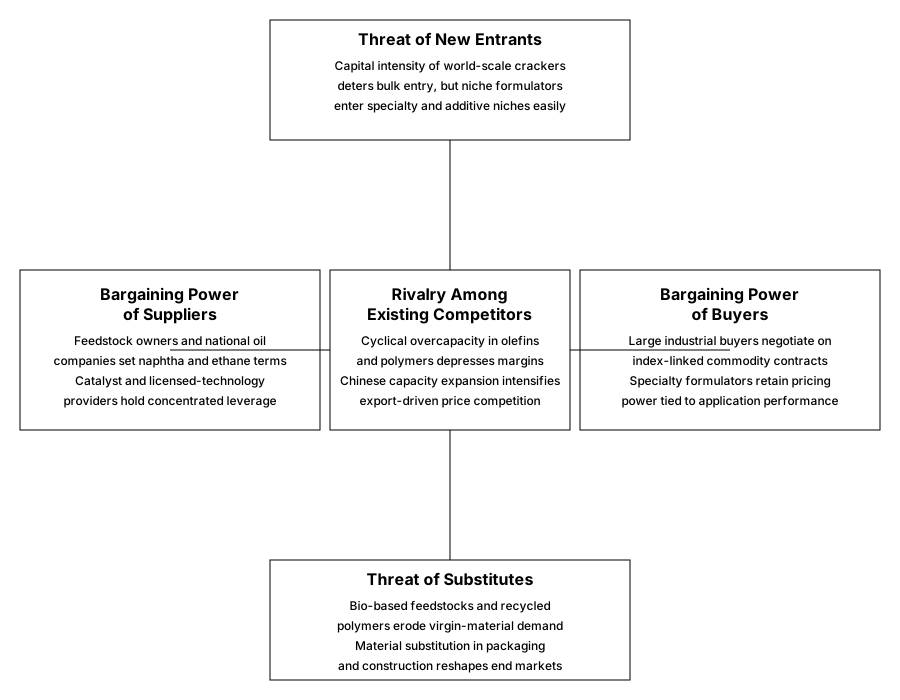
Porter's Five Forces framework helps explain why chemical company profitability varies so widely by segment even within the same corporate portfolio. Commodity petrochemicals face intense rivalry and strong buyer power because the product is fungible and capacity additions are lumpy, while specialty chemicals enjoy more balanced dynamics because switching costs and technical qualification protect incumbents. Supplier power is concentrated wherever feedstock or catalyst technology is scarce and the threat of new entrants diverges sharply between capital-intensive commodity production and comparatively accessible specialty formulation. Substitution pressure is rising steadily as bio-based feedstocks, recycled polymers and material substitution in packaging and construction give customers new options that did not exist a decade ago.
Bargaining power of buyers
Buyer power in the chemicals industry varies enormously depending on whether the product sits at the commodity or specialty end of the spectrum and this single distinction explains much of the profitability gap within the sector. Buyers of commodity petrochemicals and bulk polymers, typically large plastics converters, textile producers and industrial manufacturers, purchase in enormous volumes, can readily compare suppliers on index-linked pricing and often qualify multiple sources to preserve leverage, which compresses margins to a thin spread over feedstock cost. These buyers also benefit from transparent published pricing benchmarks that make it difficult for any single producer to hold price above the prevailing market level for long, reinforcing their negotiating position further.
Specialty chemical buyers behave quite differently, because switching a qualified formulation, coating, or catalyst carries real technical and regulatory risk, including requalification testing, potential performance degradation and lost time to market. A paint manufacturer that has spent months co-developing a resin formulation with a supplier is unlikely to switch over a modest price increase, since the cost of requalifying an alternative outweighs the savings. Large original equipment manufacturers in automotive and electronics do retain meaningful power even in specialty categories, since their purchasing scale lets them demand joint development agreements, cost transparency and multi-year pricing commitments, but this is a narrower and more relationship-based form of leverage than the price-driven power seen in commodity markets. Government and infrastructure buyers, particularly in water treatment and defense-adjacent chemicals, tend to prioritize certification and reliability over price, further muting buyer power in those channels.
| Buyer segment | Typical leverage | Primary basis of power |
|---|---|---|
| Commodity converters and mills | High | Index-linked pricing, multiple qualified sources |
| Automotive and electronics original equipment manufacturers | Moderate to high | Purchasing scale, joint development leverage |
| Specialty formulation customers | Low to moderate | Qualification and switching cost work against them |
| Government and infrastructure buyers | Low | Certification and reliability prioritized over price |
Bargaining power of suppliers
Supplier power concentrates at two distinct points in the chemical value chain: feedstock and energy inputs and specialized process technology or catalysts. Feedstock suppliers, particularly national oil companies and integrated energy majors that control crude oil, natural gas liquids and increasingly natural gas itself, hold substantial power over petrochemical producers who lack upstream integration, since naphtha and ethane prices flow directly into cracking margins. Producers based in regions with abundant, low-cost shale gas, such as the United States Gulf Coast, have structurally lower feedstock costs than naphtha-based producers in Europe or Asia, which has reshaped global trade flows and competitive positioning over the past fifteen years.
Technology and catalyst suppliers form the second concentration of power, since world-scale process licenses for ethylene cracking, polymer production, or ammonia synthesis are controlled by a small number of specialized engineering firms and catalyst producers, some of which are themselves chemical companies. A producer building a new plant has limited choice among licensors for a given process route, which gives these technology suppliers meaningful pricing power over royalties and ongoing catalyst replacement contracts. Labor supply, particularly skilled process engineers and workers certified for hazardous materials handling, has also tightened in mature markets, adding a further, if smaller, source of supplier-side cost pressure. Vertically integrated majors that own upstream feedstock positions, refining assets, or proprietary catalyst technology largely insulate themselves from this dynamic, which is precisely why integration has remained a persistent strategic pattern in the industry.
| Supplier category | Concentration | Leverage mechanism |
|---|---|---|
| National oil companies and feedstock owners | High | Control of naphtha, ethane and natural gas pricing |
| Process technology licensors | High | Limited number of proven licensed routes |
| Specialty catalyst producers | Moderate to high | Proprietary formulations tied to specific processes |
| Skilled process labor | Moderate | Tightening supply of certified technical workers |
Rivalry among existing competitors
Rivalry is most intense in commodity petrochemicals and bulk polymers, where products are largely interchangeable, fixed costs are enormous and producers face strong incentives to keep plants running near capacity even when margins compress, since idling a cracker is far costlier than selling at a thin margin. This dynamic produces a distinctly cyclical pattern of overbuilding during upcycles, followed by prolonged periods of oversupply and price competition once new capacity comes online faster than demand absorbs it. China's aggressive expansion of ethylene and polymer capacity over the past decade has intensified this dynamic globally, pushing the country from a net importer toward a net exporter of several commodity chemicals and depressing margins for producers in Europe, Japan and South Korea who lack comparable cost advantages.2
Specialty chemical rivalry looks quite different, playing out through innovation cycles, application-specific performance claims and technical service quality rather than headline pricing, since customers rarely switch a qualified specialty input purely on cost. Competition here tends to concentrate within narrow application niches, where a handful of specialized players compete on formulation science and speed of customer co-development rather than scale. Consolidation has been a persistent theme across both ends of the spectrum, as commodity producers merge to capture scale economies and specialty players acquire smaller formulators to broaden their application portfolios and cross-sell into adjacent end markets. Regional dynamics further shape rivalry, since European producers face structurally higher energy costs than their counterparts in the United States or the Middle East, which has accelerated plant closures and portfolio restructuring across the continent in recent years.
| Competitive dynamic | Where it dominates | Effect on margins |
|---|---|---|
| Capacity-driven price competition | Commodity petrochemicals and polymers | Strongly compressive during oversupply |
| Innovation and application-specific competition | Specialty formulations | Margin-protective for qualified suppliers |
| Consolidation and portfolio reshaping | Both segments | Reduces fragmentation over time |
| Regional cost-structure divergence | Europe versus United States and Middle East | Drives plant rationalization |
Threat of new entrants
Entry barriers differ so sharply across the chemicals value chain that the threat of new entrants cannot be assessed as a single industry-wide figure. World-scale commodity petrochemical production requires capital commitments that routinely exceed a billion dollars per facility, multi-year permitting and construction timelines and secured feedstock contracts, all of which make greenfield entry rare outside of state-backed investment programs, most notably in the Middle East and China, where governments have used chemical capacity as a deliberate industrialization strategy. Existing integrated producers also benefit from decades of accumulated operating know-how at their sites, embodied in incremental debottlenecking and yield improvements that a new entrant cannot replicate on day one.
Specialty and performance chemical segments present a materially lower barrier, since a technically capable formulator can enter a narrow application niche with modest capital by leasing blending and mixing capacity, securing a regulatory registration and winning a handful of anchor customers through superior performance or service. This asymmetry explains why the specialty end of the industry remains far more fragmented than the commodity end, with thousands of small and mid-sized players competing alongside diversified majors. Regulatory registration requirements, particularly chemical safety and toxicology data packages required under regimes such as REACH in the European Union, do impose a meaningful, if surmountable, barrier even in specialty segments, since building a compliant data package takes time and specialized expertise. Brand and reputation matter less than in consumer industries, but a track record of consistent quality and reliable supply carries real weight in industrial purchasing decisions, giving incumbents a soft but real advantage over unproven new entrants.
| Entry barrier | Segment most affected | Severity |
|---|---|---|
| Capital cost of world-scale plants | Commodity petrochemicals | Very high |
| Secured feedstock access | Commodity petrochemicals | High |
| Regulatory registration and toxicology data | Specialty and agrochemicals | Moderate |
| Customer qualification and track record | Specialty chemicals | Moderate |
Threat of substitutes
Substitution pressure in chemicals has historically moved slowly, since most chemical inputs are engineered into a customer's product design and changing them requires requalification, but several forces are now accelerating the pace of substitution across multiple segments simultaneously. Bio-based feedstocks and chemicals derived from renewable biomass are emerging as credible alternatives to petroleum-derived intermediates in categories such as surfactants, solvents and certain polymers, driven by customer sustainability commitments and, in some jurisdictions, regulatory incentives that favor lower-carbon inputs. Mechanical and chemical recycling of plastics is similarly beginning to substitute for virgin polymer production, particularly in packaging, as brand owners commit to recycled content targets that directly reduce demand growth for virgin commodity resin.
Material substitution at the end-use level poses a second, distinct threat, as customers in packaging, construction and automotive periodically shift between plastic, metal, glass and composite materials based on cost, weight and sustainability considerations, meaning chemical producers compete not only against each other but against entirely different material categories. Digitalization has introduced a subtler substitution effect as well, since some physical chemical products, such as certain coatings and specialty inks, face reduced demand as printed and physical media are displaced by digital alternatives. Producers with diversified feedstock flexibility and a credible position in bio-based or recycled inputs are best positioned to absorb this pressure, while single-feedstock, single-application commodity producers face the greatest exposure to substitution eroding their addressable market over time.
| Substitution vector | Segment most exposed | Trajectory |
|---|---|---|
| Bio-based feedstocks and chemicals | Surfactants, solvents, select polymers | Accelerating |
| Recycled and circular plastics | Commodity packaging polymers | Accelerating |
| Alternative structural materials | Packaging, construction, automotive | Steady, cyclical |
| Digital displacement of physical media inputs | Coatings, printing chemicals | Slow, segment-specific |
Value chain and profit pools
The chemical value chain begins with upstream feedstock extraction and processing, encompassing crude oil refining, natural gas liquids separation and increasingly biomass and recycled material collection, an activity largely controlled by energy companies and national oil producers rather than chemical manufacturers themselves. The second stage, base chemical and petrochemical production, converts these feedstocks into olefins, aromatics and basic building-block molecules through energy-intensive cracking and reforming processes at large integrated sites, representing the most capital-intensive and cyclical link in the chain. A third stage, intermediate and derivative chemical production, transforms these building blocks into polymers, resins and other semi-finished materials, where the degree of processing begins to differentiate producers on cost efficiency and yield rather than pure feedstock access.
The fourth stage, specialty formulation and compounding, is where raw and intermediate chemicals are engineered into application-specific products such as coatings, adhesives and performance additives, requiring research and development investment, application testing laboratories and close technical collaboration with customers. Distribution and logistics form a fifth, often underappreciated stage, since chemicals require specialized handling, storage and transport infrastructure and chemical distributors play an outsized role in reaching the long tail of smaller industrial customers who cannot be served economically through direct sales. The sixth stage, customer interface and technical service, has become increasingly important as specialty producers compete on solution-selling, application support and joint development rather than product alone. Finally, enabling infrastructure, spanning integrated production sites, shared utilities, catalyst and process technology and environmental control systems, underpins every other stage and represents a significant source of structural cost advantage for producers who have invested in it over decades.
Profit pool
Profit pools in the chemicals industry have migrated steadily downstream and toward specialization over the past two decades, even as revenue has remained concentrated in commodity segments by sheer volume. Base petrochemical and commodity polymer production, despite representing the largest share of industry revenue, typically earns single-digit to low double-digit operating margins that compress further during oversupply cycles, because pricing is set by the marginal cost of the highest-cost producer needed to meet demand. Specialty formulation and performance chemical segments, by contrast, routinely earn operating margins in the high teens to mid-twenties percentage range, reflecting the value customers place on application performance and the pricing power that comes from technical differentiation and switching costs.3
Distribution has quietly become an attractive profit pool in its own right, since chemical distributors capture margin by aggregating small-order customers, providing regulatory and technical support and offering just-in-time delivery that individual producers cannot economically replicate for their long tail of accounts. Catalyst and process technology licensing represents a smaller but exceptionally profitable pool, since a handful of firms control proprietary process routes and earn royalty-like economics with minimal ongoing capital investment. The shift toward specialty and technical service revenue has been the defining strategic response among legacy commodity producers, many of which have divested lower-margin bulk chemical assets over the past decade specifically to concentrate capital and management attention on higher-margin, less cyclical specialty portfolios.
Industry economics and business models
Two dominant business models coexist within the chemicals industry and most large diversified companies operate both simultaneously through distinct business units. The first is the asset-heavy, volume-driven commodity model, in which producers compete primarily on unit cost, operate at very high fixed-cost-to-variable-cost ratios and generate returns through scale, feedstock advantage and operational reliability rather than product differentiation; profitability in this model tracks capacity utilization across the industry as closely as it tracks any company-specific factor. The second is the asset-light, technology-driven specialty model, in which producers compete on formulation intellectual property, application know-how and customer intimacy, generating returns through pricing power on differentiated products rather than volume and typically requiring meaningful, sustained investment in research and technical service infrastructure rather than production capacity alone.
A third, smaller but growing model centers on chemicals-as-a-service and outsourced formulation, where producers embed technical experts within customer operations, manage chemical inventory and usage on a per-unit or subscription basis and are paid partly for the outcome delivered, such as reduced water usage or improved coating durability, rather than purely for tonnage shipped. This model has gained particular traction in water treatment and industrial cleaning chemicals, where the economics reward suppliers who can demonstrate measurable performance improvement rather than simply supplying a commodity input. Licensing of process technology and catalysts constitutes a fourth, capital-light model practiced by a small set of specialized engineering firms, generating high-margin royalty and service income without the balance sheet exposure of owning production assets directly.
Cost drivers and scalability
Fixed costs dominate the commodity end of the chemicals industry, since a world-scale cracker or ammonia plant carries enormous depreciation, maintenance and baseline energy costs regardless of output level, which creates a powerful incentive to run at maximum sustainable capacity even when margins are thin. This cost structure produces classic economies of scale, where the largest, most modern facilities enjoy a meaningful per-unit cost advantage over smaller or older plants, explaining the industry's persistent trend toward mega-scale integrated production complexes, particularly in regions with advantaged feedstock such as the United States Gulf Coast and the Middle East. Feedstock and energy typically represent the largest variable cost component in commodity production, often exceeding half of total cash cost, which means that relative feedstock pricing between regions, such as natural gas liquids in North America versus naphtha in Asia and Europe, can shift global competitiveness more than any operational efficiency gain a producer might achieve internally.
Specialty chemical cost structures look markedly different, with research and development, technical service personnel and regulatory compliance representing a larger share of total cost relative to raw material input and economies of scope, rather than pure scale, driving profitability, since a single research and formulation platform can often be leveraged across many related product lines. Utilization still matters in specialty manufacturing, but the relevant unit economics center more on formulation yield, batch efficiency and the ratio of research spending to successful commercial launches than on plant-level fixed cost absorption. A genuine flywheel effect operates in specialty chemicals through the accumulation of application data:
each successful customer co-development project generates proprietary performance data that shortens the development cycle and improves the win rate for the next similar project, compounding a technically capable formulator's advantage over time in ways that pure scale cannot replicate in commodity segments
Moats, advantages and strategic levers
Cost advantage remains the primary moat in commodity chemicals, built through advantaged feedstock access, integrated production that captures value across multiple processing steps without intermediate transportation cost and scale that spreads fixed costs across greater volume than smaller competitors can match. Regulatory moats operate throughout the industry but matter most in specialty and agrochemicals, where the accumulated toxicology and safety data required to register a product under regimes such as REACH represents years of investment that a new entrant cannot easily replicate and where existing registrations can be leveraged across product line extensions at much lower incremental cost than a first-time filing.
Switching costs form the dominant moat in qualified specialty applications, since customers who have validated a chemical input within their manufacturing process face real performance and compliance risk if they change suppliers, giving incumbent formulators durable pricing power that has little to do with brand recognition. Data and learning advantages are becoming increasingly important as digital process control and formulation modeling mature, since companies with large historical datasets on formulation performance can train predictive models that shorten development cycles, an advantage that compounds with scale of research activity rather than production. Differentiation through sustainability credentials, including verified lower-carbon production processes and certified recycled or bio-based content, has emerged as a newer but rapidly strengthening moat, as downstream customers increasingly specify these attributes contractually rather than treating them as optional.
Strategic levers
Portfolio focus represents the most consequential lever available to incumbents and investors alike, since the evidence across the industry consistently shows that companies concentrated in specialty segments with technical differentiation outperform diversified commodity-heavy portfolios on margin stability and valuation multiple, which is why divestiture of bulk chemical assets has been a persistent theme among European and North American majors. Vertical integration versus partnering is a second critical lever, particularly upstream toward feedstock, where owning or contractually securing advantaged feedstock access materially changes a commodity producer's cost position relative to peers who purchase at spot or index-linked prices.
Geographic expansion toward regions with structurally advantaged feedstock or energy costs, such as continued investment in United States Gulf Coast capacity by both domestic and foreign producers, has been a durable strategy for commodity producers seeking to reset their cost curve rather than compete on efficiency alone within a disadvantaged region. Ecosystem orchestration through joint development agreements and co-innovation partnerships with downstream customers, particularly in electric vehicle battery materials and advanced electronics, allows specialty producers to embed themselves early in a customer's product design cycle, converting what would otherwise be a commodity supply relationship into a defensible, technically specified position. Finally, decarbonization investment, whether through electrified cracking, green hydrogen for ammonia production, or carbon capture retrofits, is increasingly a strategic rather than purely compliance-driven lever, since producers who move early stand to capture premium pricing from customers with their own emissions reduction commitments while avoiding future carbon cost exposure that slower-moving competitors will face.
Structural risks, regulation and trends
Several structural risks warrant close attention from anyone evaluating exposure to this industry. Regulatory risk is substantial and rising, spanning chemical safety and registration regimes, restrictions on specific substance classes such as per- and polyfluoroalkyl substances and an expanding set of carbon pricing and emissions trading schemes that directly affect the cost structure of energy-intensive production. Technology disruption risk centers on the pace at which bio-based feedstocks, advanced recycling and material substitution erode demand for specific commodity chemical categories, a risk that varies enormously by product but is accelerating across packaging-related polymers in particular. Commodity and feedstock price risk remains the industry's most familiar structural challenge, since cracking margins can swing dramatically within a single year based on the relative price of crude oil, natural gas and the chemicals produced from them, a volatility that flows directly into earnings for any producer without feedstock diversification. Geopolitical and supply chain risk has intensified as well, with trade tensions, export restrictions on certain feedstocks and specialty inputs and regional energy security concerns reshaping investment decisions that were previously made almost purely on cost grounds.
The profit pool of the industry often skews toward specialties and downstream products, even if the revenue pool is dominated by commodities
Several secular trends are reshaping demand and supply simultaneously. On the demand side, electrification of transport and growth in renewable energy infrastructure are creating substantial new demand for battery materials, specialty polymers for lightweighting and insulation chemicals, offsetting slower growth in some traditional end markets such as conventional automotive coatings. On the supply side, China's continued capacity expansion in commodity petrochemicals, even amid government efforts to consolidate and rationalize excess capacity, is likely to keep global commodity margins under structural pressure for years, pushing Western and Japanese producers further toward specialization as a survival strategy rather than a purely offensive choice.4 Circularity is moving from a marketing narrative toward a genuine business model shift, as regulatory mandates for recycled content in several jurisdictions and corporate sustainability commitments from major consumer goods companies create durable demand for chemically and mechanically recycled feedstocks that did not exist as a commercial category a decade ago.
For entrants considering this industry, the strategic playbook divides clearly by segment. Entry into commodity petrochemicals is rarely advisable except through state-backed industrial policy or an extraordinary feedstock advantage, since the capital and scale barriers are simply too high for a conventional corporate entrant to overcome profitably. Entry into specialty niches is far more viable and should follow a narrow-first approach, establishing a defensible position in one application area with a genuinely differentiated formulation before expanding the portfolio, rather than attempting to compete broadly from the outset. Partnering or acquiring an established regulatory registration and customer base is frequently faster and less risky than building from scratch, given the multi-year timelines involved in chemical safety data generation. Regulatory strategy should be treated as a core capability rather than outsourced entirely to counsel, since companies that build in-house toxicology and registration expertise consistently bring products to market faster than those who treat compliance reactively.
Incumbents face a different set of choices. Defending commodity positions requires continuous investment in cost position, whether through feedstock security, energy efficiency, or scale, since any complacency in cost management becomes visible immediately in margin performance during the next downcycle. Expanding into adjacent specialty categories, typically through acquisition of smaller formulators with complementary technical capability, has proven the most reliable way for commodity-heavy incumbents to reset their margin profile over a multi-year horizon. Deepening moats through proprietary data, sustained research investment and early leadership in decarbonized production processes will likely separate the chemical companies that command premium valuations from those treated as cyclical commodity plays over the next decade.
Caselet: BASF and the Verbund model
BASF traces its origins to 1865 in Mannheim, Germany, when it was founded to produce synthetic dyes and the company has grown into one of the world's largest chemical producers, now organized across chemicals, materials, industrial solutions, surface technologies, nutrition and care and agricultural solutions segments.5 The company's headquarters and largest manufacturing complex remain in Ludwigshafen, Germany and it now operates roughly 235 production sites across more than 90 countries, employing well over 100,000 people worldwide. What distinguishes BASF strategically is not simply its scale but the way it has structured production around an integrated system the company calls Verbund, in which chemical plants are physically interconnected so that the byproduct or waste stream of one process becomes the direct feedstock for another, reducing transportation cost, energy loss and raw material waste across the entire site.
This integrated model illustrates several of the dynamics that define the broader industry. It demonstrates how commodity producers pursue cost advantage through structural rather than purely operational means, since the Verbund concept cannot be easily replicated by a smaller or less integrated competitor without comparable upfront capital and decades of accumulated site planning. It also shows how a company can straddle both the commodity and specialty ends of the value chain simultaneously, using its petrochemical base as an internal feedstock source for higher-margin specialty and performance materials businesses that sell directly into automotive, construction and agricultural end markets. This dual positioning has allowed BASF to smooth some of the earnings volatility that a pure commodity producer would experience, since specialty and agricultural solutions segments provide a partial offset when petrochemical margins compress during industry oversupply.
BASF's more recent strategic history also illustrates the pressures reshaping the broader industry. The company has faced sustained margin pressure in its European operations due to comparatively high natural gas and electricity costs relative to United States and Middle Eastern competitors, a gap that widened further following the disruption to European energy supply earlier this decade. In response, the company has pursued a combination of cost restructuring at its European sites and continued investment in regions with structurally lower energy costs, including expanded capacity in China through a large-scale Verbund site near Zhanjiang and continued investment in the United States Gulf Coast, illustrating the geographic rebalancing that energy cost divergence is forcing across the entire industry, not just at BASF.
The company's agricultural solutions and specialty materials segments also demonstrate the industry's broader shift toward higher-margin, application-specific chemistry, as BASF has continued to invest in crop protection innovation and battery materials for electric vehicles even while restructuring lower-margin commodity assets elsewhere in its portfolio. This pattern, defending and optimizing a commodity core through structural cost advantage while actively growing specialty and technical segments, mirrors the strategic path that most large diversified chemical companies have pursued over the past decade and it makes BASF a useful, publicly documented reference point for understanding how the industry's structural forces play out inside a single global organization. The company's ongoing portfolio evaluation, including periodic reviews of whether certain commodity businesses belong within the broader structure at all, reflects the same profit pool migration described earlier in this analysis, playing out in real time at one of the industry's most closely watched companies.
Chemicals manufacturing remains the hidden infrastructure of the physical economy, translating raw hydrocarbons and minerals into the inputs that agriculture, construction, mobility and electronics all depend on. The industry's economics reward two very different disciplines at once: relentless cost and scale management in commodity petrochemicals and deep application intimacy in specialty formulation. Capital intensity, feedstock volatility and regulatory complexity keep most of the field consolidated among a small set of integrated majors, while smaller players thrive by owning defensible niches. The strategic levers that matter most going forward are feedstock flexibility, decarbonization of energy-intensive processes and the ability to convert regulatory and technical data into pricing power rather than treating it as a cost of doing business.
Citation
Cite this article
Sridharan, M. A. (2023, April 7). Industry Analysis: Chemicals. Think Insights. https://thinkinsights.net/strategy/industry-analysis-chemicals (Accessed [[ACCESS_DATE]])
Sridharan, Mithun A. "Industry Analysis: Chemicals." Think Insights, 7 Apr. 2023, https://thinkinsights.net/strategy/industry-analysis-chemicals. Accessed [[ACCESS_DATE]].
Mithun A. Sridharan, "Industry Analysis: Chemicals," Think Insights, April 7, 2023, https://thinkinsights.net/strategy/industry-analysis-chemicals. Accessed [[ACCESS_DATE]].
Sridharan, M.A. (2023) 'Industry Analysis: Chemicals', Think Insights. Available at: https://thinkinsights.net/strategy/industry-analysis-chemicals (Accessed: [[ACCESS_DATE]]).
M. A. Sridharan, "Industry Analysis: Chemicals," Think Insights, 2023. [Online]. Available: https://thinkinsights.net/strategy/industry-analysis-chemicals. [Accessed: [[ACCESS_DATE]]].
Sridharan MA. Industry Analysis: Chemicals. Think Insights. Published April 7, 2023. Accessed [[ACCESS_DATE]]. https://thinkinsights.net/strategy/industry-analysis-chemicals
Test Your Knowledge
Industry Analysis: Chemicals
Challenge yourself on the concepts from this article and see how well you understood them.
Subscribers get weekly quizzes and insights — subscribe free
Sponsor this article
Partner with Think Insights
Reach 50,000+ business leaders, consultants, and strategists. Feature your brand alongside expert articles on strategy, leadership, and digital transformation.
Become a Sponsor