Netflix Business Model


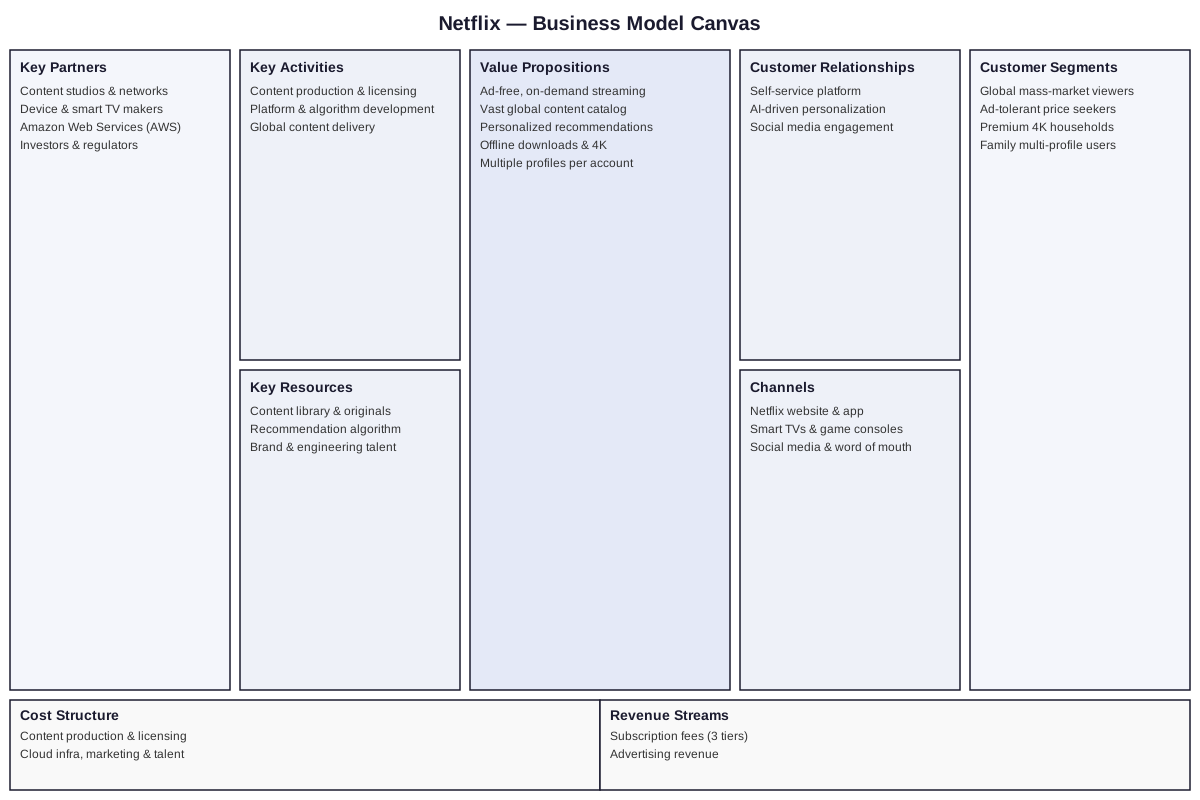
Netflix operates the world's largest paid streaming service, with 325 million subscribers across more than 190 countries and full-year 2025 revenue of $45.2 billion. The business rests on three linked decisions: charge a recurring subscription fee, reinvest a large share of that fee into owned and licensed content, and run the entire operation on rented cloud infrastructure rather than owned data centers. Since 2022, Netflix added a fourth lever, advertising, layering an ad-supported tier onto its subscription base to capture price-sensitive viewers and open a second revenue channel. Executives now split responsibility for content, product and finance between co-chief executives Ted Sarandos and Greg Peters. This piece breaks down how each part of that model works, what it costs, and where the business faces pressure from rivals, regulators and the same technology shift that let Netflix outgrow cable television in the first place.
How does Netflix make most of its money?
Netflix earns nearly all its revenue from monthly subscription fees across its Standard with Ads, Standard and Premium plans. Advertising has grown into a second revenue line since the ad-supported tier launched in 2022, with Netflix targeting roughly $3 billion in ad revenue for 2026, though subscriptions still account for the large majority of total revenue.
Who runs Netflix today?
Ted Sarandos and Greg Peters share the chief executive role as co-CEOs, a structure Netflix put in place in January 2023. Sarandos oversees content, marketing and communications, while Peters runs product, technology, advertising and finance. Co-founder Reed Hastings, who led the company as sole CEO from 1998 to 2020, now serves as executive chairman and is set to leave the board in June 2026.
How much does Netflix spend on content each year?
Netflix expects to spend approximately $20 billion in cash on content in 2026, up from around $18 billion in 2025. That budget covers licensed titles, original series and films, and productions made outside the United States, which have become a growing share of what subscribers watch worldwide.
From DVD-by-mail to global streaming
Netflix started in 1997 as a mail-order DVD rental business in Scotts Valley, California, founded by Reed Hastings and Marc Randolph. The company shipped physical discs to subscribers' homes and moved to a flat monthly subscription fee a year after launch, dropping its original pay-per-rental pricing. That subscription instinct, charge once and let customers watch as much as they want, has stayed the backbone of the business for almost three decades even as the product underneath it changed completely.
Streaming replaced the mail model gradually rather than overnight. Netflix introduced a watch-online option in 2007 with a catalog of roughly 1,000 titles, limited to computers running Internet Explorer. Broadband adoption, smart TVs and mobile apps did the rest, and by the time DVD shipments became a minor sideline, Netflix had rebuilt its cost base, its technology stack and its content pipeline around streaming. The company reoriented an entire industry in the process, pushing traditional broadcasters and cable operators to build their own direct-to-consumer apps years after Netflix had already trained audiences to expect on-demand viewing without a channel guide.
The company now operates in more than 190 countries and reports 325 million paid subscribers worldwide, a scale that puts it ahead of every rival in the direct-to-consumer video business. That footprint did not come from a single expansion decision. Netflix added markets in stages through the 2010s, pairing each new region with local pricing, local payment methods and, eventually, local-language original productions rather than treating international growth as a simple export of its U.S. catalog.
A subscription core with a growing ad layer
Netflix earns almost all its revenue from recurring subscription fees, billed monthly and available in a small number of standard tiers rather than a menu of add-ons. In the United States, subscribers currently choose between Standard with Ads, Standard and Premium, and Netflix discontinued its cheapest ad-free plan in 2024, pushing price-sensitive subscribers toward the ad-supported option instead. The tiers differ mainly on resolution and simultaneous streams: the ad-supported and Standard plans cap out at high definition and two screens, while Premium adds ultra-high-definition video and a fourth simultaneous stream, giving larger households a reason to pay more without Netflix having to build a separate product for them.
That ad-supported tier, launched in November 2022, has become a genuine second revenue line rather than a side experiment. Netflix's ad tier reached 190 million monthly active viewers by the first quarter of 2026, with more than 4,000 advertisers now buying inventory on the platform, and management expects advertising revenue to roughly double year over year to $3 billion in 2026.1 The shift reverses a position Netflix defended publicly for years, arguing ads would damage the viewing experience that defines its value proposition. That reversal, alongside charging households for sharing passwords outside their home, converted millions of non-paying viewers into paying accounts without a matching increase in content costs.
Netflix's stated purpose captures the discipline behind the pricing structure:
To entertain the world
Every plan, every price change and every ad placement gets weighed against whether it protects that core viewing experience while extracting more value from the audience Netflix already has.
Content is the product and the largest cost
Content is simultaneously Netflix's product and its biggest expense. The company expects to spend around $20 billion in cash on content in 2026, up from roughly $18 billion in 2025, and executives have said the budget is not near a ceiling.2 That spending buys a mix of licensed titles, which fill out the catalog cheaply, and original productions, which cost more but separate Netflix from competitors carrying similar licensed libraries.
Non-English original programming has become a disproportionately large part of that strategy. Series produced in South Korea, Spain, India and other markets outside the United States now travel globally on the platform, giving Netflix a content advantage that competitors with narrower production footprints struggle to match. The Korean production "Squid Game" is the clearest example: a regionally commissioned show became one of the most watched series in Netflix's history and demonstrated that a hit does not need to originate in Los Angeles or London to carry a global audience.
The company treats content spend as a subscriber acquisition and retention tool first and an awards strategy second, greenlighting projects based on projected viewing hours and regional demand rather than critical reception alone. Licensing decisions follow the same logic in reverse: Netflix regularly lets rights to popular but non-exclusive titles lapse once the cost of renewal outweighs the viewing hours those titles generate, freeing up budget for original productions that stay on the platform indefinitely.
Cloud infrastructure instead of owned data centers
Netflix runs its entire streaming operation on Amazon Web Services [AWS] rather than owned data centers, a decision that traces back to a 2008 database failure that stopped DVD shipments for three days. The company began migrating to AWS in 2009 and has expanded that relationship since, using AWS to add computing capacity and storage on demand as viewing spikes around new releases.3 Renting infrastructure from a company that also competes with Netflix through Amazon Prime Video says something about how Netflix separates operational dependencies from competitive rivalry.
The arrangement lets Netflix scale computing capacity up or down without carrying the fixed cost of data centers built for peak demand. Netflix has extended the relationship beyond basic hosting, using AWS Local Zones to give visual effects and production teams low-latency access to cloud workstations wherever they are filming. That flexibility supports a production pipeline that now spans dozens of countries rather than a single studio system.
Streaming itself runs on a separate, purpose-built system Netflix calls Open Connect, a network of caching servers Netflix places directly inside internet service provider networks free of charge. Open Connect, not AWS, delivers nearly all the actual video traffic subscribers watch, while AWS handles computing, account management, recommendations and the back-office systems that keep the service running. Splitting the two workloads lets Netflix optimize each one separately: general-purpose cloud computing for everything that needs flexibility, and dedicated hardware for the one task, video delivery, that dominates its bandwidth costs.
Leadership built for a two-headed strategy
Reed Hastings ran Netflix as sole chief executive from 1998 until 2020, when he named Ted Sarandos co-chief executive alongside him. Hastings stepped back further in January 2023, moving into the role of executive chairman and elevating Greg Peters, previously chief operating officer, to co-chief executive alongside Sarandos.4 Hastings is set to leave the Netflix board entirely in June 2026, closing the founder-led phase of the company almost three decades after it started shipping DVDs.
The co-chief executive structure splits responsibility along functional lines rather than duplicating authority. Sarandos oversees content, marketing, communications and publicity, the creative and brand side of the business, while Peters runs product, technology, advertising and finance, the operational and monetization side. The regulatory filing covering that transition confirmed the succession plan had been years in development rather than a reaction to any single event.5 The arrangement gives Netflix a leadership team where the executive managing content risk is not the same executive managing pricing and margin, a separation that matters given how tightly those two functions connect in a subscription business.
Competitive pressure and where growth must come from
Netflix no longer competes against cable television and DVD rental chains. It competes against Disney+, Amazon Prime Video, Apple TV+, Max and a long list of regional and free ad-supported services, each capable of absorbing content losses that would once have been fatal to a smaller streamer. Disney can lean on theme parks and merchandise to subsidize its streaming losses, and Amazon can bundle Prime Video into a retail membership millions of households already pay for regardless of what they watch, so Netflix has to win the streaming budget line on its own rather than cross-subsidize it from another business.
Revenue concentration adds a second layer of risk. The United States, Canada and Europe still generate the large majority of Netflix's revenue, and average revenue per user [ARPU] in those regions runs well above what Netflix earns in Latin America and Asia-Pacific, where subscriber growth is fastest but pricing power is weakest. The 2026 round of price increases, which pushed the ad-supported plan to $8.99 a month and Premium to $26.99, tests how much of that revenue gap Netflix can close through pricing rather than volume before subscribers in mature markets start canceling.6 How Netflix balances that pricing discipline against subscriber growth in newer markets will shape whether the current model keeps compounding or starts running into the limits of what mature audiences will pay.
- 1Netflix Reports First-Quarter 2026 Earnings
- 2Netflix Tops 325 Million Subscribers, Plans To Boost Content Spending To $20 Billion In 2026
- 3Netflix Case Study On AWS Local Zones For Remote Production
- 4Ted Sarandos And Greg Peters Are Now Co-CEOs Of Netflix, With Reed Hastings As Executive Chairman
- 5Netflix Fourth-Quarter 2022 Shareholder Letter, Form 8-K
- 6Netflix Confirms It's Raising Prices Again
Netflix's shift from a DVD-by-mail service to a subscription and advertising business built on rented cloud infrastructure shows a company willing to rewrite its own model more than once without losing its customer base. Adding an ad-supported tier and charging for password sharing turned account sharers into paying customers, lifting revenue without a matching jump in content spending. Competition from Disney, Amazon, Apple and regional players keeps pressure on pricing and content budgets, and reliance on North American and European revenue leaves growth in Asia-Pacific and Latin America as the next test. For executives studying subscription businesses, Netflix shows the payoff of pairing pricing flexibility with heavy, sustained content investment, and the risk of carrying content costs that keep climbing even as subscriber growth slows.
Citation
Cite this article
Sridharan, M. A. (2025, March 29). Netflix Business Model. Think Insights. https://thinkinsights.net/strategy/netflix-business-model (Accessed [[ACCESS_DATE]])
Sridharan, Mithun A. "Netflix Business Model." Think Insights, 29 Mar. 2025, https://thinkinsights.net/strategy/netflix-business-model. Accessed [[ACCESS_DATE]].
Mithun A. Sridharan, "Netflix Business Model," Think Insights, March 29, 2025, https://thinkinsights.net/strategy/netflix-business-model. Accessed [[ACCESS_DATE]].
Sridharan, M.A. (2025) 'Netflix Business Model', Think Insights. Available at: https://thinkinsights.net/strategy/netflix-business-model (Accessed: [[ACCESS_DATE]]).
M. A. Sridharan, "Netflix Business Model," Think Insights, 2025. [Online]. Available: https://thinkinsights.net/strategy/netflix-business-model. [Accessed: [[ACCESS_DATE]]].
Sridharan MA. Netflix Business Model. Think Insights. Published March 29, 2025. Accessed [[ACCESS_DATE]]. https://thinkinsights.net/strategy/netflix-business-model
Test Your Knowledge
Netflix Business Model
Challenge yourself on the concepts from this article and see how well you understood them.
Subscribers get weekly quizzes and insights — subscribe free
Sponsor this article
Partner with Think Insights
Reach 50,000+ business leaders, consultants, and strategists. Feature your brand alongside expert articles on strategy, leadership, and digital transformation.
Become a Sponsor