Monetizing Probability in Casinos


Casino profit does not depend on luck; it depends on a fixed mathematical margin built into every game, called the house edge. Operators do not try to predict individual outcomes. They collect a small, known percentage of every dollar wagered across millions of bets, letting probability do the work that pricing does in other industries. Regulation reinforces this model rather than threatening it: independent testing of Random Number Generators [RNGs] and strict compliance requirements give players confidence that outcomes are genuinely random, which sustains the volume operators need. Behavioral design, from chip tokenization to loyalty tiers, keeps that volume flowing, while promotional bonuses convert new players into recurring customers. Caesars Entertainment, the largest casino-entertainment company in the United States, illustrates how this structure scales across physical casinos and digital sports betting platforms into a business generating more than $11 billion in annual revenue.
What is the house edge in casino economics?
The house edge is a fixed statistical margin built into the rules of every casino game, similar to gross margin in retail. It tells an operator, on average, what percentage of total wagers it keeps over a large number of bets. A two percent house edge, for example, returns two dollars of every hundred wagered to the operator across enough play, regardless of any single outcome.
Why does regulation help rather than hurt casino profitability?
Regulators require independent testing of Random Number Generators [RNGs] and other game systems, which proves outcomes are genuinely random rather than manipulated. That certification builds the trust needed to secure payment processing relationships and retain players over time. Losing a gaming license eliminates an operator's entire revenue base, so compliance functions as a core business asset rather than a constraint.
How do casinos convert player psychology into predictable revenue?
Individual players often misjudge odds, believing a losing streak makes a win more likely, a pattern known as the gambler's fallacy. That misjudgment keeps people engaged and once enough bets accumulate, the Law of Large Numbers converts unpredictable individual sessions into a stable, forecastable revenue line for the operator.
Pricing Probability Into Every Game
Every casino game carries a fixed mathematical margin called the house edge and it works like gross margin in a retail business except the number is published in the rules rather than buried in a cost sheet. A roulette wheel with a 2.7 percent house edge returns, on average, $2.70 out of every $100 wagered to the operator across enough spins. The operator's task is not to predict any single spin. It is to keep the wheel spinning at volume so the published percentage plays out over time, turning gambling into something closer to a manufacturing process with a known unit margin. Commercial casino revenue in the United States reached $78.72 billion in 2025, a 9.2 percent increase over the prior year, evidence of how reliably this model scales with volume rather than any change in the underlying odds.1
Regulation as a Trust Asset
A common assumption holds that casinos profit through hidden or manipulated systems, but the opposite is true. Institutional stability rests on transparency, not concealment. Regulators such as the United Kingdom Gambling Commission [UKGC] require every Random Number Generator [RNG] used in a licensed game to pass independent testing, covering source code review, statistical analysis and ongoing annual audits.2 That certification is not a regulatory burden operators tolerate; it is the asset that lets payment processors, banks and players trust the system enough to keep betting. Compliance failures carry a steeper cost than compliance itself, since losing a license eliminates the entire revenue base overnight.
Designing Friction Out of Play
Physical casino floors and mobile apps are both engineered to hold attention without disrupting the entertainment experience. Chips, tokens and digital account balances all perform the same function: they separate the emotional weight of cash from the act of wagering. That separation is not deceptive; it mirrors how airlines use miles or retailers use store credit to make spending feel less immediate. Removing this friction extends the length of a typical session, which matters because the house edge only produces reliable profit once enough bets accumulate.
Turning Promotions Into Investments
Welcome bonuses and deposit matches are the primary tool operators use to acquire new players in a competitive market, functioning as a Customer Acquisition Cost [CAC] weighed against expected Customer Lifetime Value [LTV].3 Because a bonus paid out in cash immediately would be a pure liability, operators attach wagering requirements that oblige a player to bet through the credit before withdrawing it. That structure keeps promotional spending aligned with actual product engagement rather than a one-time discount. Responsible operators pair these offers with visible deposit limits and session timers, which cost little to implement and reduce the odds of a promotion turning into a regulatory or reputational problem later.
Predicting Crowds, Not Individuals
Player psychology supplies the volume that makes the house edge dependable. Many players act on the gambler's fallacy, the mistaken belief that a streak of losses makes a win more likely on the next bet, when in fact each independent event carries the same odds as before.4 That bias does not make outcomes predictable at the individual level; it keeps players engaged long enough for the Law of Large Numbers to convert millions of random bets into a stable, forecastable revenue line. A single session tells an operator almost nothing about profitability. A quarter's worth of aggregate play, spread across thousands of accounts, tells them almost everything.
Guardrails That Protect Recurring Revenue
Operators who push these psychological triggers too hard invite two costs: customer churn and regulatory penalties, both of which erode the recurring revenue the whole model depends on. Modern platforms instead deploy data analytics to flag sudden changes in play patterns, such as rapidly increasing deposit frequency or session length, that suggest a player is chasing losses. Tools such as self-exclusion, which lets a player formally bar themselves from a platform for a set period and deposit or time limits give players a way to set their own boundaries.5 These guardrails protect margin over the long run by keeping gambling positioned as entertainment spending rather than a source of financial harm that draws legislative crackdowns.
Scaling the Model at Caesars Entertainment
Caesars Entertainment, the largest casino-entertainment company in the United States, shows how this economic structure scales once digital channels are added to a physical footprint of more than 50 properties. The company reported net revenue of $11.486 billion for full-year 2025, up 2.4 percent from $11.245 billion in 2024, with casino wagering alone contributing $6.617 billion. Its fastest-growing unit, Caesars Digital, more than doubled adjusted earnings to $236 million from $117 million the prior year, showing that the same house-edge logic governing a Las Vegas casino floor applies just as cleanly to a mobile sportsbook. Chief Executive Officer Tom Reeg described the pattern behind that growth directly:
Fourth quarter consolidated same-store Adjusted EBITDA grew year over year driven by Caesars Digital which set a new quarterly record of $85 million, stable results in our Regional segment and a quarterly sequential improvement in operating trends in Las Vegas6
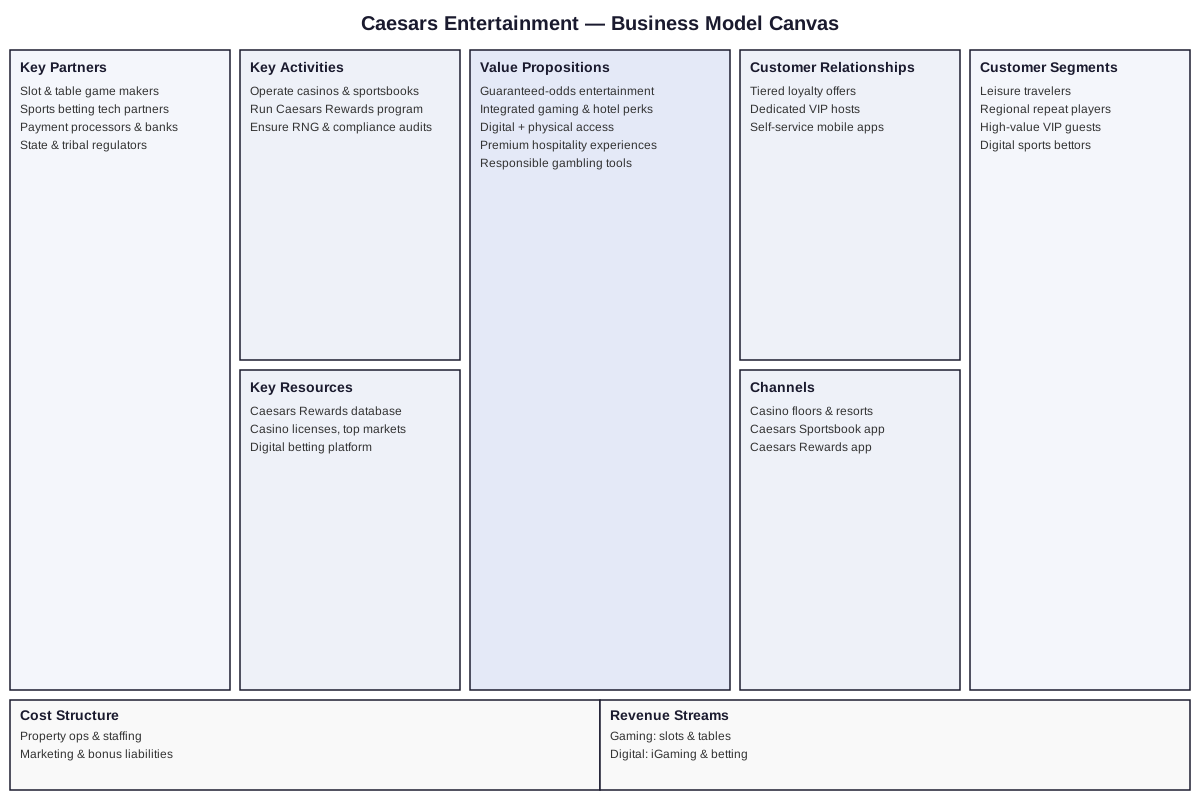
Key Partners
Caesars depends on slot and table game manufacturers, sports betting technology vendors and payment processors to run physical and digital operations. State and tribal gaming regulators control the licenses that let Caesars operate in each jurisdiction, making them a partner as much as an overseer. Media and entertainment partners, including headline performers and event promoters, help fill hotel rooms and casino floors around scheduled shows. Banking partners and credit providers support the high-volume cash and credit transactions that flow through Caesars properties daily.
Key Activities
Caesars' core activities are running casino floors and sportsbooks, operating the Caesars Rewards loyalty program and maintaining the compliance infrastructure that keeps every Random Number Generator and game certified. Marketing and promotional campaigns drive new customer acquisition across both physical and digital channels. Hospitality operations, including hotel management, dining and entertainment booking, support the non-gaming revenue that keeps guests on property longer.
Key Resources
Caesars' most valuable resource is the Caesars Rewards database, which spans tens of millions of members and links gaming, hotel and dining activity into a single profile. Casino licenses across major U.S. markets, including Nevada and New Jersey, give Caesars legal access to gaming revenue that competitors cannot easily replicate. Its proprietary digital betting and iGaming platform extends that resource base beyond physical property walls.
Value Propositions
Caesars offers guests entertainment built on transparent, mathematically fixed odds rather than any promise of winning. Caesars Rewards lets members earn and redeem credits across gaming, hotel stays, dining and shows at properties nationwide, adding convenience that a single-property competitor cannot match. Digital access through the Caesars Sportsbook and casino apps extends that same value proposition beyond the casino floor. Responsible gambling tools embedded across channels support the trust that keeps customers returning.
Customer Relationships
Most Caesars guests interact through tiered loyalty offers that scale with their spending and visit frequency. High-value players receive dedicated hosts who manage complimentary rooms, dining and event access to retain their business. Digital customers manage most of their relationship through self-service mobile apps, checking balances, claiming offers and setting responsible gambling limits without needing staff contact.
Channels
Physical casino floors and resort properties remain Caesars' primary channel for gaming and hospitality revenue. The Caesars Sportsbook and online casino apps extend that reach into digital betting and iGaming markets across states where they are licensed. The Caesars Rewards app ties both channels together, letting members track points and redeem offers wherever they play.
Customer Segments
Leisure travelers and tourists visiting Las Vegas and other resort markets make up a large share of Caesars' hospitality and gaming revenue. Regional and local repeat players sustain steady volume at properties outside major tourist markets. High-value VIP guests generate outsized revenue relative to their numbers, warranting dedicated host attention. Digital-first sports bettors and iGaming users represent Caesars' fastest-growing segment.
Cost Structure
Property operations, including staffing, utilities and maintenance across dozens of resorts, represent Caesars' largest recurring cost. Marketing spend and promotional bonus liabilities add significant expense in the competitive digital betting market. Gaming taxes, licensing fees and regulatory compliance infrastructure round out a cost base that scales with both revenue and jurisdictional footprint.
Revenue Streams
Casino wagering, including slots and table games, remains Caesars' largest revenue stream. Hospitality revenue from hotel rooms, food and beverage adds a steady non-gaming complement. The Caesars Digital segment, covering iGaming and online sports betting, is the fastest-growing stream, having more than doubled its adjusted earnings year over year. Convention and entertainment revenue from shows and events rounds out the mix.
The casino business model works because probability, unlike consumer taste or commodity prices, does not change. A two percent house edge behaves the same way this year as it did a decade ago, which lets operators forecast revenue with a precision few industries can match. Regulation, far from undermining that predictability, protects it by certifying that games run exactly as advertised. Behavioral design and loyalty programs turn one-time visitors into repeat customers, while responsible gambling tools keep that repeat behavior from tipping into harm that would draw regulatory penalties or reputational damage. Caesars Entertainment shows what this looks like at scale: a network of physical resorts, a loyalty program with tens of millions of members and a fast-growing digital sportsbook, all built on the same mathematical foundation that has underpinned casino economics for generations.
Citation
Cite this article
Sridharan, M. A. (2021, March 19). Monetizing Probability in Casinos. Think Insights. https://thinkinsights.net/strategy/monetizing-probability-casinos (Accessed [[ACCESS_DATE]])
Sridharan, Mithun A. "Monetizing Probability in Casinos." Think Insights, 19 Mar. 2021, https://thinkinsights.net/strategy/monetizing-probability-casinos. Accessed [[ACCESS_DATE]].
Mithun A. Sridharan, "Monetizing Probability in Casinos," Think Insights, March 19, 2021, https://thinkinsights.net/strategy/monetizing-probability-casinos. Accessed [[ACCESS_DATE]].
Sridharan, M.A. (2021) 'Monetizing Probability in Casinos', Think Insights. Available at: https://thinkinsights.net/strategy/monetizing-probability-casinos (Accessed: [[ACCESS_DATE]]).
M. A. Sridharan, "Monetizing Probability in Casinos," Think Insights, 2021. [Online]. Available: https://thinkinsights.net/strategy/monetizing-probability-casinos. [Accessed: [[ACCESS_DATE]]].
Sridharan MA. Monetizing Probability in Casinos. Think Insights. Published March 19, 2021. Accessed [[ACCESS_DATE]]. https://thinkinsights.net/strategy/monetizing-probability-casinos
Test Your Knowledge
Monetizing Probability in Casinos
Challenge yourself on the concepts from this article and see how well you understood them.
Subscribers get weekly quizzes and insights — subscribe free
Sponsor this article
Partner with Think Insights
Reach 50,000+ business leaders, consultants, and strategists. Feature your brand alongside expert articles on strategy, leadership, and digital transformation.
Become a Sponsor