MBTI Personality Assessment


Each of us has a different way of taking in information, making decisions, and approaching life. The Myers Briggs Type Indicator [MBTI] is a tool that helps people gain insight to their own psychological ‘type' preferences, which can help you understand natural differences among people. Understanding your preferences and the preferences of others can be beneficial to you at work. It will enable you to approach your tasks, projects and coworkers in a way that suits your style, while accommodating others' styles.
What does MBTI stand for?
MBTI stands for Myers-Briggs Type Indicator, a personality assessment developed by Katharine Cook Briggs and Isabel Briggs Myers based on Carl Jung's psychological type theory.
How many personality types does MBTI identify?
MBTI identifies 16 personality types, derived from four dichotomies: Extraversion/Introversion, Sensing/Intuition, Thinking/Feeling, and Judging/Perceiving.
What was the original purpose of MBTI?
MBTI was originally designed in the 1940s as a placement tool to align employees with suitable jobs, aiming to maximize both worker satisfaction and organizational productivity.
How is a person's MBTI type determined?
A person completes a standardized questionnaire answering questions about preferences and behaviors. Responses are scored to identify which of the four dichotomy preferences applies, producing a four-letter type code.
How does Keirsey's temperament model relate to MBTI?
David Keirsey grouped the 16 MBTI types into four broader temperaments—Artisan, Guardian, Idealist, and Rational—by dividing sensing types by J/P and intuitive types by F/T.
MBTI, short for Myers-Briggs Type Indicator, is a personality metric developed by and her daughter Isabel Briggs Myers, based on Carl Jung's theory on psychological types. Carl G. Jung introduced in the theory of psychological types in the 1920s by. Katharine Cook Briggs and her daughter, Isabel Briggs Myers, developed the MBTI tool in the 1940s. Millions of people worldwide have taken the Indicator each year since its first publication in 1962.
Myers-Briggs Type Indicator [MBTI]
The original goal of MBTI was to improve the lives of working people by providing a rational basis for aligning people with jobs. It was designed to be used as a placement tool, a convenient and easy-to-use method for sorting employees in ways that maximized their happiness and the productivity of organizations. Today, it is a common tool used by individuals and organizations alike, be it to better understand themselves or to optimize workplace dynamics.
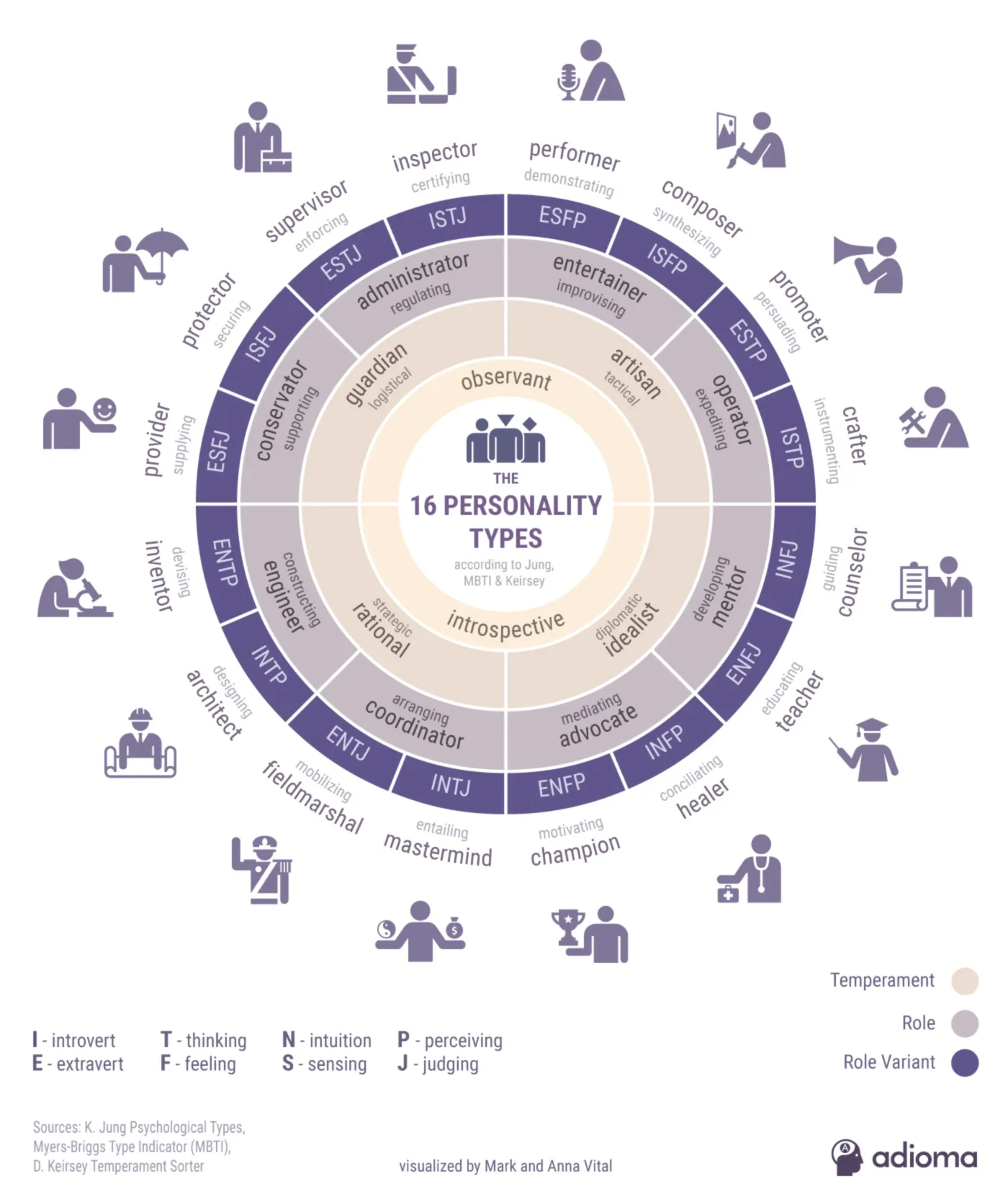
Personality Types
The Myers-Briggs Type Indicator [MBTI] classified people into four personality types:
- Extraversion / Introversion
- Sensing / Intuition
- Thinking / Feeling
- Judging / Perceiving
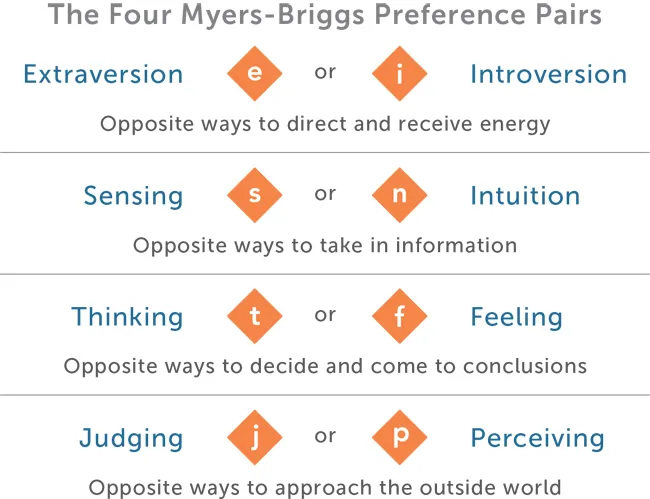
Extraversion vs. Introversion
The traits of extroversion and introversion are a central dimension in some human personality theories as the MBTI assessment. Generally, people who prefer to direct their energy outwards – to people, things, situations – are extroverts [E]. Contrarily, people who prefer to direct their energy inwards – to ideas, information, beliefs – are introverts [I]. Extroverts are action-oriented, while introverts are thought-oriented. An extrovert prefers to focus on other people and things. The introvert, however, prefers to focus on internal thoughts and ideas.
Sensing vs. Intuition
People who prefer to deal with facts, details, and concrete information are sensing types [S]. People who prefer to deal with ideas, abstract concepts, and theories are intuitive types [N]. The sensing person prefers to use the five senses to receive information. The intuitive person, however, receives input from internal thinking processes.
Thinking vs. Feeling
People who prefer to make decisions from a detached standpoint, using reason and logic to make conclusions are thinking types [T]. People who prefer to make decisions from an insider, emotional standpoint are feeling types [F]. The Thinking person judges using logic, while the Feeling person uses affective measures to judge.
Judging vs. Perceiving
People who prefer a planned, well-structured life are judging types [J]. Whereas, people who prefer to go with the flow are perceiving types [P]. Correspondingly, the judging aspect of the type results in sequential step-by-step mental processing. In contrast, the Perceiving person responds in a spontaneous and flexible way. In total, there are 16 personality types. For example, someone who is ENFJ means that this person is Extroverted, iNtuitive, Feeling and Judging. So, each personality type indicates a preference.
Keirsey Temperaments
David Keirsey expanded on the ancient study of temperament by Hippocrates and Plato. In his works1, Keirsey used the names suggested by Plato:
- Artisan (iconic)
- Guardian (pistic)
- Idealist (noetic)
- Rational (dianoetic)
Keirsey divided the four temperaments into two categories [roles], each with two types (role variants).
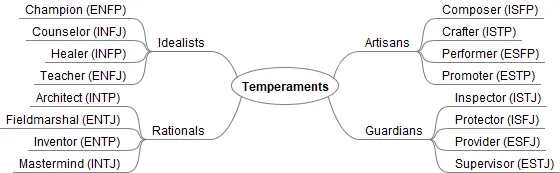
In other words, he took the 16 types and simplified them into 4 temperaments by dividing the S side of the chart into J's and P's and the N side into F's and T's. The resulting 16 types correlate with the 16 personality types described by Briggs and Myers [MBTI]. Furthermore, MBTI is also compatible with the DiSC personality assessment2.
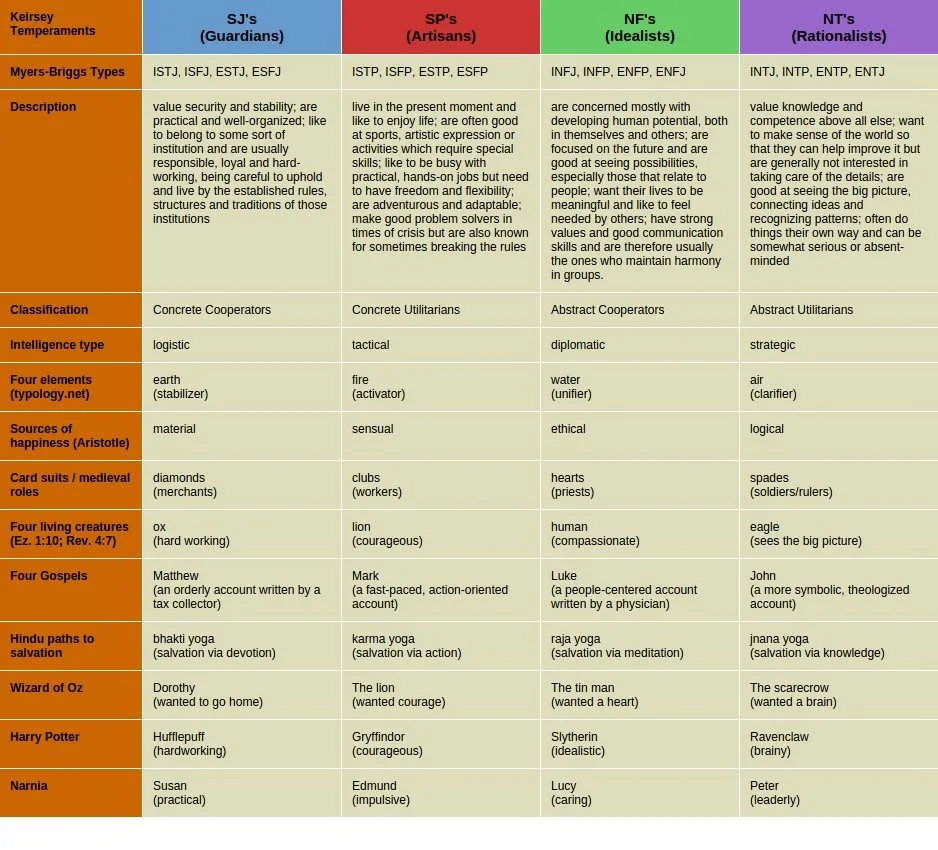
Finding your personality type
The most common way to find out your type is to take the MBTI personality test. This test requires you to answer questions or statements, as accurately as possible, to determine your type. Often, these questions require you to rate how well you relate to the question asked as these questions to map your personality type. For example, such a question may be:
Which answer comes closest to telling how you usually feel or act? Are you inclined to:
- value sentiment more than logic, or
- value logic more than sentiment?
Do you prefer to:
- arrange dates, parties, etc., well in advance, or
- be free to do whatever looks like fun when the time comes?
Once you've taken the test, you can find out how much each personality factor affects your disposition. In the consulting profession, some people may think only certain personalities can be successful. For example, it's a common belief that only extroverts can engage with and relate to customers. However, according to research3, introversion is slightly more common than extroversion. Furthermore, it takes both extroverts and introverts to build a successful engagement team.
The MBTI assessment has provided an intuitive, relatable, easy-to-apply self-discovery & diversity awareness platform that enables our employees at all levels to better understand their own & others preferred styles of work, communication, & collaboration. This has made leaders better at leading, & all contributors more effective at being led & partnering for success.
Citation
Cite this article
Sridharan, M. A. (2019, April 19). MBTI Personality Assessment. Think Insights. https://thinkinsights.net/strategy/mbti-personality-assessment (Accessed [[ACCESS_DATE]])
Sridharan, Mithun A. "MBTI Personality Assessment." Think Insights, 19 Apr. 2019, https://thinkinsights.net/strategy/mbti-personality-assessment. Accessed [[ACCESS_DATE]].
Mithun A. Sridharan, "MBTI Personality Assessment," Think Insights, April 19, 2019, https://thinkinsights.net/strategy/mbti-personality-assessment. Accessed [[ACCESS_DATE]].
Sridharan, M.A. (2019) 'MBTI Personality Assessment', Think Insights. Available at: https://thinkinsights.net/strategy/mbti-personality-assessment (Accessed: [[ACCESS_DATE]]).
M. A. Sridharan, "MBTI Personality Assessment," Think Insights, 2019. [Online]. Available: https://thinkinsights.net/strategy/mbti-personality-assessment. [Accessed: [[ACCESS_DATE]]].
Sridharan MA. MBTI Personality Assessment. Think Insights. Published April 19, 2019. Accessed [[ACCESS_DATE]]. https://thinkinsights.net/strategy/mbti-personality-assessment
Test Your Knowledge
MBTI Personality Assessment
Challenge yourself on the concepts from this article and see how well you understood them.
Subscribers get weekly quizzes and insights — subscribe free
Sponsor this article
Partner with Think Insights
Reach 50,000+ business leaders, consultants, and strategists. Feature your brand alongside expert articles on strategy, leadership, and digital transformation.
Become a Sponsor