Industry Analysis: Fishing


Global fisheries and aquaculture now land more than 235 million tonnes a year and for the first time farmed output exceeds wild catch, a reversal that should reset how boards think about supply risk and where to invest. Margin has migrated away from harvesting, which remains fragmented, fuel-exposed and quota-constrained, toward processing, branding, cold-chain logistics and certification, where scale and traceability data confer real pricing power. Wild capture has plateaued near ninety million tonnes for four decades, so growth now comes almost entirely from aquaculture, particularly salmon, shrimp and tilapia. Buyers, especially large retailers and food-service chains, are consolidating purchasing power and pushing sustainability requirements upstream. The decision facing operators and investors is straightforward: capital should follow processing, genetics, feed and traceability technology rather than additional harvesting capacity and market entry should target certified, branded segments rather than commodity landings.
Is fishing attractive for new entrants?
Attractiveness depends entirely on where in the chain an entrant plays. Harvesting is capital intensive, quota constrained and exposed to fuel prices and weather, which makes it unattractive for most new capital. Processing, branded retail products, feed technology and traceability software offer far better returns because they are not capped by biological yield and can scale with demand rather than catch volume.
Which parts of the value chain are most profitable?
Processing, branding and distribution capture the largest share of margin, followed by genetics and feed supply in aquaculture. Vessel owners and small-scale harvesters typically operate on thin, volatile margins because they sell an undifferentiated commodity into a market where buyers hold pricing leverage.
How is technology changing this industry?
Satellite vessel tracking, electronic monitoring and blockchain-based traceability are making illegal and unreported catch harder to launder into legitimate supply chains, while genomic selection and precision feeding are lifting aquaculture yields well beyond what wild capture could ever provide. These tools are also becoming a condition of market access, since major retailers increasingly require documented provenance.
What capabilities are table stakes vs differentiators?
Seaworthy vessels, valid licenses and basic cold storage are table stakes that every credible operator must have. Differentiators are traceability infrastructure, third-party sustainability certification, proprietary genetics or feed formulations and direct relationships with large retail or food-service buyers that reduce dependence on spot markets.
How should investors or consultants evaluate opportunities here?
Evaluate exposure to biological caps versus farmed capacity, the strength of quota or license positions, the buyer concentration a target faces and whether the business owns a traceability or brand asset that buyers will pay a premium for. Businesses that merely catch fish without downstream integration carry commodity risk that undermines most growth theses.
Why has aquaculture overtaken wild capture?
Wild fish stocks are biologically capped and nearly two-thirds are fished at or near sustainable limits, so catch volumes have been essentially flat since the late 1980s. Aquaculture is not bound by the same ecological ceiling in the same way and improvements in genetics, feed conversion and farming technology have let farmed output keep growing every year.
What role do government subsidies play in fishing economics?
Subsidies, particularly fuel and vessel subsidies paid by several major fishing nations, materially affect who can profitably fish distant waters and who cannot. They distort competitive dynamics between subsidized industrial fleets and unsubsidized small-scale or developing-country fishers and international negotiations over curbing harmful subsidies remain a live regulatory risk for large fleet operators.
How exposed is the industry to illegal and unreported fishing?
Illegal, unreported and unregulated fishing diverts an estimated tens of billions of dollars a year in economic value away from legitimate operators and strains the stocks that legal fishers depend on. It also creates reputational and compliance risk for buyers, which is pushing traceability requirements deeper into procurement contracts.
Is consolidation likely to continue among seafood companies?
Consolidation is likely to continue, particularly in processing, trading and aquaculture, because scale improves access to capital, certification budgets and retail contracts. Harvesting itself will probably remain more fragmented since licenses, local knowledge and vessel ownership are hard to centralize globally.
What is the biggest structural risk facing the industry over the next decade?
Climate-driven shifts in fish distribution, combined with tightening quota regimes and rising input costs, represent the biggest structural risk, because they threaten the predictability that harvesting businesses and their lenders depend on. Operators that diversify across species, geographies and value-chain stages are better positioned to absorb that volatility than single-species, single-region harvesters.
Fishing sits at an unusual intersection of primary industry and food manufacturing, drawing protein directly from a shared natural resource and then running it through a supply chain that looks, by the time it reaches a supermarket shelf, much like any other packaged food business. Executives evaluating this space need to hold two facts in mind simultaneously: the water itself imposes a hard biological ceiling that no amount of capital can lift and the downstream chain built on top of that catch behaves like a conventional, consolidating food industry with real opportunities for differentiation and margin capture. Understanding where those two logics meet and where they diverge, is the starting point for any credible strategy in this sector.
Industry at a glance
The fishing industry, for the purposes of this analysis, spans wild-capture harvesting of marine and freshwater species, aquaculture or farmed production and the processing, distribution and trading activities that convert raw catch into food and industrial products. It excludes recreational fishing, sport charters and the broader marine equipment manufacturing sector, though it does include the feed, genetics and vessel-servicing businesses that exist specifically to support commercial harvesting and farming. Global production of aquatic animals reached roughly 195 million tonnes in 2024, according to the United Nations Food and Agriculture Organization, split between about 92 million tonnes of wild capture and just over 100 million tonnes of aquaculture output, the latter crossing the symbolic threshold of half of total supply for the first time.1
Customers span all three classic categories. Business-to-consumer (B2C) demand flows through retail grocery and food service, business-to-business (B2B) demand covers restaurant supply chains, industrial processors, animal feed manufacturers and pharmaceutical inputs derived from fish oil and business-to-government (B2G) activity includes school meal programs, military procurement and food security stockpiling in several nations. The industry is heavily dependent on adjacent sectors:
fuel markets set harvesting cost structures, agricultural commodity markets set aquaculture feed costs, refrigerated logistics networks determine how far product can travel before spoiling and financial markets and insurers underwrite the vessel and farm assets that make production possible
Indicative economics show a bifurcated industry. Broader market research places the total value of fishing-related commerce at roughly 640 billion dollars in 2026, with aquaculture alone valued near 371 billion dollars at farm gate.2 Wild-capture harvesting is capital intensive at the vessel level but labor intensive in aggregate, since it still employs tens of millions of small-scale fishers globally, many operating outside formal financial systems. Aquaculture skews more capital intensive per unit of output, requiring investment in hatcheries, feed supply chains, pens or ponds and increasingly automated monitoring systems. Regulatory intensity is high throughout, covering catch quotas, vessel licensing, labor standards, food safety and, increasingly, environmental and traceability compliance tied to export market access.
Industry segmentation
Six segments describe the industry with enough granularity for strategic purposes, dimensioned primarily by value-chain position and secondarily by species type and customer channel. Marine wild capture covers the harvesting of ocean species by artisanal, small-scale and industrial fleets, ranging from coastal skiffs to distant-water factory trawlers that process and freeze catch at sea. Inland and freshwater capture, smaller in global volume but critical to food security in parts of Africa and Asia, draws from rivers, lakes and reservoirs using largely artisanal methods.
Aquaculture divides naturally into finfish farming, dominated globally by salmon, tilapia and carp species and crustacean and mollusk farming, led by shrimp and, in several Asian markets, bivalves such as oysters and mussels. Processing and value addition forms a distinct segment covering filleting, freezing, canning, smoking and the manufacture of derived products such as fishmeal and fish oil and this segment increasingly determines who captures margin regardless of where the raw material originated. Distribution and trading, including wholesale seafood markets, cold-chain logistics providers and international commodity traders, connects harvesters and farmers to processors and retailers, often across several national borders before a product reaches a consumer. Finally, a retail and food-service interface segment, spanning supermarket seafood counters, quick-service seafood chains and premium restaurant supply, sets the final price consumers pay and increasingly dictates sustainability and traceability standards back up the chain.
Market structure
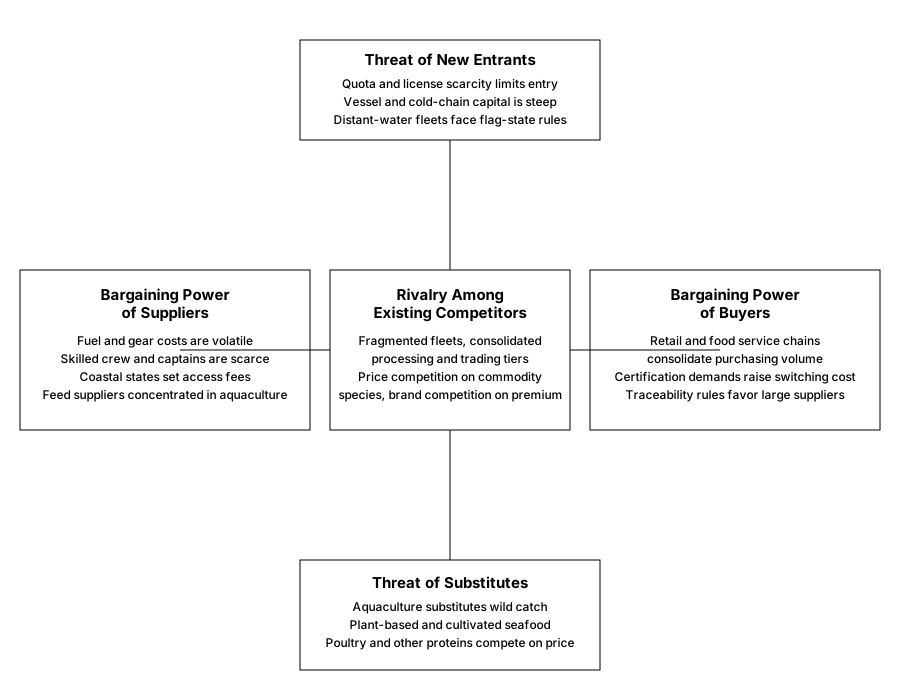
Porter's Five Forces framework clarifies why this industry rewards certain positions and punishes others. Harvesting-only businesses face intense supplier leverage from fuel and labor, real threats from substitutes and aquaculture and a competitive field where undifferentiated product limits pricing power. Downstream positions in processing, branding and distribution enjoy comparatively more favorable dynamics, buffered by certification, customer relationships and product differentiation that a raw commodity catch simply cannot offer on its own.
Bargaining power of buyers
Buyer power in fishing has strengthened considerably as retail and food-service purchasing has consolidated into fewer, larger accounts. A handful of global grocery chains and quick-service restaurant groups now account for a disproportionate share of branded seafood volume in developed markets and those buyers use that scale to negotiate on price, demand consistent year-round supply and impose sustainability certification requirements that smaller suppliers struggle to meet. This dynamic pushes processors and traders toward consolidation of their own, since only scaled suppliers can absorb the compliance costs of serving these accounts while still protecting margin.
Government and institutional buyers exercise a different form of power, setting procurement standards for school meal programs, military rations and public health initiatives that effectively function as another layer of quality and traceability gatekeeping. Meanwhile, in developing markets and traditional wet-market channels, buyer power remains more fragmented, with individual households and small restaurants negotiating directly with local fishers or market intermediaries, which keeps price transparency low but also limits any single buyer's leverage. Across both contexts, the direction of travel favors buyers who can document supply chain provenance, since fraud and species substitution scandals in past years have made traceability a genuine purchasing criterion rather than a marketing afterthought.
| Buyer type | Primary leverage | Trend |
|---|---|---|
| Large retail chains | Volume commitments, private label contracts | Rising, consolidating further |
| Food-service groups | Standardized specification, multi-year contracts | Rising |
| Government and institutional buyers | Procurement standards, safety mandates | Stable, standards tightening |
| Traditional market and household buyers | Local price negotiation | Stable, fragmented |
Bargaining power of suppliers
Suppliers to the fishing industry fall into several distinct categories, each with different degrees of leverage. Fuel suppliers exert outsized influence over harvesting economics because diesel and marine fuel can represent a large share of a vessel's operating cost and fuel price volatility directly compresses or expands fishing margins with little the operator can do beyond adjusting effort. Skilled crew, particularly experienced captains and deckhands willing to work extended sea voyages, are in short supply in several major fishing nations, giving labor real bargaining power even in an industry historically associated with low-wage employment and this scarcity has pushed wages and, in some fleets, reliance on foreign labor arrangements that have drawn regulatory scrutiny.
Coastal and flag states themselves function as a supplier of sorts, since access to fishing grounds through licenses, quotas and bilateral fishing agreements is a precondition for operating at all and these governments have grown more assertive about extracting fees and compliance commitments in exchange for access. In aquaculture, feed suppliers hold considerable power because fishmeal and fish oil markets are concentrated among a small number of producing nations and feed alone commonly represents the largest single cost line for a fish or shrimp farm. Genetics and hatchery suppliers, though a smaller cost line, increasingly command premium pricing as farmers pay for disease resistance and faster growth rates bred into proprietary broodstock lines.
| Supplier category | Source of leverage | Trend |
|---|---|---|
| Fuel and energy providers | Price volatility, no substitute in short term | Rising |
| Skilled crew and labor | Scarcity of experienced mariners | Rising |
| Coastal and flag states | Control of licenses and access rights | Rising |
| Feed and fishmeal producers | Concentrated production base | Stable to rising |
| Genetics and hatchery suppliers | Proprietary broodstock performance | Rising |
Rivalry among existing competitors
Competitive intensity varies sharply by value-chain position. Harvesting remains highly fragmented worldwide, with millions of small-scale operators competing alongside a smaller number of industrial fleets and because raw catch of a given species is largely undifferentiated, competition centers on cost and access rather than brand. Processing and trading have consolidated considerably further and a research report on the sector found the world's 150 largest seafood companies collectively generate around 120 billion dollars in sales, evidence of real scale advantages accruing to companies that can invest in quality assurance, certification and global distribution.3 Japanese conglomerates, Norwegian salmon farmers and Thai and Southeast Asian processors have each built durable positions through different combinations of vertical integration, genetics ownership and processing scale.
Rivalry plays out differently across segments as a result. In commodity wild-capture species such as pollock or skipjack tuna, competition is almost purely on price and reliability of supply and margins stay thin because buyers can switch suppliers with little friction. In farmed salmon and premium branded categories, competition increasingly centers on sustainability credentials, traceable provenance and consistent quality, allowing leading aquaculture companies to sustain healthier margins than pure harvesters. Regional dynamics matter too, since distant-water fleets from a handful of nations compete aggressively for access to productive waters far from their home ports, occasionally creating diplomatic friction with coastal states protective of their exclusive economic zones.
| Competitive dimension | Character | Trend |
|---|---|---|
| Commodity wild capture | Price-based, low differentiation | Stable, thin margins |
| Branded aquaculture | Quality and sustainability based | Intensifying |
| Processing and trading | Scale and certification based | Consolidating |
| Distant-water fleet access | Geopolitical and regulatory | Increasingly contested |
Threat of new entrants
Entry barriers differ enormously depending on where a prospective entrant wants to compete. Harvesting itself is difficult to enter at meaningful scale because fishing licenses and quota allocations in most well-managed fisheries are capped and often held by incumbents, sometimes for decades, meaning a new entrant typically must buy an existing license or quota share rather than simply build a vessel and start fishing. Vessel construction and outfitting also demand significant upfront capital and financing tends to favor operators with an established catch history, creating a circular barrier for genuinely new participants.
Aquaculture presents a somewhat more permeable entry path in emerging markets, where site permitting, rather than quota scarcity, is the binding constraint, though environmental permitting has grown more rigorous as regulators respond to concerns about nutrient runoff and disease transmission from farmed operations. Processing and value-added product businesses are the most accessible entry point for new capital, since they require food manufacturing capability rather than fishing rights, though building relationships with reliable raw material suppliers and large retail buyers still takes time. Across all paths, compliance with food safety, labor and, increasingly, carbon and biodiversity reporting requirements has become a meaningful and rising cost of entry that favors well-capitalized players.
| Entry path | Primary barrier | Trend |
|---|---|---|
| Wild-capture harvesting | Quota and license scarcity | Rising |
| Vessel-based distant-water fishing | Capital cost, flag-state regulation | Rising |
| Aquaculture site development | Environmental permitting | Rising |
| Processing and value-added products | Food safety compliance, buyer relationships | Stable |
Threat of substitutes
Substitution pressure in this industry operates on two levels: substitution between fishing methods and substitution away from seafood as a protein category entirely. Aquaculture itself is the most significant internal substitute for wild capture, since farmed salmon, shrimp and tilapia can replace their wild counterparts in most culinary and nutritional applications and this substitution has already reshaped the industry, with farmed output now exceeding wild catch in aggregate tonnage. This internal substitution is largely beneficial to the industry as a whole, since it has allowed total supply to keep growing even as wild stocks plateaued.
External substitution poses a different kind of threat. Poultry, in particular, competes directly with seafood on price and convenience in many markets and has historically grown faster than seafood consumption in several developed economies because of lower production costs and simpler supply chains. Plant-based seafood alternatives and lab-grown or cultivated seafood remain commercially small today but represent a longer-term watch item, particularly for premium species where flavor replication has advanced furthest. Health and dietary trends generally favor seafood consumption because of its association with omega-3 fatty acids and lean protein, which partially offsets the price-driven pull toward substitute proteins, but that tailwind cannot be assumed to persist indefinitely as alternative protein technology matures.
| Substitute category | Competitive basis | Trend |
|---|---|---|
| Aquaculture replacing wild catch | Cost, consistency, volume | Rising, already dominant |
| Poultry and other animal protein | Price, convenience | Rising |
| Plant-based seafood alternatives | Ethical and environmental positioning | Early stage, rising |
| Cultivated or lab-grown seafood | Novelty, sustainability positioning | Nascent |
Value chain and profit pools
The fishing value chain runs through five interdependent stages, each with distinct economics. Upstream inputs cover vessels, fishing gear, fuel, and, for aquaculture, hatcheries, broodstock genetics and feed formulation and this stage is where the industry's capital intensity and cost volatility concentrate most heavily. Harvesting and farming, the production stage proper, converts those inputs into raw catch and this is where biological risk, weather risk and regulatory quota risk are most acute, since a poor season or a closed fishery can wipe out a year's economics regardless of how efficiently a vessel or farm is run.
Processing transforms raw catch into consumable and shelf-stable products through filleting, freezing, canning and smoking and it is here that meaningful value addition first appears, since processed and packaged products command far higher prices per kilogram than whole raw fish. Distribution and logistics, spanning cold-chain trucking, refrigerated shipping and wholesale market operations, connect processors to retail and food-service buyers and this stage has become increasingly consolidated as temperature-controlled logistics networks require significant infrastructure investment. Finally, the customer interface, whether a supermarket seafood counter, a restaurant menu or an export contract, is where brand, certification and final pricing come together and it is increasingly this stage, rather than the water itself, that determines which participants in the chain earn superior returns.
Profit pool
Profit concentration in fishing has shifted decisively away from the water and toward processing, branding and distribution over the past two decades. Harvesting margins remain thin and volatile because raw catch is largely a commodity, subject to quota limits, weather disruption and fuel cost swings that harvesters cannot pass through to buyers with any reliability. Processing captures materially more value, particularly when it involves branded, ready-to-cook or value-added formats rather than simple freezing of whole fish, because processors can differentiate on quality, format and convenience in ways raw harvesters cannot.
Aquaculture genetics and feed supply represent a smaller but fast-growing profit pool, since companies that own proprietary broodstock lines or advanced feed formulations effectively capture a royalty-like margin on every farmed animal produced using their technology, insulated to a significant degree from swings in raw commodity prices. Distribution and cold-chain logistics providers, particularly those serving export markets with strict traceability and food safety requirements, have also expanded their share of total industry profit, because reliable temperature-controlled delivery has become a genuine bottleneck rather than a commodity service. Retail and food-service brands sit atop the pool, converting scale, certification and consumer trust into premium pricing that flows only partially back up the chain to the original harvester or farmer.
Industry economics and business models
Four business model patterns dominate the industry. Asset-heavy harvesting operators own or lease vessels and quota, generate revenue on a per-kilogram landed basis and bear direct exposure to fuel prices, weather and biological catch limits, making this the most cyclical and capital-intensive model in the sector. Asset-heavy aquaculture operators instead own farming infrastructure such as pens, ponds or land-based recirculating systems and their economics depend heavily on feed conversion ratios, disease management and stocking density, with revenue realized on a harvest-cycle basis that can run from several months to several years depending on species.
Asset-light trading and processing models, by contrast, generate revenue on transaction volume and value-added margin rather than owning harvesting or farming infrastructure directly, buying raw material from multiple sources and adding value through processing, packaging and logistics coordination. Branded consumer product models, increasingly important at the top of the value chain, monetize through premium retail and food-service pricing built on sustainability certification, traceability and brand trust, converting what is fundamentally a commodity input into a differentiated consumer product with materially higher margins than any upstream stage in the chain.
Cost drivers and scalability
Cost structure differs sharply between harvesting and aquaculture, with meaningful implications for how each scales. Harvesting carries a high fixed-cost base in vessel ownership and licensing, combined with a highly variable cost in fuel that can swing operating margins by double digits within a single season and because catch volume is capped by quota and biology rather than by demand, harvesting businesses cannot simply scale output to absorb fixed costs the way a manufacturer can. Aquaculture carries a more balanced cost structure, with feed typically the largest variable cost and site infrastructure the primary fixed investment and because farmed output is not bound by the same wild-stock ceiling, well-run aquaculture operations can pursue genuine economies of scale by expanding stocking density and site count, something harvesting fundamentally cannot replicate.
Processing and distribution economies of scale operate more conventionally, rewarding utilization of freezing, canning and cold-storage capacity and larger processors can spread fixed food-safety and certification compliance costs across greater volume, giving them a structural cost advantage over smaller competitors serving the same certified export markets. Unit economics throughout the chain hinge on yield, whether measured as feed conversion ratio in aquaculture, catch-per-unit-effort in harvesting, or recovery rate in filleting and processing and companies that consistently outperform peers on these yield metrics compound a cost advantage that is difficult for less disciplined operators to close.
Moats, advantages and strategic levers
Defensibility in fishing rarely comes from the water itself, since access rights, while valuable, are typically licensed rather than owned outright and can in principle be reallocated by regulators. The more durable moats sit downstream and in intangible assets. Regulatory moats are real and significant, since quota holdings, fishing licenses and aquaculture site permits are often capped in supply and difficult for new entrants to acquire, effectively grandfathering incumbents into a protected position that persists as long as they remain compliant.
Differentiation moats built on certification, traceability and brand reputation have grown considerably more important as buyers demand documented provenance and companies that invested early in third-party sustainability certification and blockchain or digital traceability systems now enjoy a genuine switching-cost advantage, since replicating that documentation trail takes competitors years, not months. Data and learning advantages are emerging in aquaculture specifically, where companies that have accumulated years of genetics, feed and farm-management data can optimize growth rates and disease resistance in ways that newer entrants without that data history cannot easily match. Cost advantages accrue mainly to scaled processors and distributors who can spread compliance and cold-chain infrastructure costs across larger volumes, while network effects remain limited in this industry compared with digital or platform businesses, appearing mainly in the trading and marketplace layer where liquidity and buyer relationships compound over time.
The companies that will lead this industry over the next decade are not necessarily those that catch the most fish, but those that own the genetics, the traceability data and the retail relationships that convert a commodity catch into a trusted product
Strategic levers
Five levers matter most for both entrants and incumbents deciding how to compete in this industry. Vertical integration into processing and branding lets harvesters and farmers capture margin currently ceded to intermediaries, though it requires capabilities, particularly food manufacturing and consumer marketing, that most harvesting operators do not naturally possess and must build or acquire. Investment in traceability and certification infrastructure has moved from a nice-to-have to close to a market-access requirement for export-oriented producers and companies that treat it as a core capability rather than a compliance cost tend to command better buyer relationships and pricing.
Geographic diversification across fishing grounds, aquaculture regions or export markets reduces exposure to any single regulatory regime, climate event or trade dispute, a meaningful consideration given how concentrated some fisheries and farming regions have become. Species and product portfolio diversification similarly reduces exposure to single-species biological or price shocks, letting operators shift emphasis between species as relative economics change season to season. Finally, disciplined participation in quota and licensing regimes, rather than pursuit of maximum short-term catch, protects long-run access to fishing grounds and positions operators favorably with regulators and certification bodies increasingly focused on stock sustainability as a condition of continued market access.
Structural risks, regulation and trends
Several structural risks deserve board-level attention. Regulatory risk is substantial and growing, as international negotiations over harmful fisheries subsidies, tightening quota regimes in response to stock assessments and expanding traceability mandates in major import markets each raise the compliance bar for operators. Nearly two-thirds of assessed marine fish stocks remain within biologically sustainable levels, but the share fished at unsustainable levels has been creeping upward by roughly one percentage point a year, a trend that puts sustained pressure on regulators to tighten quotas further.4
Illegal, unreported and unregulated fishing represents a distinct and persistent structural risk, diverting an estimated tens of billions of dollars annually in economic value away from legitimate operators while straining the same stocks legal fishers depend on for their livelihoods.5 Technology disruption cuts in the industry's favor overall, since satellite vessel tracking and electronic monitoring are making illicit catch harder to launder into legitimate supply chains and genomic selection is lifting aquaculture productivity in ways wild capture cannot replicate. Commodity and price risk remains ever-present through fuel and feed cost volatility and geopolitical risk has intensified as coastal states assert greater control over exclusive economic zones and distant-water fleets compete more openly for access to productive waters.
Macro demand drivers remain favorable in aggregate, with rising global population and continued dietary shifts toward lean protein supporting long-run seafood demand growth, even as growth in per-capita consumption has slowed in some developed markets already well supplied. Supply-side trends point clearly toward aquaculture as the primary growth engine, since wild capture has essentially reached its ecological ceiling and disruptive models such as land-based recirculating aquaculture systems and offshore farming technology are beginning to challenge the geographic constraints that have traditionally limited where farming can occur.
For entrants, the strategic playbook depends on risk appetite and capital availability. A niche entry strategy focused on a specific certified species, region or premium branded product avoids direct competition with entrenched commodity harvesters and can build defensible margin faster than a broad-based entry attempt. Partnering with or acquiring an existing quota holder or licensed operator is typically faster and less risky than attempting to build harvesting rights from scratch, given how constrained license and quota supply has become in most well-managed fisheries. A deliberate regulatory strategy, engaging early and constructively with fisheries management bodies and certification schemes, pays dividends over time as sustainability credentials become a genuine market-access requirement rather than a marketing exercise.
For incumbents, defending existing positions means protecting quota and license holdings through demonstrated compliance and stock stewardship, since regulators increasingly reward operators who can show a credible sustainability track record with continued or expanded access. Expansion opportunities lie disproportionately in aquaculture capacity, processing scale and traceability infrastructure rather than in additional wild-capture effort, given the biological ceiling already constraining that segment. Deepening moats further means continuing to invest in proprietary genetics, direct retail relationships and digital traceability systems that raise switching costs for buyers and create real separation from commodity competitors who have not made those same investments.
Caselet: Maruha Nichiro and the industrial consolidation of Japanese seafood
Maruha Nichiro Corporation, formed through the 2007 merger of Maruha Corporation and Nichiro Corporation, two seafood businesses each with roots stretching back more than a century, stands today as the world's largest seafood company by revenue, generating roughly 12.8 billion dollars annually across fishing, aquaculture, processing and global trading operations.6 Its scale illustrates precisely the pattern this analysis has described:
a business that began in wild-capture harvesting has spent decades migrating its center of gravity toward processing, branding and distribution, the stages of the chain where margin actually concentrates
The company's operations span an unusually complete slice of the value chain. It operates distant-water fishing fleets targeting tuna and other pelagic species, runs aquaculture operations for species including yellowtail and bluefin tuna and maintains an extensive processing and food manufacturing arm that produces everything from frozen fillets to branded packaged foods sold under recognizable retail labels across Japan and export markets. This vertical span gives Maruha Nichiro a structural advantage that pure harvesters lack, allowing it to smooth the volatility of any single stage, whether a poor catch season, a feed cost spike, or a shift in consumer preference, by drawing on strength elsewhere in its portfolio.
Japan's broader seafood sector, of which Maruha Nichiro is the largest constituent, has historically organized around what industry observers refer to informally as a big-three structure, alongside peers Nippon Suisan Kaisha and Kyokuyo, each pursuing a similar strategy of combining harvesting, aquaculture and heavily branded processed food operations. This concentration reflects the broader economic logic of the industry:
harvesting alone offers thin, volatile returns, while a fully integrated operator can capture margin at every stage and use its downstream brand strength to smooth the inherent unpredictability of catching or farming a biological product
Maruha Nichiro's bluefin tuna aquaculture program is a particularly instructive example of where the industry's genetics and technology investment is headed. Bluefin tuna, among the most commercially valuable seafood species in the world, has historically been sourced almost entirely from wild capture, a supply base under sustained pressure from overfishing concerns and tightening international quota regimes. By investing in full life-cycle aquaculture technology, capable of breeding and raising bluefin tuna in captivity from egg to harvest rather than merely fattening wild-caught juveniles, the company has built a supply source that is less exposed to quota cuts and wild stock volatility than competitors dependent entirely on wild catch. This kind of technology investment exemplifies the strategic lever available to well-capitalized incumbents:
own the biological supply risk rather than simply passing it through to customers
The company has also had to navigate the reputational and compliance dimension of operating in this industry, an increasingly unavoidable cost of doing business at global scale. Large, vertically integrated seafood companies face persistent scrutiny over labor practices on fishing vessels, sourcing transparency and sustainability of the wild stocks they depend upon and maintaining credibility with export markets and international buyers requires ongoing investment in certification, monitoring and supply chain documentation. Maruha Nichiro's participation in industry sustainability initiatives and its public reporting on sourcing practices reflect the broader shift described earlier in this analysis, where traceability and certification have moved from a marketing differentiator to close to a baseline requirement for continued access to premium export markets.
Maruha Nichiro's trajectory, from a domestic Japanese fishing operator to a globally diversified seafood conglomerate spanning harvesting, aquaculture, processing and branded retail products, offers a template for how incumbents in this industry defend and expand their position. Rather than competing purely on catch volume, a race the company could not reliably win given quota constraints and wild stock limits, it built scale in the stages of the chain where differentiation and margin are actually available, an approach several of its global peers, including Norway's Mowi in farmed salmon and Thailand's Thai Union in processed tuna products, have pursued with comparable logic in their respective specialties.
Fishing supplies protein to billions of people and livelihoods to tens of millions of small-scale and industrial workers, yet the water itself, an open-access, biologically capped resource, sets the industry's outer limit. Wild capture has plateaued for a generation while aquaculture now supplies the majority of aquatic animal protein, shifting the center of gravity from harvesting toward farming, processing and distribution. Profit concentrates in genetics, feed, branded processing and retail-facing logistics, not in the boats themselves. The durable strategic levers are vertical integration into processing and branding, investment in traceability and certification, geographic diversification across fishing grounds and farming regions and disciplined participation in quota and licensing regimes rather than a race for additional catch.
Citation
Cite this article
Sridharan, M. A. (2023, January 20). Industry Analysis: Fishing. Think Insights. https://thinkinsights.net/strategy/industry-analysis-fishing (Accessed [[ACCESS_DATE]])
Sridharan, Mithun A. "Industry Analysis: Fishing." Think Insights, 20 Jan. 2023, https://thinkinsights.net/strategy/industry-analysis-fishing. Accessed [[ACCESS_DATE]].
Mithun A. Sridharan, "Industry Analysis: Fishing," Think Insights, January 20, 2023, https://thinkinsights.net/strategy/industry-analysis-fishing. Accessed [[ACCESS_DATE]].
Sridharan, M.A. (2023) 'Industry Analysis: Fishing', Think Insights. Available at: https://thinkinsights.net/strategy/industry-analysis-fishing (Accessed: [[ACCESS_DATE]]).
M. A. Sridharan, "Industry Analysis: Fishing," Think Insights, 2023. [Online]. Available: https://thinkinsights.net/strategy/industry-analysis-fishing. [Accessed: [[ACCESS_DATE]]].
Sridharan MA. Industry Analysis: Fishing. Think Insights. Published January 20, 2023. Accessed [[ACCESS_DATE]]. https://thinkinsights.net/strategy/industry-analysis-fishing
Test Your Knowledge
Industry Analysis: Fishing
Challenge yourself on the concepts from this article and see how well you understood them.
Subscribers get weekly quizzes and insights — subscribe free
Sponsor this article
Partner with Think Insights
Reach 50,000+ business leaders, consultants, and strategists. Feature your brand alongside expert articles on strategy, leadership, and digital transformation.
Become a Sponsor