Information Is An Asset


Information is a strategic asset that gains value as it moves through a structured value chain—from raw data to actionable insight. Organizations that treat information with the same rigor as financial or physical assets establish governance, accountability, and continuous improvement. Those that neglect it face decline as competitors exploit overlooked opportunities. Success lies not in technology alone but in cultivating a culture where information drives innovation, operational excellence, and sustained competitive advantage across all business sizes.
What does it mean to treat information as an asset?
It means applying governance, management, and continuous improvement to information, similar to how organisations manage physical or financial assets, so that data is protected and actively used to guide decisions.
What is the Information Value Chain?
It is the process of transforming raw data into actionable insights, with value increasing at each stage, supported by a governance framework that manages and improves information assets over time.
Which organisations are most at risk from ignoring information?
Large organisations with high data volumes that lack an information-as-asset culture face the greatest risk of sudden, catastrophic decline, as competitors or new entrants exploit insights they have overlooked.
Can smaller organisations benefit from treating information as an asset?
Yes. Smaller organisations can use available information to identify specific market niches, guide investments, and innovate in goods and services, achieving steady growth despite limited resources.
What are examples of companies that failed to treat information as an asset?
Kodak and Lehman Brothers are cited as examples of organisations with access to significant information that nonetheless declined because they did not act on the insights available to them.
Information is an asset. It does accrete value through a value chain. Large organisations that do not have a culture of treating information as an asset – to be protected by a system of governance and enabled by a system of managing the information assets – are likely to befall a catastrophic change as their competitors or new entrants make use of the information they ignored. It is, however, much more than a big data technological solution. It is about embedding a mindset in current staff and recruiting and rewarding people who protect and leverage information assets as willingly and with as much insight as those that do so with physical and financial assets.
It is also about small to medium-sized organisations using the information they get to carve out niches which they can dominate through innovation in the goods and services they provide, to specific segments with specific needs.
Ignoring, under-utilising and refusing to continuously improve our capability to capture, analyse, interpret and share information is a pointer in today's economy, of future decline.
The Information Value Chain
Treating information as an asset involves recognizing its value chain. This process transforms raw data into actionable insights, increasing its value at each stage. Organizations that embrace this concept implement a governance framework to manage and continuously improve their information assets.

Four Scenarios of Information Management
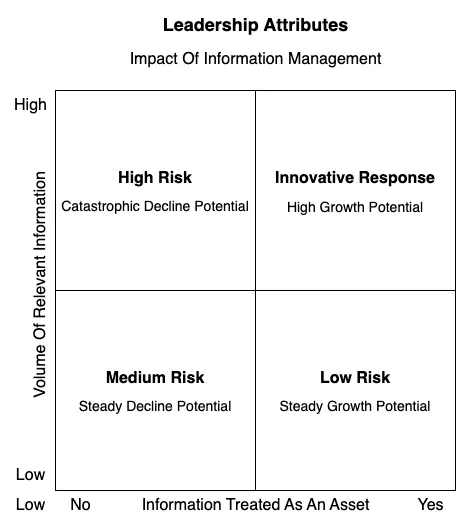
Information as an Asset with High Volume
Organizations in this category are dynamic and innovative. They integrate information-driven practices into their daily operations, strategy, and planning. These companies are well-positioned to benefit from big data initiatives.
Information as an Asset with Low Volume
These typically smaller organizations achieve steady growth despite limited resources. They excel at interpreting market signals and use every piece of information to guide their investments and innovations.
High Volume but Not Treated as an Asset
These companies are like "a person with severe myopia working in an optometrist shop, but never having had the sense to get a pair of prescription glasses." Despite initial success, they risk catastrophic decline as competitors exploit insights they've missed. Examples include Kodak and Lehman Brothers.
Low Volume and Not Treated as an Asset
Often privately held medium-sized businesses, these organizations face a steady decline. They react rather than progress, relying on relationships rather than insights to navigate changing markets.
The Risks of Ignoring Information
Organizations that fail to treat information as an asset risk becoming obsolete. Large companies may face sudden, catastrophic changes as competitors or new entrants capitalize on ignored information. Smaller organizations may experience a slower decline but ultimately fade from view.
Embracing information as an asset is crucial for long-term success. It's not just about implementing big data solutions; it's about fostering a mindset that values information as much as physical and financial assets. For smaller organizations, it means using available information to carve out dominant niches through innovation. The difference between stagnation and growth often lies in how we value and utilize the information at our fingertips. In today's economy, ignoring or underutilizing information is a clear indicator of future decline.
In today's economy, information defines competitive strength. Treating it as an asset means recognizing its value chain and embedding governance to manage, analyze, and apply insights effectively. Large organizations that overlook this risk disruption, while smaller firms can excel by using information to innovate and dominate niches. True transformation comes from cultural change—recruiting, rewarding, and empowering people who value data as they would capital. Ignoring information's potential signals not efficiency but future decline.
Citation
Cite this article
Sridharan, M. A. (2023, January 19). Information Is An Asset. Think Insights. https://thinkinsights.net/dna/information-asset (Accessed [[ACCESS_DATE]])
Sridharan, Mithun A. "Information Is An Asset." Think Insights, 19 Jan. 2023, https://thinkinsights.net/dna/information-asset. Accessed [[ACCESS_DATE]].
Mithun A. Sridharan, "Information Is An Asset," Think Insights, January 19, 2023, https://thinkinsights.net/dna/information-asset. Accessed [[ACCESS_DATE]].
Sridharan, M.A. (2023) 'Information Is An Asset', Think Insights. Available at: https://thinkinsights.net/dna/information-asset (Accessed: [[ACCESS_DATE]]).
M. A. Sridharan, "Information Is An Asset," Think Insights, 2023. [Online]. Available: https://thinkinsights.net/dna/information-asset. [Accessed: [[ACCESS_DATE]]].
Sridharan MA. Information Is An Asset. Think Insights. Published January 19, 2023. Accessed [[ACCESS_DATE]]. https://thinkinsights.net/dna/information-asset
Test Your Knowledge
Information Is An Asset
Challenge yourself on the concepts from this article and see how well you understood them.
Subscribers get weekly quizzes and insights — subscribe free
Sponsor this article
Partner with Think Insights
Reach 50,000+ business leaders, consultants, and strategists. Feature your brand alongside expert articles on strategy, leadership, and digital transformation.
Become a Sponsor