Industry Analysis: Civil Engineering


Civil engineering design and consulting firms sit upstream of every road, bridge, water system and rail line built in the world, converting public and private capital into engineered assets without ever touching a shovel. The industry is large, growing steadily on the back of infrastructure legislation and urbanization, but margin capture is uneven: scale players with deep bench strength and multidisciplinary reach are pulling ahead of fragmented regional firms, while specialist consultancies in water, geotechnical and structural niches defend premium fees through scarce licensed talent. Bargaining power is shifting toward large design firms as government clients consolidate spending through fewer, larger framework contracts and away from generalist mid-market practices that cannot offer the breadth needed for megaprojects. Leaders should prioritize scale in high-growth technical disciplines, invest in digital delivery capability and pursue programmatic client relationships over one-off project wins to protect margin as procurement consolidates.
Is civil engineering consulting attractive for new entrants?
It depends on the segment. Broad multidisciplinary design work is difficult to enter because public clients require years of qualifying project history before awarding contracts and professional licensure requirements slow the ramp of any new practice. Narrow technical niches such as geotechnical instrumentation or specialty bridge inspection are more accessible because a small team of credentialed engineers can win subconsultant roles without the balance sheet of a large prime contractor.
Which parts of the value chain are most profitable?
Front-end advisory and feasibility work, along with specialized technical disciplines such as structural peer review, seismic retrofit design and water treatment process engineering, carry the highest margins because they depend on scarce expertise rather than headcount. Detailed design production and construction administration are more commoditized and price-competitive, particularly where clients can shop fee proposals across multiple qualified firms.
How is technology changing civil engineering firms?
Building information modeling, digital twins and generative design tools are compressing the hours needed for routine design tasks while increasing the value of engineers who can validate model outputs and manage complex multidisciplinary coordination. Firms that invested early in common data environments and parametric design are now winning larger programs on the strength of demonstrated delivery speed, while laggards face margin pressure as clients expect digital deliverables as standard rather than a premium add-on.
What capabilities are table stakes versus differentiators?
Professional licensure, quality assurance systems and basic building information modeling proficiency are table stakes that every credible firm must have to qualify for public work. Differentiators include specialized technical certifications in disciplines like tunneling or coastal engineering, a track record on complex megaprojects, in-house data science teams that support asset management advisory and the balance sheet strength to carry risk on alternative delivery contracts.
How should investors evaluate opportunities in civil engineering services?
Investors should weight backlog quality and public-versus-private revenue mix heavily, since government-funded backlog is more durable through economic cycles than private developer work. Firms with high specialist fee mix, strong utilization discipline and demonstrated ability to win repeat programmatic contracts with the same public agencies tend to sustain higher margins and lower earnings volatility than generalist regional design shops.
What is the difference between civil engineering firms and architecture firms?
Architecture firms lead building design with an emphasis on form, function and occupant experience, while civil engineering firms lead the technical systems that support the built and natural environment, including roads, bridges, water infrastructure, drainage and site grading. The two professions frequently collaborate on building projects but operate as distinct practices with separate licensure, separate client relationships on infrastructure-only work and separate competitive dynamics.
Why are government agencies such a dominant customer segment?
Public agencies own and fund the majority of transportation, water and civil infrastructure assets in most countries and infrastructure spending legislation directs multi-year capital programs through these agencies. Because public works are funded by taxpayers and regulated by public procurement law, agencies exercise significant control over fee structures, delivery methods and vendor qualification criteria.
What role does private equity play in civil engineering consolidation?
Private equity firms have become active buyers of specialty engineering and infrastructure services firms, seeking asset-light, cash-generative businesses with recurring public sector revenue. Consolidation lets acquirers combine complementary technical disciplines under one platform, win larger multidisciplinary contracts and extract cost synergies from shared back-office functions, though integration risk and cultural fit with employee-owned engineering cultures remain real challenges.
How exposed is the industry to economic cycles?
Civil engineering firms with a public-sector-heavy client base are comparatively insulated from short-term economic cycles because government infrastructure budgets are set through multi-year appropriations rather than quarterly demand. Firms leaning toward private land development, commercial site engineering or residential subdivision work carry more cyclical exposure tied to interest rates, housing starts and commercial real estate investment.
What separates a defensible civil engineering firm from a commodity design shop?
A defensible firm builds long-term institutional relationships with repeat public and private clients, maintains bench depth across multiple technical disciplines so it can staff complex projects without subcontracting core scope and invests continuously in digital delivery infrastructure that improves speed and accuracy on every subsequent project. A commodity shop competes primarily on hourly rate and wins isolated projects without building the compounding trust or delivery data that produces repeat work.
Civil engineering is the technical discipline that turns public appropriations and private capital into roads, bridges, water systems, rail corridors and the graded, drained land beneath every building. The firms that practice it professionally, as opposed to the contractors who later pour the concrete, sell judgment: the calculations, drawings, permits and construction oversight that determine whether a structure stands, a water system delivers safe supply, or a highway interchange moves traffic without failing under load. This industry analysis examines that design and consulting layer of civil infrastructure, distinct from architecture, which leads building design and distinct from construction contracting, which executes the physical work engineers specify.
Industry at a glance
Civil engineering consulting and design firms sell professional services, primarily on a fee basis tied to project scope, hourly labor rates or a percentage of construction value, to three overlapping customer categories: government agencies at the federal, state and municipal level, referred to as business-to-government (B2G) work, private developers and corporations for site engineering and industrial infrastructure, categorized as business-to-business (B2B) and occasionally individual property owners for smaller civil works, which counts as business-to-consumer (B2C) though this segment is marginal in revenue terms. Government clients dominate demand because they own and fund the majority of transportation, water, flood control and public utility infrastructure, meaning the industry's fortunes track public capital budgets, multi-year infrastructure legislation and municipal bond issuance more closely than they track general economic growth.
The global civil engineering market, spanning design, consulting and related technical services, is valued in the trillions of dollars when measured broadly including construction-adjacent activity, though the pure design and consulting services segment is a much smaller slice, estimated near 200 billion dollars globally and growing at a mid-single-digit to high-single-digit annual rate through the early 2030s.1 In the United States, the largest 500 design firms tracked by industry press posted a 7.4 percent revenue increase to 158.7 billion dollars in the most recent annual ranking, evidence that scale players are absorbing a disproportionate share of growth as public infrastructure spending flows through fewer, larger vendor relationships.2
The industry is labor-intensive rather than capital-intensive: the primary asset is licensed engineering talent and the primary cost is compensation, typically 55 to 65 percent of revenue at a mature firm. Regulatory intensity is high because most jurisdictions require a licensed professional engineer to stamp and take legal responsibility for design documents, creating a structural entry barrier that protects incumbent margins even though the underlying technical knowledge is widely taught and not proprietary. Revenue models split between time-and-materials billing, common on complex or open-scope work, lump-sum fixed-fee contracts, common on well-defined public infrastructure projects and increasingly, alternative delivery structures such as design-build and progressive design-build, where the engineering firm shares risk and reward with a construction partner rather than billing purely for design hours.
Industry segmentation
The industry organizes along technical discipline and value chain position rather than around a single dimension and six segments capture most of the commercial activity. Transportation engineering covers roads, highways, bridges, rail and airport infrastructure and it is typically the largest segment by revenue because it aligns directly with government capital programs and federal funding formulas. Water and environmental engineering covers drinking water treatment, wastewater systems, stormwater management and environmental remediation, a segment with unusually durable demand because water infrastructure is aging across most developed economies and replacement is not discretionary.
Structural engineering serves both standalone infrastructure, such as bridges and dams and building-adjacent work performed in support of architects and it commands a premium fee structure because structural failure carries severe liability exposure that clients are willing to pay to avoid. Geotechnical engineering, covering soil and foundation analysis, is a specialized, often higher-margin niche because it requires site-specific investigation, laboratory testing and a narrower talent pool than general civil design. Land development and site civil engineering serves private real estate developers preparing sites for construction, including grading, drainage and utility layout and this segment carries more cyclical exposure than the public-sector segments because it tracks private capital investment and interest rates directly. Finally, a growing segment of program and construction management services has emerged, where civil engineering firms sell oversight of large capital programs on behalf of owners rather than pure design output, a segment that trades lower design margin for larger, stickier, multi-year contract value.
Market structure
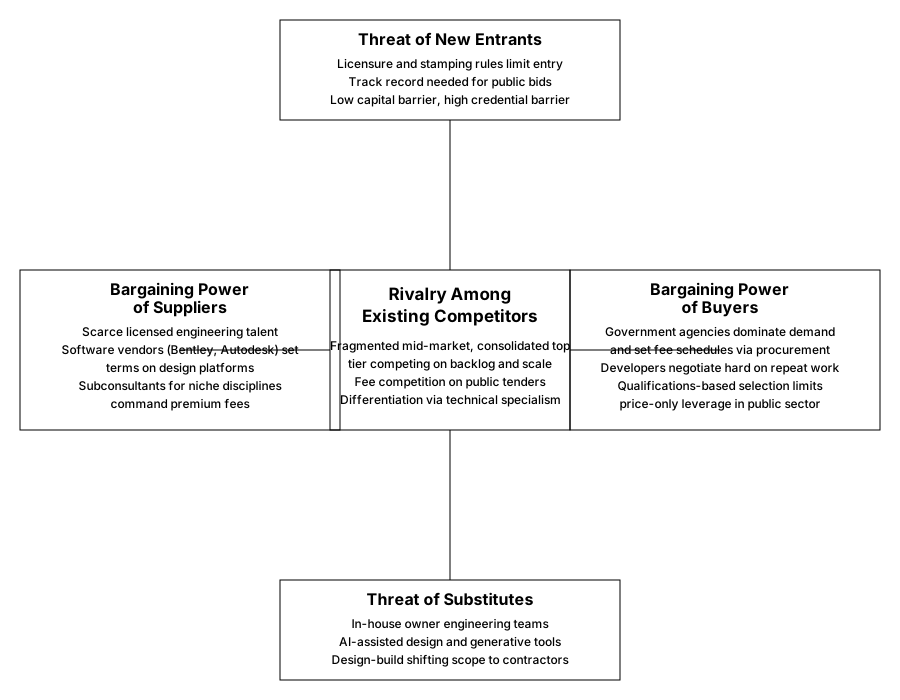
Competitive dynamics in civil engineering consulting reflect a industry where public procurement rules shape almost every interaction between buyer and seller. Qualifications-based selection, the practice of shortlisting firms on technical merit before negotiating fee, blunts pure price competition on complex public work, yet fee pressure remains intense on routine design tasks where many firms can meet the qualification bar. Consolidation among the largest global players is reshaping the competitive set, with the top firms increasingly able to offer the multidisciplinary breadth that megaprojects require, while thousands of smaller regional firms compete for subconsultant roles and less complex local work. The following Porter's Five Forces analysis unpacks each dimension of this structure.
Bargaining power of buyers
Government agencies are the industry's most powerful buyer category because they control the majority of civil infrastructure spending and set the procurement rules under which firms must compete. Federal, state and municipal agencies typically standardize fee schedules, require competitive proposals and reserve the right to negotiate hourly rates down to published maximums, which caps upside even for firms with strong technical differentiation. Qualifications-based selection processes moderate this power somewhat by preventing pure lowest-price awards on complex work, but on straightforward design tasks agencies can and do shop multiple qualified firms against each other. Private developers exercise a different kind of power: they tend to be repeat buyers with strong price sensitivity on routine site civil work, but they reward firms that can accelerate permitting and reduce project timeline risk, since carrying costs on undeveloped land are expensive. Large industrial and energy clients, particularly those building data centers and power infrastructure, have emerged as an increasingly powerful buyer category because they demand speed and are willing to pay premium fees to firms that can compress design timelines, which has shifted some bargaining leverage back toward specialist engineering firms serving that niche. Across all buyer types, the credential and liability requirements embedded in civil engineering work prevent buyers from easily switching to unlicensed or informal alternatives, which caps how far buyer power can erode firm margins even in a competitive bidding environment.
| Buyer category | Primary leverage | Constraint on that leverage |
|---|---|---|
| Federal and state transportation agencies | Fee schedules, competitive shortlists | Qualifications-based selection limits pure price competition |
| Municipal water and utility authorities | Multi-year framework negotiations | Aging infrastructure creates non-discretionary demand |
| Private real estate developers | Repeat business, price shopping on routine work | Value speed and permitting expertise over lowest fee |
| Data center and energy developers | Premium willingness for schedule certainty | Scarcity of specialist firms limits their own alternatives |
Bargaining power of suppliers
The most consequential supplier to a civil engineering firm is its own licensed workforce and the scarcity of professional engineers with the right combination of credentials and experience gives that talent pool significant leverage over employers. Demand for engineers with transportation, water and structural specialization has outpaced the supply graduating from university programs in many markets, pushing up compensation and making retention a persistent cost pressure rather than a one-time hiring challenge. Software vendors form a second influential supplier category: design and modeling platforms from firms such as Bentley Systems and Autodesk have become mission-critical infrastructure for every design firm and because switching platforms mid-project or mid-client-relationship is costly, these vendors can raise licensing fees with limited pushback. Specialized subconsultants, such as geotechnical testing labs, traffic modeling boutiques or environmental permitting specialists, represent a third supplier category whose narrow expertise commands premium subcontract rates, particularly on complex projects where the prime firm lacks in-house capability. Raw material suppliers matter much less directly to design firms than to contractors, since engineers specify materials rather than purchase them, though volatile material pricing can indirectly affect a firm's exposure when it holds cost-estimating liability on a project. On balance, supplier power in this industry concentrates heavily in labor and enabling software rather than in physical inputs, a structural feature that differentiates civil engineering from capital-intensive industries where physical supply chains dominate cost negotiations.
| Supplier category | Source of leverage | Effect on firm economics |
|---|---|---|
| Licensed professional engineers | Talent scarcity relative to demand | Rising compensation as share of revenue |
| Design and modeling software vendors | Platform lock-in across active projects | Recurring licensing cost growth |
| Specialized technical subconsultants | Narrow, hard-to-replicate expertise | Premium subcontract rates on complex scope |
| Professional liability insurers | Concentrated market for engineering E and O coverage | Rising insurance costs on high-risk project types |
Rivalry among existing competitors
Competitive intensity varies sharply by tier. At the top of the market, a small number of global multidisciplinary firms, including AECOM, Jacobs Solutions, WSP Global and Stantec, compete for the largest infrastructure programs and their scale allows them to bid on megaprojects that smaller firms cannot staff or bond. AECOM reported a record backlog exceeding 24 billion dollars in its most recent fiscal year, illustrating how much revenue visibility scale provides once a firm reaches sufficient size to win large, multi-year public programs.3 Below that tier, thousands of mid-market and regional firms compete more directly on price and relationships, often serving as subconsultants to the larger primes or competing for state and local contracts too small to attract global players. Rivalry among these mid-market firms is intensified by relatively low product differentiation on routine design work, where several qualified firms can typically produce comparable technical output, pushing competition toward fee level, schedule commitment and the strength of existing client relationships. Rivalry is dampened, however, in specialist niches such as seismic retrofit, tunneling or advanced water treatment process design, where only a handful of firms in a given region hold the relevant credentials and track record, allowing those specialists to sustain higher margins than the generalist segment. Industry observers increasingly debate whether a wave of consolidation, including speculation about a possible combination between two of the largest global players, will further concentrate the competitive set and reduce the number of credible bidders on the very largest infrastructure programs.4
| Competitive dimension | Top-tier global firms | Mid-market and regional firms |
|---|---|---|
| Primary basis of competition | Scale, multidisciplinary breadth, program management | Fee level, local relationships, responsiveness |
| Typical project size | Multi-billion-dollar infrastructure programs | Single-site or single-asset projects |
| Revenue visibility | Multi-year framework and backlog | Project-by-project, shorter cycle |
| Margin trajectory | Stable, supported by specialist mix | Compressed by fee competition |
Threat of new entrants
Structural barriers keep the threat of new entrants moderate rather than low and the barriers differ sharply by segment. Professional licensure is the most significant barrier: in most jurisdictions, a firm cannot legally offer civil engineering services without employing licensed professional engineers who personally bear liability for stamped documents and building that credentialed bench takes years, not months. Public sector procurement compounds this barrier because agencies typically require demonstrated experience on comparable prior projects before shortlisting a firm, which locks new entrants out of the largest, most attractive contracts until they accumulate a track record, often by first working as subconsultants under an established prime. Capital requirements are comparatively low, since the business does not require heavy fixed-asset investment, which means the effective barrier is human capital and reputation rather than balance sheet strength. This creates an unusual entry pattern: a small group of experienced engineers can start a specialist boutique relatively easily and compete successfully in a narrow technical niche, while broad multidisciplinary entry against the scale incumbents is far more difficult. Private equity capital flowing into the sector has also lowered the effective entry barrier for growth by acquisition, since a well-capitalized platform can acquire several credentialed regional firms and combine them into a broader competitor faster than it could build that breadth organically, contributing to the sharp rise in AEC sector deal valuations recorded in 2025.5
| Entry pathway | Barrier level | Typical entrant profile |
|---|---|---|
| Specialist boutique in a narrow discipline | Moderate, credential-driven | Senior engineers spinning out of larger firms |
| Broad multidisciplinary competitor | High, requires scale and track record | Well-capitalized platform pursuing acquisitions |
| Subconsultant to established primes | Low, easiest entry point | New or small firms building a track record |
| Direct competitor on federal megaprojects | Very high, requires bonding and prior performance | Rare, typically only existing large firms |
Threat of substitutes
Direct substitutes for professional civil engineering services are limited because licensure requirements and liability exposure make informal or unlicensed alternatives legally unusable on most public and commercial projects. The most meaningful substitute is insourcing: large public agencies, utilities and major developers sometimes build in-house engineering departments to handle routine design work, reducing their reliance on external consultants for anything beyond specialized or overflow capacity. Design-build and other alternative project delivery models present a subtler substitution threat, because they shift contractual control of the design function toward construction firms, which then either build in-house engineering capability or squeeze the fee available to design subconsultants working under them. Artificial Intelligence-assisted design tools represent an emerging substitution pathway for routine, rules-based design tasks, such as standard drainage calculations or repetitive structural checks, though the professional liability regime means a licensed engineer must still review and stamp any output before it can be used, which limits full substitution in the near term even as it reduces the labor hours required per project. Generalist management consultancies occasionally compete for the program management and advisory layer of infrastructure work, substituting for the strategic advisory portion of a civil engineering firm's offering without touching the technical design core, which pressures fees on the advisory segment specifically rather than the industry as a whole.
| Substitute pathway | Degree of threat | Segment most exposed |
|---|---|---|
| Owner in-house engineering teams | Moderate, concentrated among large agencies and utilities | Routine, recurring design work |
| Design-build shifting scope to contractors | Moderate and growing | Detailed design and construction administration |
| AI-assisted design and automation tools | Emerging, currently partial | Repetitive, rules-based calculations |
| Generalist management consultancies | Low, confined to advisory layer | Program management and strategic advisory |
Value chain and profit pools
The civil engineering value chain runs from early feasibility work through long-term asset stewardship and value concentrates unevenly across its stages. The chain begins with planning and feasibility, where firms assess needs, evaluate alternatives and produce the studies that justify public investment or private development, a stage that requires senior technical judgment and carries outsized influence over a project's eventual scope and cost. Preliminary and detailed design follows, the stage most people associate with civil engineering, where engineers translate a chosen alternative into calculations, drawings and specifications that a contractor can build from. Permitting and regulatory approval forms a distinct stage in many jurisdictions, requiring specialized expertise in environmental review, public agency coordination and stakeholder engagement that some firms treat as a standalone service line. Construction administration and inspection follows, where engineers verify that the built structure conforms to design intent, a stage that carries significant liability exposure and therefore commands steady, if not spectacular, margins. Commissioning and asset handover close out the traditional project lifecycle, while an increasingly important final stage, ongoing asset management advisory, has emerged as owners seek help planning long-term maintenance, capital renewal and resilience upgrades across their infrastructure portfolios rather than treating each project as a discrete, one-time engagement.
Profit pool
Margin concentrates most heavily at the front and back ends of the value chain rather than in the middle. Feasibility studies, alternatives analysis and specialized technical advisory command the highest fee rates because they depend on scarce senior judgment rather than production volume and clients pay a premium to reduce the risk of choosing the wrong project alternative before major capital commitment. At the back end, asset management advisory and long-term program management contracts generate durable, high-margin revenue because they convert a single project relationship into a recurring, multi-year engagement that is difficult for a competitor to displace once established. The middle of the chain, detailed design production and routine construction administration, has become progressively more commoditized as digital design tools reduce the labor hours required and as public procurement pushes fee competition on well-defined scopes of work. This has produced a barbell pattern across the industry: firms that concentrate on high-judgment advisory work or that operate at a scale sufficient to win large program management contracts sustain healthy operating margins, typically in the low double digits, while firms that compete primarily on detailed design production face persistent pressure toward the mid-single digits. The shift toward alternative project delivery models has also moved a portion of the profit pool away from pure design fees and toward shared risk and reward on design-build contracts, rewarding firms willing to accept construction cost risk in exchange for a larger share of total project value.
Industry economics and business models
Three business models dominate the industry, each with distinct economics. The traditional fee-for-service model bills clients for professional hours, either on a time-and-materials basis or as a negotiated lump sum tied to a defined scope and it remains the most common structure for public infrastructure design, where procurement rules favor transparent, auditable fee arrangements. This model is asset-light, since the primary input is billable labor and profitability depends almost entirely on the spread between billing rates and fully loaded compensation cost, moderated by how efficiently a firm manages utilization. A second model, program and construction management, shifts the revenue base from design output to oversight and coordination services delivered across the life of a large capital program, typically structured as a percentage of total program value or a negotiated multi-year fee and it produces more durable, recurring revenue than single-project design work because the engagement spans years rather than months. A third and increasingly significant model, alternative delivery participation, has the engineering firm join a design-build or public-private partnership consortium, sharing construction cost and schedule risk with a contractor partner in exchange for a larger share of total project economics than a pure design fee would provide; this model requires stronger balance sheet capacity to absorb risk but rewards firms that can manage that risk well with materially higher project-level returns than traditional fee-for-service work.
Cost drivers and scalability
Compensation is by far the dominant cost line in civil engineering firm economics, typically consuming 55 to 65 percent of revenue once benefits and payroll burden are included, which makes the industry fundamentally a labor-cost business despite selling a technical, capital-intensive-sounding output. Utilization, the share of an employee's available hours billed to client projects, is the single most important operating metric and firms with strong project pipeline management sustain utilization in the 75 to 85 percent range for technical staff, while senior principals typically run lower, in the 40 to 60 percent range, because business development and oversight duties are largely non-billable.6 Net revenue per employee is the standard scale metric the industry uses to benchmark performance and smaller firms typically generate 165,000 to 195,000 dollars in net service revenue per full-time employee, with high-performing firms substantially exceeding that range through a combination of premium specialist fee rates and disciplined utilization management.7 Economies of scale exist but operate differently than in manufacturing: larger firms gain leverage primarily through the ability to staff multidisciplinary teams from a single organization rather than subcontracting scope, through shared overhead across a broader project base and through the credibility to win larger, longer-duration contracts that smaller competitors cannot bond or staff. Economies of scope matter as much as economies of scale in this industry, since a firm that can offer transportation, water, structural and geotechnical expertise under one roof wins more work per client relationship than a narrow specialist, even when neither firm has a cost advantage on any single discipline.
Moats, advantages and strategic levers
Defensibility in civil engineering rests on a combination of regulatory, relationship and talent advantages rather than on the network effects or switching costs typical of consumer or platform businesses. The clearest structural moat is regulatory: professional licensure and the personal liability attached to a stamped design create a credential barrier that no amount of capital can shortcut and this barrier protects incumbent margins even in the more commoditized segments of the value chain. A second durable advantage comes from institutional client relationships, particularly with public agencies that run recurring, multi-year capital programs; a firm that has delivered well on a prior contract accumulates the qualification history needed to win the next one, producing a compounding advantage that a new entrant cannot replicate quickly regardless of technical competence. Talent depth functions as a third moat, since the ability to staff a multidisciplinary team of licensed specialists across transportation, water, structural and geotechnical disciplines allows a firm to bid on larger, more complex programs that a narrower competitor must decline or subcontract around. Data and delivery-history advantages are becoming more significant as digital design tools mature:
firms that have accumulated years of project data within a common digital environment can benchmark cost and schedule performance more accurately than newer entrants, a capability that increasingly influences which firms clients trust with complex, high-risk infrastructure programs
Strategic levers
Firms seeking to build or defend a position in civil engineering consulting have several concrete levers available. Specializing in a scarce technical discipline, such as seismic retrofit design, tunneling or advanced water treatment process engineering, lets a firm command premium fees and avoid the fee competition that characterizes generalist design work, though it caps addressable market size relative to a broader multidisciplinary offering. Pursuing vertical integration into program management or alternative delivery participation converts a firm from a single-project vendor into a long-term program partner, smoothing revenue volatility and capturing a larger share of total project economics, though it requires balance sheet capacity and risk tolerance that many traditional design firms lack. Geographic expansion, typically pursued through acquisition of established regional firms rather than organic office openings, lets a firm inherit local client relationships and licensure presence far faster than building from scratch, which explains the elevated pace of private equity-backed consolidation across the sector.8 Investing in digital delivery infrastructure, including common data environments, parametric design tools and asset management data platforms, raises billable throughput per employee and increasingly serves as a qualification criterion in its own right on major public procurements. Finally, deliberately diversifying the client mix between public agency work, which offers revenue stability but caps fee upside and private development or industrial work, which offers higher margin but more cyclical exposure, lets a firm manage the trade-off between earnings durability and growth rate according to its risk appetite.
Structural risks, regulation and trends
The industry's principal structural risk is dependence on public capital spending cycles, since a large share of demand traces back to government infrastructure budgets that can be delayed, reduced or redirected by political change, even though multi-year appropriations provide more insulation than typical economic cyclicality would suggest. Regulatory risk cuts in two directions: licensure and liability rules protect incumbent margins, but they also expose firms to significant legal and reputational risk when design failures occur and rising professional liability insurance costs are a persistent margin pressure across the sector. Technology disruption is a genuine, if gradual, risk, as AI-assisted design tools compress the labor hours required for routine calculations and threaten to erode the billable-hour economics that underpin traditional fee-for-service work, a concern significant enough that investment analysts have downgraded major listed engineering firms specifically over uncertainty about AI's long-term effect on engineering revenue.9 Talent supply represents a slower-moving but equally consequential structural risk, since the pipeline of newly licensed engineers has not kept pace with retiring senior staff in several major markets, threatening the bench depth firms need to staff complex, multidisciplinary programs.
Secular demand trends remain broadly favorable. Aging water, transportation and energy infrastructure across most developed economies creates a large, non-discretionary replacement and resilience backlog that will sustain demand regardless of new-build activity, while electrification, data center construction and renewable energy buildout have created a fast-growing adjacent demand pool that rewards firms with power and industrial infrastructure expertise. Urbanization in developing economies continues to drive new transportation and water infrastructure investment, offering geographic growth opportunities for firms willing to build local delivery capability rather than serve those markets remotely.
For firms considering entry or expansion, the strategic playbook divides along two paths. A narrow, specialist entry strategy, building deep credentialed expertise in a single high-barrier discipline and winning subconsultant roles under established primes, offers a realistic path into the industry without the capital or track record required to compete broadly and it can be pursued organically by a small group of experienced engineers. A broader entry strategy, building or acquiring multidisciplinary capability to compete directly for large public programs, requires either patient organic growth over many years or an acquisition-led platform strategy backed by capital willing to accept longer payback periods and it depends heavily on securing the qualification track record public agencies require before awarding major work. Incumbents defending existing positions should prioritize two things simultaneously:
deepening technical specialization in the highest-margin, most defensible disciplines and investing in the digital delivery infrastructure and program management capability that increasingly determines which firms win the largest, most durable public infrastructure programs
Caselet: AECOM and the economics of scale in infrastructure design
AECOM traces its origins to 1990, when it was assembled from several established engineering and environmental consulting practices and later grew through decades of acquisitions into one of the largest infrastructure consulting firms in the world. The company today operates across transportation, water, environment and construction management services, serving primarily government agencies alongside private developers and industrial clients and it illustrates several of the structural dynamics that define the top tier of this industry.
The firm's business mix demonstrates the value of the barbell pattern described earlier in the profit pool analysis. AECOM has deliberately shifted its portfolio toward what management describes as higher-margin professional services, including planning, design and program management, while divesting lower-margin construction and self-perform activities that carried more risk and less differentiated value. That portfolio shift shows up directly in reported backlog, which reached a record above 24 billion dollars in a recent fiscal year, reflecting the durability that multi-year public program relationships provide once a firm reaches sufficient scale to win and retain them.
AECOM's revenue mix also demonstrates the buyer power dynamics described in the Five Forces analysis. The firm's largest client category is government agencies at the federal, state and local level, whose capital budgets are shaped by infrastructure legislation and multi-year appropriations rather than short-term market conditions, giving the firm revenue visibility that a private-sector-weighted competitor would lack. At the same time, that dependence on public procurement means AECOM's growth is meaningfully tied to the pace and scale of government infrastructure investment and its quarterly results have moved visibly with the flow of federal infrastructure funding reaching state and municipal clients.
The firm's scale also illustrates the economies of scope argument made earlier: AECOM can staff transportation, water, environmental and structural expertise from within a single organization, letting it bid competitively on the largest, most complex multidisciplinary programs that smaller regional firms must either decline or subcontract around. That breadth is precisely the capability that public agencies increasingly favor as they consolidate capital programs into fewer, larger vendor relationships rather than managing dozens of smaller, discipline-specific contracts.
Recent market commentary has focused on two forces reshaping AECOM's competitive environment. First, speculation about a potential large-scale combination with another top-tier peer reflects the broader consolidation pressure described throughout this analysis, where scale increasingly determines which firms can credibly compete for the very largest infrastructure programs. Second, analysts have flagged uncertainty about how AI-assisted design tools will affect long-term engineering services revenue, a risk that applies across the industry but draws particular scrutiny for firms of AECOM's size given how much of their revenue still derives from labor-intensive design production.10
AECOM's trajectory over recent decades demonstrates a broader industry lesson:
scale alone does not guarantee margin, but scale combined with disciplined portfolio shift toward higher-judgment advisory and program management work and away from lower-margin execution activity, has proven to be a durable formula for sustaining growth and profitability through public spending cycles that individual project wins alone cannot provide
Closing perspective
Civil engineering consulting rewards firms that treat licensure, specialist depth and institutional client relationships as compounding assets rather than as one-time qualifications to check off. The industry's growth is tied closely to public infrastructure investment cycles and the firms capturing disproportionate value are those combining multidisciplinary scale with disciplined technical specialization in the highest-margin niches. As digital design tools mature and consolidation continues, the gap between firms that invest deliberately in both technical differentiation and delivery infrastructure and those that compete purely on hourly rate, is likely to widen further over the coming decade.
- 1Global Engineering Consulting Services Market Estimate
- 2Engineering News-Record Top Design Firms Ranking
- 3AECOM Backlog And Revenue Reporting
- 4Speculation On Major Engineering Firm Consolidation
- 5AEC Sector M&A Valuation Trends
- 6Utilization Rate Benchmarks For Engineering Firms
- 7Net Revenue Per Employee Benchmarks
- 8Private Equity Activity In Construction And Engineering M&A
- 9Investment Analyst Concerns On AI's Effect On Engineering Firm Revenue
- 10AECOM Earnings And Infrastructure Spending Trends
Civil engineering firms convert public and private capital into engineered infrastructure, functioning as the technical backbone of transportation, water and energy systems worldwide. The industry's economics reward scale in multidisciplinary delivery, specialist depth in high-barrier technical niches and disciplined utilization management, while punishing firms that compete purely on price for commoditized design work. Consolidation is compressing the number of firms capable of serving the largest programs and digital delivery tools are reshaping what counts as differentiated expertise. The strategic levers that matter most going forward are technical specialization in scarce disciplines, programmatic client relationships that smooth revenue volatility and disciplined integration of design technology that raises billable throughput without eroding the professional judgment clients pay for.
Citation
Cite this article
Sridharan, M. A. (2024, January 12). Industry Analysis: Civil Engineering. Think Insights. https://thinkinsights.net/strategy/industry-analysis-civil-engineering (Accessed [[ACCESS_DATE]])
Sridharan, Mithun A. "Industry Analysis: Civil Engineering." Think Insights, 12 Jan. 2024, https://thinkinsights.net/strategy/industry-analysis-civil-engineering. Accessed [[ACCESS_DATE]].
Mithun A. Sridharan, "Industry Analysis: Civil Engineering," Think Insights, January 12, 2024, https://thinkinsights.net/strategy/industry-analysis-civil-engineering. Accessed [[ACCESS_DATE]].
Sridharan, M.A. (2024) 'Industry Analysis: Civil Engineering', Think Insights. Available at: https://thinkinsights.net/strategy/industry-analysis-civil-engineering (Accessed: [[ACCESS_DATE]]).
M. A. Sridharan, "Industry Analysis: Civil Engineering," Think Insights, 2024. [Online]. Available: https://thinkinsights.net/strategy/industry-analysis-civil-engineering. [Accessed: [[ACCESS_DATE]]].
Sridharan MA. Industry Analysis: Civil Engineering. Think Insights. Published January 12, 2024. Accessed [[ACCESS_DATE]]. https://thinkinsights.net/strategy/industry-analysis-civil-engineering
Test Your Knowledge
Industry Analysis: Civil Engineering
Challenge yourself on the concepts from this article and see how well you understood them.
Subscribers get weekly quizzes and insights — subscribe free
Sponsor this article
Partner with Think Insights
Reach 50,000+ business leaders, consultants, and strategists. Feature your brand alongside expert articles on strategy, leadership, and digital transformation.
Become a Sponsor