Amazon Business Model


Amazon closed 2025 with $716.9 billion in net sales and $77.7 billion in net income, its most profitable year on record. Yet the retail division most people associate with the company barely breaks even. Nearly all of Amazon's $80 billion in operating income traces back to Amazon Web Services [AWS], advertising and the fees it charges third-party sellers, businesses built on the scale that low-margin retail creates. In 2026, Amazon is funneling that cash toward roughly $200 billion in Artificial Intelligence [AI] infrastructure spending and a satellite internet network called Amazon Leo, its answer to SpaceX's Starlink. This article breaks down how each part of Amazon's business earns money, where the real profit sits and what risks could slow the machine down.
How does Amazon make money?
Amazon earns through six connected businesses: first-party retail, third-party seller services, Amazon Web Services [AWS], advertising, Prime subscriptions and physical stores. Retail sells directly to shoppers at thin margins, seller services collect referral and fulfillment fees from the marketplace, and AWS, advertising and Prime layer high-margin, recurring revenue on top of that base. Together, those higher-margin businesses now account for close to 60% of Amazon's total revenue.
Why does AWS matter more than retail to Amazon's profit?
AWS produced $45.6 billion of Amazon's $80 billion in operating income in 2025, close to 57% of the total, even though it made up only about 18% of revenue. Retail runs on thin margins by design, so the cash that funds Amazon's biggest bets, from custom chips to satellites, comes overwhelmingly from cloud computing rather than from selling products.
What is Amazon Leo and why does it matter?
Amazon Leo, renamed from Project Kuiper in November 2025, is Amazon's low-earth orbit satellite internet network built to compete with SpaceX's Starlink. It entered enterprise beta in April 2026 and targets a commercial launch in mid-2026, and its main advantage over Starlink is direct integration with AWS, letting data from remote terminals move straight into Amazon's cloud and AI systems.
Amazon's scale in 2025
Amazon closed fiscal 2025 with $716.9 billion in net sales, up 12% from $638.0 billion the year before, and net income of $77.7 billion, up 31% from $59.2 billion.1 Diluted earnings per share reached $7.17, up from $5.53, and total operating income climbed to $80 billion, a 17% increase over the prior year.
The figure most competitor writeups skip is free cash flow, which fell sharply to $11.2 billion even as operating cash flow rose to $139.5 billion over the trailing twelve months. The gap sits in capital spending. Amazon increased its purchases of property and equipment by more than $50 billion in a single year, and nearly all of that went into AI data centers and custom chips. Retail keeps generating cash, and management is now putting almost all of it back into the ground rather than banking it.
The six revenue engines
Amazon reports results across three segments, North America, International and AWS, but the business runs on six revenue engines with different economics. Online stores, the first-party retail business where Amazon buys and resells inventory directly, carry thin margins because Amazon competes largely on price. Third-party seller services earn healthier margins through referral fees and Fulfillment by Amazon [FBA], the program that stores, packs and ships orders for independent sellers. AWS sells compute, storage, database and AI capacity billed by usage and carries the highest margins in the company.
Advertising, built mainly on sponsored product placements plus a growing Prime Video ad business, runs at very high margins because it monetizes attention Amazon already owns.2 Prime subscriptions add high, recurring revenue and drive repeat purchases across the marketplace. Physical stores, mainly Whole Foods and Amazon Fresh, remain a small, thin-margin slice of the mix. Services collectively, meaning advertising, seller services, subscriptions and AWS, now make up close to 60% of Amazon's revenue, up from roughly half in 2021.
Where the profit actually comes from
Amazon's $80 billion in operating income is not spread evenly across the business, and that split is the part most casual descriptions of the company miss. AWS alone produced $45.6 billion of operating income in 2025, about 57% of the total, despite generating only around 18% of total revenue.3 North America contributed roughly $29.6 billion, about 37% of the total, while International added a comparatively small $4.8 billion, around 6%.
That split traces back to a choice Jeff Bezos made two decades ago: keep retail prices low, accept slim margins there and use the resulting scale to build adjacent businesses that earn the real returns. Retail functions as the customer-acquisition layer, while AWS, advertising, Prime and seller services function as the monetization layer built on top of it. Remove AWS from the equation and what remains is a low-margin logistics and retail company, the exact outcome the design was built to avoid.
From bookstore to everything store
Amazon launched in July 1995 as an online bookstore, run initially out of a garage in Bellevue, Washington. Jeff Bezos, previously an executive at a Wall Street hedge fund, had noticed that web usage was growing at roughly 2,300% a year and wanted a business positioned to ride that curve. He picked books because more distinct titles exist in that category than in almost any other, which made the internet's unlimited shelf space a genuine structural advantage.
The company nearly went by a different name. Bezos originally wanted to call it Cadabra, short for abracadabra, until a lawyer pointed out it sounded too close to "cadaver" over the phone. He settled on Amazon, named for the largest river in the world, a deliberate signal of the scale he intended to reach.
The expansion since then followed a consistent pattern: survive the dot-com crash by cutting undisciplined bets, launch Prime in 2005 and AWS in 2006, absorb the occasional expensive failure like the Fire Phone, then use AWS's success through the 2010s to force Microsoft and Google to treat cloud computing as a real competitive threat. AWS itself began as an internal project to fix Amazon's own tangled infrastructure, long before Amazon realized it could sell that infrastructure to everyone else.
The mission behind the mechanics
Amazon states four guiding principles: customer obsession over competitor focus, a passion for invention, a commitment to operational excellence and long-term thinking over short-term results. The company describes its aim as becoming Earth's most customer-centric company, Earth's best employer and Earth's safest place to work. Those principles explain a pattern that recurs throughout Amazon's history: a willingness to run a business at a loss for years, sometimes over a decade, on the bet that scale will eventually make it profitable.
That patience is easier to sustain because Amazon rarely finances new bets with new debt or dilutive equity. It finances them with cash generated by AWS and advertising, businesses that took years to become profitable before they started funding the next round of experiments, from grocery to AI infrastructure to satellites.
Mapping the business model canvas
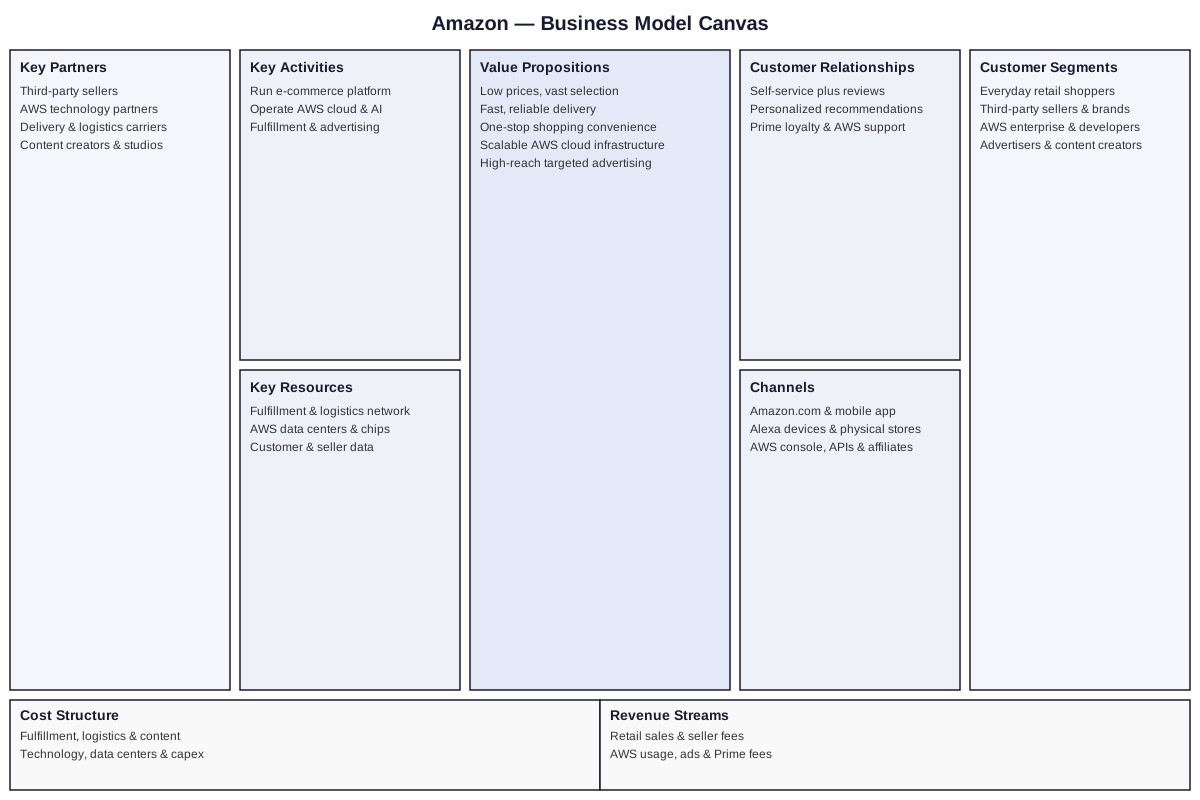
Amazon's business model breaks down cleanly into standard building blocks. Its customer segments span retail shoppers, third-party sellers and brands, AWS developers and enterprises, and content creators and advertisers. Its value proposition rests on low prices, fast delivery and wide selection, layered with convenience that removes friction from buying almost anything. Channels include Amazon.com, the mobile app, Alexa devices, physical stores and an affiliate program. Customer relationships mix self-service, ratings and reviews, personalized recommendations and support that scales through automation more than headcount.
On the resource side, key resources include Amazon's technology infrastructure, its fulfillment network, the data it collects on every purchase, its brand and its talent pool. Key activities span platform development, logistics, cloud operations, content production and marketing, carried out with key partners that include third-party sellers, AWS technology partners, affiliates, content creators and delivery carriers. Costs concentrate in cost of goods sold, fulfillment, technology infrastructure and marketing, while revenue streams span retail sales, seller fees, AWS usage, advertising, Prime subscriptions and licensing.
A two-sided network effect sits at the center of the structure. More sellers on the marketplace means more selection at competitive prices, which draws more buyers, which then makes the platform more attractive to the next wave of sellers. FBA and Prime tie that loop together by making a purchase from a third-party seller feel just as fast and reliable as one from Amazon itself.
The flywheel that keeps compounding
Amazon's growth has never depended on a single product line. It depends on how each piece of the business reinforces the others. Lower prices and wider selection increase traffic. Traffic attracts more sellers, who widen selection further, and Amazon's growing scale lowers its cost structure, which funds prices lower still. The by-products of running all of that at scale, cloud infrastructure, shopper data and shipping volume, became AWS, the advertising business and a logistics arm that Amazon now rents out to other companies.
In 2025, more than 60% of paid units sold on Amazon came from third-party sellers rather than Amazon's own inventory, and more than 1.3 million sellers adopted Amazon's generative AI listing tools during the year. The flywheel is not slowing down. AI tools are making each turn of it faster, since sellers can list, price and market products with far less manual effort than before.
The next bet: AI infrastructure and Amazon Leo
Two commitments now dominate Amazon's roadmap and separate the 2026 version of the company from how it is still often described. The first is AI infrastructure. Amazon has guided total 2026 capital spending toward roughly $200 billion, up from about $131 billion in 2025, with nearly all of the increase pointed at AI data centers, custom chips and logistics automation.4
We expect to invest about $200 billion in capital expenditures across Amazon, but predominantly in AWS, because we have very high demand
Andy Jassy, Amazon chief executive, on the fourth-quarter 2025 earnings call, made that spending plan explicit. Amazon's custom silicon line, the Graviton and Trainium chip families, crossed a $10 billion annualized run rate and continues to grow at triple-digit percentage rates. The AWS order backlog reached $244 billion, up roughly 40% year over year, evidence that enterprise and government demand for cloud and AI capacity has not slowed.
The second bet is satellite internet. Amazon rebranded Project Kuiper as Amazon Leo in November 2025 and entered enterprise beta in April 2026, with commercial service targeted for mid-2026.5 As of mid-2026, Amazon has roughly 210 to 241 satellites in orbit, short of the Federal Communications Commission's requirement of 1,618 satellites by July 30, 2026, and it has requested an extension while contracting additional launches to close the gap. The full first-generation constellation is planned at 3,236 satellites by 2029, with a second-generation expansion cleared toward 7,727 total. Starlink remains well ahead on hardware, with about 8,000 satellites in orbit and roughly $10.6 billion in 2025 revenue. Amazon's case for catching up rests less on satellite count and more on integration: a Leo terminal can route data directly into AWS, turning the network into an extension of Amazon's cloud rather than a standalone internet provider.
Competitive pressure on multiple fronts
No single competitor challenges Amazon across its full range of businesses, which is part of why the company faced relatively little direct pressure until recently. Walmart competes hardest in retail and grocery, using its large network of US stores as same-day fulfillment hubs in a way Amazon cannot easily replicate without physical locations of its own. Alibaba and JD.com compete in global and Chinese e-commerce, spanning both business-to-business and business-to-consumer marketplaces. Temu and Shein apply direct pressure on Amazon's lower-priced categories by shipping goods straight from factories at prices Amazon's own marketplace sellers often cannot match.
In cloud computing, Microsoft Azure and Google Cloud remain AWS's primary rivals, both investing heavily in AI infrastructure to close the gap. Netflix and Disney+ compete for streaming attention against Prime Video, and SpaceX's Starlink is the direct rival to Amazon Leo in satellite internet. Amazon's advantage across most of these fights is not that it wins outright, but that it can absorb losses in any single business for years while the rest of the portfolio keeps generating cash.
Risks that could slow the machine
Three risks deserve more attention than a generic acknowledgment that competition exists. The first is capital intensity. Free cash flow already fell to $11.2 billion in 2025 while Amazon is spending toward $200 billion in 2026. If AI demand softens, or AWS growth decelerates from its current pace, that spending becomes hard to justify and the balance sheet absorbs the impact directly.
The second is regulatory. The Federal Trade Commission's antitrust case against Amazon, joined by 17 state attorneys general, was originally set for trial in October 2026 but has since been pushed back to March 2027 after both sides requested more time.6 An adverse ruling could force changes to the bundling of marketplace, fulfillment, advertising and Prime that makes the flywheel as profitable as it currently is.
The third is seller relations. In April 2026, more than 700 third-party sellers representing roughly $14 billion in revenue mounted an advertising boycott over payout delays and fee increases. The marketplace depends on seller participation to keep selection wide and prices competitive, and Amazon's pricing power over those sellers cuts both ways: it protects margins, but it also creates the kind of friction that shows up in boycotts and regulatory complaints alike.
Amazon's business model rewards patience over quarterly optics. Retail keeps prices low and selection wide, pulling in the customers that AWS, advertising and Prime then monetize at far higher margins. That design took two decades to build and it still carries trade-offs many people miss: free cash flow already fell sharply as Amazon poured money into data centers and custom chips, and the payoff assumes AI demand keeps growing at the pace Amazon is betting on. A Federal Trade Commission antitrust trial, now scheduled for March 2027, threatens the bundling of marketplace, fulfillment and advertising that makes the flywheel profitable in the first place. None of that changes the underlying architecture. Amazon built a low-margin front door to fund high-margin businesses behind it, and every new bet, from custom silicon to satellites, follows the same blueprint.
Citation
Cite this article
Sridharan, M. A. (2024, January 14). Amazon Business Model. Think Insights. https://thinkinsights.net/strategy/amazon-business-model (Accessed [[ACCESS_DATE]])
Sridharan, Mithun A. "Amazon Business Model." Think Insights, 14 Jan. 2024, https://thinkinsights.net/strategy/amazon-business-model. Accessed [[ACCESS_DATE]].
Mithun A. Sridharan, "Amazon Business Model," Think Insights, January 14, 2024, https://thinkinsights.net/strategy/amazon-business-model. Accessed [[ACCESS_DATE]].
Sridharan, M.A. (2024) 'Amazon Business Model', Think Insights. Available at: https://thinkinsights.net/strategy/amazon-business-model (Accessed: [[ACCESS_DATE]]).
M. A. Sridharan, "Amazon Business Model," Think Insights, 2024. [Online]. Available: https://thinkinsights.net/strategy/amazon-business-model. [Accessed: [[ACCESS_DATE]]].
Sridharan MA. Amazon Business Model. Think Insights. Published January 14, 2024. Accessed [[ACCESS_DATE]]. https://thinkinsights.net/strategy/amazon-business-model
Test Your Knowledge
Amazon Business Model
Challenge yourself on the concepts from this article and see how well you understood them.
Subscribers get weekly quizzes and insights — subscribe free
Sponsor this article
Partner with Think Insights
Reach 50,000+ business leaders, consultants, and strategists. Feature your brand alongside expert articles on strategy, leadership, and digital transformation.
Become a Sponsor