Industry Analysis: Childcare


Childcare providers convert regulated staff-to-child ratios into a service families cannot substitute away from, yet the economics rarely reward the operators carrying that regulatory risk. The industry has scaled past 80 billion dollars in the United States alone, growing faster than gross domestic product as dual-income households and employer mandates push demand higher, but margin capture is concentrating in the minority of chains that can negotiate employer contracts, deploy enrollment software and spread fixed costs across multiple sites. Independent operators and family-based providers, still the majority of supply, absorb wage inflation and ratio compliance costs with almost no pricing power. Executives evaluating this sector should target employer-sponsored and technology-enabled multi-site platforms rather than standalone centers and treat workforce retention, not real estate, as the primary lever for margin expansion.
Is childcare attractive for new entrants?
Attractiveness depends entirely on segment and scale ambition. A single-site, owner-operated center faces thin, cyclical margins and heavy regulatory compliance burden, making it a lifestyle business more than an investment thesis. A multi-site platform that can aggregate employer contracts, negotiate real estate at scale and run centralized enrollment and payroll technology can reach mid-teens to twenty-percent EBITDA margins, which is genuinely attractive relative to the capital required. Entry is easiest through acquisition of existing licensed centers rather than de novo build, given the eighteen-to-twenty-four-month licensing and staffing ramp.
Which parts of the value chain are most profitable?
The customer interface and enabling infrastructure layers capture the most margin, specifically employer-contracting relationships, enrollment and billing software and multi-site management overhead that spreads across a larger revenue base. Direct center-level care delivery, the labor-intensive core of the industry, runs the thinnest margins because staffing costs are both the largest expense line and the least flexible one under ratio law. Real estate ownership, when centers are owned rather than leased, adds a second profit pool through appreciation and occupancy cost control.
How is technology changing this industry?
Technology is reshaping back-office economics rather than the caregiving act itself. Cloud-based enrollment, billing, ratio-compliance and parent-communication platforms have cut administrative labor per center meaningfully and improved waitlist-to-enrollment conversion, which directly lifts utilization. Workforce scheduling software helps operators manage the ratio-driven staffing puzzle across shifts and rooms. Artificial Intelligence has entered adjacent functions such as demand forecasting, subsidy eligibility screening and safety monitoring, but direct child supervision remains a regulated, human-only function in nearly every jurisdiction, which caps how much technology can compress the core labor cost line.
What capabilities are table stakes vs differentiators?
Table stakes include licensing compliance, background-checked staffing at mandated ratios, basic health and safety protocols and a functioning enrollment and billing system. Differentiators include employer-contracting sales capability, multi-site operating playbooks that standardize quality while allowing local pricing flexibility, proprietary retention programs that keep staff turnover below the sector average and data-driven occupancy management that keeps utilization above the eighty-five percent threshold most operators need to hit target margins.
How should investors or consultants evaluate opportunities here?
Evaluate opportunities on three variables: local ratio-driven cost structure relative to achievable tuition in the specific metro or submarket, the mix of private-pay versus subsidized enrollment and the operator's demonstrated ability to hold staff turnover below the roughly forty percent sector average, since turnover directly drives both quality and cost outcomes. Employer-sponsored and government-contracted revenue streams deserve a premium in underwriting because they carry multi-year commitments and reduce enrollment volatility relative to pure private-pay retail demand.
Why do childcare margins stay so thin despite strong demand?
Demand strength does not translate into pricing power because most families are already at the limit of what they can pay, often spending more on childcare than on housing or, in some states, college tuition, while regulators simultaneously cap how many children a given staff member may supervise. That combination means an operator cannot raise price freely without losing enrollment and cannot cut its largest cost, labor, without violating law. The result is a structurally squeezed margin unless an operator finds a third-party payer, such as an employer or government subsidy, to widen the gap between what families can pay and what the service costs to deliver.
What role do employers play in reshaping the industry?
Employers have become the fastest-growing payer category, contracting directly with providers for on-site or near-site centers and reserved slots as a talent-retention tool, particularly in health care, logistics and professional services where absenteeism tied to care breakdowns is costly. This B2B channel gives providers multi-year revenue visibility and higher effective price points than retail tuition, which is why the largest chains have shifted sales effort toward corporate accounts rather than walk-in family enrollment.
How does government subsidy policy affect industry economics?
Subsidy policy determines both the size of the addressable market and the collection risk operators carry, since reimbursement rates in many states sit below the actual cost of compliant care and payments can lag by months. Operators serving subsidy-eligible families need working capital discipline and often blend subsidized and private-pay enrollment within a single center to keep the weighted-average reimbursement above cost. Policy expansions, such as universal pre-kindergarten rollouts, can simultaneously grow enrollment and compress margins if reimbursement rates are not set to reflect true delivery cost.
What distinguishes center-based providers from home-based and in-home care?
Center-based providers benefit from economies of scale in real estate, administration and staff scheduling and dominate the employer-sponsored and technology-enabled segments of the market. Home-based and family child-care providers, still a large share of total capacity in many states, operate with lower fixed costs but almost no ability to spread overhead, which limits their capacity to invest in staff wages or compliance infrastructure and makes them the segment most vulnerable to closure during cost shocks.
Where is the industry heading strategically over the next five years?
Consolidation will continue as multi-site operators acquire independent centers to build employer and government contracting scale, technology platforms will keep compressing administrative cost per site and workforce compensation will become a more explicit line item as states tie licensing and subsidy eligibility to minimum wage floors for care staff. Operators that treat compensation as an investment in occupancy and retention, rather than a cost to minimize, are positioned to outperform peers still running the sector's traditional low-wage, high-turnover model.
Childcare is one of the few industries where demand is essentially guaranteed and pricing power is essentially absent, a combination that makes it a useful stress test for how strategists think about margin capture in regulated, labor-intensive local services. Every operator, from a single home-based provider watching four toddlers to a listed multi-site chain running enrollment software across five hundred locations, is solving the same equation: fixed staffing ratios set by regulators, a wage floor set by a competitive low-wage labor market and a price ceiling set by what a working family can actually afford. Understanding how a handful of operators escape that squeeze and why most cannot, is the point of this analysis.
Industry at a glance
Childcare, for purposes of this analysis, covers the paid provision of supervised care for children from infancy through school age outside the home, delivered through licensed centers, licensed and unlicensed family child-care homes and employer-sponsored or government-contracted care arrangements. It excludes curriculum-led early education and pre-kindergarten programs built primarily around pedagogical outcomes, which constitute a separate, adjacent industry; the boundary in practice is fuzzy since most centers blend supervision and structured activity, but the operating logic analyzed here is staffing, ratios, occupancy and unit economics rather than instructional design.
The customer base is a mix of business-to-consumer (B2C) and, increasingly, business-to-business (B2B) and business-to-government (B2G) relationships. Individual families paying tuition directly remain the largest revenue source industry-wide, but employers contracting for reserved slots or on-site centers and government agencies funding subsidized or voucher-based enrollment, represent the fastest-growing and highest-visibility payer segments. This three-way payer structure means providers effectively run parallel sales motions:
retail enrollment, corporate account management and public-sector contracting, each with different pricing, collection risk and contract duration characteristics
The sector's economic role extends well beyond its own revenue. It functions as enabling infrastructure for the broader labor market, since parental workforce participation, particularly for mothers, is directly constrained by the availability and cost of care. That dependency runs in both directions: childcare demand tracks birth rates, female labor force participation and return-to-office policy, while childcare supply constraints act as a tax on the rest of the economy through absenteeism, reduced hours and career exits. The U.S. Chamber of Commerce has estimated that inadequate childcare access costs the American economy tens of billions of dollars annually in lost earnings, productivity and tax revenue, a framing that has pulled employers and policymakers deeper into an industry they previously treated as a private family expense.1
Indicative metrics tell the story of an industry that is capital-light but extraordinarily labor- and regulation-intensive. The U.S. market is estimated at roughly 80 to 90 billion dollars in annual revenue as of the mid-2020s, expanding at a compound annual growth rate in the mid-single digits, driven by dual-income household growth and rising per-child spending rather than by rising birth rates, which have been flat to declining.2 Labor typically consumes sixty to seventy percent of a center's operating budget before fully burdened costs, real estate and occupancy another ten to fifteen percent and the remainder split across supplies, insurance, food and administration. Capital intensity is moderate:
centers require built-out, code-compliant space and playground infrastructure, but the dominant constraint on growth is not capital, it is the ability to recruit and retain qualified staff fast enough to open new classrooms
Industry segmentation
The industry breaks cleanly into five segments defined primarily by ownership structure, payer relationship and delivery format, each with a distinct cost base and growth trajectory.
Independent, single-site centers represent the largest share of licensed center capacity by location count, typically owner-operated, serving a local, price-sensitive, majority private-pay customer base. These operators have almost no purchasing scale, minimal technology investment and the highest exposure to local labor market wage inflation, since they cannot spread a corporate overhead function across multiple sites.
Multi-site regional and national chains, including publicly traded and private-equity-backed operators, aggregate dozens to hundreds of centers under standardized branding, curriculum licensing and back-office systems. This segment has grown its share of total capacity steadily because scale allows centralized purchasing, shared enrollment technology, and, critically, the sales infrastructure needed to win employer and government contracts that a single-site operator simply cannot service.
Employer-sponsored and worksite care forms a distinct commercial segment rather than a delivery format, since the underlying centers may be operated by the same chains serving retail families. What differentiates it is the payer: a company contracts directly, either for a dedicated on-site or near-site center or for guaranteed backup-care and reserved-slot access across a national network. This segment commands premium effective pricing and multi-year contract terms, which is why it has become the strategic focus of the largest operators.
Family child-care homes, where a caregiver provides paid care in a residential setting for a small number of children, remain a substantial share of total national capacity, particularly for infants and in rural or lower-income areas underserved by centers. These providers operate with minimal fixed overhead but also minimal ability to invest in facilities, staff, or compliance infrastructure, making them the segment most likely to exit the market during cost or demand shocks.
Government-subsidized and voucher-funded care cuts across the delivery formats above rather than constituting a separate physical channel, but it deserves separate strategic treatment because reimbursement rates, payment timing and eligibility rules are set by policy rather than market pricing and because providers who lean heavily on this revenue source carry distinct working-capital and receivables risk relative to private-pay operators.
Market structure
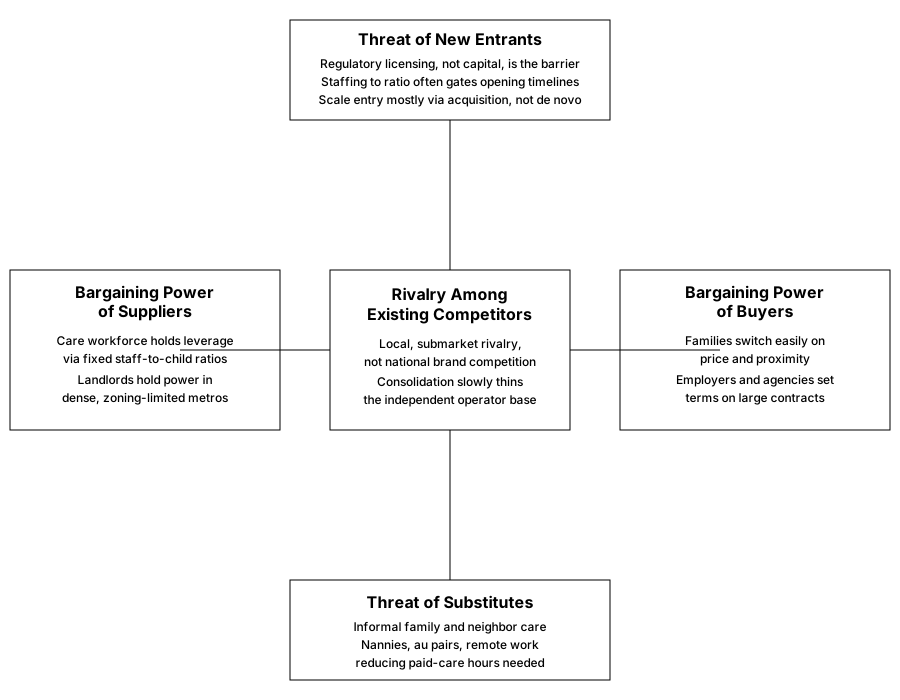
Porter's Five Forces framework, applied to childcare, describes an industry where buyer power is unusually high for a service that looks essential, supplier power is concentrated almost entirely in the labor market rather than in goods inputs, rivalry is intensely local rather than national, entry barriers are more regulatory and operational than capital-based and substitutes range from informal family care to remote work itself. The forces interact in a way that consistently compresses margin for undifferentiated operators while rewarding those who can either escape retail pricing through employer and government contracts or achieve genuine scale economics across many sites.
Bargaining power of buyers
Individual families exercise significant bargaining power despite the emotional stakes of the purchase, because childcare in most metro areas is a comparison-shopped, price-transparent local market with multiple providers within a reasonable commute. Families routinely switch centers over price increases of a few percentage points and enrollment waitlists, while long in undersupplied metros, do not translate into pricing power the way scarcity typically would, because state and local political sensitivity around childcare affordability constrains how aggressively operators can raise tuition. Employers and government agencies, the two fastest-growing buyer categories, exercise even more concentrated power, since a single corporate or state contract can represent a meaningful share of a multi-site operator's revenue, giving that buyer leverage over pricing, service levels and reporting requirements that an individual family never had. The presence of these large, sophisticated buyers has pushed the largest operators toward standardized service-level contracts, further eroding the pricing flexibility that smaller independents rely on to manage local cost shocks.
| Buyer type | Source of leverage | Effect on provider economics |
|---|---|---|
| Individual families | Local price transparency, easy switching | Caps tuition growth to wage inflation in most metros |
| Employers | Multi-year contract volume, negotiated rates | Compresses effective price per slot despite volume certainty |
| State and federal agencies | Sets reimbursement rates unilaterally | Creates below-cost pricing risk on subsidized enrollment |
| Insurance and benefits administrators | Aggregates employer demand across accounts | Standardizes contract terms, limits provider customization pricing |
Bargaining power of suppliers
The dominant supplier in childcare is not a vendor of goods but the labor market itself and its leverage has grown substantially as wage floors across the broader low-wage economy have risen, pulling potential childcare workers toward retail, warehousing and hospitality jobs that offer comparable pay without the emotional intensity and licensing requirements of care work. Because state ratio laws fix the number of staff a center must employ per enrolled child, operators cannot substitute capital for labor the way a manufacturer might automate around a costly input, which hands the caregiving workforce structural leverage even though individual workers rarely organize or negotiate collectively. Real estate landlords represent a secondary supplier group with meaningful power in dense urban submarkets where zoning restricts the supply of code-compliant space and food and curriculum-material vendors, by contrast, have essentially no leverage given the commodity nature of those inputs and the many available substitutes. The Federal Reserve Bank of Minneapolis has documented how this labor-cost structure, combined with fixed ratios, produces an industry where wage increases cannot be offset by productivity gains the way they can in most other service sectors.3
| Supplier category | Leverage source | Constraint imposed on operators |
|---|---|---|
| Care and teaching staff | Ratio laws force fixed headcount per child | Cannot substitute capital for labor to manage wage inflation |
| Commercial landlords | Zoning limits code-compliant space in dense metros | Occupancy cost inflation in supply-constrained submarkets |
| Licensing and accreditation bodies | Control market access | Compliance cost is non-negotiable and non-deferrable |
| Insurance carriers | Limited underwriters willing to cover child supervision risk | Premium costs rise faster than general liability benchmarks |
Rivalry among existing competitors
Competitive rivalry in childcare is almost entirely local rather than national, since a family choosing a center cares about proximity, hours and price within a narrow commute radius, not about brand presence across metros. This localizes competition into hundreds of effectively separate submarkets, each with its own supply-demand balance, meaning a national chain can hold a strong overall market position while still facing intense head-to-head competition from a single well-run independent center three blocks from one of its locations. Rivalry intensifies where supply is adequate or oversupplied, pushing tuition growth toward wage-inflation levels and squeezing already-thin margins, while in undersupplied childcare deserts, rivalry effectively disappears and waitlists become the norm, though even there operators face political and reputational constraints on pricing. The Center for American Progress has documented that a majority of Americans live in areas with limited licensed childcare supply relative to demand, meaning large portions of the market technically face muted rivalry even as national commentary treats the industry as undersupplied everywhere.4 Consolidation by multi-site chains is gradually changing rivalry dynamics by removing independent operators from the competitive set through acquisition, though the pace of consolidation remains far slower than in other local-services industries given the fragmented, owner-operator nature of much of the supply base.
| Rivalry driver | Local dynamic | Strategic implication |
|---|---|---|
| Submarket supply-demand balance | Ranges widely by neighborhood and metro | Pricing power varies block to block, not brand to brand |
| Hours and schedule flexibility | Extended and weekend hours differentiate weakly | Marginal differentiator, not a durable advantage |
| Brand and chain affiliation | Weak influence on family choice versus price and proximity | Limits national chains' ability to command a premium |
| Consolidation pace | Slow relative to other fragmented local services | Extended window for scaled roll-up strategies |
Threat of new entrants
Entry barriers in childcare are unusual in that they are almost entirely regulatory and operational rather than financial, since the capital required to open a single center is modest relative to most industries that carry meaningful barriers to entry. Licensing requirements, background-check processes, facility code compliance and insurance underwriting create a slow, multi-month qualification process that deters casual entrants without requiring large upfront capital and staffing a new center to opening-day ratio compliance is frequently the binding constraint rather than construction or licensing timelines. This combination means new entry happens constantly at the single-site level, driven by individual entrepreneurs and former center directors opening their own locations, but rarely happens at meaningful scale, since building a multi-site platform requires the operational systems, employer relationships and capital access that take years to assemble. Private equity and strategic acquirers have effectively substituted consolidation for organic new entry as the primary route to scale, buying existing licensed operators rather than building new capacity, which keeps the aggregate threat of large-scale new entrants low even as small-scale entry remains easy.
| Entry barrier | Nature of barrier | Effect on entrant pool |
|---|---|---|
| Licensing and background-check timelines | Regulatory, four to twelve months typical | Deters speculative or undercapitalized entrants |
| Staffing to opening-day ratios | Operational, tied to local labor supply | Often the true binding constraint on new-site timing |
| Facility build-out and code compliance | Moderate capital, low relative to other industries | Not a meaningful deterrent for serious operators |
| Access to employer and government contracts | Relationship and scale-dependent | Effectively excludes single-site entrants from B2B channel |
Threat of substitutes
Substitutes for licensed childcare are more varied and more consequential than in most service industries, ranging from informal, unlicensed arrangements with relatives or neighbors, to nannies and au pairs for higher-income households, to remote and hybrid work arrangements that reduce the number of hours a family needs paid care at all. Informal and family-based care remains the largest substitute by volume, particularly for infants and in lower-income households where licensed center tuition is simply unaffordable relative to income and this substitute carries no direct cost to the family beyond opportunity cost, making it extremely price-elastic competition for licensed providers. Remote work represents a structural substitute unique to the post-pandemic period, since a parent working from home part-time can reduce paid care hours without eliminating the need for care entirely, a dynamic that has muted demand growth in some higher-income, white-collar-heavy submarkets even as overall industry revenue has continued to climb. Nannies and au pairs serve as a premium substitute for higher-income families who value one-on-one care and flexibility over the group setting and socialization benefits of a center and this segment competes primarily on convenience and customization rather than price.
| Substitute type | Primary appeal | Segment most exposed |
|---|---|---|
| Informal family or neighbor care | No direct cost, high trust | Lower-income households, infant care |
| Nannies and au pairs | One-on-one attention, schedule flexibility | Higher-income, dual-professional households |
| Remote or hybrid work arrangements | Reduces paid-care hours needed | White-collar households in flexible-work roles |
| Unlicensed home-based care | Lower price than licensed centers | Price-sensitive families in undersupplied areas |
Value chain and profit pools
The childcare value chain runs through five stages, each with distinct economics that matter to how an operator should think about where to invest.
Upstream inputs consist primarily of the labor market, real estate and licensing infrastructure rather than physical goods, a structural difference from most industries analyzed through a traditional value-chain lens. Recruiting, training and credentialing caregivers is the single most consequential upstream activity, since the quality and stability of that labor pool determines both compliance risk and the customer experience that drives retention and referral.
Facility development and build-out follows, covering site selection, code-compliant construction or renovation, playground and safety infrastructure and initial licensing approval. This stage is capital-intensive relative to ongoing operations but modest relative to other real-estate-dependent service industries and increasingly it is outsourced to specialized developers who then lease finished space to operators rather than operators building and owning directly.
Care delivery and daily operations form the core of the value chain and consume the overwhelming majority of ongoing cost, encompassing staffing to ratio, curriculum or activity execution, meal service, health and safety compliance and daily family communication. This is where the labor-intensity of the industry is most visible and where operational excellence, particularly around staff scheduling and retention, translates most directly into margin.
Enrollment, billing and customer interface functions have become an increasingly distinct and technology-enabled stage, covering marketing, waitlist and enrollment management, tuition billing and collection and subsidy or voucher processing where applicable. Cloud-based platforms purpose-built for this function have meaningfully reduced the administrative labor once required at the center level, freeing directors to focus on staffing and quality rather than paperwork.
Employer and government contracting represents a distinct, higher-value stage layered on top of the core operating model, requiring dedicated sales, account management and reporting capabilities that most single-site operators cannot support, which is precisely why this stage has concentrated among the largest chains.
Enabling infrastructure, spanning payroll and benefits administration, insurance, compliance monitoring and multi-site management systems, sits underneath all the customer-facing stages and is where scale economics show up most clearly, since the cost of these functions grows far more slowly than the number of centers they support.
Profit pool
Profit concentrates disproportionately in the enrollment, billing and employer-contracting stages of the value chain rather than in direct care delivery, which is the opposite of what a casual observer might expect from an industry whose entire value proposition rests on the quality of in-classroom care. Direct care delivery carries the thinnest margins because it is where the ratio-driven labor cost lives and because pricing at the retail level is capped by what individual families can pay, leaving little room between cost and price. The enrollment and billing layer, by contrast, benefits from technology leverage: a platform or centralized team serving many centers spreads its cost across a much larger revenue base, generating margins that a single-site operator's small administrative function could never achieve. Employer contracting captures the largest premium of all, since corporate buyers pay for guaranteed access and often absorb a meaningfully higher effective price per slot than retail tuition, while committing to multi-year terms that reduce the revenue volatility operators otherwise face from month-to-month family enrollment decisions. Bright Horizons Family Solutions, the largest dedicated provider of employer-sponsored childcare, has built its entire public-company investment thesis around this profit pool, reporting that a substantial and growing share of its enrollment now comes through employer-sponsored sites rather than retail tuition, supported by new Fortune 500 contract wins each year.5 This shift has pulled strategic attention among the largest operators away from adding retail capacity and toward building the sales and account-management muscle needed to win and retain corporate accounts, a capability gap that is difficult for smaller competitors to close.
Industry economics and business models
Three business models dominate the industry, each with a distinct relationship between fixed cost, capacity utilization and margin.
The retail tuition model, still the largest by revenue, operates on a straightforward fee-for-service basis where families pay weekly or monthly tuition set by local market rates and profitability depends almost entirely on occupancy relative to the fixed staffing and facility cost base. Operators running this model live and die by utilization:
a center staffed and licensed for one hundred children but enrolling seventy is carrying nearly the full fixed cost of full capacity while collecting seventy percent of potential revenue, which is why occupancy management, not tuition pricing, is the primary lever most retail operators actually control day to day
The employer-contracted model shifts revenue from individual families to corporate buyers, typically structured as either a dedicated on-site or near-site center funded substantially by the employer, or a network-access arrangement where the employer subsidizes or fully covers slots at existing centers for its employees. This model trades some pricing upside for revenue certainty, since contracts run multiple years and are far less sensitive to the month-to-month enrollment churn that plagues retail centers and it commands the premium effective pricing described in the profit-pool discussion above.
The subsidized and voucher-funded model serves families through government reimbursement rather than direct tuition and its defining economic feature is that reimbursement rates are set administratively rather than through market pricing, frequently below the actual cost of ratio-compliant, high-quality care. Operators who serve this segment at scale typically blend subsidized and private-pay enrollment within the same centers to keep weighted-average revenue per child above cost and they carry meaningful working-capital risk given the payment-timing lags common in public reimbursement systems.
A fourth pattern, family child-care as a micro-enterprise model, deserves separate mention because it operates outside the fixed-cost logic of the other three:
a single caregiver's home functions as both facility and workplace, minimizing overhead but also capping revenue at whatever a handful of children can generate, with essentially no path to the scale economics available to center-based operators
Cost drivers and scalability
Labor is, by a wide margin, the dominant cost driver in childcare, typically representing sixty to seventy percent of operating expense before full benefits burden and seventy percent or more once payroll taxes, workers compensation and any benefits are included. Because state ratio laws fix the minimum number of staff per enrolled child by age group, this cost line has almost no flexibility relative to enrollment in the short run: a center cannot simply reduce headcount to match a temporary enrollment dip without either violating licensing requirements or closing a classroom entirely. Real estate and occupancy cost forms the second-largest fixed cost, typically ten to fifteen percent of revenue and behaves as a true fixed cost regardless of enrollment level, which is why occupancy utilization above roughly eighty-five percent is the threshold most operators need to clear to hit healthy margins, even though many stable centers in practice run closer to seventy to eighty-five percent.
Economies of scale in this industry are real but concentrated in specific functions rather than spread evenly across the cost base. Centralized payroll, benefits administration, insurance procurement, marketing and enrollment technology all scale efficiently across a multi-site portfolio, meaningfully lowering per-center administrative cost as an operator grows from a handful of locations to dozens or hundreds. Direct care staffing, by contrast, exhibits essentially no economies of scale, since ratio requirements apply identically whether an operator runs one center or five hundred, meaning the largest chains still face the same per-classroom labor cost structure as an independent competitor down the street. This split explains why multi-site operators consistently outperform independents on overall margin despite facing identical unit economics at the classroom level:
the advantage comes entirely from spreading fixed corporate overhead and technology investment across more revenue, not from any efficiency gain in the care-delivery process itself
The closest thing to a growth loop in this industry runs through employer contracting and retention: a multi-site operator with strong employer relationships gains predictable, multi-year enrollment that funds investment in staff compensation and retention programs, which lowers turnover, which improves care quality and family satisfaction, which strengthens the operator's pitch to the next corporate account. Operators who instead compete purely on retail tuition price tend to get trapped in the opposite loop, where thin margins force wage suppression, which drives turnover, which degrades quality and family retention, reinforcing the pressure to compete on price rather than differentiation.
Moats, advantages and strategic levers
Defensibility in childcare is weaker than in most industries analyzed through a strategy lens, which is precisely why understanding where thin moats do exist matters so much to capital allocation decisions. Cost advantage exists at the corporate overhead level for multi-site operators, as described above, but not at the classroom level, meaning scale alone does not produce a durable cost advantage the way it would in a manufacturing or logistics business. Switching costs for individual families are genuinely low, since a family can change centers within weeks with minimal disruption beyond the emotional cost of a child adjusting to a new environment, which is a real but not economically binding deterrent to switching.
The most durable advantage in the industry is relational rather than structural: multi-year employer and government contracts function as a genuine switching-cost moat, since a corporate buyer that has invested in building and staffing an on-site center, or negotiated a network-access arrangement, faces meaningful disruption and cost in switching providers, giving incumbent contract holders real renewal leverage. Regulatory moats exist in a narrow sense, since the licensing and background-check process deters casual entry, but they are shallow moats because the process, while slow, is not prohibitively expensive or technically difficult for a serious operator to complete.
Data and learning advantages are emerging but not yet decisive. Operators with enrollment and workforce-scheduling technology across many sites accumulate data on occupancy patterns, staffing efficiency and retention drivers that smaller competitors lack and this data advantage compounds over time as the platform serves more sites, though it has not yet produced the kind of winner-take-most dynamic seen in genuinely data-driven industries. Brand recognition matters at the margin for employer sales, where a nationally recognized name lowers the corporate buyer's perceived risk in a benefits decision, but it carries little weight with individual families choosing based on proximity and price.
Strategic levers
An entrant or incumbent has four meaningful levers available and the right combination depends heavily on ambition and capital access. Segment focus is the first and most consequential choice:
competing purely in retail tuition condemns an operator to the industry's thinnest margins, while building toward employer and government contracting requires a sales and account-management capability that takes years and capital to construct, making this the single highest-leverage strategic decision a growing operator makes
Consolidation through acquisition of existing licensed centers offers a faster path to scale than organic new-site development, given the licensing and staffing ramp time discussed earlier and it is the strategy most private-equity-backed operators have pursued to build the multi-site footprint needed to compete for large employer and government contracts. Geographic expansion works best when it follows employer demand rather than leading it, since a corporate account with locations in multiple metros creates a natural template for where to open next, reducing the market-entry risk an operator would otherwise face expanding into an unfamiliar submarket speculatively.
Vertical integration into real estate ownership, rather than leasing, offers a secondary profit pool through occupancy-cost control and asset appreciation, though it also increases capital intensity and reduces the flexibility to exit an underperforming location, a tradeoff that has pushed most scaled operators toward a mixed portfolio of owned and leased sites rather than a uniform approach. Workforce investment, treated as a strategic lever rather than a cost line, is increasingly the differentiator between operators who can sustain occupancy above the utilization threshold needed for healthy margins and those trapped in the high-turnover, quality-erosion cycle described earlier and it is the lever most underutilized by operators still managing the business as a real estate or enrollment problem rather than a staffing one.
Structural risks, regulation and trends
The industry's central structural risk is regulatory, not competitive: staff-to-child ratios, minimum wage floors, licensing standards and subsidy reimbursement rates are all set by state and, increasingly, federal policy and changes to any of these can shift an operator's cost base or addressable market overnight in ways no amount of operational excellence can offset. A tightening of ratio requirements, intended to improve care quality, mechanically raises labor cost per child without a corresponding increase in revenue unless tuition or reimbursement rates rise in parallel and several states have moved in this direction in recent years even as reimbursement rates have lagged.
Workforce shortage is the second major structural risk and arguably the more binding constraint in practice, since the sector's wage levels sit near the bottom of the broader labor market even as the job requires background checks, training and sustained emotional labor. The Center for the Study of Child Care Employment at the University of California, Berkeley, has tracked how the workforce has struggled to recover fully in the years following the pandemic-era exodus, with turnover remaining a persistent constraint on capacity even where demand and licensed slots exist.6 This shortage functions as a supply constraint on the entire industry independent of demand, meaning even well-capitalized operators cannot simply open new capacity faster than the local labor market can supply qualified staff.
Macro and secular demand drivers remain favorable overall: dual-income household formation continues to rise, employer interest in childcare as a retention benefit has grown structurally rather than cyclically since the pandemic exposed how directly care access affects workforce participation and government policy attention, while inconsistent across states, has generally moved toward expanding public investment rather than retreating from it. KPMG has characterized the current period as a genuine inflection point for employer engagement with childcare, noting that companies increasingly view care access as core workforce infrastructure rather than a peripheral benefit.7
Supply-side trends point toward continued consolidation among multi-site operators, gradual technology adoption in the enrollment and workforce-management layers of the value chain and persistent geographic unevenness, with childcare deserts remaining concentrated in rural areas and lower-income urban neighborhoods where private-pay economics alone cannot support licensed capacity. Disruptive models remain limited relative to other services industries, given the regulatory floor on remote or automated substitution for direct child supervision, though technology-enabled matching platforms connecting families to home-based and family child-care providers have expanded the addressable market for that segment without displacing the core center-based model.
The strategic playbook for a new entrant should weight niche focus over broad geographic ambition in the early stages, since building credibility and operational systems in one metro before expanding is far less capital-intensive than attempting simultaneous multi-market entry and should favor acquisition of existing licensed operators over de novo development given the licensing and staffing timeline discussed earlier. Regulatory strategy matters as much as commercial strategy:
an entrant should map state-by-state ratio, licensing and reimbursement rules before committing capital, since the same business model can be highly profitable in one state and marginal in a neighboring one purely due to regulatory differences
Incumbent strategy divides into defend, expand and deepen postures depending on an operator's current position. Defending share in a mature, well-supplied metro means competing on retention and quality rather than price, since price competition in an already-thin-margin business accelerates the race to the bottom that has historically plagued the sector. Expansion should prioritize employer and government contracting over additional retail capacity, given the profit-pool concentration described earlier and deepening moats means investing in workforce retention infrastructure, since staff stability is the input that most directly protects both quality reputation and the occupancy levels that determine margin.
KinderCare Learning Companies: scale as the operating model
KinderCare Learning Companies offers a useful window into how scale, employer contracting and workforce economics play out inside an actual operator rather than in the abstract. Founded in 1969 in Montgomery, Alabama, as a single center, the company grew over five decades into one of the largest for-profit childcare operators in the United States, eventually operating several thousand centers along with a dedicated backup-care and employer-sponsored division serving corporate clients directly. The company has passed through several rounds of private-equity ownership, a pattern common across the largest chains in this industry, reflecting investor interest in the roll-up economics available to an operator that can spread corporate overhead across a large site count.
KinderCare's operating history illustrates the industry's central tension clearly. On one hand, the company achieved genuine scale advantages: centralized payroll and benefits administration, a shared enrollment and billing technology platform, national purchasing agreements for supplies and insurance and a dedicated sales function capable of winning and servicing large employer contracts that a single-site competitor could never pursue. These functions let the company run meaningfully leaner corporate overhead per center than an independent operator managing the same functions alone at small scale.
On the other hand, KinderCare's classroom-level economics remained subject to the same ratio-driven labor cost structure as every competitor, independent or chain. The company could not engineer its way around state-mandated staff-to-child ratios and it has, like the rest of the industry, faced persistent workforce recruitment and retention challenges, particularly in the years following the pandemic-driven exodus of care workers to better-paying, less emotionally demanding jobs in retail and logistics. This is precisely the dynamic described earlier in the cost-drivers discussion:
scale compresses overhead but does nothing to compress the largest cost line, direct staffing, which is fixed by regulation rather than by operating choice
The company's strategic response mirrors the playbook this analysis has argued is optimal for scaled operators: heavy investment in its employer-sponsored and backup-care division, which offers higher effective pricing and multi-year contract stability relative to retail tuition, alongside continued consolidation of independent centers to extend geographic reach into markets where large employers have workforce concentrations. This employer-facing strategy positions KinderCare and its direct competitors as benefits infrastructure providers to corporate America as much as childcare operators to individual families, a repositioning that has meaningfully changed how the largest chains allocate sales and account-management investment relative to a decade earlier.
The lesson for strategists evaluating this industry is not that scale is worthless, since KinderCare's overhead efficiency and employer-contracting capability are real and durable advantages unavailable to smaller competitors. The lesson is that scale advantages in childcare concentrate narrowly in specific value-chain stages, corporate overhead and B2B contracting chief among them, while leaving the core cost driver, ratio-mandated staffing, essentially untouched regardless of how large an operator grows. Any investment thesis built on this industry needs to separate those two effects explicitly rather than assuming scale produces the kind of broad-based cost advantage it would in a less regulated, less labor-intensive business.
Sources for this section draw on publicly available company history and industry reporting rather than proprietary data, consistent with the broader treatment of chain economics addressed earlier in the value-chain and profit-pool discussion.
- 1Understanding America's Labor Shortage And The Childcare Issue
- 2U.S. Child Care Market Size And Share
- 3Hardly Child's Play
- 4America's Licensed Child Care Deserts
- 5Bright Horizons Family Solutions Annual Report
- 6A Struggling Child Care Workforce Faces New Threats
- 7Crisis In Childcare And The State Of Work In America
Childcare sits at the intersection of family economics and workforce participation, a local service business dressed in the language of a social good. Its unit economics run on ratios fixed by regulators, wages that struggle to clear a living threshold and occupancy that must stay near capacity to cover fixed costs. Margin has migrated toward multi-site operators who own employer relationships, proprietary enrollment platforms and real estate, leaving single-site and family-based providers exposed to every cost shock. The strategic levers that matter are consolidation, B2B contracting, technology-enabled utilization management and workforce compensation redesigned around retention economics rather than minimum-wage compliance. Capital allocators who understand childcare as a staffing and real estate optimization problem, not a curriculum business, will outperform those chasing enrollment growth alone.
Citation
Cite this article
Sridharan, M. A. (2023, December 27). Industry Analysis: Childcare. Think Insights. https://thinkinsights.net/strategy/industry-analysis-childcare (Accessed [[ACCESS_DATE]])
Sridharan, Mithun A. "Industry Analysis: Childcare." Think Insights, 27 Dec. 2023, https://thinkinsights.net/strategy/industry-analysis-childcare. Accessed [[ACCESS_DATE]].
Mithun A. Sridharan, "Industry Analysis: Childcare," Think Insights, December 27, 2023, https://thinkinsights.net/strategy/industry-analysis-childcare. Accessed [[ACCESS_DATE]].
Sridharan, M.A. (2023) 'Industry Analysis: Childcare', Think Insights. Available at: https://thinkinsights.net/strategy/industry-analysis-childcare (Accessed: [[ACCESS_DATE]]).
M. A. Sridharan, "Industry Analysis: Childcare," Think Insights, 2023. [Online]. Available: https://thinkinsights.net/strategy/industry-analysis-childcare. [Accessed: [[ACCESS_DATE]]].
Sridharan MA. Industry Analysis: Childcare. Think Insights. Published December 27, 2023. Accessed [[ACCESS_DATE]]. https://thinkinsights.net/strategy/industry-analysis-childcare
Test Your Knowledge
Industry Analysis: Childcare
Challenge yourself on the concepts from this article and see how well you understood them.
Subscribers get weekly quizzes and insights — subscribe free
Sponsor this article
Partner with Think Insights
Reach 50,000+ business leaders, consultants, and strategists. Feature your brand alongside expert articles on strategy, leadership, and digital transformation.
Become a Sponsor