Industry Analysis: Architecture and Planning


Architecture and urban planning firms sit at the front of every building and district decision, yet the profession captures a thin slice of the value it creates. The industry generates roughly 65 billion dollars in annual United States revenue, grows near gross domestic product rates and remains fragmented, with the largest firm holding well under 5% share. Margin concentrates in specialized technical disciplines, program management and repeat institutional relationships, not in signature design work. Bargaining power is tilting toward large developers, public agencies and design-build contractors who now absorb design scope into broader delivery contracts. Firms that want durable economics should move upstream into advisory and program management, deepen sector specialization in healthcare, science, or infrastructure and treat building information modeling and data services as a margin lever rather than a cost center.
Is architecture and planning attractive for new entrants?
Attractiveness depends on entry point. A solo practitioner chasing residential and small commercial work faces low capital barriers but brutal fee competition and thin margins. A well-capitalized entrant targeting healthcare, science and technology or federal infrastructure work faces steep barriers, licensure requirements and long client qualification cycles, but the reward is stickier, higher-margin relationships. The industry is attractive for entrants who bring a differentiated capability, such as advanced sustainability engineering or digital delivery, rather than generic design competence.
Which parts of the value chain are most profitable?
Program and construction management, specialized technical consulting such as structural or building envelope engineering and post-occupancy data services carry the strongest margins. Core schematic design and construction documentation, the most visible part of an architect's work, are the most commoditized and fee-compressed stages, because clients can compare proposals easily and switch firms between phases.
How is technology changing this industry?
Building information modeling has moved from differentiator to baseline expectation, with roughly three-quarters of United States firms using it and Artificial Intelligence tools are now compressing early-stage design iteration and code compliance checking from weeks to days. The economic effect is a gradual shift of value from drafting labor toward firms that can turn design data into predictive, reusable intellectual property across projects.
What capabilities are table stakes versus differentiators?
Licensure, code knowledge, liability insurance and basic BIM proficiency are table stakes that every credible firm must have. Differentiators include sector-specific delivery expertise, such as life sciences laboratories or transit-oriented mixed use, integrated project delivery capability, proprietary design-to-construction data pipelines and the balance-sheet strength to take on program management or development risk alongside design fees.
How should investors or consultants evaluate opportunities here?
Evaluate firms on backlog quality and client concentration, fee structure mix between fixed-fee and hourly work, net multiplier and utilization trends and exposure to counter-cyclical segments such as public infrastructure or healthcare versus cyclical segments such as speculative office and retail. A firm's design reputation matters far less to durable returns than its contract structure and sector diversification.
Why does the industry remain so fragmented despite decades of consolidation?
Licensure is granted to individuals, not firms and client relationships are frequently built around a specific principal or partner rather than a corporate brand. That personal, reputation-driven structure limits the scale economies available to a would-be consolidator and keeps thousands of small practices viable even as a handful of global platforms grow through acquisition.
What separates a resilient firm from a cyclical one during downturns?
Resilient firms diversify revenue across public and institutional clients whose capital budgets move independently of interest rates, maintain a healthy mix of fixed-fee and cost-reimbursable contracts and keep overhead flexible through contract staffing rather than permanent headcount. Firms overweighted in speculative private commercial work are typically the first to see billings contract when financing tightens.
Does sustainability regulation help or hurt architecture firm economics?
It helps firms that invest early in decarbonization and building performance expertise, because those skills become billable specialties commanding premium fees and it hurts firms that treat compliance as a cost to be minimized, because they end up competing purely on price against firms with deeper technical benches. Regulatory tightening around embodied carbon and energy codes is steadily expanding the addressable market for performance-focused consulting.
How do real estate developers affect the balance of power in this industry?
Developers are simultaneously the primary client and a growing internal competitor, since many large developers now maintain in-house design and planning staff for repeat product types, pushing external firms toward differentiated or one-off assignments where in-house capability does not exist. That dynamic increases developer bargaining power on fees for repeatable building types, such as multifamily housing, while leaving fee integrity intact for complex, one-time civic or cultural commissions.
What is the single biggest strategic decision facing a mid-size architecture firm today?
The central decision is whether to compete as a broad, full-service generalist absorbing commoditization risk, or to concentrate deliberately in two or three sectors where deep technical knowledge, code expertise and repeat client trust can command a fee premium and resist substitution by design-build contractors and in-house developer teams.
Architecture and urban planning sit at an unusual intersection of professional licensure, creative judgment and capital-intensive client relationships. A relatively small workforce of licensed professionals, supported by a much larger group of unlicensed designers, planners and technical staff, translates a client's ambitions and a regulator's constraints into drawings, models and eventually buildings, neighborhoods and infrastructure that shape economic activity for generations. Despite designing an environment worth trillions of dollars, the profession itself captures a comparatively modest share of that value, a tension that runs through every strategic decision a firm leader makes.
Industry at a glance
Architecture and planning services cover the design of buildings, campuses and public spaces, along with the master planning of neighborhoods, cities and regional land use. The scope includes schematic design, design development, construction documentation, construction administration, interior architecture, landscape architecture in many firms and urban and regional planning work such as zoning studies, comprehensive plans and transit corridor design. It excludes general contracting, civil and structural engineering when performed by independent firms and real estate brokerage, though many large architecture platforms now bundle adjacent engineering and program management services under one roof.
Clients span all three procurement channels. Private developers and corporations commission office towers, retail centers and mixed-use projects on a business-to-business basis. Homeowners and small business owners commission residential and small commercial work on a business-to-consumer basis, though this segment is served mostly by small firms and sole proprietors. Government agencies at the federal, state and municipal level commission schools, courthouses, transit facilities and comprehensive plans on a business-to-government basis and this channel behaves counter-cyclically relative to private commercial demand because public capital budgets are set years in advance and are less sensitive to short-term interest rate swings.
The United States architectural services industry generates roughly 63.5 billion dollars in revenue in 2026, with modest near-term growth reflecting a soft billings environment and the broader global architectural services market is estimated near 390 billion dollars in 2026, expanding at a mid-single-digit compound annual rate through the early 2030s.1 The industry is highly labor-intensive rather than capital-intensive, with direct labor typically representing about 30% of net operating revenue and overhead running at 150% to 175% of direct labor cost at well-run firms, meaning most of a firm's cost base is people, not equipment or real estate.2 Regulatory intensity is high because the practice of architecture is licensed state by state in the United States and by comparable bodies internationally, professional liability insurance is mandatory for firms taking on design risk and building codes, zoning ordinances and accessibility standards constrain almost every design decision a firm makes.
Revenue models across the industry are dominated by fee-for-service arrangements, either a stipulated lump sum, an hourly rate structure, or a percentage of construction cost, with professional fee plus reimbursable expenses and fixed fee identified by firm leaders as the two most common methods used to determine client charges.3 A smaller but growing share of revenue comes from program and construction management fees, planning and advisory retainers, and, in a handful of vertically integrated firms, development participation where the architecture firm takes an equity or fee-development stake in the projects it designs.
Industry segmentation
The industry divides into several segments defined primarily by project type and secondarily by client channel and firm scale. Commercial and workplace design serves corporate tenants, developers and real estate investment trusts producing office, retail and mixed-use projects and this segment is the most cyclical because it tracks capital markets and interest rate conditions closely. Healthcare and life sciences design serves hospital systems, university medical centers and biotechnology companies and it is among the most technically demanding and margin-resilient segments because hospital and laboratory code requirements create high switching costs once a firm has built institutional trust and technical familiarity with a client's facilities.
Institutional and civic design serves government agencies, school districts and higher education institutions producing courthouses, schools, libraries and campus buildings and this segment behaves counter-cyclically because public capital budgets are appropriated years ahead of construction. Residential design splits into a high-volume, low-margin single-family and small multifamily segment served largely by small firms and a large-scale multifamily and mixed-use segment increasingly served by firms with production-line repeatable design processes serving national developer clients.
Urban and regional planning is a distinct discipline within the same licensing and client ecosystem, encompassing comprehensive plans, zoning code rewrites, transit-oriented development studies and climate resilience planning, typically commissioned by municipal and regional government agencies and increasingly by private master developers designing large mixed-use districts. Infrastructure and industrial design, covering transportation facilities, water treatment plants and manufacturing campuses, is smaller in headcount but has grown quickly as federal infrastructure funding and reshoring of manufacturing capacity have expanded public and private capital budgets. Firms are further dimensioned by scale, from thousands of sole proprietors and small studios serving local clients, to a tier of roughly 300 large multidisciplinary platforms that dominate national and global institutional work, led by Gensler with approximately 1.95 billion dollars in architecture revenue and Perkins&Will as the second-largest firm by revenue.4
Market structure
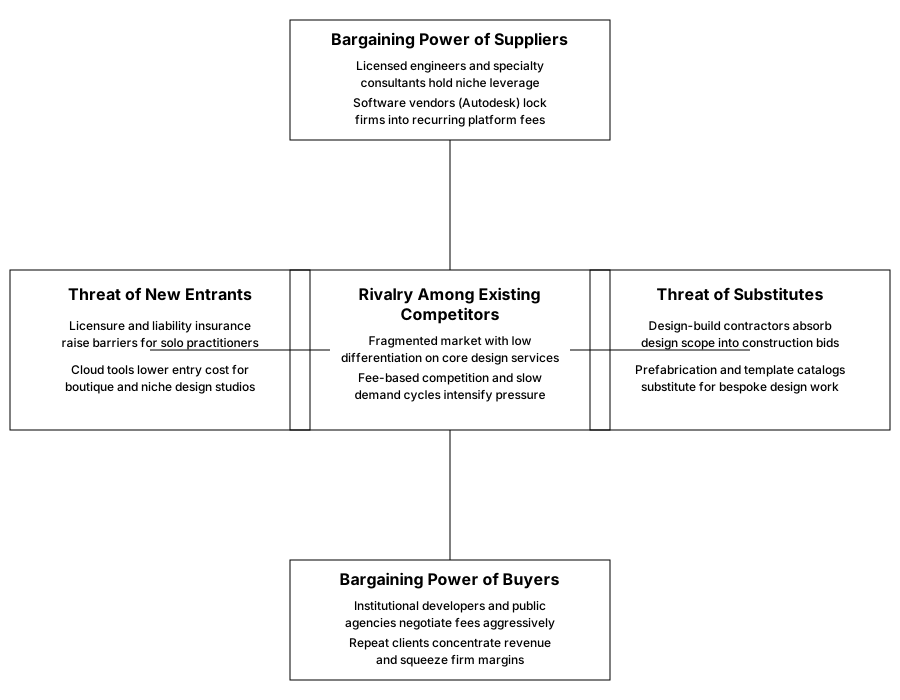
Competitive dynamics in architecture and planning are shaped less by product differentiation and more by relationship durability, licensure barriers and the industry's dependence on a small number of powerful buyer types. The five forces below outline where structural power actually sits and the picture that emerges is one of moderate buyer power concentrated among large institutional clients, growing supplier leverage from software and specialty engineering firms, intense rivalry in commoditized building types, real but uneven barriers to entry and a slow but persistent substitution threat from design-build delivery models.
Bargaining power of buyers
Buyer power in architecture and planning varies enormously by client type and that variation is the single most important determinant of firm-level profitability. Large institutional developers, national homebuilders and government procurement offices command the most leverage because they commission repeat work, run competitive request-for-proposal processes and can credibly threaten to move a relationship to a competing firm between project phases. These buyers frequently negotiate fees down to thin percentages of construction cost and impose standardized contract terms that shift liability and working-capital risk onto the design firm. Smaller, one-time clients such as individual homeowners or small business owners have comparatively little leverage individually, but because so much of the industry's revenue flows through fragmented small-project work, aggregate price sensitivity in that tier remains high. Public sector clients occupy a middle position: procurement rules constrain price negotiation somewhat through qualifications-based selection in many jurisdictions, but budget caps and public scrutiny of spending create their own downward pressure on fees. The countervailing force is technical complexity; buyers commissioning hospitals, laboratories, or airports face much higher switching costs mid-project and therefore concede more schedule and fee flexibility once a firm is embedded.
| Buyer type | Typical leverage | Primary constraint on firm |
|---|---|---|
| National developers and homebuilders | High | Repeatable request-for-proposal competition compresses fee percentage |
| Government and public agencies | Moderate to high | Procurement rules and public budget scrutiny cap fee growth |
| Corporate and institutional occupiers | Moderate | Long relationships offset by internal facilities staff benchmarking costs |
| Healthcare and life sciences clients | Low to moderate | Code complexity and continuity needs reduce switching likelihood |
| Individual and small business clients | Low individually, high in aggregate | Fragmented demand keeps average project fees under constant pressure |
Bargaining power of suppliers
Suppliers to architecture and planning firms are not raw material vendors in the traditional sense; they are the specialized professionals, engineering subconsultants and technology providers a firm depends on to deliver a complete project. Structural, mechanical, electrical and civil engineers, along with specialty consultants in acoustics, lighting, or building envelope performance, hold real leverage because their expertise is licensed, scarce in some geographies and difficult to substitute mid-project without jeopardizing schedule and liability exposure. Software vendors have become an increasingly powerful supplier category, since the dominant building information modeling and computer-aided design platforms operate on subscription pricing and firms face significant switching costs once staff training, project archives and client deliverables are built around a specific toolset. Skilled labor itself functions as a supplier constraint, because architecture schools produce a limited number of graduates relative to demand and more than a third of candidates who begin the path to licensure abandon it within a decade, tightening the pool of qualified project leaders firms can hire.5 Construction material and cost data providers, along with specialty renderers and visualization studios, hold comparatively less power because their services are more fungible.
| Supplier category | Leverage driver | Effect on firm economics |
|---|---|---|
| Structural and mechanical engineering subconsultants | Licensed expertise, project-critical sign-off | Squeezes design fee pool through subconsultant fee splits |
| Building information modeling and design software vendors | Platform lock-in, subscription pricing | Raises fixed technology overhead regardless of project volume |
| Licensed architectural and planning talent | Scarcity relative to demand, high attrition from licensure path | Drives wage inflation and project delivery bottlenecks |
| Specialty consultants in sustainability and code compliance | Narrow expert pool, regulatory necessity | Commands premium subconsultant rates on complex projects |
| Construction cost and material data providers | Fragmented, more substitutable | Limited pricing power over client firms |
Rivalry among existing competitors
Competitive rivalry is fierce in the commoditized segments of the market and considerably calmer in specialized, relationship-driven niches. Thousands of small and mid-size firms compete for residential, small commercial and standard multifamily work largely on fee and schedule, because clients can compare proposals across firms with reasonable confidence that baseline design competence is similar. At the top of the market, a few hundred large, multidisciplinary platforms compete for complex institutional, healthcare and infrastructure commissions, where reputation, past performance on similar building types and bonding capacity for large program management contracts matter more than price alone. Consolidation has intensified rivalry at the top end, as firms including Stantec, Arcadis and Perkins&Will have acquired smaller specialist practices to broaden service lines and geographic reach, pressuring independent mid-size firms that lack the balance sheet to match that scale.6 Billings volatility adds another layer of rivalry pressure, since the Architecture Billings Index has oscillated between contraction and modest growth through 2025 and into 2026, meaning firms are frequently competing for a shrinking pool of new inquiries during soft periods. Low switching costs between design phases, particularly between schematic design and construction documentation, mean rivalry remains structurally high even for firms with strong client relationships.
| Rivalry dimension | Condition | Strategic implication |
|---|---|---|
| Commodity building types (standard multifamily, small commercial) | High fee competition, low differentiation | Firms compete on price, schedule and repeatable production process |
| Specialized building types (healthcare, science, civic) | Moderate rivalry, reputation-driven selection | Technical track record and past performance dominate selection |
| Large multidisciplinary platforms | Rising rivalry through acquisition-driven scale | Mid-size independents face pressure to specialize or merge |
| Billings cycle sensitivity | Demand volatility across private commercial segment | Firms diversify client mix to smooth revenue through downturns |
Threat of new entrants
Entry barriers in architecture and planning are real but asymmetric across the market. Practicing architecture under that title requires a state or national license, typically demanding an accredited degree, a period of documented professional experience and a multi-part licensing examination and firms taking on design liability must carry professional errors and omissions insurance that is expensive and harder to obtain without a track record.7 These requirements deter casual entry into liability-bearing design work, but they do not stop a licensed individual from opening a solo practice with minimal capital, since the core assets of a design business are professional judgment and a laptop running subscription software rather than factories or inventory. Cloud-based design and project management tools have lowered the operating cost of starting a small studio considerably over the past decade, expanding the population of boutique firms competing for smaller commissions. The more meaningful barrier sits at the institutional end of the market, where winning a hospital, transit authority or corporate campus commission requires a demonstrable portfolio of comparable past projects, bonding capacity and professional references that a new entrant simply cannot manufacture quickly, effectively insulating large incumbents from new-entrant competition on their most profitable work.
| Entry barrier | Segment affected | Severity |
|---|---|---|
| State licensure and examination requirements | All licensed design work | Moderate, deters unlicensed practice but not solo entry |
| Professional liability insurance cost | Firms bearing design risk | Moderate, higher for firms without claims history |
| Track record requirement for institutional work | Healthcare, civic, infrastructure | High, effectively excludes new entrants |
| Low fixed capital requirement for small studios | Residential and small commercial | Low, encourages continuous new studio formation |
| Client relationship and referral networks | Repeat institutional and developer work | High, built over years, difficult to replicate |
Threat of substitutes
Substitution in architecture and planning rarely means clients skip design altogether; it means the design function gets absorbed into a different delivery model or replaced with a standardized, lower-cost alternative. Design-build contractors, who bundle design and construction under a single contract, have grown steadily as an alternative to the traditional design-bid-build sequence, since owners value the single point of accountability and often the compressed schedule and this shifts design fee capture toward the contractor rather than an independent architecture firm.8 Modular and prefabricated construction systems, along with catalog-based building templates increasingly used for hotels, multifamily housing and retail chains, substitute bespoke design work with repeatable, pre-engineered products that require only limited customization by a licensed professional of record. In-house design and planning staff at large developers and retail chains substitute for external architecture firms on repeatable building types, engaging outside firms only for unusual or one-time projects. Artificial Intelligence-assisted design generation tools are an emerging substitution threat for early-stage conceptual work, though they currently augment rather than replace the licensed professional judgment required for construction documents and code compliance sign-off.
| Substitute | Mechanism | Segment most exposed |
|---|---|---|
| Design-build delivery contracts | Bundles design fee into construction contract | Commercial and industrial projects |
| Modular and prefabricated building systems | Standardizes design into repeatable components | Hospitality, multifamily, retail chains |
| In-house corporate design and planning teams | Internalizes repeatable design work | National developers and retail occupiers |
| Template and catalog architecture products | Reduces custom design scope | Small commercial and production housing |
| Artificial Intelligence design generation tools | Compresses early-stage design iteration | Conceptual and schematic design phases |
Value chain and profit pools
The architecture and planning value chain begins with upstream inputs, meaning the codified knowledge base of building codes, zoning ordinances and material and structural data that firms must master before producing usable design output, along with the licensed talent pipeline that supplies the profession's core labor. The second stage is programming and schematic design, where a firm translates a client's functional requirements and budget into an initial spatial concept, a phase that carries high creative value but relatively modest fee capture because clients often shop this phase competitively across multiple firms. The third stage, design development and construction documentation, is where the bulk of billable hours accumulate, producing the detailed drawings, specifications and coordination with engineering subconsultants that a contractor needs to build the project; this stage is the most labor-intensive and the most exposed to fee compression because clients increasingly benchmark hourly rates against offshore or junior-staffed production teams.
Construction administration, the fourth stage, involves the architect reviewing contractor submittals, answering field questions and certifying payment applications and firms increasingly find this stage a source of unbilled liability exposure rather than a clean profit center, since scope creep during construction rarely comes with a proportional fee increase. Distribution and client interface, the fifth stage, covers business development, proposal writing and the relationship management that determines which firms even get invited to compete and this stage consumes significant unbilled principal time that smaller firms struggle to staff separately from production work. The sixth stage, enabling infrastructure, includes the technology stack, namely building information modeling platforms, project management software and increasingly Artificial Intelligence-assisted drafting tools, that determines how efficiently a firm can move through the documentation stage, alongside professional liability insurance and continuing education that keep the license current.
Profit pool
Profit concentrates disproportionately in the stages adjacent to, but not squarely inside, traditional design services. Program and construction management fees, charged as a percentage of total project cost on complex institutional and infrastructure work, tend to carry higher margins than core architectural design fees because they scale with project value rather than design hours and rely on relationship trust built over many projects. Specialized technical consulting, such as sustainability performance modeling, healthcare code compliance or laboratory planning, commands premium billing rates because the qualified talent pool is narrow and clients cannot easily benchmark those services against a large competitive set.
Within core design work itself, the schematic design and conceptual phases carry outsized reputational value but limited fee capture, since clients often solicit multiple free or low-cost concept proposals before committing, while construction documentation, though the largest single line item on most invoices, is also the most commoditized and margin-thin because it is comparatively easy for a client to benchmark hourly production rates across firms. The clearest historical shift in profit pool location has been the movement of value away from independent design fees and toward design-build contractors and program managers who now control the overall project budget and can dictate how much of it flows to the architecture firm; a firm's strategic response to this shift, whether to partner with contractors, acquire construction management capability, or specialize in project types too complex for design-build bundling, is now one of the defining choices in the industry.
Industry economics and business models
The dominant business model remains fee-for-service, asset-light professional practice, where a firm's balance sheet holds little beyond receivables, work-in-progress billings and modest office and software assets and its primary economic engine is converting billable staff hours into client invoices at a multiple of direct labor cost. A second model, growing steadily among the largest platforms, is the diversified multidisciplinary practice that bundles architecture with engineering, planning, interior design and program management under one contract, capturing a larger share of total project spend and smoothing revenue volatility across service lines that respond differently to economic cycles. A third and smaller model is development participation, where a firm takes an equity stake or development fee alongside its design fee on select projects, trading additional risk for a share of the far larger profit pool captured by real estate developers rather than settling for design fee income alone. A fourth, still nascent model is data and software-enabled services, where firms license reusable design templates, building performance analytics or planning software tools built from their project archives, converting what was once a one-time deliverable into a recurring revenue stream, though this model remains a small share of total industry revenue today.
Cost drivers and scalability
Direct labor is the dominant cost driver in architecture and planning, typically representing about 30% of net operating revenue, with overhead, covering rent, technology, insurance, marketing and non-billable administrative staff, running at roughly 150% to 175% of direct labor cost at well-managed firms.9 Because the primary input is skilled labor rather than equipment or inventory, the industry has limited traditional economies of scale; a larger firm does not automatically produce a set of construction documents more cheaply per square foot than a smaller one. Scale economies instead show up in three places:
purchasing power for enterprise software licenses and insurance, the ability to spread specialized technical expertise such as sustainability consulting across many projects and the credibility that comes from a large, diversified portfolio when competing for institutional work that a small firm cannot bid on regardless of quality
Utilization rate, the share of a professional's time billed to client projects, is the single most important unit-economics lever in the industry, with top-quartile firms sustaining utilization near 82% compared with roughly 71% at bottom-quartile firms, a gap that translates directly into profitability given how labor-dominated the cost structure is.10 Net multiplier, the ratio of net revenue to direct labor cost, is the corresponding profitability lever, with healthy firms sustaining a multiplier between 2.75 and 3.25, meaning every dollar of billable labor cost needs to generate close to three dollars of revenue for the firm to fund overhead and profit. There is no meaningful growth flywheel comparable to a digital platform business, since each new project still requires proportional new labor hours, though repeat institutional relationships function as a soft flywheel by lowering the unbilled business development cost of winning the next commission from the same client.
Moats, advantages and strategic levers
Defensibility in architecture and planning is built less on patentable intellectual property and more on relationship depth, licensure-protected authority and accumulated technical knowledge specific to complex building types. Switching costs are the strongest moat available to an incumbent firm serving institutional clients, because a hospital system or university that has spent years working with a firm on its campus master plan faces real risk in bringing in a new architect unfamiliar with its facilities, regulatory history and internal decision-making culture. Regulatory moats exist at the individual level through licensure but only weakly at the firm level, since licensure attaches to a person, not a corporate entity, meaning a firm's moat depends on retaining its licensed talent rather than on any structural barrier protecting the firm itself.
Data and learning advantages are becoming more meaningful as firms accumulate proprietary libraries of building performance data, code compliance precedent and reusable design components across hundreds of past projects, a knowledge base that is genuinely difficult for a new entrant or even a large generalist competitor to replicate quickly. Differentiation through design reputation remains real in cultural and civic commissions where aesthetic distinction drives client selection, but it is a comparatively weak economic moat because reputation does not reliably translate into fee premiums on the much larger pool of standard commercial and institutional work where technical execution matters more than architectural expression. Network effects are largely absent in this industry, since one firm's success designing a building does not directly make another firm's designs more valuable, though scale advantages in cross-referral among a diversified firm's service lines approximate a mild version of the same dynamic.
Strategic levers
A firm choosing where to compete has several concrete levers available. Sector specialization, concentrating deliberately in two or three building types such as healthcare, science and technology, or transportation infrastructure, builds the kind of technical depth and code fluency that commands fee premiums and resists substitution by generalist competitors or design-build contractors. Vertical integration, adding engineering, interior design, program management or even limited development capability under one roof, captures a larger share of total project spend and reduces the firm's exposure to fee compression on any single service line, though it requires capital and management discipline that many design-led practices lack.
Geographic expansion, particularly into markets with strong public infrastructure spending or population growth, diversifies a firm's exposure away from any single regional economic cycle and the largest platforms have pursued this aggressively through acquisition of established local practices rather than slower organic office openings. Ecosystem orchestration, positioning the firm as the lead consultant coordinating engineering, sustainability and construction management subconsultants on complex projects, converts a firm from a single service provider into a client's primary point of accountability, which is precisely the role design-build contractors and program managers have been capturing from independent architects. Finally, technology investment in building information modeling, Artificial Intelligence-assisted drafting and reusable design data pipelines is no longer optional differentiation but a lever for protecting margin against fee compression in commoditized documentation work, since firms that fail to raise production efficiency will find their net multiplier eroding as client fee expectations stay flat or decline.
Structural risks, regulation and trends
The industry's most significant structural risk is cyclicality tied to interest rates and construction financing, since private commercial and residential development slows sharply when borrowing costs rise and architecture billings, sitting nine to twelve months ahead of construction activity, serve as an early warning indicator that has flashed contraction repeatedly through the 2024 to 2026 period.11 Technology disruption is a slower-moving but real risk, as Artificial Intelligence tools increasingly compress the labor hours required for early-stage design iteration and code compliance checking, which threatens the economics of firms whose business model depends on billing large volumes of junior staff hours for construction documentation. Regulatory risk cuts both ways: tightening energy codes and embodied carbon requirements expand the addressable market for firms with genuine sustainability expertise while raising compliance costs and liability exposure for firms without it. Talent supply is a persistent structural constraint, since more than a third of people who begin pursuing architectural licensure abandon the path within a decade, tightening the pipeline of qualified project leaders even as overall industry demand grows.
Secular demand drivers remain broadly favorable despite near-term cyclicality. Aging infrastructure across transportation, water and public buildings is generating multi-decade replacement and modernization demand, much of it publicly funded and therefore less exposed to interest rate cycles than private commercial work. Healthcare facility demand continues to grow with demographic aging and the expansion of outpatient and specialty care networks and life sciences real estate has expanded meaningfully as biotechnology investment has grown. Supply-side trends favor consolidation, as the capital required to build integrated engineering, sustainability and program management capability increasingly exceeds what small independent firms can self-fund, pushing many toward acquisition by larger platforms or private equity-backed roll-ups.
For firms considering how to enter or expand within this industry, the playbook depends heavily on starting position. A new entrant is generally better served pursuing a narrow, technically differentiated niche, such as laboratory design or transit facility planning, than attempting to compete broadly against established generalists, because narrow expertise is the fastest route to overcoming the track-record barrier that protects institutional work. Build-versus-partner-versus-buy decisions favor partnership or acquisition for firms seeking rapid geographic or capability expansion, since organic growth in a relationship-driven, licensure-constrained business is slow, while acquisition of an established local practice buys instant credibility and an existing client base. Regulatory strategy should treat code and sustainability expertise as an offensive investment rather than a defensive compliance cost, since firms that get ahead of tightening building performance standards will be positioned to charge for expertise that laggards cannot offer.
Incumbent firms face a different set of choices. Defending existing institutional relationships requires continued investment in the technical depth that created switching costs in the first place, since a client's loyalty erodes quickly if a firm's expertise falls behind that of specialized competitors. Expanding into adjacent, higher-margin services such as program management and sustainability consulting is a more reliable growth lever than simply pursuing more design volume in commoditized building types, given how thin margins have become in fee-competitive segments. Deepening moats ultimately means investing in the technology and data infrastructure that makes a firm's accumulated project knowledge genuinely reusable, since that reusable knowledge base, more than any single building's design quality, is what will separate durable, high-margin firms from commoditized competitors over the next decade.
Caselet: Gensler and the platform model
Gensler illustrates how scale, diversification and technical breadth translate architectural reputation into durable commercial leverage in a fragmented industry. Founded in 1965 as a small San Francisco practice, the firm has grown into the largest architecture business in the world by revenue, reporting roughly 1.95 billion dollars in architecture revenue and holding the top position in Architectural Record's annual ranking of United States firms for at least seven consecutive years.12 Its growth trajectory did not come from concentrating on a single signature building type or aesthetic style, the traditional route to reputation in the profession; it came from building a diversified, multidisciplinary platform spanning workplace design, hospitality, aviation, retail, urban design, brand strategy and sustainability consulting, operating from dozens of offices across multiple continents rather than a single flagship studio.
That diversification directly addresses several of the structural vulnerabilities described throughout this analysis. Where a narrow, single-sector firm is highly exposed to that sector's specific demand cycle, Gensler's spread across workplace, hospitality, retail, science and civic work means a downturn in speculative office construction, a segment the firm has historically been strongly associated with, can be partly offset by continued activity in healthcare, aviation or public infrastructure work. Where fee compression is most severe in commoditized building types, the firm's scale allows it to bundle interior design, brand consulting and sustainability advisory alongside core architecture, capturing a larger share of a client's total project spend than a single-service competitor could. Where institutional clients value continuity and track record above all else, a global platform with a demonstrated portfolio across nearly every major building type can credibly compete for almost any large commission a competitor might win, a structural advantage a boutique firm, however well designed its buildings, cannot replicate.
Gensler's public output reveals how research and data have become part of its competitive positioning rather than a peripheral marketing exercise. The firm regularly publishes workplace and experience research, including studies on employee preferences for office design, that it uses both to generate media visibility and to inform client advisory conversations that extend well beyond a traditional architecture engagement into occupancy strategy and organizational design. That research function operationalizes exactly the kind of data and learning advantage described earlier in this analysis, converting the firm's accumulated project experience into a reusable asset that supports both business development and premium advisory fees, rather than treating each project's learnings as disposable once the building is complete.
The firm's ownership structure also reflects a durable, non-obvious strategic choice relative to industry peers pursuing private equity-backed roll-ups. Gensler has remained an employee-owned partnership rather than selling to outside investors or pursuing a public listing, a structure that keeps the firm's principal-level talent, the individuals most responsible for winning and retaining major institutional relationships, financially aligned with long-term firm performance rather than incentivized toward a near-term exit. That alignment matters in a business built on the kind of multi-decade institutional trust described throughout this analysis, since client relationships in healthcare, higher education and civic work are typically cultivated by specific senior principals over many years and retaining those principals through equity participation protects the very switching-cost moat that gives the firm its pricing power.
Gensler's position also illustrates the limits of scale in this industry. Despite its size, the firm still holds a small single-digit percentage of total global architectural services spending, underscoring how genuinely fragmented this profession remains even at the very top of the market and how much of the industry's revenue continues to flow through thousands of small and mid-size practices operating far outside the reach of any single dominant platform.
- 1Architectural Services Market Size And Forecast
- 2AE Firm Financial Metrics Net Multiplier And Overhead Rate
- 3ABI March 2026 Architecture Firm Billings
- 4Top 300 Architecture Firms Of 2026
- 5NBTN 2025 State Of Licensure
- 6Safety In Numbers Why More Architects Are Selling Their Firms
- 7NCARB Pathways To Practice FAQs
- 8Architectural Services In The US Industry Analysis
- 9Top Architect KPIs Formulas Examples And Benchmarks
- 10Top Architect KPIs Formulas Examples And Benchmarks
- 11ABI January 2026 Billings Remain Soft To Start 2026
- 12Top 300 Architecture Firms Of 2026
Architecture and planning firms translate regulatory codes, client ambition and site constraints into buildings and districts that shape economic activity for decades. The industry remains labor-intensive, fee-constrained and fragmented, with net multipliers and utilization rates determining firm-level profitability more than brand recognition does. Consolidation, technology adoption and the shift toward integrated delivery are steadily moving power away from solo practitioners and toward diversified, technically deep platforms. The firms capturing the most value are those combining licensure-protected design authority with program management, data services and long-term institutional client relationships, rather than those competing purely on aesthetic reputation.
Citation
Cite this article
Sridharan, M. A. (2023, July 8). Industry Analysis: Architecture and Planning. Think Insights. https://thinkinsights.net/strategy/industry-analysis-architecture-and-planning (Accessed [[ACCESS_DATE]])
Sridharan, Mithun A. "Industry Analysis: Architecture and Planning." Think Insights, 8 July 2023, https://thinkinsights.net/strategy/industry-analysis-architecture-and-planning. Accessed [[ACCESS_DATE]].
Mithun A. Sridharan, "Industry Analysis: Architecture and Planning," Think Insights, July 8, 2023, https://thinkinsights.net/strategy/industry-analysis-architecture-and-planning. Accessed [[ACCESS_DATE]].
Sridharan, M.A. (2023) 'Industry Analysis: Architecture and Planning', Think Insights. Available at: https://thinkinsights.net/strategy/industry-analysis-architecture-and-planning (Accessed: [[ACCESS_DATE]]).
M. A. Sridharan, "Industry Analysis: Architecture and Planning," Think Insights, 2023. [Online]. Available: https://thinkinsights.net/strategy/industry-analysis-architecture-and-planning. [Accessed: [[ACCESS_DATE]]].
Sridharan MA. Industry Analysis: Architecture and Planning. Think Insights. Published July 8, 2023. Accessed [[ACCESS_DATE]]. https://thinkinsights.net/strategy/industry-analysis-architecture-and-planning
Test Your Knowledge
Industry Analysis: Architecture and Planning
Challenge yourself on the concepts from this article and see how well you understood them.
Subscribers get weekly quizzes and insights — subscribe free
Sponsor this article
Partner with Think Insights
Reach 50,000+ business leaders, consultants, and strategists. Feature your brand alongside expert articles on strategy, leadership, and digital transformation.
Become a Sponsor