Five Product Levels Framework


Philip Kotler's Five Product Levels framework is a widely used tool in marketing and product development that helps businesses enhance their products and services to meet and exceed customer expectations. The framework breaks down a product into five distinct levels, each adding value and helping differentiate the product from its competitors. By understanding and applying this model, businesses can create better offerings, improve customer satisfaction, and remain competitive in the marketplace.
What are the five levels in Kotler's framework?
The five levels are Core Benefit, Basic Product, Expected Product, Augmented Product, and Potential Product. Each builds on the previous, adding increasing value to the overall offering.
What is the difference between the basic and expected product?
The basic product includes only the minimum features needed for functionality. The expected product adds attributes customers assume will be included, based on market standards and prior experience.
How does the augmented product create competitive advantage?
The augmented product includes features beyond customer expectations, such as premium services or unique capabilities. These differentiators can build brand loyalty and distinguish a product in a competitive market.
What does the potential product level represent?
It refers to future improvements or innovations that could be added to the product. It encourages businesses to anticipate evolving customer needs and emerging technologies.
How can businesses apply this framework practically?
Businesses can use the framework to audit existing products, identify gaps at each level, prioritise development efforts, and align product messaging with what customers actually value at different stages.
Kotler's Five Product Levels framework provides a clear structure for businesses to assess their products and identify areas for improvement. Each level builds upon the previous one, adding value and ensuring that the product evolves to meet customer needs at various stages. The model consists of five levels:
- Core Benefit
- Basic Product
- Expected Product
- Augmented Product
- Potential Product
Each of these levels serves a unique purpose and adds value to the overall offering.
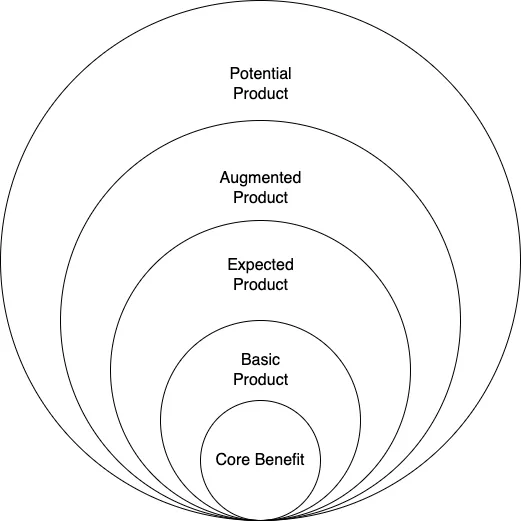
Core Benefit
The first and most fundamental level is the core benefit. This represents the primary reason customers purchase the product or service. It's the essential need that the product fulfills. For example, when purchasing a smartphone, the core benefit is communication. The customer is looking for a device that allows them to make calls, send messages, and stay connected with others. In the context of a car, the core benefit could be transportation, providing the user with the ability to travel from one location to another. The core benefit is not about the product's specific features or attributes but rather about the basic solution it provides to the customer's problem or need.
Basic Product
The basic product refers to the features and attributes that enable the product to fulfill the core benefit. This level includes the essential elements that make the product functional. In the case of a smartphone, the basic product would include the screen, battery, operating system, and the ability to make calls. For a car, it would be the engine, wheels, and seats that allow it to transport passengers from one place to another. The basic product is what customers expect from the product in its simplest form. It's the minimum viable product required to meet their needs.
Expected Product
The expected product encompasses the set of attributes or features that customers anticipate when purchasing the product. These are the characteristics that customers consider standard and assume will be included in the offering. In the case of a smartphone, customers might expect a high-quality camera, sufficient storage, and a user-friendly interface. When buying a car, customers may expect safety features like airbags, a reliable engine, and air conditioning. The expected product is the next level of value beyond the basic product, and it reflects the standard that customers have come to expect from similar products in the market.
Augmented Product
The augmented product represents the additional features and services that provide extra value to the customer. These are the attributes that differentiate the product from competitors and set it apart in the marketplace. In the smartphone example, augmented features might include wireless charging, a sophisticated camera system, or exclusive software features like facial recognition. For a car, augmented features could include a sunroof, leather seats, advanced navigation systems, or a premium sound system. The augmented product adds value by providing extras that enhance the customer experience. These features may not be essential but serve to create a stronger connection with the product and brand.
Potential Product
The potential product refers to the possible changes or improvements that could be made to the product in the future. It's about envisioning what the product could become by adding new features, improving existing attributes, or addressing future customer needs. In the case of a smartphone, the potential product might include innovations such as foldable screens, enhanced battery life, or augmented reality capabilities. For a car, it could involve the development of self-driving technology, electric powertrains, or further enhancements to fuel efficiency. The potential product is a forward-thinking concept that helps businesses stay ahead of customer expectations and anticipate future trends.
The Value of Kotler's Framework in Business
Kotler's Five Product Levels framework is not only valuable for understanding product development but also for improving customer satisfaction, identifying competitive advantages, and driving innovation. By considering each level, businesses can identify which aspects of their products need to be improved, which features will differentiate them from competitors, and how they can better meet customer expectations.
Enhancing Product Development
The framework is a powerful tool for product development because it provides a clear roadmap for businesses to follow. By focusing on each level, companies can develop products that meet basic customer needs, exceed expectations, and offer differentiated features that create loyalty and demand. The model helps businesses ensure that they're not just meeting the minimum requirements but are also offering additional value through innovative features and future possibilities.
Understanding Customer Expectations
By applying Kotler's Five Product Levels, businesses can gain a deeper understanding of customer expectations at different stages. The model highlights that customers may not only want a product that performs its core function but also expect additional features and benefits. Understanding these expectations can help businesses tailor their products and messaging to effectively communicate the value they offer.
Identifying Competitive Advantage
Kotler's framework also helps businesses identify their competitive advantage. By focusing on the augmented product level, companies can offer unique features or services that their competitors may not provide. These differentiators help to build brand loyalty and set the product apart in a crowded market.
Planning for the Future
The potential product level encourages businesses to think about the future of their products and how they can continue to innovate. This forward-thinking approach ensures that companies stay ahead of customer demands and remain relevant in the marketplace.
Kotler's Five Product Levels framework offers businesses a structured approach to product development that goes beyond simply meeting basic customer needs. By focusing on the core benefit, basic product, expected product, augmented product, and potential product, companies can create more value for their customers, differentiate their products in the market, and plan for future growth. This model is an essential tool for businesses looking to stay competitive and innovate in today's dynamic market.
Citation
Cite this article
Sridharan, M. A. (2023, July 7). Five Product Levels Framework. Think Insights. https://thinkinsights.net/strategy/five-product-levels-framework (Accessed [[ACCESS_DATE]])
Sridharan, Mithun A. "Five Product Levels Framework." Think Insights, 7 July 2023, https://thinkinsights.net/strategy/five-product-levels-framework. Accessed [[ACCESS_DATE]].
Mithun A. Sridharan, "Five Product Levels Framework," Think Insights, July 7, 2023, https://thinkinsights.net/strategy/five-product-levels-framework. Accessed [[ACCESS_DATE]].
Sridharan, M.A. (2023) 'Five Product Levels Framework', Think Insights. Available at: https://thinkinsights.net/strategy/five-product-levels-framework (Accessed: [[ACCESS_DATE]]).
M. A. Sridharan, "Five Product Levels Framework," Think Insights, 2023. [Online]. Available: https://thinkinsights.net/strategy/five-product-levels-framework. [Accessed: [[ACCESS_DATE]]].
Sridharan MA. Five Product Levels Framework. Think Insights. Published July 7, 2023. Accessed [[ACCESS_DATE]]. https://thinkinsights.net/strategy/five-product-levels-framework
Test Your Knowledge
Five Product Levels Framework
Challenge yourself on the concepts from this article and see how well you understood them.
Subscribers get weekly quizzes and insights — subscribe free
Sponsor this article
Partner with Think Insights
Reach 50,000+ business leaders, consultants, and strategists. Feature your brand alongside expert articles on strategy, leadership, and digital transformation.
Become a Sponsor