Four Corners Model


Firms don''t exist in isolation. It''s jungle out there and it''s every firm for themselves. This makes a strategist's job more complicated. It''s not enough simply for the analyst to look at their own core competencies and attempt to maximize them. No, the corporate strategists job is also to out-maneuver their chief competitors. Here we look at one of the classic strategy tools used to figure out what your competitors'' likely next moves are.
What is Porter's Four Corners Model?
It is a framework developed by Michael Porter to analyze and predict competitors' likely strategies in the medium term by examining their motivations and capabilities.
What are the four corners in the model?
The four corners are: Drivers (what motivates competitors), Management Assumptions (their beliefs about themselves and rivals), Strategy (their current actions and effectiveness), and Capabilities (what they can realistically do).
How does this model differ from Porter's Five Forces?
Five Forces analyzes industry structure without focusing on individual competitors, while the Four Corners Model specifically examines competitive dynamics and predicts how individual rivals are likely to behave.
What does the Capabilities corner assess?
It evaluates what a competitor would realistically be able to do in response to rivalry, such as whether they are more likely to cut prices or target distribution channels.
When should the Four Corners Model be used?
It is most useful when planning competitive strategy and wanting a structured way to anticipate rivals' responses before making significant strategic decisions.
Michael Porter enjoys near-legendary status among strategists, consultants and analysts. Porter — the Bishop William Lawrence University Professor at The Institute for Strategy and Competitiveness at the Harvard Business School — has indelibly influenced the way we think about strategy not only in the realm of business but also in that of international geopolitics. Porter's Four Corners Model, which is a framework for thinking about what your competitors' strategy is likely to be in the medium term future. It's a great way of making sure your thinking is structured analytically and that you're not missing any key factors that might influence your competitors' decision making. In contrast to Porter's Five Forces framework, which does not consider competition, the four corners model is based around the competitive forces that shape strategy.
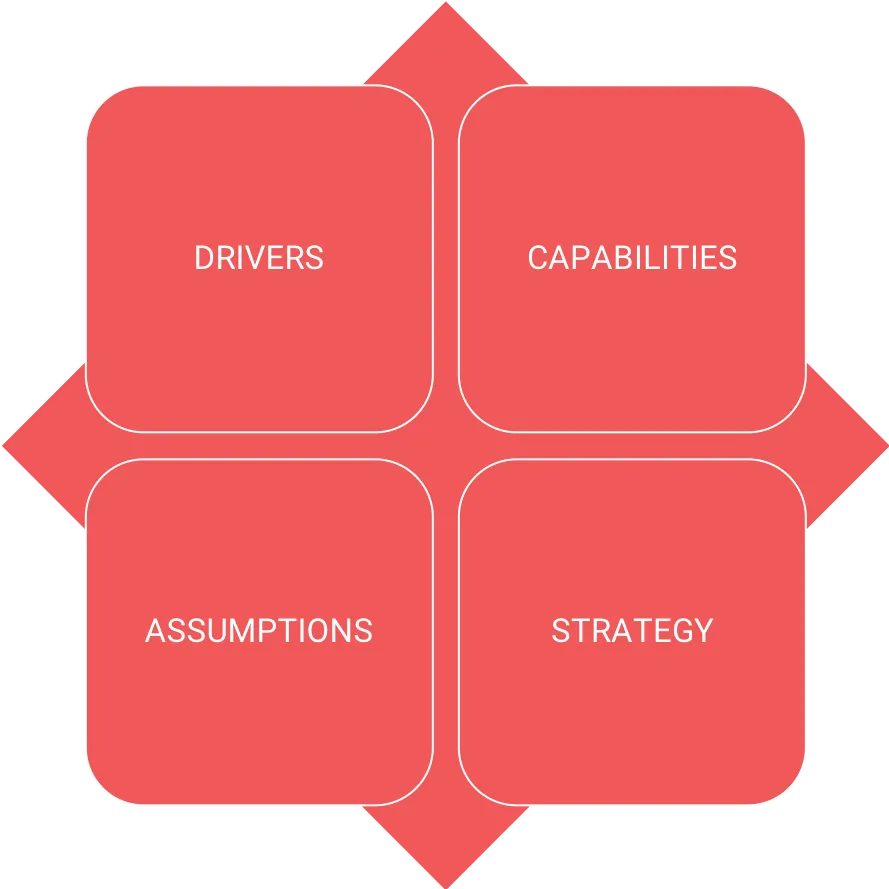
Corner 1: Motivation — Drivers
The important thing to think about here is the way your competitors' values influence the way they act. What is it that drives them forwards, drives them to compete? How does this motivate and shape their strategy?
Corner 2: Motivation — Management Assumptions
What do they believe about themselves and the world in which they operate? What assumptions have they made about their own strengths and weaknesses in relation to their competitors? Is this likely to make their strategy pro-active or reactive? Aggressive, or defensive?
Corner 3: Actions — Strategy
How do your competitors actually act and are they happy will they be with the efficacy of their actions? Is there a gap between intended strategy and realized strategy? Is there likely to be a sea-change in their strategy due to current lack of success or are they likely to keep moving in the same direction?
Corner 4: Actions — Capabilities
This corner looks at they way in which a competitor might like to act, tempered by a realistic assessment of what they are capable of doing. What are their best options for responding to competition from their rivals? For example are they more likely to respond with a price drop or through aggressively targeting its distribution network?
Porter's Four Corners tool has been around for a long time and it's earned a place for itself as a useful and respected management tool. The real advantage of this approach is the way it tries to get inside the mind of the opposition, the way it explores the beliefs and assumptions of your competitors. Another strength is that it does not simply use past behavior to predict future action, but actively tries to see if there is likely to be a shift in their strategy.
Citation
Cite this article
Sridharan, M. A. (2018, November 16). Four Corners Model. Think Insights. https://thinkinsights.net/strategy/four-corners-model (Accessed [[ACCESS_DATE]])
Sridharan, Mithun A. "Four Corners Model." Think Insights, 16 Nov. 2018, https://thinkinsights.net/strategy/four-corners-model. Accessed [[ACCESS_DATE]].
Mithun A. Sridharan, "Four Corners Model," Think Insights, November 16, 2018, https://thinkinsights.net/strategy/four-corners-model. Accessed [[ACCESS_DATE]].
Sridharan, M.A. (2018) 'Four Corners Model', Think Insights. Available at: https://thinkinsights.net/strategy/four-corners-model (Accessed: [[ACCESS_DATE]]).
M. A. Sridharan, "Four Corners Model," Think Insights, 2018. [Online]. Available: https://thinkinsights.net/strategy/four-corners-model. [Accessed: [[ACCESS_DATE]]].
Sridharan MA. Four Corners Model. Think Insights. Published November 16, 2018. Accessed [[ACCESS_DATE]]. https://thinkinsights.net/strategy/four-corners-model
Test Your Knowledge
Four Corners Model
Challenge yourself on the concepts from this article and see how well you understood them.
Subscribers get weekly quizzes and insights — subscribe free
Sponsor this article
Partner with Think Insights
Reach 50,000+ business leaders, consultants, and strategists. Feature your brand alongside expert articles on strategy, leadership, and digital transformation.
Become a Sponsor