Are Robots Taking Over Our Jobs?


Our human society has, time and again, completely revamped the central idea of work. Now, as we step rapidly into machine-powered cognitive revolution, we are redefining work to create valuable human-machine collaborations, thereby shifting our understanding of work. With the advent of Artificial Intelligence and Robots, we must reconsider how jobs are designed and work to adapt and learn for future growth.
What was the Otto self-driving truck demonstration?
In October 2016, an Uber subsidiary called Otto completed a driverless delivery of 2,000 cases of Budweiser over 120 miles in Colorado, showcasing early autonomous trucking capability.
When might AI reach full human-level intelligence according to some projections?
Political blogger Kevin Drum argues AI could reach full human-level capability by around 2045, based on observed exponential growth in AI development.
Which types of jobs are considered most at risk from automation?
Routine physical and cognitive tasks are expected to be automated first, followed by nonroutine roles such as surgeons, construction workers, and police officers, potentially by the 2040s.
What is the main counterargument to AI job displacement fears?
Human ingenuity and the ability to control AI's development pace are key factors futurists overlook, comparing AI to water that can be harnessed through proper frameworks.
What questions should we ask about AI?
Rather than focusing on AI's capabilities, ask what we want AI to do, how quickly we should deploy it, and to what extent its emergence should be controlled.
In October 2016, an Uber trucking subsidiary named Otto delivered 2,000 cases of Budweiser 120 miles from Fort Collins, Colorado, to Colorado Springs—without a driver at the wheel. Within a few years, this technology will go from prototype to full production. The biggest cost savings for the trucking industry will eventually come from eliminating the driver entirely and that means millions of truck drivers will be out of a job! The idea that commercial trucking could be done by robots is a relatively new idea - and a potentially controversial one, given the possibility that robots could one day replace human drivers.
Popular opinion
In a recent article, titled You Will Lose Your Job to a Robot—and Sooner Than You Think', the American political blogger and columnist, Kevin Drum, makes a compelling argument why the future of work looks bleak. His central idea lies in the exponential progression of Artificial Intelligence [AI]. According to his article, AI will reach 1/10th the power of the human brain by 2035; by 2045, we will have full human-level AI. In the future, the meaning of work will change, as history has demonstrated. In the context of AI, the following categorical changes are to be expected:
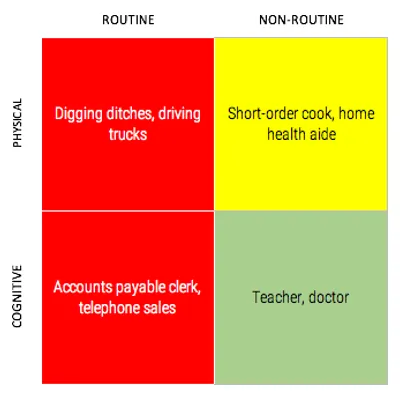
As per the article:
Routine tasks will be the first to go—and thanks to advances in robotics engineering, both physical and cognitive tasks will be affected. Nonroutine jobs will be next: surgeons, novelists, construction workers, police officers, and so forth. These jobs could all be fully automated during the 2040s. By 2060, AI-based robots will be capable of performing any task currently done by humans.
My opinion
Personally, my views on the future of work digresses from those of these futurists and fear-mongers. AI becomes a very potent resource only if we have it under our control. If we can control its release, we win. To give you an analogy, the water in a dam could be deployed to a myriad of beneficial purposes. To do so, we need a framework, tools, and structures to harness this natural resource. Similarly, we should be thinking of AI and robots in the framework as we control the dynamics of water. Much of the futuristic thinking seems stuck in the previous era when knowledge was hard to come by and we celebrated each new piece of the puzzle as it emerged. However, what we should be celebrating is our ability to build the dam and control the forces of nature.
A note for self-proclaimed futurists
Futurists need to learn how to think holistically. They seem to assume that those being left behind by the technological disruptions will just succumb and die to make way for the glorious new day that is coming. But, what they're missing out on the element of human ingenuity, resilience, and adaptability. To me, knowledge is the engine that drives human development - and it has been throughout history. AI takes the knowledge to its pinnacle. Combined with machines and human ingenuity, this tipping point is poised to alter - what it means to be human. Therefore, futurists need to think about the entire picture, all the parts involved in the human endeavour, and not just the latest fads that are fun to speculate about. So, instead of saying:
AI is amazing, it will do this, it will do that
We should be asking:
What do we want AI to do? And when? How fast do we want to bring it online? How are we going to control the pace of it's emergence? To what degree should it emerge at all?
As technology develops at an accelerated pace, cognitive abilities and tasks that were once thought to be reserved for humans are increasingly being carried out by machines. It is imperative that governments, businesses, academic institutions and individuals consider how to proactively shape a new, positive future of work - one that we want rather than one that emerges through inertia. How do you envision the future of work? Do you think AI will make you redundant? Please share your comments.
Citation
Cite this article
Sridharan, M. A. (2018, November 14). Are Robots Taking Over Our Jobs?. Think Insights. https://thinkinsights.net/digital/are-robots-taking-over-our-jobs (Accessed [[ACCESS_DATE]])
Sridharan, Mithun A. "Are Robots Taking Over Our Jobs?." Think Insights, 14 Nov. 2018, https://thinkinsights.net/digital/are-robots-taking-over-our-jobs. Accessed [[ACCESS_DATE]].
Mithun A. Sridharan, "Are Robots Taking Over Our Jobs?," Think Insights, November 14, 2018, https://thinkinsights.net/digital/are-robots-taking-over-our-jobs. Accessed [[ACCESS_DATE]].
Sridharan, M.A. (2018) 'Are Robots Taking Over Our Jobs?', Think Insights. Available at: https://thinkinsights.net/digital/are-robots-taking-over-our-jobs (Accessed: [[ACCESS_DATE]]).
M. A. Sridharan, "Are Robots Taking Over Our Jobs?," Think Insights, 2018. [Online]. Available: https://thinkinsights.net/digital/are-robots-taking-over-our-jobs. [Accessed: [[ACCESS_DATE]]].
Sridharan MA. Are Robots Taking Over Our Jobs?. Think Insights. Published November 14, 2018. Accessed [[ACCESS_DATE]]. https://thinkinsights.net/digital/are-robots-taking-over-our-jobs
Test Your Knowledge
Are Robots Taking Over Our Jobs?
Challenge yourself on the concepts from this article and see how well you understood them.
Subscribers get weekly quizzes and insights — subscribe free
Sponsor this article
Partner with Think Insights
Reach 50,000+ business leaders, consultants, and strategists. Feature your brand alongside expert articles on strategy, leadership, and digital transformation.
Become a Sponsor