Business Model Canvas for Nonprofits


Nonprofit leaders often run three organizations at once: one serving beneficiaries, one raising money and one reporting outcomes. The standard Business Model Canvas, built for commercial ventures, does not separate those roles cleanly. A nonprofit version splits the customer into beneficiaries who receive value and donors who fund it, then rebuilds each of the nine blocks around mission logic instead of margin. This piece explains why the standard canvas breaks down for mission-driven organizations, how each block shifts when applied to social impact work and how Charity: Water, the clean water nonprofit, illustrates the adapted model in practice. Executives and board members get a practical lens for testing whether program design, funding strategy and impact reporting actually connect, rather than running on separate calendars.
How does a nonprofit canvas differ from the standard one?
The nonprofit version splits the customer into beneficiaries who receive mission value and donors who supply the resources, then rewrites value propositions, relationships and channels separately for each group instead of treating them as one segment.
Why does Charity: Water separate donations from overhead?
Charity: Water splits its funding into two streams so public donations fund only water projects, while a separate donor group called The Well covers salaries and operating costs, letting the organization tell donors that their full gift reaches the field.
How often should a nonprofit revisit its canvas?
Leaders should revisit the canvas whenever a program shifts, a major grant changes behavior or a new partnership alters delivery, since each of those events can move beneficiary needs and funding logic out of alignment.
Why Nonprofits Need a Different Canvas
Alexander Osterwalder and Yves Pigneur introduced the Business Model Canvas [BMC] in 2005 as a one-page tool for mapping how a company creates and captures value.1 The tool assumes the person who receives value and the person who pays for it are the same customer, which works well for a company selling a product. That assumption breaks the moment the framework meets a nonprofit, because the group receiving a service rarely funds it directly. A food bank client does not pay for groceries and a workforce training graduate does not fund the classroom that trained them. Recognizing that split is the starting point for adapting the canvas rather than simply relabeling boxes.
Splitting the Customer Into Two Roles
Nonprofits operate at meaningful scale in the United States, with roughly 1.9 million organizations registered as tax-exempt charities.2 Each of those groups faces the same structural challenge: beneficiaries receive mission value, while donors, foundations and government agencies supply the resources that make delivery possible. Treating both groups as one customer segment flattens the value proposition, because the promise made to a family receiving clean water differs from the promise made to a donor funding the well. Once leaders separate beneficiary segments from funder segments, the canvas stops hiding that difference and starts forcing a decision about which relationship gets prioritized where.
A nonprofit customer question always splits into two: who receives the value and who pays for it
Rebuilding the Nine Blocks Around Mission
Every block in the standard canvas needs a mission-specific translation, not just a nonprofit label. The value proposition becomes two propositions: one describing the outcome a beneficiary experiences and one describing the change a donor is funding. Strategyzer, the consultancy Osterwalder co-founded, frames a value proposition as the specific combination of products, services and outcomes that create value for a defined customer.3 Nonprofits need that same specificity twice over, once for the person served and once for the person or institution funding the service. Key resources also expand beyond staff and cash to include community trust, volunteer capacity and the data systems that prove outcomes to funders.
Funding Streams Carry Different Logic
Revenue streams in a nonprofit canvas function differently than in a company, because income rarely tracks straightforward market demand. Individual donations tend to offer flexibility but require constant stewardship and repeated proof that the mission still matters. Foundation grants fund focused initiatives but pull reporting requirements and scope restrictions into the model. Charity: Water, the nonprofit that funds clean water projects in developing countries, built its fundraising model around this distinction by separating public donations from the money that covers salaries and overhead.4 That structure turns a funding decision into a strategic choice about what each dollar is allowed to do.
Charity: Water as a Working Model
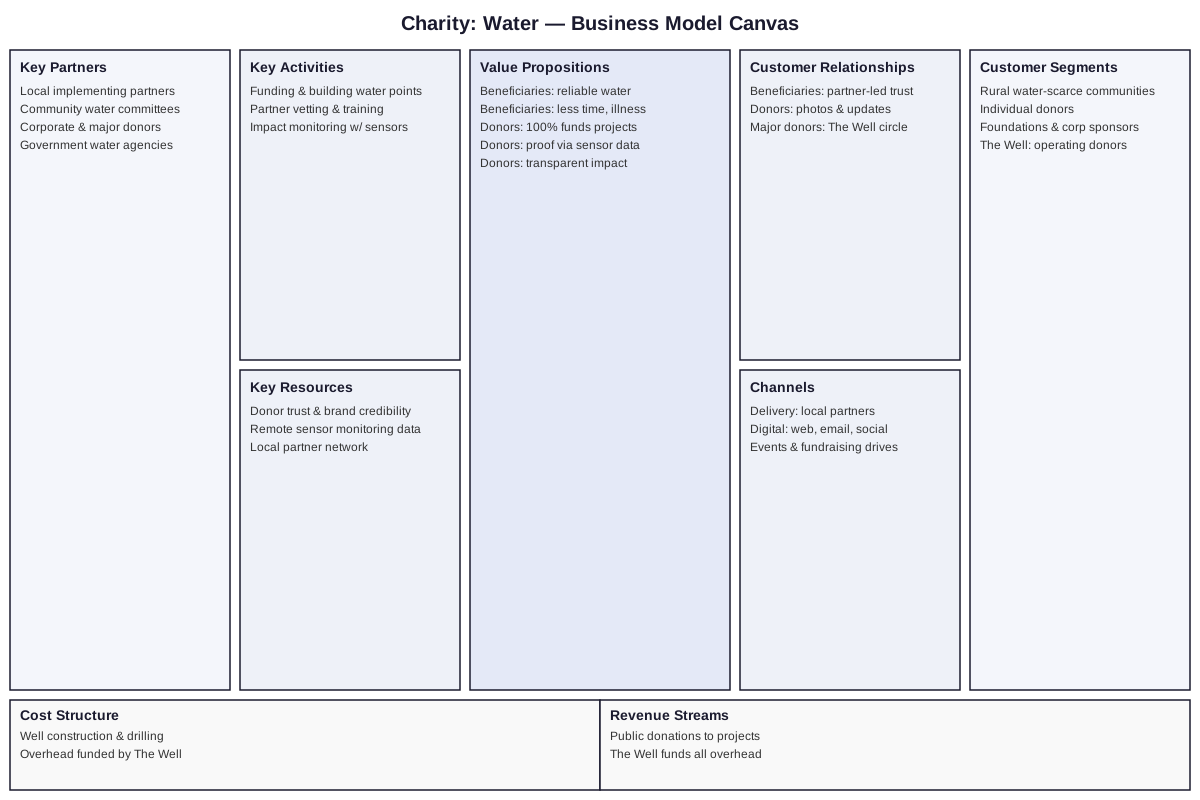
Charity: Water applies the adapted canvas without naming it that way. Its 100% model promises that every dollar from public donations funds water projects directly, while a separate group of donors called The Well covers all operating costs, including salaries and technology.5 That separation solves the funder value proposition problem directly, because a donor giving to a project knows exactly where the money goes instead of guessing how much reaches the field. The organization pairs that funding structure with local implementing partners who select, build and maintain water points, which keeps beneficiary relationships rooted in community trust rather than headquarters direction.
Making the Canvas a Decision Tool
A canvas only earns its place on a strategy team's wall if it forces trade-offs instead of collecting a wish list of programs and partners. The strongest versions place an impact test next to every block: if a channel changes, what outcome should move; if a funding source grows, what capacity should expand. Investopedia describes the business model canvas as a tool meant to be revisited and tested against real assumptions, not filled out once and filed away.6 Nonprofits that revisit the canvas after a funding shift or program change keep mission logic and resourcing logic pointed at the same target.
Every box on the canvas should answer one question: how does this sustain mission impact
Key Partners
Charity: Water depends on local implementing partners, mostly community-based organizations already working in the regions it serves. These partners design water points, negotiate with village leaders and manage construction crews on the ground. Corporate sponsors and major donors, including members of The Well, supply funding and visibility. Government water agencies and community water committees round out the network, handling permitting and long-term upkeep once a project is complete.
Key Activities
The organization's core activities center on funding and overseeing construction of wells, piped systems and rainwater catchments in underserved communities. Staff vet and train implementing partners so each project meets consistent engineering and safety standards. Remote sensors installed at water points feed usage data back to headquarters, letting teams spot breakdowns before a community loses access. Outreach and donor communication run alongside project delivery to keep funding steady.
Key Resources
Donor trust functions as Charity: Water's most valuable asset, built through transparent reporting and its public 100% donation pledge. Remote monitoring data lets the organization prove that funded wells stay functional years after completion, which strengthens future fundraising. A network of vetted local partners provides on-the-ground expertise the organization could not replicate from its New York headquarters. Staff experience in water engineering and nonprofit finance rounds out the resource base.
Value Propositions
For beneficiaries, Charity: Water offers reliable access to clean water close to home, cutting the time women and children spend walking to distant sources. For donors, it offers a rare guarantee: every cent of a public donation funds an actual project, not overhead. Location data and photos from funded wells give donors visible proof their money produced a working water point. That transparency, more than the water itself, is what donors are ultimately buying.
Customer Relationships
Beneficiary relationships run through local partners who stay embedded in the community long after a well is built, handling repairs and training water committees. Individual donors receive project updates and photos and for some campaigns, coordinates showing exactly where their money went. Members of The Well, who fund operating costs, get closer engagement, including direct briefings on organizational strategy. Each relationship type reflects a different kind of trust the organization has to earn.
Channels
Water itself reaches communities through local partners who handle construction, training and maintenance, not through Charity: Water staff directly. Donor-facing channels include the organization's website, email campaigns and social media, where updates and campaign stories keep supporters engaged. Corporate partnerships and cause marketing campaigns extend reach into new donor networks. Events and creative fundraising pushes, including its annual charity ball, generate both money and public visibility.
Customer Segments
Rural and peri-urban communities without reliable clean water access make up the beneficiary segment, spread across the partner countries where Charity: Water operates. On the funding side, individual donors form the base of public giving, drawn in through digital campaigns and personal appeals. Foundations and corporate sponsors fund specific projects or regional programs, often with reporting requirements attached. The Well, a smaller circle of major donors, funds operations rather than projects.
Cost Structure
Project costs cover drilling, materials, construction labor and the monitoring hardware installed at each water point, all funded entirely by public donations. Separately, overhead costs, including salaries, office space and technology, are covered by The Well rather than by project donations. Keeping those two cost pools apart is what makes the 100% donation pledge possible without starving the organization of operating capacity.
Revenue Streams
Public donations from individuals, campaigns and project-specific gifts make up the funding stream dedicated entirely to water projects. The Well supplies a second, separate stream that funds staff, systems and operations, keeping those costs out of the project ledger. Corporate sponsorships and foundation grants supplement both streams, typically tied to specific regions or water solutions. That two-stream structure is the financial engine behind the 100% model.
A nonprofit business model canvas only earns its place on the wall if it changes decisions. That means testing beneficiary segments against real delivery capacity, matching funding streams to the type of organization the mission requires and refusing to treat activity counts as proof of impact. Charity: Water's split between public donations and operating costs shows how a funding structure can be designed around trust rather than convenience. The lesson for other nonprofits is not to copy that structure but to ask the same question it answers: does the money raised match the way the organization plans to deliver value. Leaders who revisit the canvas after every major program or funding shift keep mission and resourcing logic pointed in the same direction.
Citation
Cite this article
Sridharan, M. A. (2021, June 6). Business Model Canvas for Nonprofits. Think Insights. https://thinkinsights.net/strategy/business-model-canvas-nonprofits (Accessed [[ACCESS_DATE]])
Sridharan, Mithun A. "Business Model Canvas for Nonprofits." Think Insights, 6 June 2021, https://thinkinsights.net/strategy/business-model-canvas-nonprofits. Accessed [[ACCESS_DATE]].
Mithun A. Sridharan, "Business Model Canvas for Nonprofits," Think Insights, June 6, 2021, https://thinkinsights.net/strategy/business-model-canvas-nonprofits. Accessed [[ACCESS_DATE]].
Sridharan, M.A. (2021) 'Business Model Canvas for Nonprofits', Think Insights. Available at: https://thinkinsights.net/strategy/business-model-canvas-nonprofits (Accessed: [[ACCESS_DATE]]).
M. A. Sridharan, "Business Model Canvas for Nonprofits," Think Insights, 2021. [Online]. Available: https://thinkinsights.net/strategy/business-model-canvas-nonprofits. [Accessed: [[ACCESS_DATE]]].
Sridharan MA. Business Model Canvas for Nonprofits. Think Insights. Published June 6, 2021. Accessed [[ACCESS_DATE]]. https://thinkinsights.net/strategy/business-model-canvas-nonprofits
Test Your Knowledge
Business Model Canvas for Nonprofits
Challenge yourself on the concepts from this article and see how well you understood them.
Subscribers get weekly quizzes and insights — subscribe free
Sponsor this article
Partner with Think Insights
Reach 50,000+ business leaders, consultants, and strategists. Feature your brand alongside expert articles on strategy, leadership, and digital transformation.
Become a Sponsor