Toms Shoes' One-for-One Reckoning


Toms Shoes built its identity on a simple pledge: for every pair of shoes sold, the company would donate a pair to a child in need. Founder Blake Mycoskie launched the one-for-one model in 2006 after a trip to Argentina, and the idea turned into one of the most recognized cause-marketing stories in retail, with more than 35 million pairs donated across 70 countries. But the model that built the brand also strained it. A 2014 deal that gave private equity firm Bain Capital a 50% stake loaded Toms with debt, and by December 2019 creditors led by Jefferies, Nexus Capital Management and Brookfield Asset Management took ownership entirely, restructuring $300 million in debt and pushing out both Mycoskie and Bain. This article traces how the donation model worked commercially, why it became a liability and what changed after the 2019 takeover.
What is the Toms Shoes one-for-one model?
For every pair of shoes a customer bought, Toms donated a pair to a child in need, a pledge founder Blake Mycoskie introduced after visiting Argentina in 2006. The company later applied a modified version of the same principle to its eyewear line, using profits to help restore sight in developing countries.
Why did Toms Shoes lose its founder-led ownership?
Toms took on significant debt after Bain Capital acquired a 50% stake in 2014, and when sales stagnated, the company couldn't meet its loan obligations. In December 2019, a group of creditors led by Jefferies, Nexus Capital Management and Brookfield Asset Management took ownership in exchange for restructuring $300 million in debt, ending Blake Mycoskie's and Bain Capital's control.
Did Toms Shoes stop donating shoes after 2019?
Toms Shoes continued its giving commitment after the ownership change, though the company has since described its social impact work in broader terms covering grassroots giving partners rather than a strict shoe-for-shoe pledge on every sale. The core idea of tying purchases to a social contribution has remained part of the brand even as the mechanics evolved.
An idea born from a trip to Argentina
Blake Mycoskie founded Toms Shoes in 2006 after traveling to Argentina and seeing children without shoes to protect their feet from injury and disease. He based the company's first product, the alpargata, on a canvas slip-on design already popular in the country, and built the business around a pledge to donate a pair of shoes for every pair sold. The company donated 10,000 pairs to children in Argentina in its first year alone, and by 2007 it had launched an annual "One Day Without Shoes" campaign to build public awareness of the cause. 1
The one-for-one pledge did more than generate goodwill. It gave customers a clear, easily shared reason to talk about the brand, turning purchases into a story people wanted to tell friends and post about, which lowered the company's dependence on traditional advertising in its early years.
The economics behind giving a pair away
Toms Shoes built a profitable business despite donating a product for every one it sold, because the unit economics left enough room. The company has said it costs roughly $10 to produce a pair of shoes that retail between $40 and $140, a margin wide enough to absorb the cost of the donated pair and still turn a profit on the sale. That gap is central to understanding why the one-for-one pledge functioned as a business model rather than pure philanthropy funded separately from sales.
The one-for-one model worked commercially only because the retail markup was wide enough to cover both the sold shoe and the donated one.
By 2011, the company extended the same logic to eyewear, using profits from glasses sales to fund vision restoration efforts in developing countries. 2 Toms has said this eyewear-tied giving has helped restore sight to more than 275,000 people, and the company later expanded into coffee, bags and other accessories, each carrying some version of a giving component tied to sales.
Bain Capital's 2014 stake and the debt it brought
Blake Mycoskie remained sole owner of Toms Shoes until 2014, when he sold a 50% stake to Bain Capital, a private equity firm, in a deal that valued the company at roughly $625 million including debt. 3 Mycoskie framed the deal as a way to accelerate growth, giving the company access to capital and Bain's operational expertise. What the deal also brought was debt: the leveraged structure common to private equity transactions loaded Toms Shoes with borrowing obligations that assumed continued sales growth to service.
That growth didn't materialize at the pace the debt required. Toms Shoes faced stagnating sales in the years following the Bain investment, a period when direct-to-consumer competitors and broader shifts in footwear spending pressured the brand's core business.
When the debt came due
By 2019, Toms Shoes carried a credit rating deep into junk territory, and analysts warned the company would not be able to repay its roughly $300 million loan without renegotiating with lenders. 4 In December 2019, a group of creditors led by Jefferies Financial Group, Nexus Capital Management and Brookfield Asset Management agreed to take ownership of the company in exchange for restructuring that debt, ending both Mycoskie's and Bain Capital's control. 5
As part of the restructuring, the new ownership group committed to investing $35 million into the business, providing fresh capital to stabilize operations that the prior debt load had constrained. The takeover marked one of the more prominent examples of a mission-driven direct-to-consumer brand's growth story colliding with the realities of leveraged private equity ownership.
What changed after the takeover
Under its new owners, Toms Shoes retained the core giving commitment that built its brand identity, even as the company adjusted how it talks about and structures that impact work. The company has continued distributing products through nonprofit partners and describing its social contributions in broader terms, reflecting lessons from years of criticism that a rigid one-for-one shoe donation could disrupt local markets rather than help them. Toms has also continued selling its expanded product range, including bags and accessories introduced before the ownership change, rather than retreating to footwear alone.
The 2019 transition illustrates a distinction worth drawing out: the one-for-one concept as a marketing and brand differentiator survived, but the specific financial structure that funded rapid pre-2019 expansion did not. Toms Shoes today operates with a cleaner balance sheet than it did under the Bain-era debt load, though it also operates with less of the scale ambition that leveraged growth capital had been meant to fund.
Direct sales built the customer relationship, partnerships extended the reach
Toms Shoes has generated most of its revenue through direct sales via its own retail stores and online store, a channel that gives the company control over pricing and a direct relationship with customers rather than relying on wholesale distribution through third-party retailers. Retail locations typically display information about the specific beneficiaries of the company's giving programs, reinforcing the cause-driven positioning at the point of sale.
The company has supplemented direct sales with limited-edition partnerships with other brands, a strategy that generates incremental revenue while occasionally reducing marketing and distribution costs when a partner already has an established audience or distribution network. 6 These collaborations remain a secondary revenue stream compared with core footwear and accessory sales through Toms' own channels.
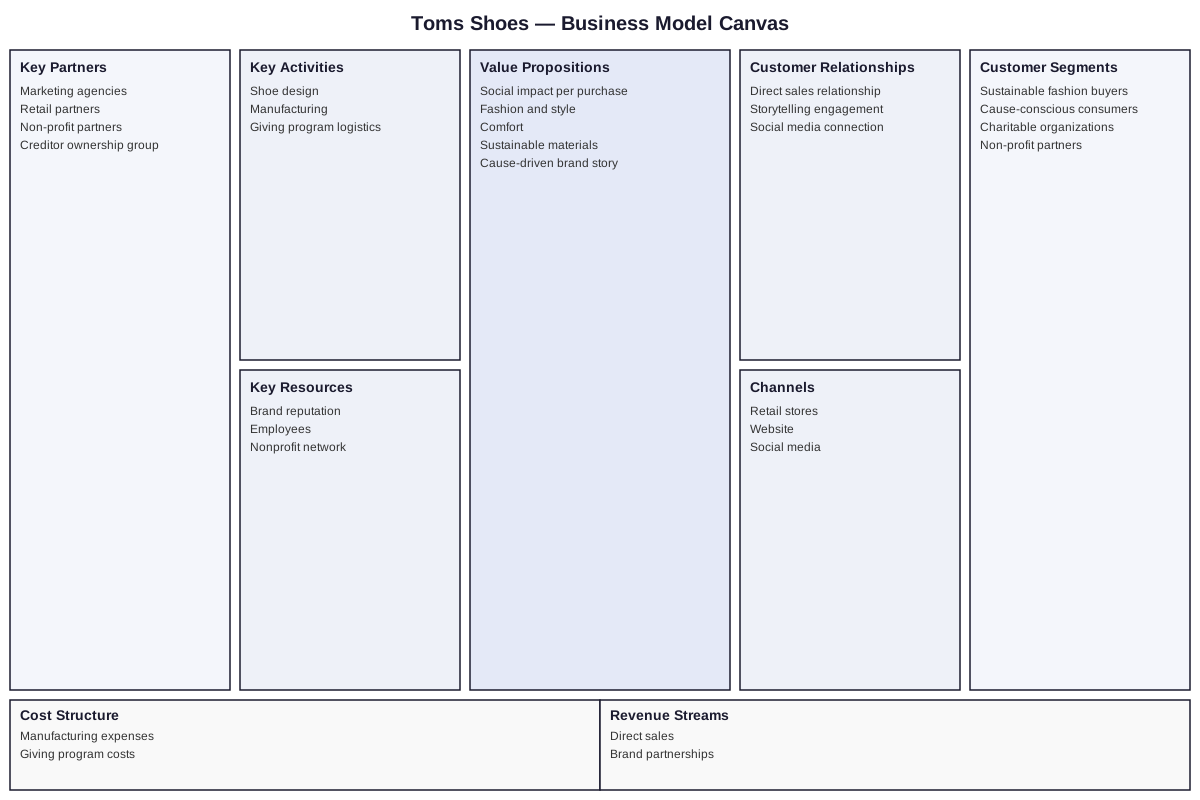
Key Partners
Toms Shoes works with marketing and advertising agencies to sustain brand awareness, particularly given the company's historical reliance on earned media and word-of-mouth rather than heavy paid advertising. Retailers that carry Toms products alongside the company's own stores extend its distribution reach. Non-profit organizations, more than 100 of which the company has partnered with over the years, remain essential to distributing donated products to the communities the giving program targets.
Key Activities
Toms Shoes' core activities include designing and manufacturing footwear, along with the eyewear, bags and accessories the company has added to its product range. Marketing efforts built around the brand's social impact story remain a continuous activity, distinct from conventional product advertising. Managing the logistics of the giving program, including coordination with nonprofit distribution partners, is an operational activity unique to Toms' business model compared with conventional footwear brands.
Key Resources
Toms Shoes' brand reputation, built over nearly two decades around its giving pledge, is its most valuable resource and the primary reason customers choose the brand over lower-priced alternatives. The company's employees, particularly those managing product design and the giving program logistics, represent a second key resource. Strategic partnerships with nonprofit organizations and, more recently, the creditor ownership group's capital investment, round out the resources supporting the business.
Value Propositions
Toms Shoes offers customers a way to make a social impact through ordinary purchases, appealing to shoppers who want their spending to align with charitable values. The company also competes on design and comfort, offering a range of casual footwear styles built with breathable, soft materials. Sustainability is a further value proposition, with the company using organic cotton, recycled materials and eco-friendly dyes in parts of its product line.
Customer Relationships
Toms Shoes builds customer relationships primarily through its direct sales channels, both retail stores and its website, which give the company visibility into customer behavior and purchase history. The brand's storytelling around its giving program creates an emotional relationship that goes beyond a typical transactional retail interaction. Social media engagement reinforces this connection, letting customers see the impact of their purchases and share that story with their own networks.
Channels
Toms Shoes sells primarily through its own website and physical retail stores located in major cities, giving it direct control over the customer experience and pricing. Social media serves as both a marketing and sales-supporting channel, particularly given how central shareable storytelling has been to the brand's growth. Limited-edition partnership products occasionally extend distribution through a partner brand's existing channels.
Customer Segments
Toms Shoes' core customer segment includes consumers who prioritize sustainable and ethically produced fashion, willing to pay a premium for products tied to a social cause. Charitable organizations and nonprofit partners form a second, non-purchasing segment essential to the company's giving program, since they distribute donated products to the communities the company aims to serve.
Cost Structure
Toms Shoes' costs include manufacturing expenses for its footwear and expanded product lines, along with marketing and advertising spending to sustain brand visibility. Corporate social responsibility expenses, tied directly to the company's giving programs, represent a cost category distinctive to its business model. Administrative and research and development expenses round out its major cost categories.
Revenue Streams
Direct sales through Toms Shoes' retail stores and online store generate the majority of the company's revenue. Limited-edition partnerships with other brands contribute a smaller, supplementary revenue stream, generating income from co-branded products while occasionally reducing the company's own marketing and distribution costs.
- 1Toms Shoes founding story and early growth
- 2Toms Shoes expands into eyewear with vision-focused giving
- 3Bain Capital's 2014 investment in Toms Shoes
- 4Toms Shoes' 2019 credit crisis and debt load
- 5Creditors take ownership of Toms Shoes in debt-for-equity deal
- 6Toms Shoes brand partnerships and product expansion
Toms Shoes proved that a donation pledge could function as a marketing engine, generating word-of-mouth attention that conventional advertising struggles to match. But the same commitment that built the brand also became a fixed cost the company couldn't easily scale down when sales slowed, and the 2014 private equity deal added debt obligations on top of it. The 2019 creditor takeover marked less a rejection of the one-for-one idea than a correction of the balance sheet built around it, with the new owners injecting $35 million and keeping the donation commitment in a modified form. Whether Toms can rebuild the growth trajectory it had before the Bain deal will depend on whether cause marketing alone can still differentiate the brand in a footwear market now full of sustainability-focused competitors making similar promises.
Citation
Cite this article
Sridharan, M. A. (2020, November 14). Toms Shoes' One-for-One Reckoning. Think Insights. https://thinkinsights.net/strategy/toms-shoes-one-one-reckoning (Accessed [[ACCESS_DATE]])
Sridharan, Mithun A. "Toms Shoes' One-for-One Reckoning." Think Insights, 14 Nov. 2020, https://thinkinsights.net/strategy/toms-shoes-one-one-reckoning. Accessed [[ACCESS_DATE]].
Mithun A. Sridharan, "Toms Shoes' One-for-One Reckoning," Think Insights, November 14, 2020, https://thinkinsights.net/strategy/toms-shoes-one-one-reckoning. Accessed [[ACCESS_DATE]].
Sridharan, M.A. (2020) 'Toms Shoes' One-for-One Reckoning', Think Insights. Available at: https://thinkinsights.net/strategy/toms-shoes-one-one-reckoning (Accessed: [[ACCESS_DATE]]).
M. A. Sridharan, "Toms Shoes' One-for-One Reckoning," Think Insights, 2020. [Online]. Available: https://thinkinsights.net/strategy/toms-shoes-one-one-reckoning. [Accessed: [[ACCESS_DATE]]].
Sridharan MA. Toms Shoes' One-for-One Reckoning. Think Insights. Published November 14, 2020. Accessed [[ACCESS_DATE]]. https://thinkinsights.net/strategy/toms-shoes-one-one-reckoning
Test Your Knowledge
Toms Shoes' One-for-One Reckoning
Challenge yourself on the concepts from this article and see how well you understood them.
Subscribers get weekly quizzes and insights — subscribe free
Sponsor this article
Partner with Think Insights
Reach 50,000+ business leaders, consultants, and strategists. Feature your brand alongside expert articles on strategy, leadership, and digital transformation.
Become a Sponsor