Crypto Payment Gateways vs Processors


Merchants now choose between two payment rails that solve different problems. Traditional processors route a card transaction through a gateway, a processor and a card network, each layer adding cost but also adding protection against fraud and disputes. Crypto payment gateways skip that layered network, settle in minutes and charge a fraction of the fee, but expose merchants to price swings and a thinner safety net. The right choice depends on transaction size, customer base and appetite for risk rather than on which technology sounds more modern. Most large merchants now run both rails side by side, using cards for everyday retail and crypto for cross-border or younger, digitally native customers who want the option.
What fees should a business expect from a crypto payment gateway?
Most crypto gateways charge close to 1 percent of the transaction, often on a tiered scale that drops further once monthly volume passes a set threshold, plus a small flat fee per transaction. That compares with a blended card cost that regularly exceeds 2 percent once network, processor and gateway fees are added together.
Why do traditional processors still dominate mass-market retail?
Card networks offer chargeback protection, fraud liability shifts and dispute resolution that customers have come to expect at checkout. For high-volume, low-margin retail, that protection is worth more than the fee savings crypto offers, especially where refunds and disputes are routine.
Can a business accept both crypto and card payments at once?
Yes and most merchants that add crypto keep their card processor in place rather than replacing it. A crypto gateway typically plugs in as an additional checkout option, converting to fiat on settlement so accounting and treasury processes stay unchanged.
How Traditional Processors Move Money
A card payment looks instant to the shopper but travels through several institutions before it clears. The transaction passes from the merchant's payment gateway to an acquiring processor, then to the card network and finally to the customer's issuing bank and each party performs its own authorization, fraud screening and compliance check. That layered structure is why funds usually settle in one to three business days rather than immediately.
The layering carries a price. Merchants paid a record $198.25 billion in card processing fees in 2025, with the average combined Visa and Mastercard interchange rate climbing to 2.36 percent of transaction value.1 On top of interchange, merchants absorb currency conversion charges for international sales and chargeback fees when disputes arise. What that fee buys is a mature dispute system: a customer who never receives a product can reverse the charge and the bank, not the merchant alone, carries much of the fraud risk.
How Crypto Gateways Settle Payments
A crypto payment gateway removes the chain of intermediaries. The customer sends digital currency directly to a wallet address or scans a QR code, the transaction confirms on the blockchain and the gateway converts the funds to fiat if the merchant asked for that option. There is no card network fee to pass along, no interchange negotiation and no multi-day settlement cycle.
BitPay prices this service on a tiered schedule: 2 percent of transaction value for merchants processing under $500,000 a month, dropping to 1.5 percent between $500,000 and $999,999 and 1 percent above $1 million, plus a flat $0.25 charge per transaction.2 The gateway also expanded its integration with Coinbase so wallet balances sync directly and settle without an added blockchain fee, which shortens the path between a customer's wallet and a merchant's bank account. Most gateways bundle volatility protection, a merchant dashboard and automatic fiat conversion into the same fee, so the cost advantage over cards narrows once those features are counted.
Weighing Cost Against Certainty
The cost comparison looks simple on paper: cards near 2.36 percent against crypto near 1 percent. But a lower fee does not automatically mean a better outcome for every merchant. A small retailer with thin margins gains real savings from switching a share of volume to crypto, while a high-volume enterprise negotiating custom interchange rates may find the gap much smaller than the headline numbers suggest.
Crypto settlement removes the multi-day card cycle, but the merchant that opts for fiat conversion still depends on the gateway's exchange-rate execution at the moment of settlement
Volatility is the other side of the ledger. A merchant that holds cryptocurrency instead of converting immediately can see the value of a completed sale rise or fall before it settles, which is why most gateways default to same-day fiat conversion for merchants that want price certainty. BitPay leaned on this logic when it deepened its Coinbase integration to let wallet balances sync directly and settle without an added blockchain fee, cutting the gap between a completed transaction and a merchant's bank deposit.3
Risk Allocation and the Customer at Checkout
Traditional processors distribute risk across banks, networks and processors, which is precisely why a customer trusts a card at checkout even from an unfamiliar merchant. That distributed risk model took decades to build and remains the reason chargeback rights are a baseline consumer expectation in most markets. A small business that accepts cards outsources fraud risk to that network rather than carrying it alone.
Crypto payments shift more of that risk back onto the merchant and the customer, since blockchain transactions are irreversible once confirmed. In exchange, a merchant that adds crypto signals to a specific segment of shoppers that it accommodates a payment method they already use daily. That signal carries commercial weight with customers who see card networks as an unnecessary intermediary rather than a form of protection. Thirty-six percent of Gen Z consumers used a digital wallet for their most recent retail purchase as of November 2025, up from 15 percent in March 2024, a shift that puts pressure on merchants to widen checkout options rather than assume cards alone will do.4
Who Is Actually Using Crypto at Checkout
Adoption skews younger and the gap between generations keeps widening. Ownership of cryptocurrency follows the same pattern as digital wallet use, with more than half of Gen Z respondents reporting they currently own or have owned crypto, compared with roughly a third of the general population.5 That demographic tilt matters for merchants selling to a younger customer base or operating across borders, where a crypto option can substitute for an international wire transfer. It matters less to a grocery chain or a utility company whose customer base skews older and values familiar checkout flows over novelty.
Regulation Is Catching Up to the Market
Governments spent 2025 building the rulebook that crypto payments previously lacked. The European Union's Markets in Crypto-Assets framework took full effect at the start of the year, giving crypto asset service providers and stablecoin issuers a single set of rules across the bloc for the first time. The United States followed with the GENIUS Act in July 2025, creating a federal framework for payment stablecoins and assigning oversight to the Office of the Comptroller of the Currency, the Federal Reserve, the FDIC and the Treasury.6 For a merchant, clearer rules cut both ways: compliance costs rise as gateways implement new reporting and licensing requirements, but customer confidence in holding and spending crypto also improves once a recognized regulator stands behind the token in use.
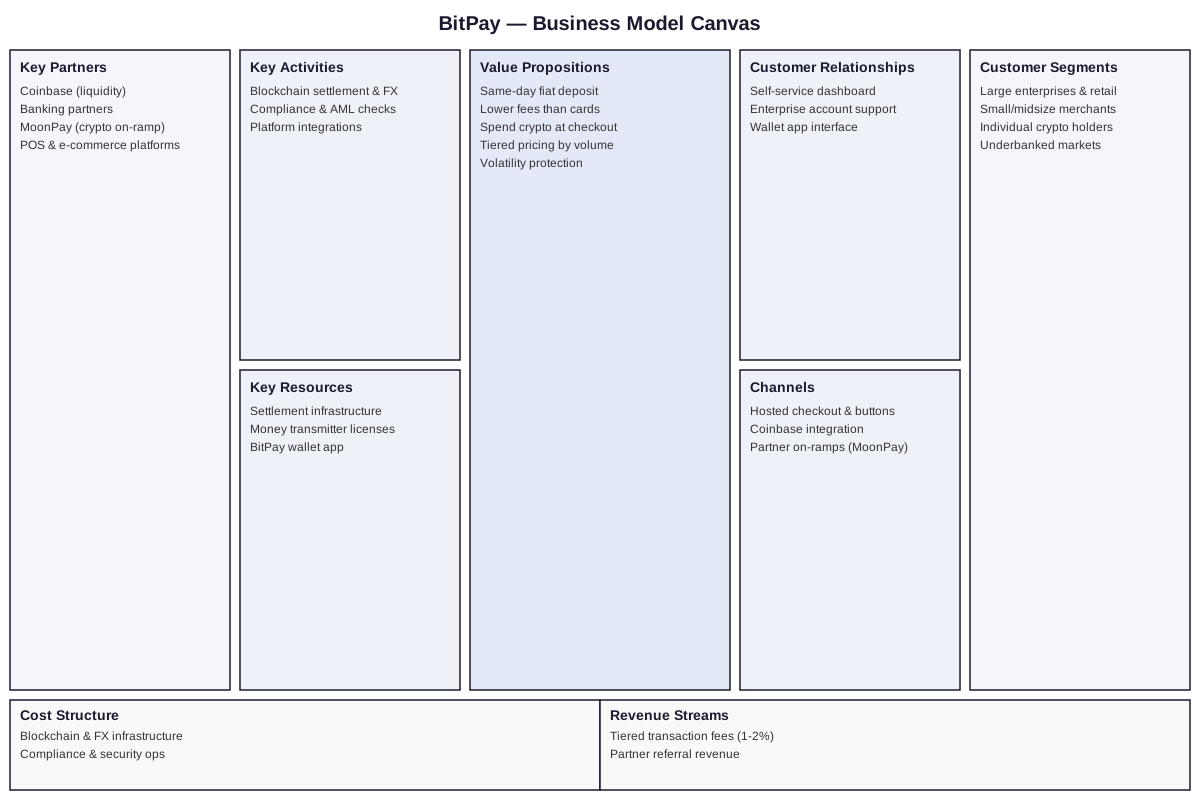
Key Partners
BitPay depends on exchanges and liquidity partners, chiefly Coinbase, to let customers move funds between a personal wallet and a merchant payment without friction. Banking partners handle the fiat leg, converting settled crypto into a same-day deposit in a merchant's bank account. Payment processors such as MoonPay extend the range of cryptocurrencies a customer can acquire before checkout. Point-of-sale and e-commerce platform partners embed BitPay's checkout button directly into existing retail software.
Key Activities
BitPay's core activity is converting a customer's crypto payment into a merchant-ready settlement, which means running blockchain confirmation, exchange-rate calculation and fraud screening in real time. The company maintains compliance operations across jurisdictions, including PCI standards and anti-money-laundering checks tied to its regulatory obligations. It builds and maintains integrations with point-of-sale systems, invoicing tools and e-commerce platforms. Ongoing wallet development supports the consumer side of the business alongside the merchant gateway.
Key Resources
BitPay's settlement infrastructure, including its blockchain confirmation systems and exchange-rate engine, is the resource that turns a volatile asset into a predictable deposit. Licensing and compliance registrations across multiple jurisdictions let it operate as a regulated money transmitter rather than an unregulated intermediary. Its merchant network and accumulated transaction history give it negotiating leverage with liquidity partners. The BitPay wallet app itself functions as a resource that keeps consumers inside its ecosystem on both sides of a transaction.
Value Propositions
For merchants, BitPay converts an unpredictable asset into a same-day fiat deposit while charging less than a typical card network. For customers, it offers a way to spend cryptocurrency at checkout without needing the merchant to hold or price crypto directly. The tiered fee schedule rewards larger merchants with a lower percentage cost as volume grows. Settlement that clears in about a day, rather than several, gives merchants faster access to cash than a typical card cycle allows.
Customer Relationships
BitPay serves merchants through a self-service dashboard that reports transaction history, settlement status and exchange rates without requiring a dedicated account manager for most accounts. Larger enterprise clients get direct support for custom pricing tiers and white-label integration. Consumers interact with the brand mainly through the wallet app, which handles storage, spending and fund tracking in one interface. Support documentation and developer resources reduce the need for live support on routine integration questions.
Channels
Merchants reach BitPay through hosted checkout pages, embeddable payment buttons and digital invoicing tools that plug into existing e-commerce and point-of-sale systems. Its Coinbase integration extends BitPay's reach directly into another exchange's user base without a separate signup step. Partnerships with platforms like MoonPay give consumers an on-ramp to acquire cryptocurrency before spending it through BitPay. Enterprise sales channels handle large retail chains that need custom integration support.
Customer Segments
Large enterprises and retail chains form BitPay's core merchant segment, drawn by its scale and white-label options. Small and midsize merchants use the same gateway for cross-border sales, where crypto substitutes for slower international transfers. Individual consumers who hold cryptocurrency use the BitPay wallet to spend it at participating merchants. Businesses in jurisdictions with limited banking access also use the gateway to reach international customers without a local banking relationship.
Cost Structure
BitPay's costs center on maintaining blockchain infrastructure, exchange-rate systems and compliance operations across the jurisdictions it serves. Ongoing investment in security, including PCI compliance and fraud monitoring, adds a fixed operating cost regardless of transaction volume. Partner integration and platform maintenance for point-of-sale and e-commerce systems represent a smaller but continuous expense.
Revenue Streams
BitPay's primary revenue comes from its tiered transaction fee, ranging from 1 to 2 percent of payment value depending on a merchant's monthly volume, plus a flat per-transaction charge. Additional revenue comes from referral arrangements with partners like MoonPay when a wallet user completes a crypto purchase through a partner exchange.
Neither rail replaces the other and the two now function as complements rather than substitutes. Card networks still anchor mass-market retail because chargeback protection and dispute resolution matter more than a percentage point of fee savings. Crypto gateways earn their place with merchants who sell across borders, serve younger customers or want same-day settlement without waiting on a bank cycle. Processors like BitPay have built a business by absorbing the technical complexity of blockchain settlement and handing merchants a fiat deposit the next morning, which removes the volatility argument that once held back adoption. The businesses that get this right treat payment method as a customer segmentation decision, not a technology bet and add crypto as one more checkout option rather than a wholesale replacement for the systems that already work.
Citation
Cite this article
Sridharan, M. A. (2020, November 12). Crypto Payment Gateways vs Processors. Think Insights. https://thinkinsights.net/digital-transformation/crypto-payment-gateways-vs-processors (Accessed [[ACCESS_DATE]])
Sridharan, Mithun A. "Crypto Payment Gateways vs Processors." Think Insights, 12 Nov. 2020, https://thinkinsights.net/digital-transformation/crypto-payment-gateways-vs-processors. Accessed [[ACCESS_DATE]].
Mithun A. Sridharan, "Crypto Payment Gateways vs Processors," Think Insights, November 12, 2020, https://thinkinsights.net/digital-transformation/crypto-payment-gateways-vs-processors. Accessed [[ACCESS_DATE]].
Sridharan, M.A. (2020) 'Crypto Payment Gateways vs Processors', Think Insights. Available at: https://thinkinsights.net/digital-transformation/crypto-payment-gateways-vs-processors (Accessed: [[ACCESS_DATE]]).
M. A. Sridharan, "Crypto Payment Gateways vs Processors," Think Insights, 2020. [Online]. Available: https://thinkinsights.net/digital-transformation/crypto-payment-gateways-vs-processors. [Accessed: [[ACCESS_DATE]]].
Sridharan MA. Crypto Payment Gateways vs Processors. Think Insights. Published November 12, 2020. Accessed [[ACCESS_DATE]]. https://thinkinsights.net/digital-transformation/crypto-payment-gateways-vs-processors
Test Your Knowledge
Crypto Payment Gateways vs Processors
Challenge yourself on the concepts from this article and see how well you understood them.
Subscribers get weekly quizzes and insights — subscribe free
Sponsor this article
Partner with Think Insights
Reach 50,000+ business leaders, consultants, and strategists. Feature your brand alongside expert articles on strategy, leadership, and digital transformation.
Become a Sponsor