External Factor Evaluation (EFE)


External Factor Evaluation (EFE) Matrix is a strategy tool used to examine company's external environment and to identify the available opportunities and threats. The External Factor Evaluation (EFE) Matrix is a strategic management tool used to assess and prioritize a company's external opportunities and threats. This systematic approach helps organizations analyze their external environment, including factors such as economic conditions, market trends, technological advancements, competitive landscape, and regulatory changes.
What is the External Factor Evaluation (EFE) matrix?
The EFE matrix is a strategic tool that identifies and evaluates key external opportunities and threats affecting a company, summarising findings from external environment analyses.
How are weights assigned in the EFE matrix?
Each external factor receives a weight from 0.0 to 1.0 based on its importance to industry success. All weights must sum to 1.0, and no single factor should typically exceed 0.30.
What do ratings represent in the EFE matrix?
Ratings reflect how well a company's current strategy responds to each factor. A rating of 4 indicates a superior response, 3 above average, 2 average, and 1 a poor response.
What does the total weighted score indicate?
The total score ranges from 1 to 4. A score above 2.5 suggests strategies are reasonably aligned with external conditions; below 2.5 indicates the company is poorly positioned to capitalise on opportunities or counter threats.
Does the EFE matrix directly produce a strategy?
No. The EFE matrix identifies and evaluates external factors but does not directly formulate a strategy or recommend a specific strategic move.
External Factor Evaluation (EFE) matrix is a strategic analysis tool used to evaluate firm's external environment and to reveal its strengths as well as weaknesses. The external and internal factor analyses have been introduced by Fred R. David in his book, Strategic Management1. According to the author, both tools are used to summarise the information gained from company's external and internal environment analyses.
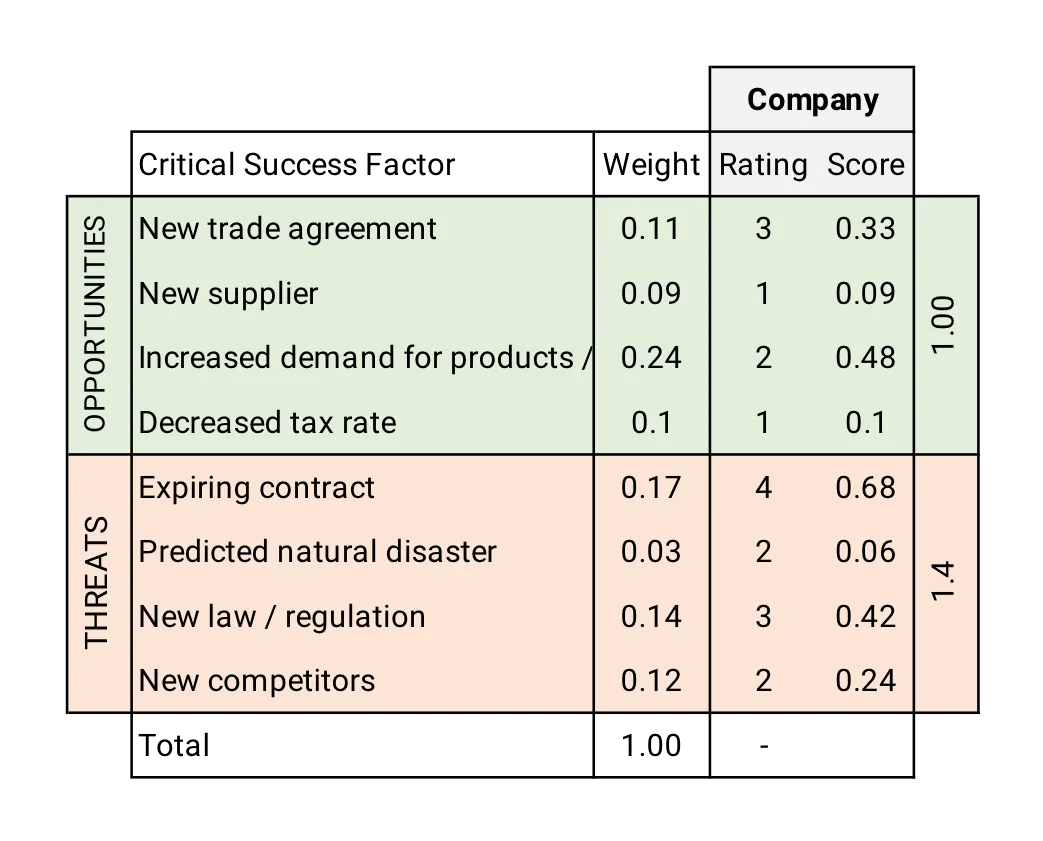
Key External Factors
When using the EFE matrix we identify the key external opportunities and threats that are affecting or might affect a company. By analysing the external environment with the tools like PESTLE analysis, Porter's Five Forces or Profile Matrix, the key external factors can be identified. The general rule is to identify as many key external and internal factors as possible.
Weights
Each key factor should be assigned a weight ranging from 0.0 (low importance) to 1.0 (high importance). The number indicates how important the factor is if a company wants to succeed in an industry. If there were no weights assigned, all the factors would be equally important, which is an impossible scenario in the real world. The sum of all the weights must equal 1.0. Separate factors should not be given too much emphasis (assigning a weight of 0.30 or more) because the success in an industry is rarely determined by one or few factors.
Ratings
The ratings in external matrix refer to how effectively company's current strategy responds to the opportunities and threats. The numbers range from 4 to 1, where 4 means a superior response, 3 – above average response, 2 – average response and 1 – poor response. Ratings, as well as weights, are assigned subjectively to each factor. In our example, we can see that the company's response to the opportunities is rather poor, because only one opportunity has received a rating of 3, while the rest have received the rating of 1. The company is better prepared to meet the threats, especially the first threat.
Weighted Score
The score is the result of weight multiplied by rating. Each key factor must receive a score. Total weighted score is simply the sum of all individual weighted scores. The firm can receive the same total score from 1 to 4 in both matrices. The total score of 2.5 is an average score. In external evaluation a low total score indicates that company's strategies aren't well designed to meet the opportunities and defend against threats. In internal evaluation a low score indicates that the company is weak against its competitors. Note that EFE analyses only help identify and evaluate the factors, but do not directly help formulate a strategy or the next best strategic move.
The EFE Matrix involves a multi-step process: identifying key external factors, assigning weights based on their relative importance, and rating the company's response to each factor. Typically, 10-20 factors are selected, with opportunities listed first, followed by threats. Each factor is given a weight ranging from 0.0 to 1.0, with the total of all weights equaling 1.0. Ratings from 1 to 4 are then assigned to indicate how effectively the company's current strategies address these factors. The weighted scores are calculated and summed, resulting in a total weighted score between 1.0 and 4.0. A score above 2.5 suggests the company is responding well to its external environment, while a score below 2.5 indicates room for improvement. This tool aids in strategic decision-making, resource allocation, and enhancing overall competitiveness by providing insights into how well an organization is capitalizing on opportunities and mitigating threats in its industry.
- 1David, F.R. (2009). Strategic Management: Concepts and Cases. 12th ed. FT Prentice Hall
Test Your Knowledge
External Factor Evaluation (EFE)
Challenge yourself on the concepts from this article and see how well you understood them.
Subscribers get weekly quizzes and insights — subscribe free
Partner with Think Insights
Reach 50,000+ business leaders, consultants, and strategists. Feature your brand alongside expert articles on strategy, leadership, and digital transformation.
