House of Quality


The House of Quality [HoQ] is the bedrock of Quality Function Deployment [QFD], acting as a powerful planning tool that links the spoken desires of customers directly to the practical engineering specifications required for product or service creation. It serves as a comprehensive matrix, creating a visual map that systematically translates subjective "Wants" into objective "Hows". This structured approach ensures that every design choice is traceable back to a specific customer need, aligning the development team's efforts with true market value. The HoQ is fundamentally about making certain that the voice of the customer drives the entire product realization process from beginning to end, fostering a truly customer-centric design philosophy.
Who invented the House of Quality?
Dr. Yoji Akao conceptualized Quality Function Deployment in 1966. The specific matrix structure known as the House of Quality was first applied at Mitsubishi Heavy Industries in Kobe, Japan, in 1972.
What are the main sections of the House of Quality?
The matrix contains five key sections: Customer Needs (the Whats), Technical Requirements (the Hows), the Relationship Matrix linking both, the Roof showing interactions among technical requirements, and the Basement providing prioritized rankings.
What does the triangular roof of the matrix represent?
The roof maps how technical requirements interact with each other, identifying positive synergies and negative trade-offs. For example, increasing engine horsepower may negatively correlate with fuel efficiency, forcing early design compromises.
How are technical requirements prioritized in the House of Quality?
Each technical requirement receives an absolute importance score calculated by multiplying each customer need's importance weight by the corresponding relationship strength, then summing those values vertically across all customer needs.
When did Western companies begin adopting the House of Quality?
Xerox Corporation and Ford Motor Company began using the framework in the early 1980s. Dr. Don Clausing at Xerox and MIT helped refine implementation methods and promote adoption in the United States.
The development of the House of Quality and the encompassing methodology of Quality Function Deployment [QFD] is a story rooted in the post-war Japanese industrial renaissance. This innovative management system first took shape in Japan during the late 1960s. The framework's primary architect is widely recognized as Dr. Yoji Akao, a distinguished Japanese professor and quality control expert. Working with a team, Akao began formalizing the concepts in 1966, driven by a desire to bring the customer directly into the product development process earlier than ever before.
While Dr. Akao conceptualized and defined the overarching QFD system, the specific and iconic matrix structure known as the House of Quality was first practically applied at the Mitsubishi Heavy Industries shipyard in Kobe, Japan, in 1972. The engineers there sought a more structured method to manage the complexity of designing large, intricate components, such as a new oil tanker. They realized that simply meeting specifications was insufficient; they needed a tool to proactively align engineering effort with client expectations. The resulting matrix, with its distinct 'roof' correlating design requirements, earned the unforgettable moniker "House of Quality".
The framework was not solely a Japanese phenomenon for long. Its introduction to the West, particularly the United States, in the early 1980s, largely happened through the efforts of academics and corporate leaders. One of the most significant moments in its western adoption occurred when Xerox Corporation and later Ford Motor Company began utilizing the HoQ to enhance their product competitiveness. Pioneers like Dr. Don Clausing at Xerox and MIT helped to refine the implementation methods and vigorously promoted its benefits in reducing late-stage design changes and costs.
The House of Quality represents a philosophical shift away from a reactive, inspection-heavy quality control system to a proactive, design-based quality assurance mechanism. Its creators understood that quality could not simply be "inspected in" at the end, but needed to be "engineered in" from the very start. This foundational belief in upstream quality planning remains the lasting legacy of Dr. Akao and the pioneering teams in Japanese industry who built this enduring, customer-focused engineering tool. The framework's ability to create a shared, unambiguous document of customer needs and technical responses makes it an indispensable asset in the engineering and manufacturing disciplines worldwide.
The Framework
The House of Quality is more than just a table; it functions as a highly structured conversation between the market (the customer) and the design team (the engineers). It systematically translates subjective, often vague customer needs — the "Whats" — into measurable, actionable and objective technical requirements — the "Hows". The completed matrix, which indeed resembles a house with a characteristic triangular 'roof', is a living blueprint for the entire product development lifecycle.
To grasp the framework, one must understand its distinct, interconnected sections or 'rooms.' These sections allow for the step-by-step transformation of raw market data into detailed engineering decisions.
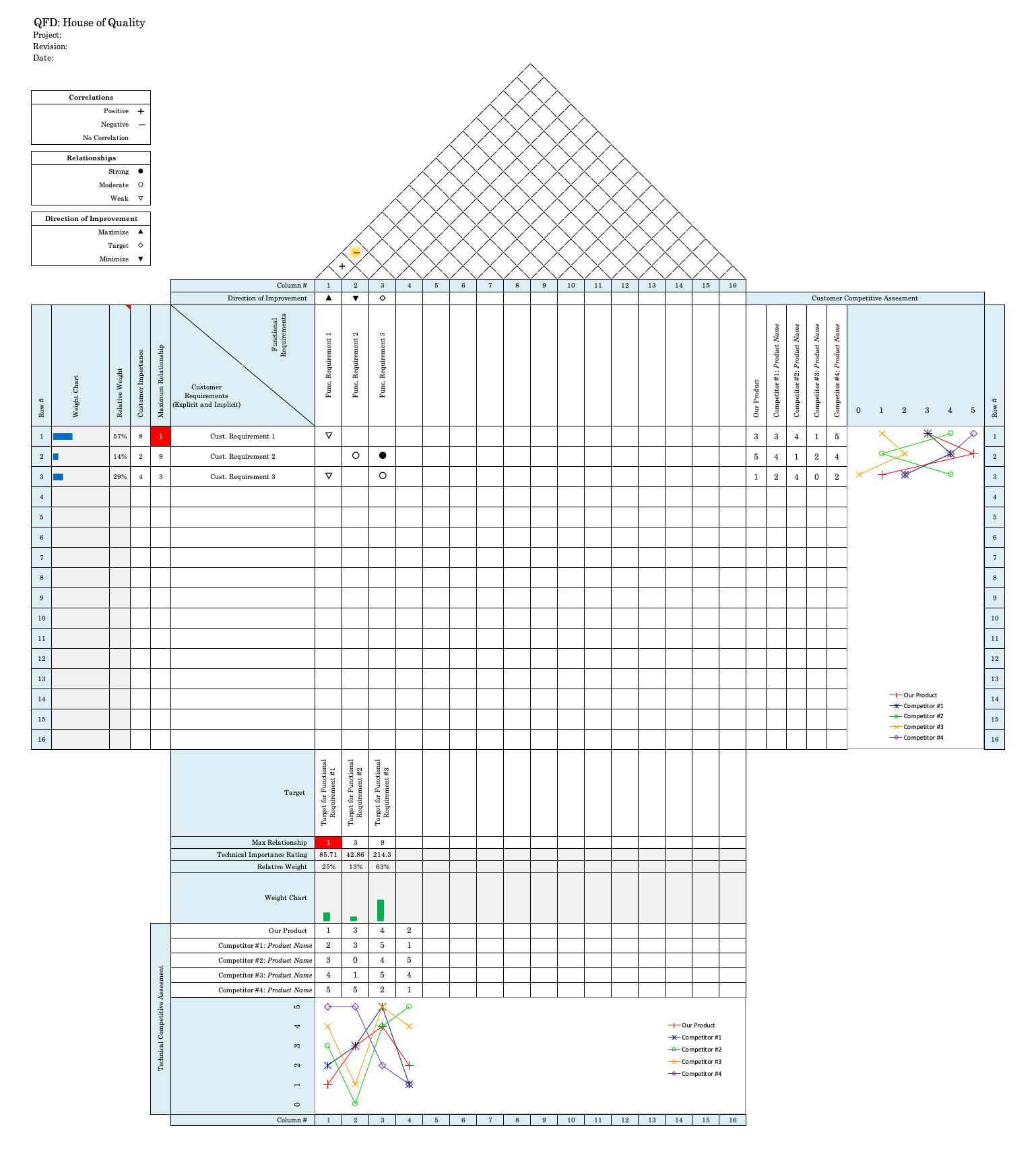
The Customer Needs (The "Whats") - Left Wall
This section forms the foundation of the house, listing the unfiltered voice of the customer, often derived from interviews, focus groups and market research. These are the stated and unstated desires for the product or service. They should be written as specific, understandable customer phrases, focusing on what the customer expects, not how it should be achieved.
- Weighting Customer Importance: Alongside the listed needs, the team must assign a numerical importance rating. This rating, typically on a scale of 1 (least important) to 5 (most important) or 1 to 9, reflects the relative significance of each need to the target customer segment. This prioritization prevents the design team from wasting resources on features customers do not value highly
- Competitive Assessment [Perception]: Below the needs list, a critical sub-section compares the current product (or a concept) and key competitors based on how well each satisfies the customer needs. This benchmarking exercise identifies immediate strengths and weaknesses from the customer's viewpoint
The Technical Requirements (The "Hows") - Ceiling
Positioned across the top of the matrix, the technical requirements represent the design team's answer to the "Whats". These are the tangible, measurable and controllable engineering characteristics required to deliver the customer's needs. Unlike the customer needs, which are qualitative, the technical requirements must be quantitative and objective.
- Measurability is Key: If a technical requirement cannot be assigned a metric, a unit of measure or a target value, it must be refined. For example, instead of a vague "make the door close easily," the technical requirement might be "Door closing force [Newtons]" or "Sound level upon closing [decibels]"
- Target Values and Direction: Each "How" must be accompanied by a specific target value (e.g., "15 Newtons") and an indication of the desired direction for improvement (e.g., maximize, minimize or target a specific nominal value)
The Relationship Matrix - The Main Room
This is the core of the house and the most complex section. It is a grid that sits at the intersection of the "Whats" and the "Hows," demonstrating the direct impact of each technical requirement on each customer need. The team uses standardized symbols (often circles, triangles and squares or numerical scores like 9, 3 and 1) to denote the strength of the relationship: strong, moderate or weak.
- The Power of Correlation: A strong relationship here indicates that adjusting that specific engineering characteristic will have a substantial and positive effect on meeting that particular customer need. For example, a strong correlation might exist between the technical requirement "Acoustic insulation density" and the customer need "The car cabin should be quiet"
- Zero Correlation: Conversely, an empty cell signifies no meaningful relationship, preventing unnecessary or misguided design effort. The pattern of relationships across the matrix visually confirms whether the engineering team has truly identified the right technical levers to pull to satisfy the market
The Interrelationships (The "Roof") - The Attic
The defining triangular matrix, the roof, maps how the technical requirements interact with each other. This is arguably the most insightful part of the HoQ, transforming the process from mere translation into genuine systems engineering. Interactions are often positive (one technical improvement helps another) or negative (improving one characteristic hinders another).
Identifying Trade-Offs: Negative correlations (trade-offs) are critically important. For instance, increasing the technical requirement "Engine horsepower" might negatively impact "Fuel efficiency (liters per kilometer)". The roof forces the design team to confront these internal conflicts early on and make strategic compromises or seek innovative solutions that can resolve the tension. The roof ensures holistic system design rather than optimizing components in isolation.
Prioritized Technical Requirements - Basement Floor
This section synthesizes all the data from the rooms above to produce a final, prioritized list of the technical requirements. This is achieved by calculating the "absolute importance" of each "How". The calculation involves multiplying the Customer Importance Weight for each "What" by the Relationship Strength it shares with the "How," and then summing these weighted scores vertically for every technical requirement.
\[\text{Absolute Score:}\quad \text{TP}_j = \sum_{i=1}^{n} W_i \cdot R_{ij}\]
where:
- $\text{TP}_j$ is the Technical Priority for column
- $j$, $n$ is the total number of customer rows
- $W_i$ is the Customer Importance Weight for row
- $i$, and $R_{ij}$ is the Relationship Score between row $i$ and column $j$
The result is a quantitative rank that definitively shows which engineering specifications are most critical for satisfying the highest-priority customer needs. This data-driven ranking prevents the team from being swayed by internal politics or personal design preferences, keeping the focus strictly on what delivers market value.
Competitive Benchmarking [Technical] - Right Wall
Similar to the customer-focused competitive assessment, this section evaluates the product and its competitors based on the measured values of the technical requirements. The team uses laboratory testing and objective metrics (e.g., measured battery life in hours, measured material tensile strength in Pascals) to determine where the product currently stands in the technical landscape.
By comparing the target values from the ceiling with the actual technical performance of competitors, the team can identify specific areas where they must innovate to achieve a competitive advantage. This side wall provides the context necessary to finalize the precise target values for the design.
Cascading The Houses
A crucial, unique concept within QFD is that the House of Quality is rarely a one-time exercise. The output of the first house — the prioritized technical requirements (the "Hows") — often becomes the input ("Whats") for a second-level house.
This hierarchical process, known as QFD Deployment or Cascading Houses, ensures the customer's voice penetrates every level of the organization:
- House 1 (Product Planning): Translates Customer Needs into Product Design Characteristics
- House 2 (Parts Deployment): Translates Product Design Characteristics into Critical Part Characteristics. (e.g., moving from "low closing force" to specific "spring constants" in a component)
- House 3 (Process Planning): Translates Critical Part Characteristics into Key Manufacturing Processes. (e.g., defining the necessary machining tolerances or material handling steps)
- House 4 (Quality Control/Operations Planning): Translates Key Manufacturing Processes into Production Control Requirements. (e.g., establishing quality checks, inspection points and operator training protocols)
This cascading effect creates a direct line of sight from the customer's initial desire ("I want an easy-to-use car") all the way down to a specific tolerance on a machine tool on the factory floor ("The diameter must be 5.00 ± 0.01 millimeters"). This is the true power of QFD: creating an unbreakable chain of quality and intent throughout the entire value chain.
Case Study: Anker Innovations
Anker Innovations, a global leader in charging technology and portable power, can be used to illustrate the application of the House of Quality framework in developing their high-end portable power stations (branded under their PowerHouse line). For Anker, the HoQ is essential because their products sit at the complex intersection of electrical engineering, battery chemistry and consumer convenience.
The Customer Need ("Whats")
Through market research, Anker identified the key needs for a new mid-range portable power station targeting outdoor enthusiasts and home backup use. These were weighted on a 1 [low] to 9 [high] scale:
- Long-Lasting Power: (Weight: 9) The unit should operate essential devices for an extended time
- Fast Recharging: (Weight: 8) The unit should recharge quickly from a wall outlet or solar panel
- Portability/Weight: (Weight: 7) The unit must be light enough to be carried comfortably by one person
- Quiet Operation: (Weight: 5) The cooling fans should not be disruptive
The Technical Requirements ("Hows")
Anker's engineering team translated these into measurable technical specifications:
- Battery Capacity (Watt-hours): Maximize
- Input Charging Rate [Watts]: Maximize
- Total Unit Weight [Kilograms]: Minimize
- Fan Noise Level [Decibels]: Minimize
- Inverter Efficiency [Percent]: Maximize
The Relationship Matrix and the Roof
The engineering team then mapped the relationships using numerical scores (9 for Strong, 3 for Moderate, 1 for Weak and 0 for None)
| Technical Requirement [How] | Battery Capacity | Input Charging Rate | Total Unit Weight | Fan Noise Level | Inverter Efficiency |
|---|---|---|---|---|---|
| Customer Need [What] | |||||
| Long-Lasting Power (9) | 9 [Strong] | 1 [Weak] | 1 [Weak] | 0 [None] | 9 [Strong] |
| Fast Recharging (8) | 1 [Weak] | 9 [Strong] | 0 [None] | 0 [None] | 0 [None] |
| Portability/Weight (7) | 9 [Strong] | 1 [Weak] | 9 [Strong] | 0 [None] | 1 [Weak] |
| Quiet Operation (5) | 0 [None] | 1 [Weak] | 0 [None] | 9 [Strong] | 1 [Weak] |
| THE ROOF [Interrelations] | |||||
| Battery Capacity | - | 3 [Pos] | -9 [Neg] | 0 [None] | 0 [None] |
| Input Charging Rate | - | - | 3 [Pos] | -9 [Neg] | 0 [None] |
Key Insights from the HoQ
Trade-Off in the Roof: The roof immediately highlighted a critical negative correlation (-9 [Neg]) between Battery Capacity and Total Unit Weight. Larger batteries (for longer power) inherently increase the weight (damaging portability). This forced Anker to focus R&D on high energy-density battery cells (like Lithium Iron Phosphate (LiFePO4) chemistries, which offer a better capacity-to-weight ratio than older lead-acid or standard lithium-ion cells) to mitigate the trade-off. This strategic focus was a direct result of the HoQ analysis Prioritization: Calculating the weighted scores revealed that Battery Capacity and Input Charging Rate received the highest total importance scores, confirming that these must be the primary engineering goals. The team must allocate maximum resources to achieving the target of 2000+ Watt-hours and 1000+ Watts charging Hidden Links: The matrix showed that Inverter Efficiency had a strong, positive relationship (score of 9) with Long-Lasting Power. By improving the efficiency of the internal circuitry (i.e., reducing energy lost as heat), the engineers could effectively increase the usage time without making the battery physically larger, thus providing a design solution that simultaneously addressed the "Long-Lasting Power" need and the "Portability/Weight" conflict identified in the roof
The House of Quality provided Anker with an unambiguous, data-driven map, ensuring that the final design focused on innovative battery chemistries and high-efficiency electronics — the exact engineering levers required to achieve market success and overcome the most difficult design compromises.
The House of Quality [HoQ] stands as a foundational framework within the broader Quality Function Deployment [QFD] methodology, providing a rigorous, systematic method for product planning. It successfully bridges the gap between the subjective, qualitative desires of the consumer — the "Whats" — and the objective, measurable parameters of product engineering — the "Hows". By utilizing six distinct sections, the matrix quantifies customer importance, identifies necessary technical responses, maps the strength of these relationships, and, most crucially, uses the characteristic "roof" to expose critical internal design trade-offs and conflicts. The calculated prioritization forces the engineering team to focus resources on the technical specifications that will deliver the maximum customer value. Ultimately, the HoQ acts as a powerful communication tool, ensuring that the voice of the customer is not just heard, but is systematically embedded and deployed across every technical decision in the product creation journey.
Citation
Cite this article
Sridharan, M. A. (2023, December 12). House of Quality. Think Insights. https://thinkinsights.net/consulting/house-quality (Accessed [[ACCESS_DATE]])
Sridharan, Mithun A. "House of Quality." Think Insights, 12 Dec. 2023, https://thinkinsights.net/consulting/house-quality. Accessed [[ACCESS_DATE]].
Mithun A. Sridharan, "House of Quality," Think Insights, December 12, 2023, https://thinkinsights.net/consulting/house-quality. Accessed [[ACCESS_DATE]].
Sridharan, M.A. (2023) 'House of Quality', Think Insights. Available at: https://thinkinsights.net/consulting/house-quality (Accessed: [[ACCESS_DATE]]).
M. A. Sridharan, "House of Quality," Think Insights, 2023. [Online]. Available: https://thinkinsights.net/consulting/house-quality. [Accessed: [[ACCESS_DATE]]].
Sridharan MA. House of Quality. Think Insights. Published December 12, 2023. Accessed [[ACCESS_DATE]]. https://thinkinsights.net/consulting/house-quality
Test Your Knowledge
House of Quality
Challenge yourself on the concepts from this article and see how well you understood them.
Subscribers get weekly quizzes and insights — subscribe free
Sponsor this article
Partner with Think Insights
Reach 50,000+ business leaders, consultants, and strategists. Feature your brand alongside expert articles on strategy, leadership, and digital transformation.
Become a Sponsor