Eisenhower Matrix


The Eisenhower Matrix helps prioritise tasks by urgency and importance. This framework identifies activities you should focus on and those you should delegate or ignore., The Eisenhower Matrix helps prioritise tasks by urgency and importance. This framework identifies activities you should focus on and those you should delegate or ignore.
What is the Eisenhower Matrix?
A time management framework that classifies tasks into four quadrants based on urgency and importance, helping individuals focus on high-priority activities.
What are the four quadrants of the Eisenhower Matrix?
A: Important and urgent (do immediately). B: Important but not urgent [schedule]. C: Urgent but not important [delegate]. D: Neither urgent nor important (eliminate or defer).
Who created the Eisenhower Matrix?
Dwight D. Eisenhower developed the underlying time management method. Stephen Covey later popularised it through his book The Seven Habits of Highly Effective People.
How does the Eisenhower Matrix apply in consulting?
It helps consulting teams prioritise tasks that deliver the most client value, ensuring urgent and important work is addressed first while less critical tasks are delegated or deferred.
How does the Eisenhower Matrix relate to the Pareto Principle?
The Pareto Principle suggests 20% of efforts produce 80% of outcomes. The Eisenhower Matrix helps identify that high-impact 20%, preventing time being spent on low-value tasks.
In a consulting engagement, it's important that the team focusses on activities that deliver the most client value. The engagement team should address these activities as quickly as possible. Therefore, it's crucial to set priorities to ensure that the urgent matters don't fall through the cracks. As with most things in life, less urgent tasks often consume unnecessary time. This time is better used for something more urgent / fulfilling. The Eisenhower Principle, also referred to as Urgent-Important Matrix, is a framework to set sensible priorities and optimise your time management. This framework helps you to quickly meet more goals and deliver impact.
What is the Eisenhower Principle?
The Pareto Principle states that 80% of the outcomes can be achieved with 20% of the efforts. However, most junior consultants occupy themselves with the other 80% of tasks that only lead to 20% of the results. Dwight D. Eisenhower, the American general & Supreme commander for the Allied Powers during World War II and 34th US president, recognised the need to better manage his time during the war. He developed a time management method to classify tasks based on importance and urgency. Stephen Covey, author of The Seven Habits of Highly Effective People, further popularized Eisenhower's framework by supporting Eisenhower's use of four quadrants to determine the urgency of tasks.
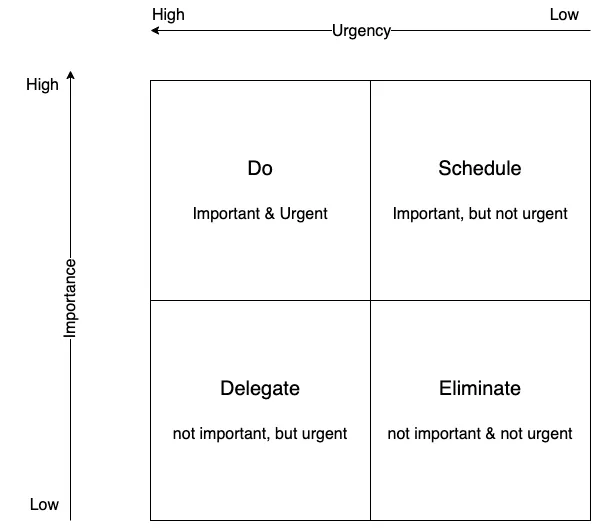
How does the Eisenhower box work?
The Eisenhower box displayed as a matrix with four fields of activity:
- A – important and urgent: These tasks with the highest priority. Complete them immediately.
- B – important, but not urgent. You should complete these tasks to achieve your goals. However, you may postpone these tasks for a while
- C – urgent, but not important. You should quickly complete these tasks. However, the tasks are of minor importance. Delegate these tasks when possible
- D – neither important nor urgent. These tasks are not or hardly relevant for achieving the objectives. Therefore, your don't have to complete them urgently. You may often leave these tasks unfinished
Using the Eisenhower box, you must first perform the tasks that are important and urgent. Then, devote your time to those activities that are important, but less urgent. Delegate the less important tasks to others or discard them.
Example
An employee is sitting in their office in London at 09:00 hrs. After checking her morning e-mails, she reads a newspaper article. At 11:00 hrs, her boss is expecting a prospective customer to arrive for a meeting. Then her telephone rings. The boss informs her that she suddenly has to attend a meeting in Frankfurt at short notice and therefore can't attend the meeting. The employee now needs to schedule a new appointment and organise the trip to Frankfurt. The boss also needs certain reports for the trip. If the employee follows the Eisenhower Principle, she would:
- Supply the reports that the boss needs for her trip (A task)
- Arrange a new appointment with the customer (B task)
- Delegate buying a flight ticket to the travels department of the company (C task)
- Read the newspaper article (D task)
Eisenhower.me
Eisenhower.me is a website that makes this process easy for you. Through apps and strategies, they identify where your activities fall in the quadrant grid. Subsequently, you can focus and work on those high value activities. Eisenhower.me helps you prioritise your activities, while simultaneously increasing your productivity.
By setting priorities in a straightforward manner, the most important activities can be completed first. The model is particularly important for Management & Leadership, as their time is usually scarce. They should delegate less important activities to their employees. In turn, this empowers the staff to be more involved in the engagements., By setting priorities in a straightforward manner, the most important activities can be completed first. The model is particularly important for Management & Leadership, as their time is usually scarce. They should delegate less important activities to their employees. In turn, this empowers the staff to be more involved in the engagements.
Citation
Cite this article
Sridharan, M. A. (2018, August 27). Eisenhower Matrix. Think Insights. https://thinkinsights.net/consulting/eisenhower-matrix (Accessed [[ACCESS_DATE]])
Sridharan, Mithun A. "Eisenhower Matrix." Think Insights, 27 Aug. 2018, https://thinkinsights.net/consulting/eisenhower-matrix. Accessed [[ACCESS_DATE]].
Mithun A. Sridharan, "Eisenhower Matrix," Think Insights, August 27, 2018, https://thinkinsights.net/consulting/eisenhower-matrix. Accessed [[ACCESS_DATE]].
Sridharan, M.A. (2018) 'Eisenhower Matrix', Think Insights. Available at: https://thinkinsights.net/consulting/eisenhower-matrix (Accessed: [[ACCESS_DATE]]).
M. A. Sridharan, "Eisenhower Matrix," Think Insights, 2018. [Online]. Available: https://thinkinsights.net/consulting/eisenhower-matrix. [Accessed: [[ACCESS_DATE]]].
Sridharan MA. Eisenhower Matrix. Think Insights. Published August 27, 2018. Accessed [[ACCESS_DATE]]. https://thinkinsights.net/consulting/eisenhower-matrix
Test Your Knowledge
Eisenhower Matrix
Challenge yourself on the concepts from this article and see how well you understood them.
Subscribers get weekly quizzes and insights — subscribe free
Sponsor this article
Partner with Think Insights
Reach 50,000+ business leaders, consultants, and strategists. Feature your brand alongside expert articles on strategy, leadership, and digital transformation.
Become a Sponsor