Action Priority Matrix

The Action Priority Matrix is a tool that enables you to make the most of your time by helping you choose the right tasks and opportunities to pursue. The world is full of opportunities. Unfortunately, there is never enough time to pursue all of these opportunities. Hence, you need to be diligent in choosing your opportunities and tasks, so you make the most of your time. You want to ensure that you choose those tasks that will give you the most significant return on your time investment. You also want to avoid those tasks that don't move you forward.
What are the four quadrants of the Action Priority Matrix?
The four quadrants are Quick Wins (low effort, high impact), Major Projects (high effort, high impact), Fill Ins (low effort, low impact), and Thankless Tasks (high effort, low impact).
Which tasks should receive the highest priority?
Quick Wins should be your highest priority, as they deliver high impact for relatively little effort.
What should you do with Thankless Tasks?
Thankless Tasks should be eliminated entirely, as they require high effort but produce low impact, making them not worth your time.
How do you score tasks when using the Action Priority Matrix?
Score each task on both effort and impact, using a consistent scale such as 1 to 10, then plot each task on the grid accordingly.
How does the Action Priority Matrix differ from the Eisenhower Matrix?
The Action Priority Matrix uses effort and impact as its axes, while the Eisenhower Matrix prioritizes tasks based on urgency and importance.
The Action Priority Matrix is a simple tool which can help ensure you're spending your time working on the right tasks in the correct order. By working on the right things consistently, you'll experience improved results over the long-term. The Action Priority Matrix is a 2x2 grid.
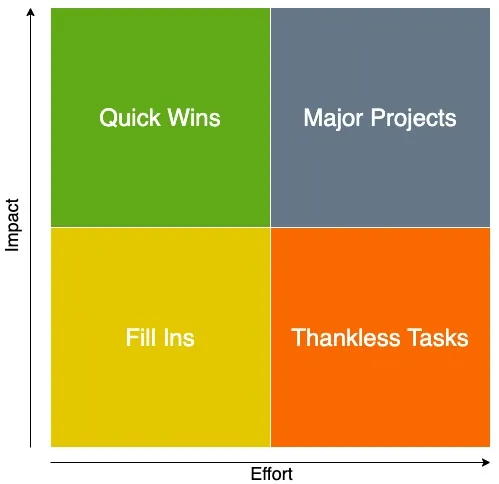
On the X-axis we have the effort needed to complete a task, going from low to high. On the Y-axis, we have the impact on results completing a task will have. To use this tool, score your tasks or to-do list, first by effort and then by their impact. Then, place each task on the grid according to its score. The four quadrants are:
- Quick Wins
- Major Projects
- Fill Ins, and
- Thankless Tasks
Quick Wins
These are tasks requiring little effort but which have a high impact. As such, they are very attractive because they have high returns for a small outlay of energy. Completing quick wins should be your highest priority, and you should concentrate on these tasks as much as you can.
Major Projects
These are tasks that can give you significant results [impact], but unlike quick wins, they require you to invest a lot of time into them. These types of tasks should be your next priority after quick wins. You'll need to invest a lot of time into these projects to get them done but be careful not to let these tasks consume all of your time.
Fill-Ins
These are tasks that require a low effort for you to perform, but they also have little impact on your results. As hinted at by the name, you use these tasks to fill in your time. You should only perform these tasks if you have the time available after working on your quick wins and major projects. Consider delegating these tasks if you have that as an option. Alternatively, consider dropping these tasks altogether if possible.
Thankless Tasks
These are tasks which have a low impact but which still require a high effort. You should aim to completely eliminate these tasks, as they are not worth your time to complete.
Using the Model
To use the model, follow these four steps:
- Make a complete list of all of your tasks.
- Score your tasks for effort and impact. You can use any scale you like to do this, but a simple 1-10 scale works well, where one is very low, and ten is very high.
- Place each activity in the matrix according to its effort and impact scores.
- Prioritize your activities:
- Give quick wins the highest priority.
- Spend the remaining time on your major projects. You should spend the majority of your time on these tasks.
- If you have any remaining time, do your fill-in activities. Otherwise, delegate or drop these tasks.
- Eliminate thankless tasks. Spend absolutely zero time performing these tasks.
The Action Priority Matrix is very closely related to the Eisenhower Matrix, which is used to prioritize a personal to-do list using urgency and importance.
The Action Priority Matrix works best when reviewed regularly, as task effort and impact can change over time. Reassess your matrix periodically to ensure your priorities remain aligned with current goals.
Citation
Cite this article
Sridharan, M. A. (2020, February 13). Action Priority Matrix. Think Insights. https://thinkinsights.net/consulting/action-priority-matrix (Accessed [[ACCESS_DATE]])
Sridharan, Mithun A. "Action Priority Matrix." Think Insights, 13 Feb. 2020, https://thinkinsights.net/consulting/action-priority-matrix. Accessed [[ACCESS_DATE]].
Mithun A. Sridharan, "Action Priority Matrix," Think Insights, February 13, 2020, https://thinkinsights.net/consulting/action-priority-matrix. Accessed [[ACCESS_DATE]].
Sridharan, M.A. (2020) 'Action Priority Matrix', Think Insights. Available at: https://thinkinsights.net/consulting/action-priority-matrix (Accessed: [[ACCESS_DATE]]).
M. A. Sridharan, "Action Priority Matrix," Think Insights, 2020. [Online]. Available: https://thinkinsights.net/consulting/action-priority-matrix. [Accessed: [[ACCESS_DATE]]].
Sridharan MA. Action Priority Matrix. Think Insights. Published February 13, 2020. Accessed [[ACCESS_DATE]]. https://thinkinsights.net/consulting/action-priority-matrix
Test Your Knowledge
Action Priority Matrix
Challenge yourself on the concepts from this article and see how well you understood them.
Subscribers get weekly quizzes and insights — subscribe free
Sponsor this article
Partner with Think Insights
Reach 50,000+ business leaders, consultants, and strategists. Feature your brand alongside expert articles on strategy, leadership, and digital transformation.
Become a Sponsor