What Is a Business Model


A business model explains how a company creates value, delivers it to customers and captures a share of it back as profit. Management theorist Alexander Osterwalder formalized this three-part logic during his doctoral research. That framework later became the Business Model Canvas, now taught in business schools and used in corporate strategy sessions worldwide. Most executives still equate the term with pricing, or how a company charges customers. That is only one piece of a much larger system, one that also includes partners, resources, activities, channels and customer relationships. Harvard Business School's Joan Magretta described a business model as a story that explains how an enterprise works and gets paid for doing so. This article breaks down what a business model actually contains, how its building blocks connect, and why the same logic persists even as industries and technologies keep changing around it
Is a business model the same as a business plan?
No. A business plan is a written document that lays out goals, financial projections and operational detail, usually for investors or lenders. A business model is the logic of how a company creates, delivers and captures value, and that logic can be described in a single diagram such as the Business Model Canvas. A business plan documents the model along with financing needs, hiring plans and timelines, so the two terms describe different levels of detail rather than competing ideas.
What's the difference between a business model and a revenue model?
A revenue model covers only how money flows from the customer to the company, whether through subscriptions, transaction fees, advertising or one-time sales. A business model covers that plus everything else needed to create and deliver the underlying value, including partners, resources, activities and customer relationships. A revenue model is one component nested inside a business model, not a synonym for it.
Can two companies use the same business model and still both succeed?
Yes, because a business model describes a system, not a competitive position. Target and Walmart both run the discount retail business model, yet they compete on different choices, such as merchandise mix, store format and target customer. Strategy determines which company wins within a shared business model, while the model itself simply explains how each company creates, delivers and captures value.
What a business model actually describes
A business model describes how a company creates value, delivers that value to customers and captures a share of it as profit. That three-part definition traces back to Alexander Osterwalder. The Swiss management theorist researched dozens of existing definitions during his doctoral thesis and combined them into one framework. Gartner's own glossary uses the same three-part structure. It defines a business model as a description of how a company creates, delivers and captures value, built from four parts: the value proposition, the customers served, a financial model and the capabilities needed to run all three.1 The definition matters because it moves the conversation past pricing. It points toward the full system a company builds to serve customers at a profit.
Executives often reduce a business model to how a company makes money. That skips two steps that come before revenue: deciding what value to create and how to reach the right customer. Skip those steps and a company ends up with a price point but no real reason for a customer to choose it. A business model, understood properly, forces that reasoning before a single dollar changes hands.
Every business model has a front stage and a backstage
Joan Magretta, writing in Harvard Business Review, split the work behind any business model into two halves.2 The first half covers everything involved in making something: designing a product, sourcing materials, manufacturing it. The second half covers everything involved in selling that same thing: finding customers, closing a sale, delivering the service. Practitioners call the first half the backstage and the second half the stage. The label borrows from theater, since customers only see the visible performance. A much larger operation runs behind the curtain.
Magretta traced the questions a sound business model has to answer back to management theorist Peter Drucker.
A good business model answers Peter Drucker's age-old questions: Who is the customer? And what does the customer value?
Most public discussion of a company's strategy focuses on the stage. That is the part customers and competitors can observe directly. Backstage decisions, like which supplier to use or how to structure manufacturing, rarely make headlines. Yet they decide whether the visible half of the business can run at a cost that still leaves room for profit.
Creating, delivering and capturing value in practice
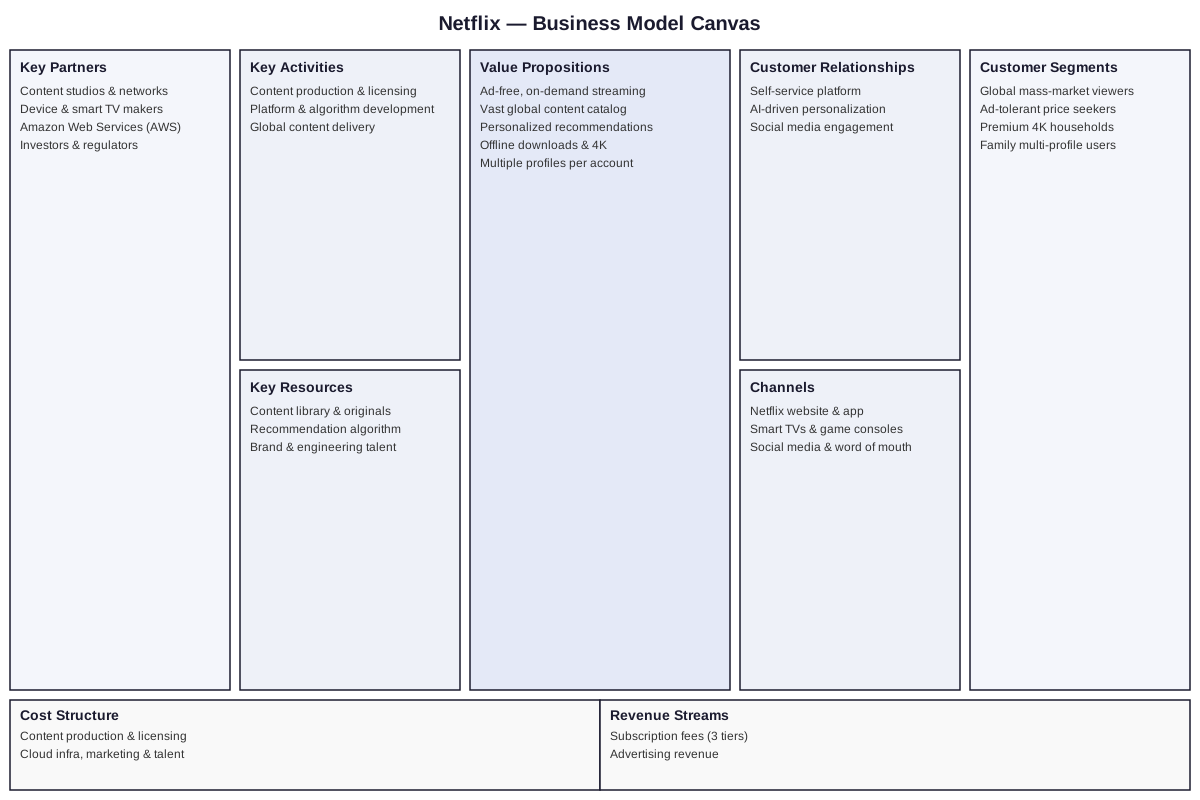
The clearest way to see this three-part logic at work is to compare how one industry solved the same problem a generation apart. Video rental chains like Blockbuster created value by licensing films and stocking copies across thousands of stores. They delivered that value by letting customers browse shelves and walk out with a cassette or disc. They captured value through a rental fee at the counter, often with a late fee attached. Streaming services like Netflix solve the identical problem, watching a film at home, using that same three-part logic. They just execute it through different mechanics. Netflix creates value by producing original shows and licensing a catalog of films. It delivers that value instantly over an internet connection, using a recommendation engine to surface relevant titles. It captures value through a recurring monthly subscription instead of a per-rental fee.
Nothing about the underlying logic changed between the two eras. What changed is the technology available to execute each step. A company that recognizes this can innovate on one step without reinventing the other two. A grocery chain that shifts from in-store shelves to a subscription meal-kit service is running the same experiment. It still sources ingredients. It still gets them to a customer. It still charges for the result, just through a different mechanism at each stage.
The nine building blocks of the business model canvas
Osterwalder and his co-author Yves Pigneur turned that three-part definition into a design tool called the Business Model Canvas.3 It breaks a business model into nine building blocks that a team can fill in on one page. Four blocks describe how a company creates value: key partners, the outside organizations it relies on, key activities, the work it must perform, key resources, the assets it needs, and the value proposition itself, the bundle of products and services offered to solve a customer problem. Two blocks describe how a company delivers value: channels, the paths used to reach customers, and customer relationships, the type of interaction kept with each segment, whether personal, automated or self-service. Three more blocks describe how a company captures value: customer segments, the specific groups served, revenue streams, the way it charges for value, and cost structure, the expenses needed to run everything else on the canvas.
Filling out all nine blocks, rather than only revenue streams, is what separates a business model from a pricing strategy. A team that jumps straight to revenue streams, before agreeing on customer segments and value proposition, is pricing a product nobody has actually defined yet.
A revenue model and a strategy are not the same thing
A revenue model describes only how money flows from a customer to a company.4 That includes subscriptions, transaction fees, advertising, licensing or one-time sales. It is one component nested inside the larger business model, not a synonym for it. A revenue model says nothing about how value gets created or delivered in the first place. Two companies can share an identical revenue model, a monthly subscription for example, while running completely different business models underneath it. A streaming service and a gym membership both bill monthly. Yet they create and deliver value through entirely different activities, resources and partners.
A business model is also distinct from strategy, even though people use the two terms interchangeably. A business model explains how a company's pieces fit together as a system. Strategy explains how that company will out-perform rivals running a similar system. Companies usually do this by serving a different customer segment, controlling a scarce resource or executing with more discipline. Target and Walmart both run a discount retail business model. Yet they compete through different choices around merchandise, store format and target customer. That is why one company's success under a given business model never guarantees the same result for a competitor copying it.
Testing a business model before scaling it
Designing a business model on paper is only half the process. The other half is testing whether every assumption in it actually holds up in the market. The design sequence usually moves through three questions, in order. Is the value proposition desirable enough that customers actually want it? Is the model feasible enough that the company can operate and deliver it? Is it viable enough that revenue exceeds the cost of delivery? Skipping ahead to viability before confirming desirability is a common mistake, since a company can build an efficient, profitable operation around a product nobody particularly wants.
Companies that treat every block of their business model as a hypothesis, rather than a fixed assumption, tend to outperform peers that lock in a model early and stop questioning it. McKinsey's research on digital strategy found that companies prioritizing business model innovation were roughly three and a half times more likely to outperform peers on revenue growth.5 Testing does not stop once a company launches. Every new competitor, technology shift or change in customer behavior reopens questions that once seemed settled.
Why business models keep changing
New technology rarely changes what customers need. It changes what they will tolerate as the process for getting it. Car ownership and mobility apps solve the same need: getting from one place to another. In-person classrooms and online courses solve the same need: learning a skill. Each shift forces an existing business model to answer a new version of the same question. Given how customers now prefer to behave, how does this company still create, deliver and capture value for them?
Companies that wait for a competitor to answer that question first usually end up defending market share instead of building it. The taxi industry did not lose ground to ride-hailing apps because riders stopped wanting transportation. It lost ground because a competitor redesigned the delivery and capture steps around a smartphone instead of a street-corner hail. That lesson applies past any one industry. A business model built around yesterday's constraints on distribution, payment or communication is vulnerable the moment those constraints disappear, no matter how well it once performed.
Ownership, protection and licensing of a business model
A business model itself cannot be patented in the United States. Patent law protects specific inventions and processes, not an abstract description of how a company creates and captures value. What can be patented, under narrower conditions set after the 1998 State Street Bank v. Signature Financial Group ruling, is a specific business method tied to a particular technology or process.6 The U.S. Patent and Trademark Office draws that line explicitly between a business model and a patentable business method. That is why a competitor can legally build a company that creates, delivers and captures value the same way Amazon or Netflix does. Replicating the technology, brand and execution behind either company still remains genuinely difficult.
Licensing works differently from patenting, and it applies more directly to how business models actually spread. A company cannot license a business model as an abstract idea. It can license the brand, operating procedures and trademarks that make one version of that model work. That arrangement is what franchising formalizes. McDonald's, Subway and other franchise chains license exactly this bundle to independent operators, who pay royalties to run a proven format instead of designing a new one.
Every durable company runs on the same three-part logic. It creates value for a defined set of customers, delivers that value through specific channels and relationships, and captures a portion of it back as revenue that exceeds the cost of delivery. Osterwalder's nine building blocks give that logic a shared vocabulary. They let teams design, test and argue about a business model before committing capital to it. None of this replaces strategy, which is the separate question of how a company will out-compete rivals running a similar model. Nor does it replace execution, since even a well-designed model fails if a competitor secures the same customers or partners first. Executives who treat their business model as fixed risk losing to competitors willing to redesign how value gets created, delivered and captured for the same underlying customer need
Citation
Cite this article
Sridharan, M. A. (2024, May 23). What Is a Business Model. Think Insights. https://thinkinsights.net/strategy/what-business-model (Accessed [[ACCESS_DATE]])
Sridharan, Mithun A. "What Is a Business Model." Think Insights, 23 May 2024, https://thinkinsights.net/strategy/what-business-model. Accessed [[ACCESS_DATE]].
Mithun A. Sridharan, "What Is a Business Model," Think Insights, May 23, 2024, https://thinkinsights.net/strategy/what-business-model. Accessed [[ACCESS_DATE]].
Sridharan, M.A. (2024) 'What Is a Business Model', Think Insights. Available at: https://thinkinsights.net/strategy/what-business-model (Accessed: [[ACCESS_DATE]]).
M. A. Sridharan, "What Is a Business Model," Think Insights, 2024. [Online]. Available: https://thinkinsights.net/strategy/what-business-model. [Accessed: [[ACCESS_DATE]]].
Sridharan MA. What Is a Business Model. Think Insights. Published May 23, 2024. Accessed [[ACCESS_DATE]]. https://thinkinsights.net/strategy/what-business-model
Test Your Knowledge
What Is a Business Model
Challenge yourself on the concepts from this article and see how well you understood them.
Subscribers get weekly quizzes and insights — subscribe free
Sponsor this article
Partner with Think Insights
Reach 50,000+ business leaders, consultants, and strategists. Feature your brand alongside expert articles on strategy, leadership, and digital transformation.
Become a Sponsor