Walmart Vs Amazon Business Model


Walmart and Amazon compete for the same household budget through opposite playbooks, and neither approach transfers cleanly to a business that lacks its underlying assets. Walmart's edge comes from store density, supplier scale and pricing discipline built over six decades. Amazon's comes from cloud infrastructure, algorithmic personalization and subscription lock-in through Prime, built in roughly half that time. Executives studying either company as a benchmark should resist scoring the rivalry as a simple win or loss. The sharper lens is architecture: Walmart converts physical footprint into logistics leverage, while Amazon converts data and compute into service breadth. Fiscal 2025 results show both models producing strong returns through different mechanics, Walmart through volume and margin discipline, Amazon through high-margin services layered on retail. The practical question for leaders is which mechanism, not which brand, fits their own asset base.
What is the core difference between Walmart's and Amazon's business models?
Walmart is built around physical retail scale, supplier leverage and cost discipline across roughly 10,500 stores worldwide, while Amazon is anchored to a digital marketplace, cloud computing and subscription services. Amazon Web Services supplies a disproportionate share of Amazon's operating profit despite generating a much smaller share of its total revenue, a structural feature Walmart's store-based model does not replicate.
How do Walmart and Amazon each generate the bulk of their profit?
Walmart earns most of its profit from product margins across supercenters and Sam's Club, supplemented by membership fees and a fast-growing advertising unit called Walmart Connect. Amazon's profit leans heavily on Amazon Web Services and third-party seller services, both of which carry far higher margins than its first-party retail sales.
Which company is better positioned for long-term growth?
Neither model is inherently superior; each faces different constraints. Walmart's growth depends on expanding grocery share, closing the digital gap with Amazon and scaling advertising revenue, while Amazon's growth depends on defending its cloud lead against Microsoft and Google and converting advertising gains into durable margin expansion.
Origins and Growth Paths
Sam Walton opened the first Walmart store in Rogers, Arkansas, in 1962, built on a simple premise: buy in bulk, keep overhead low and pass the savings to shoppers. That formula scaled into a national chain of discount stores through the 1970s and 1980s, then into the Supercenter format that combined groceries and general merchandise under one roof, a format that still anchors Walmart's footprint today.1 Jeff Bezos founded Amazon in Seattle in 1994 as an online bookstore, betting that the internet could outgrow physical retail's shelf-space limits. He diversified quickly into music, electronics and eventually thousands of categories, funding growth through investor capital rather than near-term profit.
The two companies faced different early tests. Walmart's expansion into urban and international markets in the 1980s and 1990s ran into supply chain strain and local resistance, which the company answered by investing in distribution infrastructure. Amazon survived the dot-com collapse of the early 2000s by prioritizing long-term market share over quarterly earnings, a bet that paid off once Amazon Prime launched in 2005 and gave the company a recurring subscription relationship with tens of millions of households. Both companies pursued a defining acquisition in the same decade: Walmart's 2016 purchase of Jet.com to accelerate its e-commerce build-out, and Amazon's 2017 purchase of Whole Foods to gain a physical grocery footprint, each company reaching for the capability it lacked.
Business Model Architecture
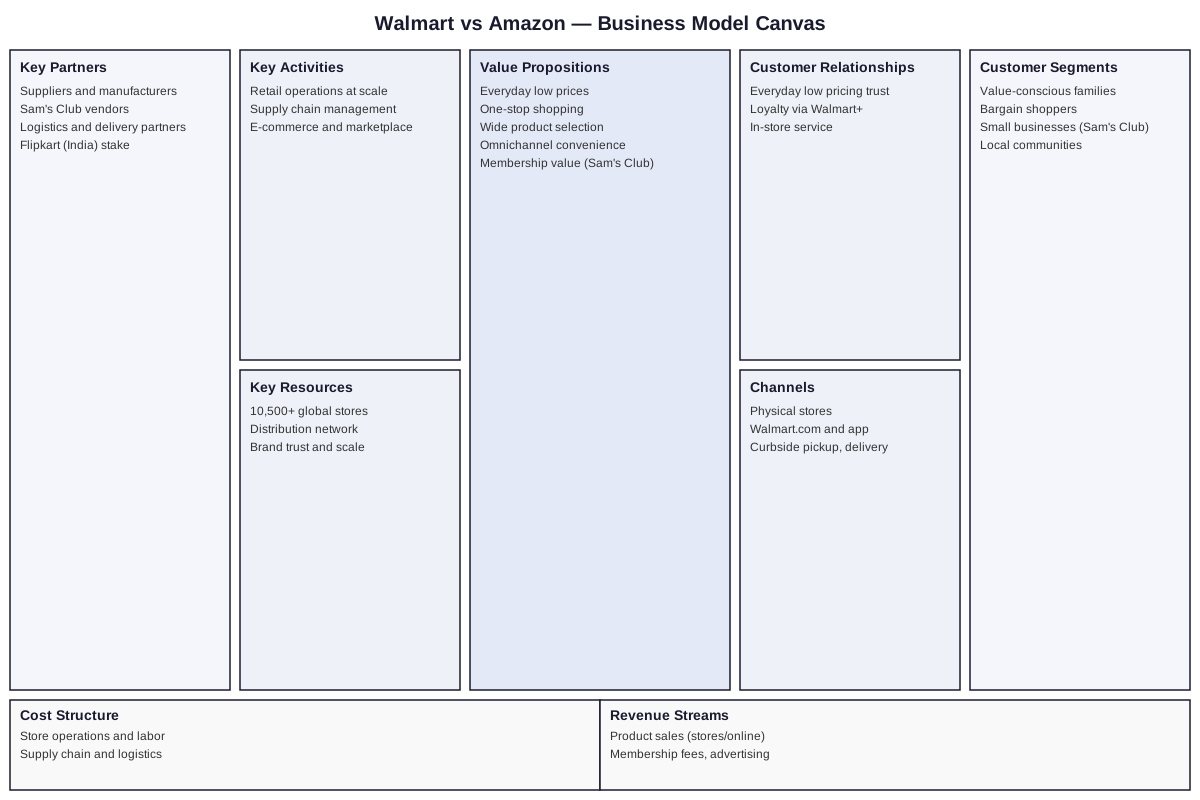
Walmart runs a hybrid model: brick-and-mortar retail at its core, with e-commerce layered on top through its website, app and Walmart+ subscription. The company operates more than 10,500 stores globally, including Supercenters, discount stores and Sam's Club warehouse locations, and treats store density as a distribution asset rather than just a sales channel. Every store doubles as a fulfillment point for online orders, curbside pickup and same-day delivery, which lets Walmart compete on speed without building a delivery network from scratch.
Amazon's architecture inverts that logic. It began as a pure online retailer and grew into a marketplace that connects consumers with millions of third-party sellers, then added Amazon Web Services [AWS] as a separate, high-margin cloud computing business serving corporate customers worldwide. Where Walmart's stores generate data as a byproduct of transactions, Amazon's entire business runs on data and computing infrastructure as a primary asset, which it then resells to outside companies through AWS. The two firms increasingly overlap in the middle: Walmart is building a third-party marketplace and an advertising business that resemble Amazon's, while Amazon keeps opening physical grocery and convenience formats that resemble Walmart's.
Revenue Streams and Profit Engines
Walmart's revenue for the fiscal year ended January 31, 2025, reached 681 billion dollars, driven primarily by product sales across its stores and online platforms.2 Sam's Club membership fees added more than 4.3 billion dollars, and Walmart Connect, its retail media and advertising arm, grew roughly 46 percent for the fiscal year to nearly 6.4 billion dollars, a small slice of total revenue but a fast-growing, high-margin one. Walmart also earns fees from financial services such as money transfers and bill payment, though these remain minor relative to core retail sales.
Amazon's revenue mix looks different in both composition and margin structure. Net sales reached 716.9 billion dollars in 2025, split across North America retail, international retail and AWS. AWS alone generated 128.7 billion dollars, up 20 percent year over year, and because cloud infrastructure carries far higher margins than retail, AWS contributes a share of operating profit well beyond its share of revenue. Advertising has become Amazon's other profit engine, growing more than 22 percent to roughly 68.6 billion dollars as the company sells placements across its marketplace and streaming properties. Amazon Prime subscription fees round out the mix, converting a shipping perk into a recurring revenue stream that also drives loyalty across grocery, video and music.
Customer Segments and Value Proposition
Walmart's customer base skews toward value-conscious households, families managing tight budgets and shoppers who want groceries, apparel and general merchandise in a single trip. Its value proposition rests on the Everyday Low Pricing [EDLP] strategy, consistent prices rather than promotional swings, paired with the convenience of a store within a short drive of most U.S. households. Sam's Club serves a related but distinct segment: small businesses and bulk buyers willing to pay an annual fee for wholesale pricing.
Amazon draws a broader but more digitally native customer base: shoppers who prioritize selection, speed and personalization over in-person browsing. Amazon captured roughly 40.5 percent of U.S. e-commerce spending in 2025, compared with Walmart's 9.2 percent, though Walmart's online share has been growing faster off a smaller base.3 Amazon Prime members represent a distinct segment within that base, paying an annual fee for shipping speed plus entertainment content, which pulls Amazon into direct competition with subscription video services as well as retailers. Businesses form a third segment for both companies, buying wholesale through Sam's Club or provisioning cloud infrastructure through AWS.
Technology and Operational Backbone
Walmart's technology investment concentrates on supply chain visibility and store operations. Radio-frequency identification tagging and inventory management systems track products from supplier to shelf, reducing stockouts and excess inventory, while data analytics on purchasing patterns feed assortment and pricing decisions. Warehouse automation and shelf-scanning robots have cut labor hours on routine inventory tasks, and the company's omnichannel systems tie its app, website and stores into a single order and fulfillment pool.
Amazon's technology stack starts from a different base: AWS itself, which underpins Amazon's own operations while also serving as the company's most profitable business line. Machine learning models drive product recommendations, search ranking and dynamic pricing, adjusting continuously to demand and competitor moves. Fulfillment centers use robotics extensively for picking and sorting, and the company has piloted cashier-less retail through Amazon Go, using cameras and sensors to let shoppers skip checkout entirely. Voice technology through Alexa-enabled devices extends Amazon's data collection and purchasing funnel into the home, a channel Walmart has no direct equivalent for.
Marketing and Brand Positioning
Walmart's brand rests on a decades-old promise of affordability, expressed through its long-running slogan.
Save money. Live better
The company backs that message with traditional media, television and print campaigns aimed at families, alongside a growing social media presence and loyalty perks through Walmart+, which bundles free delivery, fuel discounts and scan-and-go checkout. Community sponsorships and local sourcing initiatives reinforce a brand identity built on trust and everyday reliability rather than novelty.
Amazon's marketing leans almost entirely digital, built on personalized recommendations and behavioral targeting rather than mass-media storytelling. Its internal culture and brand tone are captured in its own slogan.
Work hard. Have fun. Make history
Influencer partnerships, algorithm-driven product placement and event-based sales campaigns such as Prime Day generate urgency around specific dates rather than steady, season-long promotion. Walmart briefly surpassed a 1 trillion dollar market capitalization in early 2026 before settling back near 900 billion dollars, a milestone that underscored how far its brand and stock have re-rated even as Amazon's roughly 2.5 trillion dollar valuation still dwarfs it.4
Financial Performance and Market Position
Walmart's net income for fiscal 2025 reached 19.4 billion dollars on operating income of roughly 29.5 billion dollars, reflecting thin retail margins offset by enormous volume. Its gross margin sits in the mid-20s as a percentage of revenue, typical for a grocery-heavy retailer competing on price. Amazon's full-year 2025 results tell a different story: net income of 77.7 billion dollars on operating income of 80 billion dollars, both up sharply from 2024, with AWS and advertising doing the heavy lifting on margin.5 Amazon's gross margin runs closer to double Walmart's, a direct consequence of its services mix rather than any inherent superiority in retail execution.
Market valuation reflects that margin gap. Amazon trades at roughly 2.5 trillion dollars in market capitalization against Walmart's approximately 900 billion dollars, even though Walmart's revenue is smaller than Amazon's by less than 40 billion dollars. Investors are pricing Amazon's cloud and advertising growth more richly than Walmart's retail volume, a gap Walmart is trying to narrow by scaling its own higher-margin businesses.
Strategic Outlook and Competitive Convergence
Both companies are now investing in the capabilities the other pioneered. Walmart is scaling its marketplace, advertising and financial services businesses to lift margins without abandoning its store network, while pushing further into international markets including India through its Flipkart stake and Mexico and Canada closer to home. Amazon continues opening physical grocery and convenience formats, expanding same-day delivery infrastructure and investing in healthcare and financial services to diversify beyond its marketplace and cloud core.
Artificial Intelligence [AI] has become the next front in this convergence. Amazon is deploying AI across seller tools, customer service and AWS itself, while Walmart is training its workforce on AI tools to improve productivity in stores and supply chain planning. Sustainability commitments run in parallel: both companies have set targets around net-zero emissions and renewable energy, Amazon by 2040 and Walmart with a similar horizon, reflecting pressure from investors and regulators rather than a departure from core strategy. The competitive line between the two companies is no longer physical versus digital; it runs through which company can convert its existing advantage, store density for Walmart, cloud and data infrastructure for Amazon, into the next layer of retail, financial services and AI-driven commerce.
Walmart and Amazon prove that retail scale can be built from opposite directions and still reach dominance. Walmart converted physical density, supplier relationships and pricing discipline into a revenue base above 680 billion dollars, while Amazon converted digital infrastructure, cloud computing and subscription services into a business generating over 716 billion dollars with markedly higher margins. Their rivalry no longer centers on price alone; it now spans advertising, financial services, logistics and Artificial Intelligence, with each company borrowing tactics once associated with the other. Walmart is expanding marketplace and advertising revenue to lift its margin profile, while Amazon keeps investing in physical stores and same-day delivery to challenge Walmart's convenience advantage. For executives, the lesson is not which company to copy but which combination of physical and digital assets best supports differentiation in their own markets.
Citation
Cite this article
Sridharan, M. A. (2025, June 12). Walmart Vs Amazon Business Model. Think Insights. https://thinkinsights.net/strategy/walmart-vs-amazon-business-model (Accessed [[ACCESS_DATE]])
Sridharan, Mithun A. "Walmart Vs Amazon Business Model." Think Insights, 12 June 2025, https://thinkinsights.net/strategy/walmart-vs-amazon-business-model. Accessed [[ACCESS_DATE]].
Mithun A. Sridharan, "Walmart Vs Amazon Business Model," Think Insights, June 12, 2025, https://thinkinsights.net/strategy/walmart-vs-amazon-business-model. Accessed [[ACCESS_DATE]].
Sridharan, M.A. (2025) 'Walmart Vs Amazon Business Model', Think Insights. Available at: https://thinkinsights.net/strategy/walmart-vs-amazon-business-model (Accessed: [[ACCESS_DATE]]).
M. A. Sridharan, "Walmart Vs Amazon Business Model," Think Insights, 2025. [Online]. Available: https://thinkinsights.net/strategy/walmart-vs-amazon-business-model. [Accessed: [[ACCESS_DATE]]].
Sridharan MA. Walmart Vs Amazon Business Model. Think Insights. Published June 12, 2025. Accessed [[ACCESS_DATE]]. https://thinkinsights.net/strategy/walmart-vs-amazon-business-model
Test Your Knowledge
Walmart Vs Amazon Business Model
Challenge yourself on the concepts from this article and see how well you understood them.
Subscribers get weekly quizzes and insights — subscribe free
Sponsor this article
Partner with Think Insights
Reach 50,000+ business leaders, consultants, and strategists. Feature your brand alongside expert articles on strategy, leadership, and digital transformation.
Become a Sponsor