UK Online Casino Business Model


The UK online casino market pairs a digitally mature consumer base with one of the strictest regulatory regimes in gambling. That combination has reshaped how operators compete. Licensing conditions covering fund segregation, self-exclusion and deposit limits raise the cost of entry, which consolidates the market around operators with the infrastructure to comply at scale. Revenue still rests on the house edge built into slots, live dealer and table games, but the more interesting shift is in acquisition strategy: fewer operators lean on wagering-locked bonuses and more compete on withdrawal speed and transparent terms. Entain, the FTSE 100 group behind Ladbrokes, Coral and bwin, illustrates how a diversified operator builds cost structure, partnerships and customer relationships around that regulatory reality. The lesson extends past gambling to any market where transparency becomes a competitive lever rather than a compliance burden
How does a UK online casino make money?
UK online casinos earn most of their revenue from the house edge built into slots, table games and live dealer products, which produces a predictable margin over a large enough volume of bets. Secondary income comes from affiliate commissions and business-to-business technology licensing to other operators.
Why are UK gambling operators moving away from bonus wagering requirements?
Regulators capped wagering requirements at 10 times a bonus's value and banned mixed-product promotions, removing much of the acquisition value those bonuses once offered. Many operators had already started competing on withdrawal speed and transparent terms instead, since a poor withdrawal experience is a leading cause of players abandoning a platform.
What role does BetMGM play in Entain's business model?
BetMGM is a 50/50 joint venture between Entain and MGM Resorts International that gives Entain exposure to the regulated US sports betting and igaming market without operating there alone. It reported $2.8 billion in net revenue in 2025 and reached profitability at the EBITDA level, adding a second growth engine alongside Entain's UK and European business.
Market Structure and Regulation
The UK Gambling Commission licenses every operator that wants to serve UK consumers and it sets the terms under which that licence stays valid. Those terms are demanding by design. Operators must segregate player funds from operating capital, disclose how well those funds are protected if the business fails and participate in GAMSTOP, the national self-exclusion register that locks out registered players across every licensed site at once.1
Recent reforms pushed the bar higher still, adding a £2 per spin stake limit for players aged 18 to 24 on online slots and a cap on how large a wagering requirement a bonus can carry. The compliance cost of meeting all this is high enough that it filters the market toward operators with the balance sheet and systems to absorb it, which is one reason the sector has consolidated around a handful of large groups.
How Operators Make Money
Casino revenue starts with the house edge, the statistical advantage built into every game that produces a predictable margin across a large enough number of bets.2 A slot with a 96 percent return to player pays out £96 for every £100 wagered in aggregate, leaving £4 in gross gaming revenue before costs. Live dealer tables, often streamed from third-party studios, tend to carry a smaller edge per hand but longer sessions and higher average stakes, so the revenue per active player often matches or beats slots.
Table games vary more by format: blackjack played with correct strategy leaves the operator a thin margin, while roulette holds a steadier one regardless of how a player bets. Beyond the games themselves, operators earn commission from affiliate sites that refer new depositors and from data tools that flag high-value players for targeted promotions, though UK rules require any bonus terms attached to those promotions to be stated plainly and not overstate what a player can actually access.
The Shift Away from Locked Bonuses
For years the standard acquisition tool was the headline deposit bonus, wrapped in a wagering requirement that forced a player to bet through several multiples of the bonus before withdrawing anything. That structure recovered most of the bonus cost for the operator but left many players who tried to withdraw dissatisfied, because the gap between advertised and realistically accessible value only became clear at the exit point.
Regulators have now moved to close that gap directly: bonus wagering requirements above 10 times the offer are barred and mixed-product promotions that stack sports and casino requirements together are banned outright.3 A growing number of operators had already been moving away from wagering-locked bonuses before the rule change, betting that fast, fee-free withdrawals and clear terms would retain players more effectively than a bonus a player has to fight to unlock. That bet requires confidence that the product itself, not a locked balance, is what brings a player back.
Cost Structure Under Compliance
Cost lines for a UK operator sit in five broad buckets: licensing and compliance, technology, game content, marketing and payment processing. Licence fees scale with gross gambling yield, so the Gambling Commission takes a proportionally larger share from bigger operators and compliance costs rise with active player volume as transaction monitoring and audit obligations scale with it.
Game content is mostly licensed from third-party studios on a revenue share or flat fee, which lets an operator field a large library without funding development, though it also means most operators draw from the same small set of suppliers and end up with similar catalogues. Payment processing costs vary sharply by method: bank transfers routed through the UK's Faster Payments infrastructure carry minimal per-transaction fees, while card and e-wallet transactions cost more, so operators who build direct bank-transfer rails gain a durable cost edge at scale.4
Competitive Positioning and Trust
With game libraries converging across the market, the basis of competition has moved to payment speed, terms clarity and trust signals rather than the games themselves. Operators that once competed on the size of a welcome offer now compete on how quickly a withdrawal clears and how few conditions are attached to it, because a bad withdrawal experience is a common reason players leave a platform altogether.
The market now splits roughly into large diversified groups with sizeable marketing budgets, mid-size specialists built around a strong brand or format and newer entrants competing purely on product quality and transparent terms. That third group tends to attract a smaller audience that screens hard on terms before depositing, but the players it keeps are worth more over time than the average acquired through a bonus-led campaign.
A Diversified Operator in Practice
Entain plc, the FTSE 100 group formed from the 2020 rebrand of GVC Holdings, illustrates how a large UK-facing operator builds a business model around this regulatory and competitive backdrop. Its portfolio spans Ladbrokes and Coral in UK retail and online betting, bwin and Sportingbet internationally and gaming brands including Foxy Bingo and PartyCasino, giving it scale across markets and product types that a single-brand operator cannot match.
Entain also holds a 50/50 joint venture with MGM Resorts International called BetMGM, which delivered $2.8 billion of net revenue in 2025 and turned profitable at the EBITDA line, showing how a UK-rooted operator uses partnership structures to enter a regulated market it could not enter alone.5 That international diversification does not replace the domestic business; it sits alongside a UK retail and online estate that still has to meet every licensing condition described above.
Strategic Takeaway
The pattern in UK online casino is one visible across other regulated digital consumer markets: once compliance raises the cost of operating on information asymmetry, the operators built around genuine product quality gain a structural edge over those built around extracting value from confused customers. Entain's scale lets it absorb compliance cost that would strain a smaller entrant, but the underlying lesson holds regardless of size.
Where regulation pushes toward transparency, the winning business model is the one that would have worked even without the regulation forcing it.
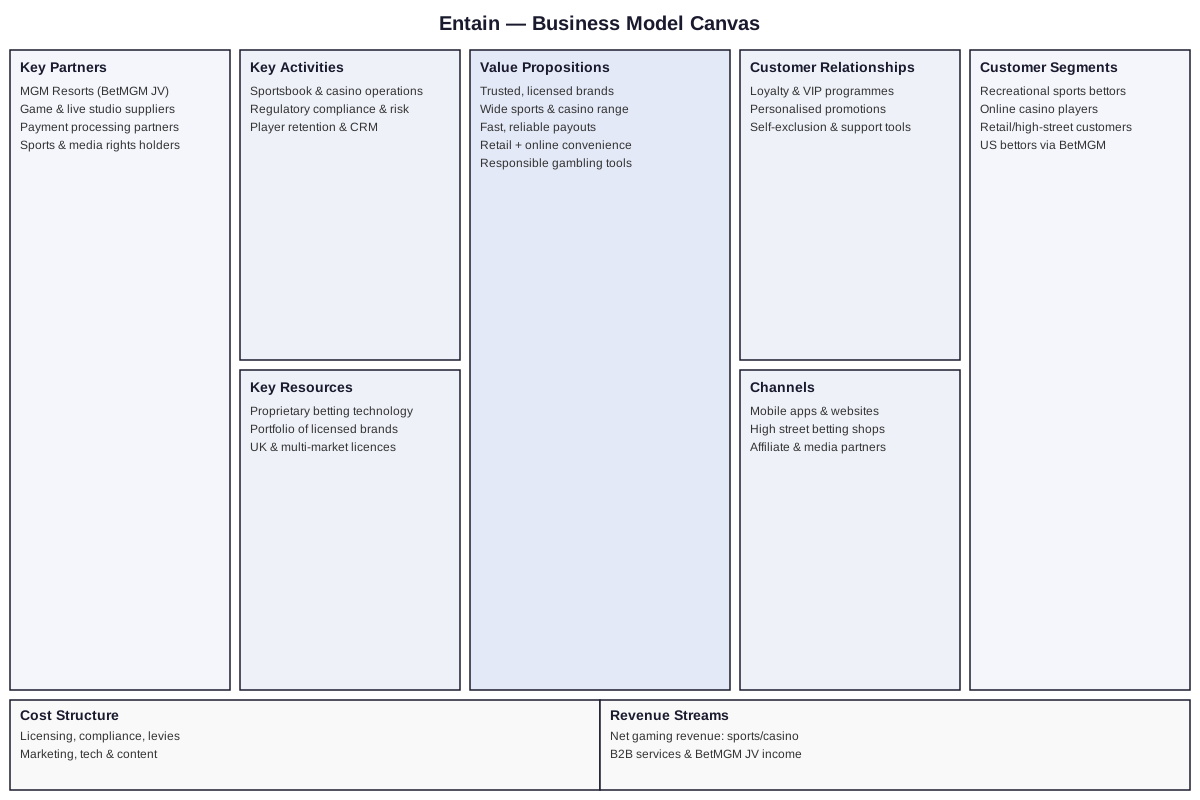
Key Partners
Entain's most significant partner is MGM Resorts International, with which it operates the 50/50 BetMGM joint venture that gives the group access to the regulated US sports betting and igaming market. Beyond that venture, Entain depends on third-party game and live-studio suppliers for much of its casino content, since building every title in-house would be prohibitively expensive. Payment processors and banking partners keep deposits and withdrawals moving across the group's brands and sports leagues and media rights holders supply the data and broadcast rights that make sports betting products viable. Affiliate marketers and content creators round out the partner base, referring new depositors in exchange for commission.
Key Activities
The core activity across Entain's brands is running sportsbook and casino operations at scale, from odds-setting and game hosting to settling millions of individual bets. A parallel activity, less visible but just as resource-intensive, is regulatory compliance and risk management across every jurisdiction the group operates in, since a licence failure in one market can affect the whole group's reputation. Entain also invests heavily in player retention and customer relationship management, using data on betting and deposit behavior to personalize offers and identify players who may need responsible gambling interventions.
Key Resources
Entain's proprietary betting and gaming technology platform underpins every brand in the portfolio, letting the group add new markets or products without rebuilding core systems each time. The brand portfolio itself, spanning Ladbrokes, Coral, bwin, Sportingbet and several gaming labels, is a resource in its own right, carrying decades of consumer recognition in different markets. Multi-market gambling licences, expensive and slow to obtain, are the third pillar, since they are what make every other resource usable in a given jurisdiction.
Value Propositions
For UK consumers, Entain's value proposition centers on operating trusted, licensed brands that carry a track record most newer entrants cannot match. Its sportsbook and casino range spans betting, slots, live dealer tables, bingo and poker under different brands, giving customers a wide set of products without leaving the group's ecosystem. Fast, reliable payouts and a shift toward clearer bonus terms address the exact friction point that drives customers to switch operators. Entain's retail estate adds a proposition unavailable to online-only competitors: the option to bet or play in person, then continue on an app. Built-in responsible gambling tools reduce a source of friction that regulators are increasingly requiring the whole market to address.
Customer Relationships
Entain manages customer relationships through loyalty and VIP programmes that reward higher-value players with tailored perks across its brands. Personalized promotions, built from deposit and betting history, aim to keep offers relevant rather than generic, within the disclosure rules UK regulators require. The group also maintains self-exclusion and player support tools that let customers set their own limits or step away from the platform entirely, a relationship dimension regulation now makes mandatory rather than optional.
Channels
Mobile apps and websites carry the bulk of Entain's UK online volume, reflecting how far consumer betting and casino play has shifted away from physical locations. The group still operates a large network of high street betting shops under the Ladbrokes and Coral names, a channel that continues to serve customers who prefer in-person betting or live sports viewing. Affiliate sites and media partners extend the group's reach further, referring new customers in exchange for commission on the value they generate.
Customer Segments
Recreational sports bettors make up a large share of Entain's UK customer base, wagering on football and other major sports through the Ladbrokes, Coral and bwin brands. Online casino players form a second segment, drawn to slots, live dealer tables and bingo products across the group's gaming brands. A retail segment, distinct from the online audience, still values the high street shop experience for placing bets and watching live sport. In the United States, BetMGM serves an entirely separate segment of bettors in states where sports betting and igaming have been legalized.
Cost Structure
Licensing fees, compliance systems and gambling-specific levies make up a large and growing share of Entain's cost base, scaling with both revenue and player volume across markets. The UK's increase in Remote Gaming Duty adds directly to this cost line, alongside the systems needed to run affordability checks and monitor transactions at scale. Marketing remains a major cost given how competitive customer acquisition has become, though the group increasingly weighs it against retention spend on product and payment infrastructure. Technology development and game content licensing round out the cost base, split between building proprietary platform features and paying third-party studios for casino titles.
Revenue Streams
Net gaming revenue from sports betting and casino products, the house edge and betting margin realized across millions of individual wagers, remains Entain's primary revenue stream. Its 50 percent share of BetMGM's profits adds a second stream tied to the US market rather than the UK, diversifying the group's revenue base geographically. Business-to-business services, where Entain licenses its technology and content to third-party operators, provide a smaller but higher-margin stream that does not depend on direct customer acquisition.
The UK online casino market shows what happens when regulation forces transparency onto an industry that once profited from its absence. Licensing conditions, stake limits and bonus caps raise the cost of doing business, but they also reward operators whose products work without relying on confused or locked-in customers. Entain's position as a diversified, multi-brand operator, anchored in UK retail and online betting and extended internationally through BetMGM, shows how scale and partnership structures let a group absorb that compliance burden while still competing on trust and payout speed. The broader lesson travels well beyond gambling. Wherever regulators push a market toward disclosure and fair dealing, the operators that built their business model around genuine value delivery, rather than around exploiting information gaps, tend to come out ahead once the rules catch up
Citation
Cite this article
Sridharan, M. A. (2021, April 11). UK Online Casino Business Model. Think Insights. https://thinkinsights.net/strategy/uk-online-casino-business-model (Accessed [[ACCESS_DATE]])
Sridharan, Mithun A. "UK Online Casino Business Model." Think Insights, 11 Apr. 2021, https://thinkinsights.net/strategy/uk-online-casino-business-model. Accessed [[ACCESS_DATE]].
Mithun A. Sridharan, "UK Online Casino Business Model," Think Insights, April 11, 2021, https://thinkinsights.net/strategy/uk-online-casino-business-model. Accessed [[ACCESS_DATE]].
Sridharan, M.A. (2021) 'UK Online Casino Business Model', Think Insights. Available at: https://thinkinsights.net/strategy/uk-online-casino-business-model (Accessed: [[ACCESS_DATE]]).
M. A. Sridharan, "UK Online Casino Business Model," Think Insights, 2021. [Online]. Available: https://thinkinsights.net/strategy/uk-online-casino-business-model. [Accessed: [[ACCESS_DATE]]].
Sridharan MA. UK Online Casino Business Model. Think Insights. Published April 11, 2021. Accessed [[ACCESS_DATE]]. https://thinkinsights.net/strategy/uk-online-casino-business-model
Test Your Knowledge
UK Online Casino Business Model
Challenge yourself on the concepts from this article and see how well you understood them.
Subscribers get weekly quizzes and insights — subscribe free
Sponsor this article
Partner with Think Insights
Reach 50,000+ business leaders, consultants, and strategists. Feature your brand alongside expert articles on strategy, leadership, and digital transformation.
Become a Sponsor