Three Circles Framework


Creating a strong value proposition and positioning strategy is a challenge many companies face. Often, the outcome is a failure, with businesses focusing on elements the market doesn't care about, offering things their competitors can easily outdo, or promoting features that aren't even strengths of their own company. To help companies overcome these obstacles, we use the Three Circles Framework at B2B International. This tool ensures that businesses understand customer needs, their own strengths and weaknesses, and the competitive landscape. Armed with this knowledge, companies can build effective value propositions and positioning strategies that resonate with the market.
What are the three core elements of the Three Circles Framework?
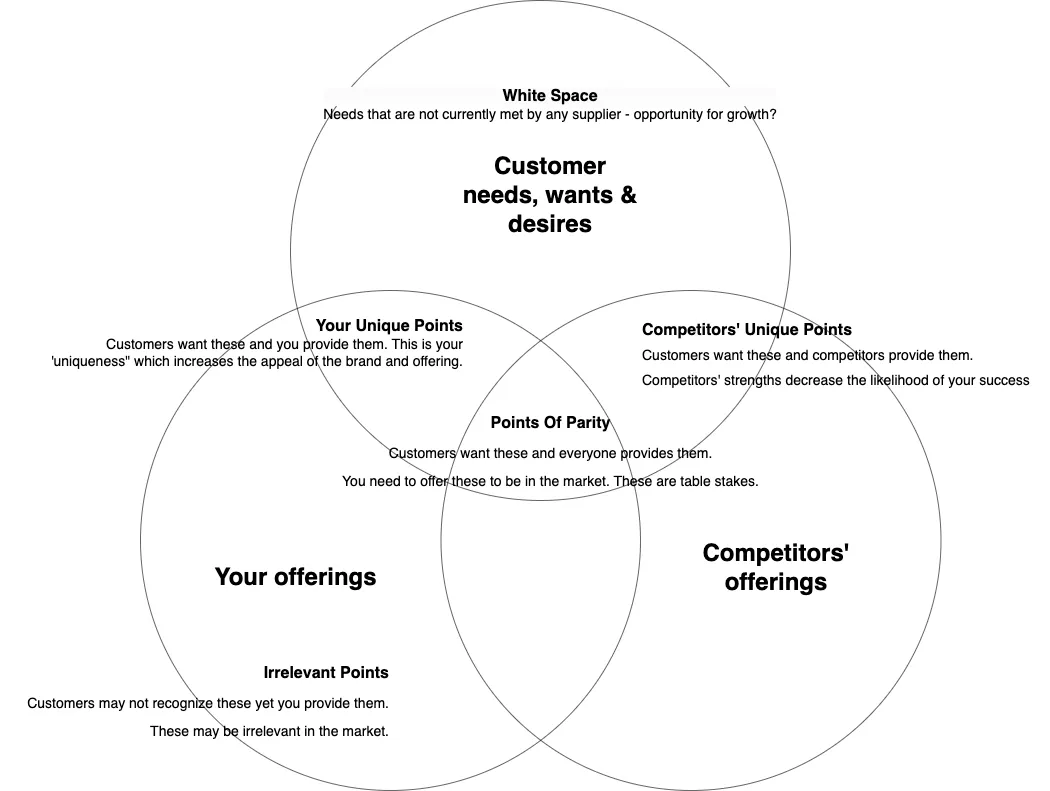
The framework examines customer needs, company strengths, and competitor strengths. Analyzing how these three areas overlap reveals positioning opportunities and potential gaps in the market.
What is the difference between points of parity and points of differentiation?
Points of parity are areas where a company's offerings are similar to competitors. Points of differentiation are areas where a company uniquely meets customer needs that competitors do not currently address.
What does 'white space' mean in this framework?
White space refers to customer needs that are unmet or inadequately addressed by any current competitor. Targeting white space can allow a company to capture new market share.
Why is understanding competitor strengths necessary?
Knowing where competitors perform well helps a company identify where it may be at a disadvantage and where genuine opportunities for differentiation or market entry exist.
Can a company succeed by competing only on points of parity?
It is possible if the company's quality matches or exceeds competitors, but differentiation generally offers a stronger and more sustainable competitive position.
The Three Circles Framework is based on three core elements: customer needs, company strengths, and competitor strengths. These areas are interconnected and provide insights into how a company stands in the market. By understanding the points of parity (what the company shares with its competitors) and points of differentiation (what sets the company apart), businesses can more effectively position themselves.
Understanding Customer Needs
The first step in using the Three Circles Framework is assessing customer needs. Companies cannot develop a value proposition or positioning strategy around things the market doesn't care about. It's essential to understand what customers truly want and need.
Through segmentation and customer needs research, businesses can identify the gaps in the market—areas where customer needs are either not being met or are inadequately addressed by current offerings. By focusing on these needs, companies can create solutions that resonate with their target audience, providing real value that customers are eager to engage with.
Assessing Company Strengths
Next, businesses must assess their own strengths. It's not enough to know what the market wants; companies need to understand what they excel at. The Three Circles Framework helps identify these strengths—whether it's a product, a service, or a unique capability—that make the company stand out.
Equally important is identifying areas where the company might be strong but the market doesn't care. This helps businesses avoid focusing on features that are irrelevant to customers. By concentrating on their true strengths, companies can build a value proposition that emphasizes what they do best.
Analyzing Competitor Strengths
The third component of the Three Circles Framework is assessing the strengths of competitors. A deep understanding of the competitive landscape is critical when shaping a company's positioning. By analyzing the strengths of competitors, businesses can gauge how well their offerings stack up against the competition.
This analysis allows companies to see where competitors meet customer needs more effectively, where their strengths lie, and where there might be opportunities to differentiate. This step is key in determining where a company can position itself to succeed and where it may be at a disadvantage.
How the Three Circles Framework Helps Companies Succeed
Once a company has assessed customer needs, its own strengths, and its competitors' strengths, the next step is to identify strategic opportunities. The Three Circles Framework allows businesses to find three distinct areas for positioning: points of parity, points of differentiation, and white space.
Points of Parity: Competing on Equal Ground
The "points of parity" represent the intersection of customer needs, company strengths, and competitor strengths. This is where the products, services, or capabilities offered by the company are similar to those of competitors. It's a battleground where companies offer the same solutions to meet customer needs.
Competing in the points of parity can be challenging because it's hard to differentiate when everyone is offering essentially the same thing. However, if a company's strengths are equal to or better than its competitors, it can still succeed by delivering high-quality offerings that meet the market's core demands.
Points of Differentiation: Gaining an Edge
A more successful strategy often lies in focusing on points of differentiation. These are the areas where the company's strengths uniquely align with customer needs. This intersection represents what the company does well that no competitor currently provides. It's here that a company can build a strong competitive advantage by offering something customers can't get elsewhere.
Focusing on points of differentiation allows a business to position itself as a leader in a specific niche, offering specialized solutions that competitors cannot easily replicate. This is where innovation and creativity can give companies a lasting edge.
White Space: Targeting Unmet Needs
Another opportunity the Three Circles Framework provides is the identification of "white space." This is the area where customer needs are unmet or inadequately addressed, and where competitors have not yet capitalized on these gaps. By focusing on this white space, companies can create new products, services, or capabilities that cater directly to these unmet needs.
Entering the white space can be a highly rewarding strategy, allowing a business to differentiate itself significantly. If executed correctly, targeting the white space can help a company capture market share quickly and position itself as an innovator in the field.
The Three Circles Framework is an essential tool for businesses looking to develop effective value propositions and positioning strategies. By focusing on customer needs, assessing internal strengths, and understanding competitor strengths, companies can identify where they can excel in the market. Whether they choose to compete in the points of parity, emphasize their unique points of differentiation, or venture into the white space, the Three Circles Framework provides the insights necessary for a successful strategy. By using this framework, businesses can make informed decisions about where to compete, how to differentiate, and which customer needs to prioritize. This helps create a clear and compelling brand positioning that resonates with the target market, ultimately driving success in the competitive business landscape.
Citation
Cite this article
Sridharan, M. A. (2022, June 25). Three Circles Framework. Think Insights. https://thinkinsights.net/strategy/three-circles-framework (Accessed [[ACCESS_DATE]])
Sridharan, Mithun A. "Three Circles Framework." Think Insights, 25 June 2022, https://thinkinsights.net/strategy/three-circles-framework. Accessed [[ACCESS_DATE]].
Mithun A. Sridharan, "Three Circles Framework," Think Insights, June 25, 2022, https://thinkinsights.net/strategy/three-circles-framework. Accessed [[ACCESS_DATE]].
Sridharan, M.A. (2022) 'Three Circles Framework', Think Insights. Available at: https://thinkinsights.net/strategy/three-circles-framework (Accessed: [[ACCESS_DATE]]).
M. A. Sridharan, "Three Circles Framework," Think Insights, 2022. [Online]. Available: https://thinkinsights.net/strategy/three-circles-framework. [Accessed: [[ACCESS_DATE]]].
Sridharan MA. Three Circles Framework. Think Insights. Published June 25, 2022. Accessed [[ACCESS_DATE]]. https://thinkinsights.net/strategy/three-circles-framework
Test Your Knowledge
Three Circles Framework
Challenge yourself on the concepts from this article and see how well you understood them.
Subscribers get weekly quizzes and insights — subscribe free
Sponsor this article
Partner with Think Insights
Reach 50,000+ business leaders, consultants, and strategists. Feature your brand alongside expert articles on strategy, leadership, and digital transformation.
Become a Sponsor