Theory of Change


Most social change initiatives launch with conviction and urgency, yet struggle to show clearly how their activities are meant to deliver the long-term outcomes they promise. Funders ask what impact a program will create, boards want to know how that impact will be generated, and teams need a shared story of change that guides day-to-day choices. A robust Theory of Change [ToC] brings these needs together in a single structure by explicitly linking vision, pathways, interventions, and evidence. The practical recommendation is straightforward: treat ToC as the backbone of program and portfolio strategy, not as a compliance diagram. Start with the impact you seek, translate that impact into specific outcomes, map the sequence of outputs and preconditions, and then align interventions, indicators, and assumptions with that map. Use this theory to drive grant strategy, stakeholder communication, measurement, and tactical decisions so that every major choice can be traced back to a clear logic of how change is expected to unfold. For leaders of social programs, public agencies, and philanthropic organizations, the decision requirement is simple. Either you continue to rely on loosely defined goals and fragmented plans, or you invest the time to build and maintain a ToC that explains, in concrete terms, how the initiative intends to move from resources to impact. When ToC is constructed and used well, it reveals the missing middle between ground-level actions and system-level results, exposes weak assumptions, and creates a practical pathway for systems change that teams can execute against for years.
Why do complex programs need a Theory of Change?
Complex programs operate across multiple actors, time horizons, and levels of impact, and without an explicit Theory of Change, teams struggle to explain how activities connect to outcomes, which undermines funding, coordination, and evaluation.
How does a Theory of Change support measurement?
ToC forces programs to define preconditions and outcomes precisely, then identify indicators, baselines, thresholds, and timelines so that measurement strategies track progress against an explicit change pathway rather than against isolated metrics.
What is the biggest risk when using ToC?
The biggest risk is treating ToC as a static, predictive diagram instead of a living framework; when teams fail to revisit assumptions and pathways, the theory can drift away from reality and weaken strategic decisions.
Theory of Change [ToC] is a structured approach to planning and evaluating programs and systems that explains what impact a change effort aims to create and how that impact is expected to materialize over time. Rather than focusing only on activities or long-term goals, ToC connects the ground-level actions and resources to intermediate outcomes and ultimate impact through a logically linked set of statements and diagrams. This makes the often invisible “missing middle” between day-to-day work and societal outcomes visible and discussable.
A well-constructed ToC articulates pathways of change, clarifies where resources will be invested, and provides a shared narrative of how stakeholders believe change will occur. Because it forces teams to connect vision, outcomes, outputs, and interventions explicitly, ToC is particularly useful for addressing complex social problems where multiple actors, institutions, and contexts interact. In these environments, intuitive stories of change are rarely sufficient; ToC brings enough structure to support disciplined design while remaining flexible enough to adapt as conditions evolve.
Over the past decades, ToC has drawn on program analysis, logic model planning, and informed social practice, and is now widely used in evaluation, goal setting, and strategic planning across governments and philanthropic institutions. It is a core element in many large-scale social change efforts because it offers both a planning tool and a way to communicate the logic of an initiative to funders, boards, partners, and communities.
How ToC is used globally
Today, Theory of Change is embedded in the governance and funding practices of major international organizations and development agencies. The United Nations, the World Bank, USAID (United States Agency for International Development), and the former UK Department for International Development have all used ToC to shape large-scale social programs and evaluate their impact. These institutions work across diverse contexts, and ToC provides a consistent spine for planning and assessing complex interventions that span multiple countries, sectors, and stakeholder groups.
In these settings, ToC is more than a formal requirement. It becomes a translation device between strategy documents, grant proposals, operational plans, and evaluation frameworks. Teams use ToC to specify the work that must be undertaken, the signals of progress they expect to see, and the pathways—presumed or hypothesized—through which change might unfold. When ToC is clear, it strengthens strategies by aligning internal beliefs and external expectations about what success looks like in a particular context.
For executive teams managing social change portfolios, this global practice offers a practical lesson: ToC is a disciplined way to surface assumptions and align activities with outcomes, not a theoretical exercise. The rigor required to build a ToC is repaid when programs can demonstrate coherence across initiatives and explain why they believe a particular sequence of actions will produce the desired impact.
Basic form of a Theory of Change
In its simplest form, a Theory of Change is a sequence of logically connected statements that describe an initiative’s focus, plan, and intended outcomes in a clear and concise way. This narrative often starts from a long-term vision and works backward to specify intermediate outcomes, outputs, and the actions required to move from one stage to the next. Even without diagrams, such a narrative helps stakeholders see how different elements of a program relate to each other.
A basic ToC in the health sector, for example, might describe how increasing community awareness, strengthening primary care services, and improving access to diagnostics together contribute to disease prevention and control. Even if it does not fully capture technical details of disease elimination, this kind of high-level ToC still communicates the essence of the problem, the proposed solution, and the desired outcome.
As initiatives grow in complexity, ToC is often expressed as a diagram or flow chart that depicts relationships among components in a more visual manner. These diagrams are accompanied by narrative descriptions that explain each element and linkage, ensuring that the visual representation is grounded in a shared understanding of how the components interact.
Core components of a ToC framework
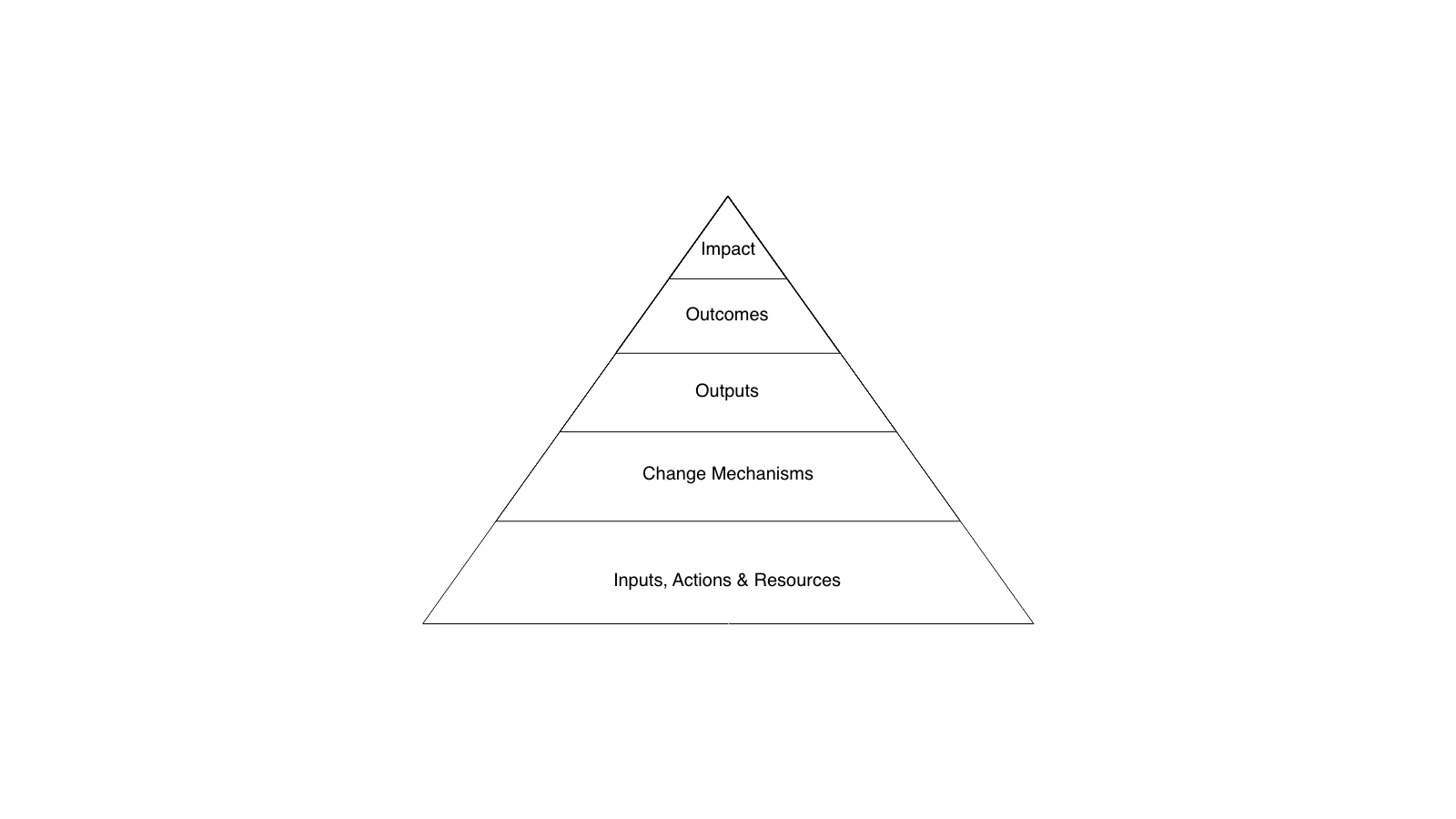
A mature ToC framework is typically organized around five core components: inputs, change mechanisms, outputs, outcomes, and impact. Diagrams are usually read from left to right or top to bottom, beginning with the inputs that feed into the system and ending with the impact that the initiative seeks to create.
Inputs represent the resources and capacities required to initiate change mechanisms, such as funding, staff, knowledge, infrastructure, and partnerships. Change mechanisms are the activities, policies, and interventions that transform those inputs into specific outputs, such as services delivered, products provided, or relationships built. Outputs then lead to outcomes, which are the observable changes in behavior, conditions, or status among target populations.
Impact sits at the far end of the framework and captures the long-term, often societal-level results that the initiative aims to achieve. A ToC diagram might show, for instance, how investments in environmental health contribute to economic welfare by strengthening various forms of capital—financial, manufactured, intellectual, social, and natural—and how those forms of capital interact over time. By mapping these relationships, ToC makes it easier to see how early-stage activities connect to broader developmental goals.
Strategic benefits of using Theory of Change
Theory of Change is designed as a practical tool to improve the design, implementation, and assessment of programs. One of its major benefits is that it provides a clear foundation for grant and investment strategies. Funders and boards need structured explanations of how programs intend to create positive impact; ToC offers that explanation in a way that combines evidence, logic, and narrative. This increases credibility and reduces miscommunication about what a program is trying to achieve and why.
Another benefit is that ToC embeds the testing of assumptions into the development process. As stakeholders articulate pathways and preconditions, they inevitably surface beliefs about how change happens for specific populations and in specific contexts. Challenging these beliefs early leads to more honest conversations about feasibility, risk, and requirements, and helps build stronger internal buy-in before significant resources are committed.
ToC also enhances communication among team members and collaborators. The act of creating a ToC raises new questions and invites contributions from different disciplines and levels of the organization. This dialogue encourages participative collaboration and helps stakeholders develop a shared understanding of how the organization believes change will occur. As a result, messaging to external audiences becomes sharper because the underlying logic has been thoroughly debated.
Finally, ToC serves as a guide for measuring success and making decisions. It provides a map for tracking progress and identifying achievements and failures against specific preconditions and outcomes. This map supports the development of key performance indicators, strategic implementation choices, and tactical decisions about how to allocate time and resources across program components.
Backward mapping and high-level steps
Most ToC diagrams are constructed using a backward mapping approach that starts with the impact and works back through outcomes, outputs, and change mechanisms to inputs. Stakeholders focus on a series of high-level steps while considering the contextual factors that influence their decisions.
The first step is to determine the long-term vision or impact. Participants discuss and agree on what the initiative ultimately seeks to achieve, often beyond the formal timeframe of the program. The quality of this vision matters, because every other element of the ToC depends on its clarity.
Once the vision is established, stakeholders identify the outcomes that must be in place by the end of the program to support that vision. They then specify the outputs that will contribute to those outcomes and work backward to define the change mechanisms and inputs that will enable the outputs. Throughout this process, teams reflect on underlying assumptions and contextual realities, ensuring that the pathway they create is grounded in what is known about the operating environment.
Practical elements of a strong Theory of Change
A strong Theory of Change ensures that programs are delivering the right activities for the outcomes they seek. This requires several key elements to come together: precise outcome definitions, coherent pathways of change, explicit assumptions, and aligned interventions. Vague or compound outcome statements make it difficult to decide what to do and how to measure success, so ToC forces teams to unpack broad aspirations into specific, actionable constructs.
Because social change agents often speak in multi-dimensional terms such as “better family functioning” or “integrated youth services,” ToC processes encourage them to break these concepts into discrete outcomes that can be acted on and tracked. This unpacking improves clarity, supports consensus-building among stakeholders, and creates a foundation for designing indicators and strategies that match the intended results.
ToC also requires that pathways of change link outcomes logically, showing how preconditions and intermediate states must accumulate for long-term goals to be reached. These pathways cannot rely on a single “mega-program” that is assumed to cause all necessary changes. Instead, they highlight multiple steps and branches, each of which needs its own interventions and evidence.
Identifying outcomes: from ideas to agreement
The first practical task in many ToC processes is to identify long-term and intermediate outcomes with enough precision to guide action. This work is most effective when conducted with a democratic and inclusive tone in groups that are small enough to enable meaningful discussion, typically fewer than ten participants. The objective is to move from broad aspirations to a defined set of outcomes that reflect collective intent.
Brainstorming is often the starting point. Participants generate ideas in response to questions such as what the ultimate goals of the program are, what a successful initiative should look like, what funders and participants expect, and how the community should be different in the long term if change succeeds. These ideas are captured visibly, often on notes or cards, and then shared so everyone can see the range of perspectives.
Once ideas are visible, the group reviews and sorts them into categories. Repeated themes are discussed, and wording that best captures each concept is refined. Voting is used to converge on a set of long-term outcomes that represents the group’s shared understanding. This combination of brainstorming, sharing, refining, and voting helps build both clarity and ownership over the outcomes that will anchor the ToC.
Developing pathways to change
Pathways of Change [PoC] are maps that show how actions and outcomes relate to each other over the life of an initiative. In a ToC context, PoC diagrams link outcomes rather than activities, illustrating the sequence of conditions that must exist for the long-term goal to be reached. The PoC is the skeleton on which further detail—indicators, interventions, and assumptions—is added to construct a full Theory of Change.
Constructing PoC is typically the most time-intensive part of ToC development. Participants focus on identifying preconditions that represent the most immediate outcomes related to the long-term goal, starting from the final step before the goal, then the penultimate outcomes, and moving backward to early outcomes. This backward mapping ensures that the pathway reflects a logical progression rather than a list of disconnected steps.
The process involves brainstorming preconditions, sorting and grouping similar ideas, narrowing the set to four to six key outcomes for each level, and then mapping them onto diagrams. At each step, the group pauses to test whether the emerging storyline makes sense as a representation of how the change process might unfold. The result is a pathway that captures necessary and sufficient preconditions for achieving the long-term outcome.
Operationalizing preconditions with indicators
Once pathways and preconditions are defined, the next task is to operationalize those preconditions by deciding what evidence will show that they have been achieved. This involves identifying indicators, target populations, baselines, thresholds, and timelines for each outcome. Tackling this work early ensures that measurement strategies are aligned with the logic of the ToC rather than retrofitted later.
A precondition such as “children are healthy at age five” might be operationalized with indicators like the percentage of children with a healthy height-to-weight ratio or the average number of days out of school due to illness. The target population could be defined as children within a particular community or program. Baseline values capture current status, thresholds define the level of change required to consider the outcome successful, and timelines indicate how long change is expected to take.
During this process, participants must avoid limiting their thinking to data they already have, which can lead to mismatched indicators and outcomes. Instead, they should focus first on defining the best indicators conceptually, and only then on how to measure them. This allows researchers and evaluators to design appropriate instruments and methods based on a coherent measurement blueprint.
Defining interventions and managing scope
Interventions are the high-level strategies, programs, and policies that are designed to bring about the outcomes in the ToC. Defining them involves planning actions that correspond to specific preconditions and pathways, while accepting that no single initiative can influence every outcome on the map. A key step is deciding which subset of outcomes the group can reasonably address given its capacity and mandate.
This decision requires a reality check and expectation management. Participants must recognize that some outcomes lie outside the initiative’s direct influence or depend on systemic changes that require broader coalitions. By the end of this process, the group should have selected a subset of outcomes that will serve as the basis for detailed intervention planning.
Mapping interventions to outcomes then becomes a creative exercise. Sub-groups propose interventions for particular outcomes, explain why they believe those interventions can plausibly produce the desired changes, and adjust their plans based on feedback. Through this iterative process, each outcome on the pathway is either linked to a targeted intervention, recognized as a result of earlier domino effects, or acknowledged as beyond the initiative’s scope.
Articulating and testing assumptions
Every Theory of Change rests on assumptions, some explicit and some tacit. These assumptions relate to why particular preconditions are considered necessary and sufficient for the long-term outcome, to the social science evidence connecting activities and outcomes, and to contextual factors such as local economies, social relations, and institutional behavior. Making these assumptions explicit is essential because a single flawed assumption can undermine an otherwise robust pathway.
The process of articulating assumptions typically begins with a review of the PoC, indicators, and interventions, followed by structured discussion. Stakeholders ask whether the theory makes sense as a whole, whether preconditions are logical steps toward the long-term outcome, and whether outcomes can realistically reach the levels predicted. They also explore external factors that might derail the theory, such as economic shocks, policy changes, or cultural dynamics.
Questioning assumptions from multiple angles is central to building a resilient ToC. For instance, a community revitalization plan that assumes landlords will comply with regulations once they are made aware of them must confront the possibility that awareness is not the issue, and that enforcement or financial support may be needed. When these types of assumptions are probed and refined, the resulting ToC better reflects the complexity of real-world change.
Bringing the Theory of Change together
The main benefit of Theory of Change comes from making diverse views and assumptions about the change process explicit and visible. A well-developed ToC specifies how to create a set of conditions that allow a program to deliver desired outcomes and highlights the partnerships, forums, technical assistance, tools, and processes required to operate collaboratively while remaining focused on results. Visual maps of ToC for large initiatives, such as efforts to build sustainable rural communities free of hunger and poverty, show how multiple levels of activity and outcomes connect to an overarching objective.
These maps help groups see where efforts reinforce each other and where gaps exist. They also provide a shared reference for aligning program design, funding decisions, and evaluation efforts. When stakeholders can point to a diagram and narrative that reflect their collective understanding of how change might occur, coordination improves and roles become clearer.
At the same time, ToC processes expose common red flags that can undermine success. These include lack of mandate or buy-in from key decision-makers, insufficient participation from the right stakeholders, outcomes stated as actions rather than conditions, outcomes that are vague or not chronological, and rushed backwards mapping that skips critical reflection. Addressing these red flags requires deliberate facilitation and commitment to the process.
Limitations and how to manage them
Despite its strengths, Theory of Change has limitations that leaders must understand and manage. Visual depictions can make pathways appear more predictable than they are, when in reality social change is influenced by unpredictable actors and external events. Teams must resist the temptation to treat ToC diagrams as firm forecasts; instead, they should see them as hypotheses to be tested and updated.
Complex change is seldom linear, yet many ToC graphics show chains of outcomes in straight lines. In practice, progress can include steps forward and backward, and sometimes important outcomes involve mitigating or protecting against threats rather than achieving ideal states. These nuances are difficult to capture visually, but groups can use narrative and reflection to document different forms of positive change and incorporate them into the theory.
Developing ToC can also be fatiguing or frustrating, especially for participants who perceive it as abstract thinking rather than tangible action. The process is time-consuming and demands sustained attention from diverse stakeholders. To manage this, leaders should communicate the benefits clearly, structure sessions to be efficient and inclusive, and demonstrate how ToC influences real decisions about programs, funding, and measurement. When groups see that the theory is actually used, they are more willing to invest in its development and refinement.
A carefully constructed Theory of Change does not guarantee success, but it dramatically improves the odds that effort, funding, and attention are directed toward conditions that matter for long-term impact. When vision, pathways, interventions, and evidence live in one coherent framework, leaders gain a common reference point for difficult decisions about scope, sequencing, and priority. They see where assumptions need testing, where pathways are underdeveloped, and where indicators must be strengthened before serious investment follows. The greatest value of ToC lies in its ability to make implicit beliefs and contested narratives explicit. That transparency allows diverse stakeholders to debate goals and strategies with shared data rather than competing anecdotes. It also anchors measurement design in the logic of the program rather than in whatever metrics happen to be available. Over time, the combination of disciplined mapping, critical reflection on assumptions, and adaptation in response to evidence turns ToC from a one-off exercise into a governance habit. For executive teams working on complex social or systems change, the challenge is to sustain this discipline. New initiatives, shifting political conditions, and emerging partners will all test the theory. When ToC is revisited and refined instead of set aside, it becomes a durable asset that shapes strategy, guides collaboration, and helps stakeholders see their roles in a larger change story. In that sense, ToC is not only a planning tool; it is a way of keeping ambition grounded in a realistic pathway from where communities stand today to the outcomes they deserve tomorrow.
Citation
Cite this article
Sridharan, M. A. (2026, January 22). Theory of Change. Think Insights. https://thinkinsights.net/strategy/theory-change (Accessed [[ACCESS_DATE]])
Sridharan, Mithun A. "Theory of Change." Think Insights, 22 Jan. 2026, https://thinkinsights.net/strategy/theory-change. Accessed [[ACCESS_DATE]].
Mithun A. Sridharan, "Theory of Change," Think Insights, January 22, 2026, https://thinkinsights.net/strategy/theory-change. Accessed [[ACCESS_DATE]].
Sridharan, M.A. (2026) 'Theory of Change', Think Insights. Available at: https://thinkinsights.net/strategy/theory-change (Accessed: [[ACCESS_DATE]]).
M. A. Sridharan, "Theory of Change," Think Insights, 2026. [Online]. Available: https://thinkinsights.net/strategy/theory-change. [Accessed: [[ACCESS_DATE]]].
Sridharan MA. Theory of Change. Think Insights. Published January 22, 2026. Accessed [[ACCESS_DATE]]. https://thinkinsights.net/strategy/theory-change
Test Your Knowledge
Theory of Change
Challenge yourself on the concepts from this article and see how well you understood them.
Subscribers get weekly quizzes and insights — subscribe free
Sponsor this article
Partner with Think Insights
Reach 50,000+ business leaders, consultants, and strategists. Feature your brand alongside expert articles on strategy, leadership, and digital transformation.
Become a Sponsor