Tesla's Business Model


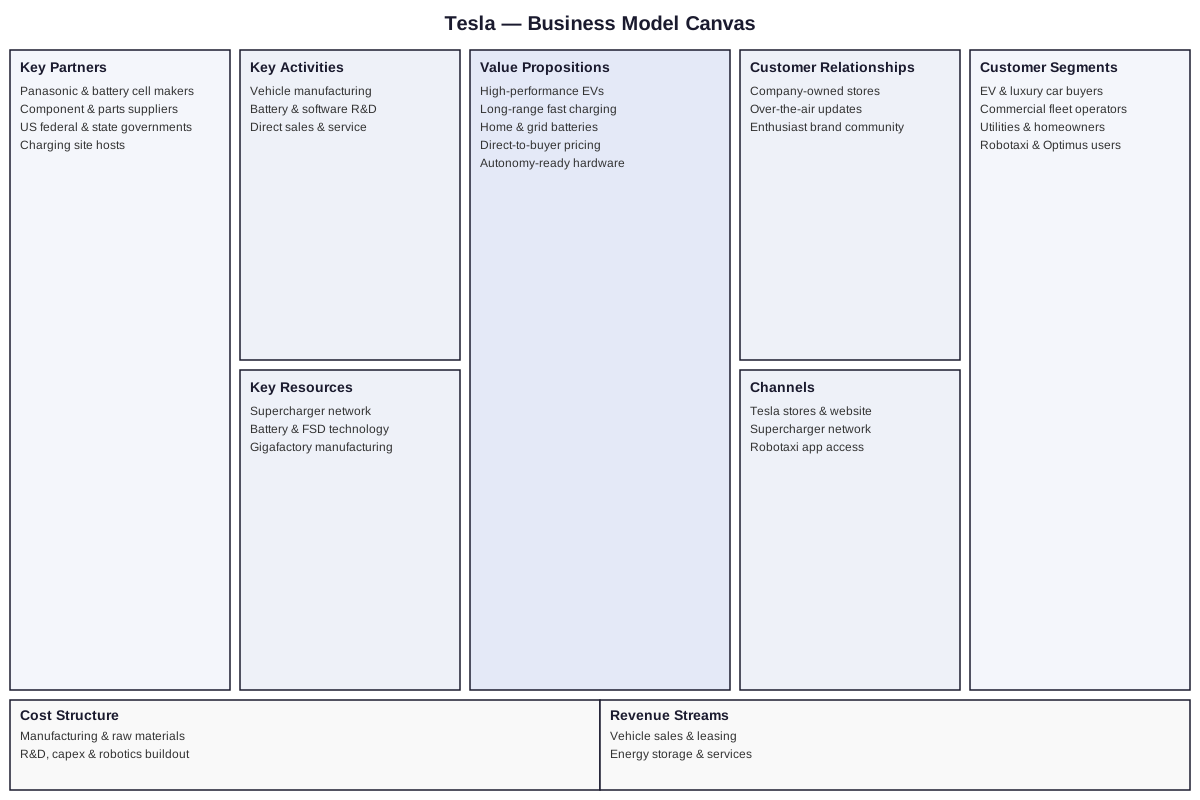
Tesla runs three businesses inside one balance sheet: an automaker that still supplies most of its revenue, an energy storage business growing faster than any other unit, and a services arm built around its own Supercharger network and software. In 2025, automotive revenue fell to $69.5 billion while energy generation and storage revenue climbed to $12.8 billion, a shift that shows where the company's momentum now sits. Tesla sells directly to buyers rather than through franchised dealers, a structural choice that shaped its stores, pricing and customer data from the start. The company's next bet reaches beyond vehicles entirely: a robotaxi fleet expanding across US cities and a humanoid robot, Optimus, built on the same autonomy software. Executives evaluating Tesla's model need to separate what funds the company today from what management is betting will fund it tomorrow
What is Tesla's core business model?
Tesla designs, manufactures and sells electric vehicles directly to consumers through its own stores and website, bypassing the franchised dealer networks that carry most other car brands. That direct relationship extends into charging, service and software, letting Tesla capture the full margin on a sale and control the customer experience from order to delivery. The same direct-sales structure now applies to a second business, selling solar panels and battery storage systems to homes, businesses and utilities.
How does Tesla make money beyond selling cars?
Vehicle sales still generate the largest share of revenue, but two other segments have grown quickly. Energy generation and storage, built around the Megapack battery system, brought in $12.8 billion in 2025, up 27% from the prior year. Services and other revenue, covering vehicle repairs, used car sales, insurance and Supercharger access for non-Tesla drivers, reached $12.5 billion. Regulatory credits sold to other automakers add a smaller, high-margin line that has shrunk as rivals build their own electric vehicle programs.
What is Tesla's bet on autonomy and robotics?
Tesla is running two parallel programs on one underlying software stack: a robotaxi service that expanded from Austin into new US cities through 2026, and Optimus, a humanoid robot entering mass production the same year. Both machines share Tesla's Full Self-Driving [FSD] computer vision system and chip architecture, so improvements to one program carry over to the other. Management has said robotaxi and robotics revenue will not become financially material until 2027 at the earliest, making this the highest-risk part of Tesla's model.
From a Roadster to a robotics platform
Martin Eberhard and Marc Tarpenning founded Tesla Motors in 2003, aiming to prove that an electric car could outperform a gasoline sports car rather than compromise on performance to save fuel. Elon Musk joined as chairman after leading a $7.5 million funding round in 2004 and took over as chief executive officer [CEO] in 2008, the same year Tesla shipped its first product, the Roadster. The Roadster sold as a low-volume, high-priced sports car, a deliberate choice Musk explained in a 2006 plan for the company:
build an expensive product first, then use the proceeds to fund a cheaper one, then a cheaper one again, until the company could produce a mass market electric car
Tesla dropped "Motors" from its name in 2017, a change that reflected a business that had already moved well past building cars into solar panels, home batteries and grid-scale storage.
A direct sales model built out of necessity
Tesla sells every vehicle through its own stores and website rather than through the independently owned dealerships nearly every other automaker relies on. That choice was not purely strategic. State franchise laws, passed across most states starting in the 1930s, restrict or ban manufacturers from selling directly to consumers, and Tesla spent years fighting those laws in states including Texas, Arizona and New York to keep its stores open1. Musk argued that a franchised dealer earning most of its profit from financing and gasoline-engine service work had little incentive to explain or sell an electric car properly, so Tesla built its own retail and service network instead. That same build-it-yourself instinct carried over to charging. Tesla constructed a proprietary Supercharger network rather than waiting for a shared industry standard to emerge, solving the range-anxiety problem that kept many buyers away from earlier electric cars, and the network became valuable enough that competitors eventually asked for access rather than building a rival network from scratch. Tesla opened Supercharger access to non-Tesla vehicles in 2021 and released its charging connector as the North American Charging Standard [NACS] in 2022, a standard Ford, General Motors and Rivian later adopted for their own vehicles.
Three revenue lines, one balance sheet
Tesla's 2025 results show a company in transition. Automotive revenue, which includes vehicle sales, leasing and paid software features, fell 10% to $69.5 billion as price competition intensified across the US, Europe and China. Energy generation and storage revenue climbed 27% to $12.8 billion, and services and other revenue, covering vehicle repair, used car sales, insurance and paid Supercharging for non-Tesla vehicles, reached $12.5 billion, up 19% from 2024, according to the company's annual filing with the Securities and Exchange Commission [SEC]2. Regulatory credits sold to other automakers that need to offset their own vehicle emissions add a smaller but high-margin line to the mix, one that has shrunk as competitors build out their own electric vehicle programs and need fewer purchased credits to meet emissions targets. Automotive revenue still supplies most of Tesla's total sales, but its declining share, alongside two segments growing at double-digit rates, shows where the company's momentum has shifted.
Who owns Tesla and what drives it
Musk has served as Tesla's chief executive since 2008 and remains its largest individual shareholder, though institutional managers such as Vanguard and BlackRock hold a larger combined stake through the index funds they run. Tesla's board has tied Musk's compensation to a series of valuation and operational milestones rather than a fixed salary, a structure that keeps his personal financial outcome linked directly to the company's stock price and long-term execution. That structure also means governance discussions at Tesla rarely separate the company's strategy from its CEO's other ventures in Artificial Intelligence, satellites and social media, since investors increasingly weigh all of them together when judging Tesla's prospects. The company states its purpose in one sentence that has stayed unchanged for years.
Accelerate the world's transition to sustainable energy
That mission covers vehicles, solar panels, home and grid batteries and now robotics, giving Tesla room to describe itself as an energy and technology company rather than strictly an automaker.
Megapack and the energy storage bet
Energy storage has become the fastest-growing part of Tesla's business, built around the Megapack, a grid-scale battery system sold to utilities and large energy developers, and the smaller Powerwall aimed at homes and small businesses. Tesla deployed 46.7 gigawatt-hours of storage products in 2025, a 48% increase from the prior year, with the fourth quarter alone setting a new quarterly deployment record3. Gross margin on the segment reached 28.7% in the fourth quarter, comfortably ahead of the margin Tesla earns on vehicles, which explains why the company keeps investing in additional manufacturing capacity for the product. Tesla's Shanghai Megafactory began production in February 2025 with 40 gigawatt-hours of annual capacity, and a second plant under construction in Houston is scheduled to open by the end of 2026 with a further 50 gigawatt-hours of annual output.
Betting the company on robotaxis
Tesla launched a paid robotaxi service in Austin in June 2025, running roughly ten Model Y vehicles with a safety monitor seated in the passenger seat rather than a driver behind the wheel. The company began testing driverless rides without any safety monitor in December 2025, first with employees and then with paying members of the public the following month. Musk told investors on the January 2026 earnings call that the combined Austin and Bay Area fleet had grown to well over 500 vehicles, expanding at a pace he described as roughly doubling every month, and the company outlined plans to launch service in seven additional US cities, including Dallas, Houston, Phoenix, Miami, Orlando, Tampa and Las Vegas, during the first half of 20264. The service still depends on Tesla's Full Self-Driving [FSD] software clearing regulatory approval city by city, and Musk told investors that robotaxi revenue is unlikely to become financially material until 2027.
Optimus and the pivot to a robotics platform
Alongside the robotaxi rollout, Tesla began mass production of Optimus, a bipedal humanoid robot, in January 2026, targeting a price between $20,000 and $30,000 per unit. The robot runs on the same computer vision architecture and chip design Tesla built for FSD, so engineering progress on one program carries over to the other. Tesla's 2026 capital budget, which the company's finance chief put at more than $25 billion, funds a new Optimus production line inside the Fremont factory, a second Optimus plant at Gigafactory Texas, continued robotaxi expansion and a dedicated semiconductor research facility. Tesla is pitching Optimus and the robotaxi as one connected bet rather than two separate products, since both machines depend on the same reliable, low-cost autonomy software to reach commercial scale.
Competitive pressure and structural risk
Tesla's vehicle business faces sharper competition than at any point in its history. Chinese manufacturers led by BYD undercut Tesla on price while matching or exceeding it on range and features in China, the world's largest electric vehicle market, and legacy automakers such as Ford and General Motors have used decades of manufacturing experience to close the technology gap in North America and Europe. Tesla's own tone on its newest bets has grown noticeably more cautious:
executives who once promised near-term robotaxi profitability now describe 2026 as a buildout period and point to 2027 as the year autonomy and robotics revenue turns material5
yahoo.com/technology/articles/teslas-once-bullish-tone-robotaxis-093600168.html). No US regulator has approved fully driverless commercial operation at national scale, and a serious accident involving Tesla's robotaxi fleet could delay approvals across every city on its expansion list. Executives and board members assessing Tesla's model need to hold two facts at once, a vehicle and energy business that already generates close to $95 billion a year, and a robotics bet that could reshape the company or consume capital for years before it pays off.
Tesla's business model rests on a sequence Musk first outlined in 2006: sell an expensive product to fund a cheaper one, then use the cash from vehicles to build the infrastructure and software that vehicles alone could not justify. That sequence produced the Supercharger network, a direct sales channel free of dealer margins and now an energy storage division growing faster than the car business itself. The newest phase asks investors to wait longer for returns: a robotaxi fleet still confined to a handful of cities and a humanoid robot entering production without a proven market. Automotive revenue funds these bets today, but Tesla's own executives have said meaningful robotaxi and robotics revenue will not arrive before 2027. Board members judging the company should weigh a proven vehicle and energy business against a robotics platform that remains, for now, unproven at scale
Citation
Cite this article
Sridharan, M. A. (2023, November 15). Tesla's Business Model. Think Insights. https://thinkinsights.net/strategy/teslas-business-model (Accessed [[ACCESS_DATE]])
Sridharan, Mithun A. "Tesla's Business Model." Think Insights, 15 Nov. 2023, https://thinkinsights.net/strategy/teslas-business-model. Accessed [[ACCESS_DATE]].
Mithun A. Sridharan, "Tesla's Business Model," Think Insights, November 15, 2023, https://thinkinsights.net/strategy/teslas-business-model. Accessed [[ACCESS_DATE]].
Sridharan, M.A. (2023) 'Tesla's Business Model', Think Insights. Available at: https://thinkinsights.net/strategy/teslas-business-model (Accessed: [[ACCESS_DATE]]).
M. A. Sridharan, "Tesla's Business Model," Think Insights, 2023. [Online]. Available: https://thinkinsights.net/strategy/teslas-business-model. [Accessed: [[ACCESS_DATE]]].
Sridharan MA. Tesla's Business Model. Think Insights. Published November 15, 2023. Accessed [[ACCESS_DATE]]. https://thinkinsights.net/strategy/teslas-business-model
Test Your Knowledge
Tesla's Business Model
Challenge yourself on the concepts from this article and see how well you understood them.
Subscribers get weekly quizzes and insights — subscribe free
Sponsor this article
Partner with Think Insights
Reach 50,000+ business leaders, consultants, and strategists. Feature your brand alongside expert articles on strategy, leadership, and digital transformation.
Become a Sponsor