TELUS's Diversified Technology Model


TELUS operates one of Canada's largest telecommunications networks, generating roughly $20.5 billion in revenue on 21.2 million subscriber connections in 2025. Wireless plans and home internet remain the foundation, built on owned fiber and 5G infrastructure that gives TELUS control over pricing and service quality. Rather than depending solely on connectivity, TELUS has pushed into healthcare, agriculture and enterprise technology, applying the same subscription logic to new markets. TELUS Health now covers more than 161 million lives worldwide through employer wellbeing programs, virtual care and payor systems. TELUS Agriculture & Consumer Goods extends data and software tools across food supply chains. In 2025, TELUS completed the privatization of TELUS Digital, folding its customer experience and Artificial Intelligence unit back into the parent company to sharpen its enterprise AI push.
How does TELUS generate most of its revenue?
Wireless subscriptions and device financing produce the largest share of TELUS's revenue, followed by home internet, television and security bundles. Health, agriculture and enterprise contracts add smaller but fast-growing recurring revenue outside traditional telecom.
Why did TELUS expand into healthcare and agriculture?
TELUS applies its network, data and software expertise to industries with long-term contracts and limited price competition. Both sectors let TELUS grow revenue without depending entirely on a mature, heavily contested domestic telecom market.
What was the purpose of taking TELUS Digital private again?
TELUS completed the privatization of TELUS Digital in October 2025 to integrate its customer experience and Artificial Intelligence capabilities more closely with the rest of the business. Full ownership lets TELUS apply AI tools built for external clients across its own wireless, health and enterprise operations.
A Network Built Through Consolidation
TELUS traces its origin to the 1990 privatization of Alberta Government Telephones [AGT], the provincial carrier that had served Alberta since the early 1900s. The newly independent company acquired Edmonton Telephones Corporation (Ed Tel) in 1995, then merged with BC Telecom in 1999 to create the national carrier known today as TELUS Corporation.1 That merger moved headquarters from Edmonton to Vancouver and gave TELUS the scale to compete against Bell Canada and Rogers Communications on a national footing. The pattern set in that period, acquiring capability and building a national network around it, still shapes TELUS's growth into healthcare, agriculture and digital services today.
Wireless Subscriptions Anchor the Business
Wireless remains TELUS's largest revenue source, built on monthly plans, data tiers and device financing sold to millions of Canadians. Device financing lets customers pay for smartphones over time, which raises average revenue per user [ARPU] and ties customers to multiyear contracts. TELUS closed 2025 with 21.2 million total subscriber connections and postpaid mobile phone churn of 0.97 percent, its twelfth straight year below the 1 percent mark.
Darren Entwistle, TELUS's president and chief executive officer, described the quarter this way:
TELUS delivered strong, quality customer growth and robust financial performance, powered by our team's relentless focus on operational excellence2
That retention record matters because wireless customers who stay for years generate far more lifetime value than one-time equipment sales.
Fiber and Bundling Deepen Household Ties
Home internet and television round out TELUS's consumer business, delivered through both legacy copper and an expanding fiber network branded PureFibre. Fiber connections offer faster speeds and lower latency than cable, letting TELUS charge a premium in urban markets such as Vancouver, Calgary and Edmonton. TELUS has committed to investing more than $66 billion in Canadian network infrastructure and Artificial Intelligence capacity through 2030, extending PureFibre reach into smaller communities where cable competition is thinner.3 Bundling internet, television and mobile into one discounted package remains the main lever for lifting household lifetime value and cutting churn.
Health Becomes a Global Growth Platform
TELUS Health has grown from a domestic electronic health records business into a global workforce health and wellbeing provider. The May 2025 acquisition of Workplace Options added a network of more than 180,000 providers across more than 200 countries and territories, extending TELUS Health well beyond Canada.4 TELUS reported more than 161 million lives covered worldwide by the end of 2025, through employee assistance programs, virtual care and payor and provider solutions.
Darren Entwistle framed the segment's momentum directly:
TELUS Health delivered another strong quarter of growth, achieving revenue and Adjusted EBITDA growth of 13 per cent and 10 per cent, respectively, fueled by strategic investments, continuous product innovation and disciplined execution across our global platforms
Agriculture Extends the Data Playbook
TELUS Agriculture & Consumer Goods applies the same data and software model to food production, supply chains and consumer goods manufacturers worldwide. The unit sells traceability, forecasting and farm management software rather than physical infrastructure, so it carries a different cost profile than the wireless or fiber businesses. Growth here has been uneven. TELUS disclosed lower agriculture and consumer goods revenue in the fourth quarter of 2025, attributing the decline to the divestiture of non-core assets as the company narrows its focus within the segment.5 The unit still reduces TELUS's dependence on a mature domestic telecom market by monetizing analytics expertise abroad.
Enterprise Contracts and TELUS Digital Add Depth
TELUS sells connectivity, cybersecurity, cloud and Internet of Things [IoT] solutions to businesses and government agencies, contracts that tend to run for multiple years and carry high switching costs. In October 2025, TELUS completed the privatization of TELUS Digital, its customer experience and business process outsourcing unit formerly known as TELUS International, bringing full ownership back in-house.6 TELUS Digital generated $2,658 million in revenue in 2024 and management now plans to use the unit's AI tools across TELUS's own wireless, health and enterprise operations rather than selling them only to outside clients. That integration is expected to generate roughly $800 million in AI-enabled revenue in 2025, with a target near $2 billion by 2028.
Competition Keeps Pricing Power in Check
TELUS competes against Bell Canada and Rogers Communications nationally, alongside Shaw's former assets, now absorbed into Rogers and a mix of smaller regional internet service providers in Western Canada. Smaller providers typically compete on price, while TELUS positions itself on network quality, bundled offerings and customer service, a stance that supports higher average revenue but leaves it exposed in price-sensitive segments. Regulatory decisions on wholesale network access and spectrum allocation also shape how much pricing flexibility TELUS retains in any given market.
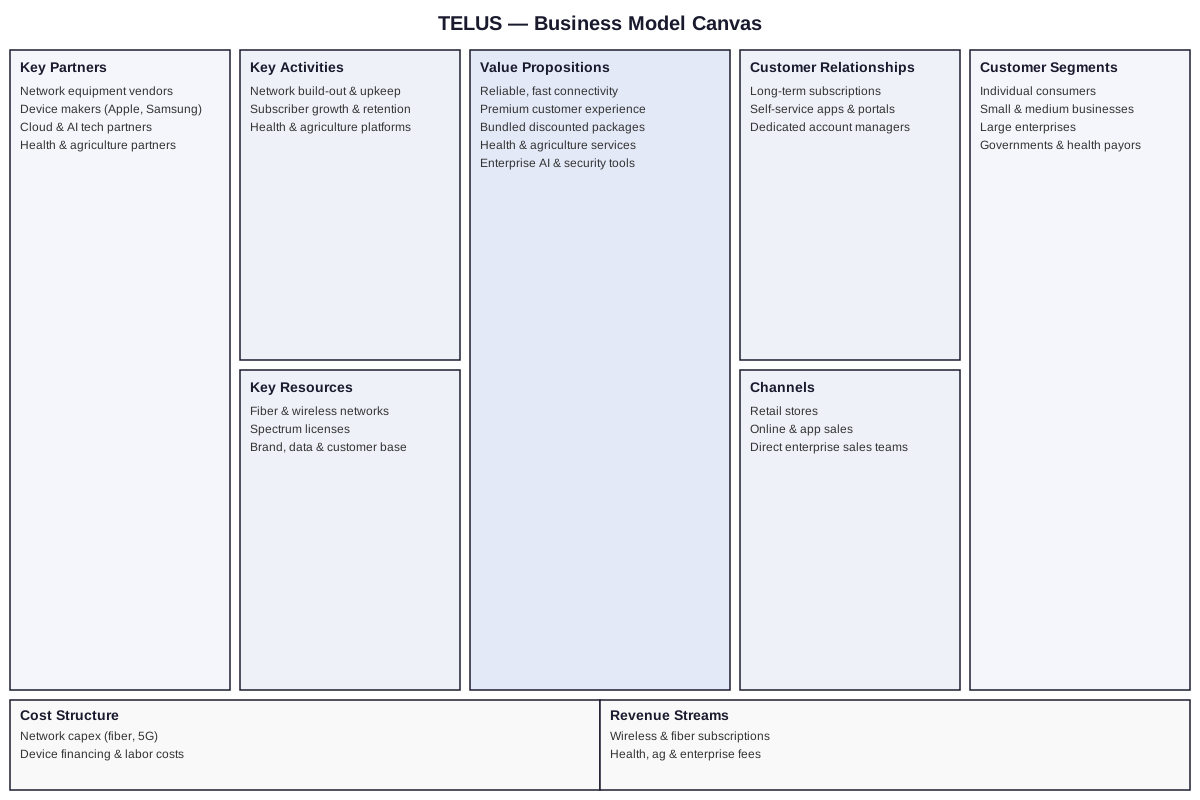
Key Partners
TELUS depends on network equipment makers, device manufacturers such as Apple and Samsung and cloud and Artificial Intelligence vendors to build and run its platforms. Health system partners, clinics and employer benefits providers extend TELUS Health's reach, while agriculture technology and food supply chain partners support TELUS Agriculture & Consumer Goods. Regulators, including Innovation, Science and Economic Development Canada, control the spectrum licenses TELUS needs to operate.
Key Activities
TELUS's central activity is building and maintaining fiber and wireless networks, including ongoing 5G and PureFibre expansion. Acquiring and retaining subscribers through bundling, promotions and device financing keeps the core telecom business growing. Operating TELUS Health's clinical and payor platforms and TELUS Agriculture's software tools extends these same network and data skills into new industries.
Key Resources
TELUS's most valuable resources are its owned fiber and wireless infrastructure and the spectrum licenses that let it operate nationally. Its brand, customer base and years of subscriber data support pricing, retention and cross-selling across telecom, health and agriculture units. Technology platforms built for health records, virtual care and farm management add resources that go beyond traditional network assets.
Value Propositions
TELUS positions itself on reliable, fast connectivity rather than the lowest price, backed by its fiber and 5G network investment. Bundled internet, television and mobile packages add convenience and discounts that raise switching costs for households. Beyond telecom, TELUS offers health systems and employers digital health and wellbeing services and offers agriculture and consumer goods businesses data tools that improve supply chain visibility.
Customer Relationships
Most consumer relationships run on long-term subscription contracts supported by self-service apps and online account portals. Enterprise, government and health clients typically work with dedicated account managers who negotiate multiyear contracts. Community programs such as the annual TELUS Day of Giving reinforce brand loyalty among consumer subscribers.
Channels
TELUS reaches consumers through retail stores, its website and mobile apps, alongside authorized dealers in smaller markets. Enterprise and government clients are served by a direct sales force that negotiates custom contracts. TELUS Health and TELUS Agriculture & Consumer Goods sell directly to employers, payors and agribusiness clients through dedicated business-to-business teams.
Customer Segments
TELUS serves individual consumers, small and medium businesses, large enterprises and government organizations across Canada. Its health unit adds employers, insurers and healthcare providers worldwide as customers for virtual care and benefits administration. Agriculture and consumer goods clients range from farms to global food and beverage manufacturers.
Cost Structure
Network capital expenditure, including fiber builds, 5G equipment and spectrum, represents TELUS's largest recurring cost. Device financing, subsidies and customer acquisition costs add further expense to the consumer wireless and internet business. Labor, technology licensing and integration costs from health and agriculture acquisitions round out the cost base.
Revenue Streams
Monthly wireless, internet, television and security subscriptions generate the bulk of TELUS's revenue. Enterprise and government contracts for connectivity, cybersecurity and cloud services add stable, high-value revenue. Health services fees from payors, providers and employers, along with agriculture software licensing and TELUS Digital's external client fees, complete the revenue mix.
- 1TELUS Formed Through Its 1999 Merger With BC Telecom
- 2TELUS Reports Fourth-Quarter And Full-Year 2025 Results
- 3TELUS Outlines Its $66 Billion Canadian Investment Plan
- 4TELUS Health Acquires Workplace Options
- 5TELUS Discloses Fourth-Quarter 2025 Segment Results
- 6TELUS Digital Reports Full-Year 2024 Results
TELUS's business model rests on a simple idea: own the network, then layer recurring revenue on top of it. Wireless and fiber connections still generate the bulk of cash flow, protected by high switching costs and steady subscriber additions. Diversification into health, agriculture and enterprise technology reduces reliance on a mature domestic telecom market and gives TELUS access to growth outside Canada. Bringing TELUS Digital back under full ownership signals a bet that Artificial Intelligence and data services, not just connectivity, will drive the next phase of growth. Execution now depends on managing debt taken on during this expansion while competitors in wireless and cable keep pressuring pricing in Canada's largest markets.
Citation
Cite this article
Sridharan, M. A. (2021, May 13). TELUS's Diversified Technology Model. Think Insights. https://thinkinsights.net/strategy/teluss-diversified-technology-model (Accessed [[ACCESS_DATE]])
Sridharan, Mithun A. "TELUS's Diversified Technology Model." Think Insights, 13 May 2021, https://thinkinsights.net/strategy/teluss-diversified-technology-model. Accessed [[ACCESS_DATE]].
Mithun A. Sridharan, "TELUS's Diversified Technology Model," Think Insights, May 13, 2021, https://thinkinsights.net/strategy/teluss-diversified-technology-model. Accessed [[ACCESS_DATE]].
Sridharan, M.A. (2021) 'TELUS's Diversified Technology Model', Think Insights. Available at: https://thinkinsights.net/strategy/teluss-diversified-technology-model (Accessed: [[ACCESS_DATE]]).
M. A. Sridharan, "TELUS's Diversified Technology Model," Think Insights, 2021. [Online]. Available: https://thinkinsights.net/strategy/teluss-diversified-technology-model. [Accessed: [[ACCESS_DATE]]].
Sridharan MA. TELUS's Diversified Technology Model. Think Insights. Published May 13, 2021. Accessed [[ACCESS_DATE]]. https://thinkinsights.net/strategy/teluss-diversified-technology-model
Test Your Knowledge
TELUS's Diversified Technology Model
Challenge yourself on the concepts from this article and see how well you understood them.
Subscribers get weekly quizzes and insights — subscribe free
Sponsor this article
Partner with Think Insights
Reach 50,000+ business leaders, consultants, and strategists. Feature your brand alongside expert articles on strategy, leadership, and digital transformation.
Become a Sponsor