Strategy House


If you want a strategy that people follow instead of a slide they forget, you need a decision filter that fits on one page. Start by defining a sharp roof, a few must-win battles, focused initiatives, and the enablers and culture that make execution possible, then use that house in every planning conversation.
How is a Strategy House different from strategy slides?
A Strategy House compresses strategic logic into one page that leaders can use as a decision filter. It links vision, must-win battles, initiatives, enablers, and culture so every choice traces back to a clear intent.
When should organizations build a Strategy House?
Build a Strategy House when you need to translate analytical work into a concise, actionable story that guides investment, prioritization, and cross-functional focus over several years, not just through one planning cycle.
Who should participate in building the Strategy House?
Senior leaders must sponsor the process, but cross-functional teams should co-create the house so the pillars, initiatives, and enablers reflect real constraints, shared ownership, and how work is done on the ground.
Why Strategy Needs A House
Most organizations do not suffer from a lack of strategic ideas; they suffer from an excess of unfiltered initiatives that never add up to a coherent direction. Leaders ask for a strategy and receive a deck full of analysis, slogans, and project lists that feel impressive in the room but quickly lose relevance once daily execution resumes. Teams leave workshops with different interpretations of what matters, and the next budgeting cycle quietly dilutes every bold choice.
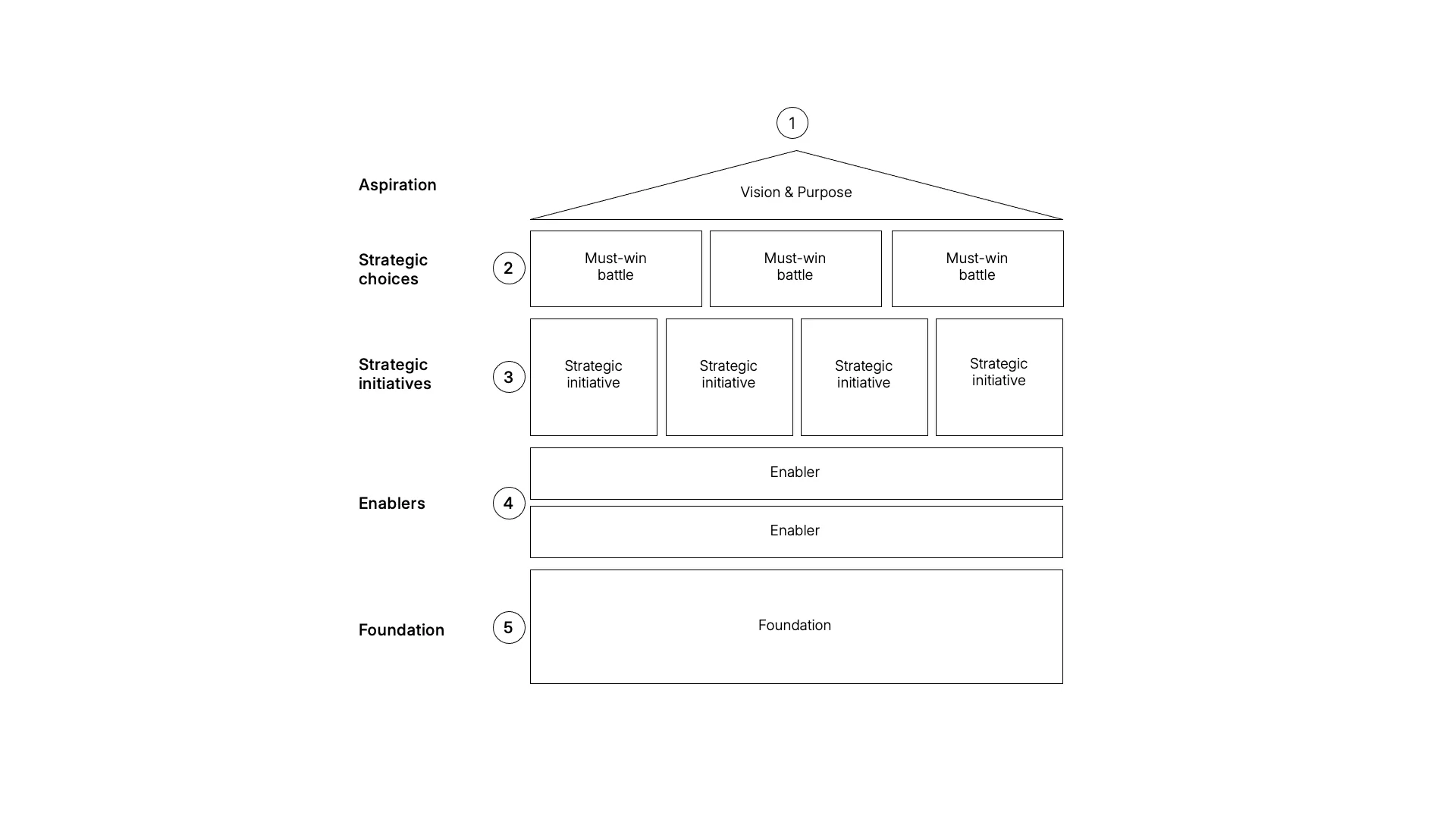
The Strategy House exists to close this gap between intent and execution. It reduces the strategy to one page that forces explicit tradeoffs and connects decisions from the boardroom to frontline teams. The framework looks simple, yet its power lies in the discipline it imposes:
every new idea must strengthen the roof, reinforce one of a few pillars, or support an existing initiative
Anything else becomes a conscious "not yet" or "not us", rather than a default addition to the backlog.
When used consistently, the Strategy House becomes part of how leaders speak, not just how they present. It gives executives a shared language to test proposals, track progress, and update direction when assumptions change, without rebuilding the entire planning process each quarter.
The Five Components Of A Strategy House
A Strategy House resembles an actual building for a reason. Each component supports the others, and weakness in any layer eventually compromises the whole structure. The framework typically includes five elements:
the roof, the pillars, the initiatives under each pillar, the enablers, and the foundation of culture and ways of working
The roof articulates the organization’s purpose and long-term ambition in precise terms. It answers why the business exists, which problem it aims to solve, and what success looks like over a defined time frame. Vague aspirations such as "be the best" or "grow profitably" do not qualify; a strong roof must be measurable enough that people can tell whether they are closing the gap.
Beneath the roof, a small number of pillars represent the must-win battles. These pillars are not departments; they are cross-functional outcomes the organization must achieve to realize its ambition, such as winning a specific customer segment or leading on a particular capability. Under each pillar, a concentrated set of strategic initiatives describe what the organization will actually do. Enablers sit underneath these initiatives, covering the technology, capabilities, funding, and governance required to execute. At the base, the foundation describes cultural norms, leadership behaviors, and structural choices that sustain the entire house over time.
Designing A Roof That Guides Real Choices
The roof of the Strategy House is more than a vision statement; it is a directional contract with the organization. Good roofs specify a time horizon, a financial or impact ambition, and a clear scope. For example, "Achieve a top three market position in European sustainable packaging by 2028 with 15 percent EBIT (earnings before interest and taxes)" tells teams where to compete, by when, and at what level of performance. Ambitions at this level help leaders decide which markets to exit, not merely which ones to enter.
A precise roof also anchors external communication and investor expectations. When board members, shareholders, and employees hear the same articulation of the destination, they can challenge whether the rest of the house lines up with that target. Public companies often express this ambition through medium-term guidance and long-term strategic narratives in their investor materials, which then cascade into internal Strategy Houses.1
To test the quality of a roof, ask three questions:
- can people repeat it in their own words
- can you say whether a proposed initiative helps or hurts the ambition, and
- would you be comfortable committing publicly to this destination
If the answer is no to any of these, the roof needs sharpening before you touch the rest of the house.
Choosing Must‑Win Battles As Pillars
Once the roof is clear, the question becomes where the organization must win to make that ambition credible. Pillars translate the destination into three to five must-win battles that cut across functions. These might include choices such as
Win in mid-market manufacturing Lead in digital service experience, or Double share in priority growth countries
Each pillar should be important enough that failing on it would put the roof at risk.
Pillars are not a place to restate the organization chart. When companies label pillars as "Sales", "Operations", and "Research and Development", they usually end up with a departmental wish list rather than a strategy. Instead, pillars should describe outcomes that require collaboration between those units, forcing leaders to confront tradeoffs about where scarce talent and capital will go.2
A practical way to define pillars is to start from the outside in. Use tools such as industry structure analysis, market attractiveness matrices, and customer research to understand where the business can create distinctive value. Then convert those choices into three to five crisp, outcome-oriented pillars. Each pillar should pass a simple test:
if it were removed, would the rest of the house still make sense, or would the strategic story fundamentally weaken.
Translating Pillars Into Strategic Initiatives
Pillars without initiatives are aspirations; initiatives without pillars are noise. The Strategy House forces you to connect every major initiative to a specific pillar and explain its role in achieving the roof. Under each must-win battle, you list a small number of strategic initiatives that describe what the organization will actually build, change, or scale over the next several years.
Strategic initiatives must be concrete enough that teams can plan and measure them. Instead of "Improve customer experience", a better initiative might be "Launch a digital self-service portal that resolves 80 percent of service requests within 24 hours." Such specificity allows teams to design roadmaps, set milestones, and monitor progress transparently. It also makes it easier to say no to adjacent ideas that do not materially move the metrics you care about.3
Constraint is essential here. If a pillar has twenty initiatives with no visible prioritization, the Strategy House has turned into a project catalog. A practical rule of thumb is that executives should be able to explain why each initiative is in the house and what would happen if it were removed. If they cannot, the portfolio needs trimming before the Strategy House is ready to guide execution.
Identifying Enablers That Make Execution Possible
Beneath the initiatives, the Strategy House includes a layer of enablers. These are not projects, but capabilities, systems, and resources without which the initiatives will stall. Typical enablers include modern technology platforms, data and analytics capabilities, funding commitments, cross-functional governance structures, and critical partnerships. This layer matters because many strategies fail not from flawed logic, but from unaddressed capability gaps.
An honest enabler discussion often surfaces uncomfortable truths. A company may discover that its core systems cannot support the envisioned digital experience, or that its talent pipeline does not include enough experienced product managers to deliver the roadmap. Writing these gaps into the house does not solve them, but it prevents leaders from pretending they do not exist. It also prompts explicit decisions about where to invest in capability-building and where to sequence initiatives later.
Enablers should be specific and testable. "Improve data capabilities" is vague, whereas "Implement an integrated enterprise resource planning platform across all plants by 2026" provides a clear basis for planning and tracking. Over time, the enabler layer becomes a record of the structural improvements the organization must make to keep executing at a higher level.4
Building A Foundation Of Culture And Ways Of Working
At the base of the Strategy House sits the foundation: culture, leadership behaviors, organizational structure, and critical processes. Without a solid foundation, the roof, pillars, and initiatives remain fragile no matter how elegant the logic appears. This is where you articulate the mindsets and routines that will sustain execution, such as data-driven decision-making, disciplined prioritization, and a bias for cross-functional collaboration.
Being concrete about culture is important. Statements such as "We value innovation" carry little meaning unless tied to observable behaviors. A Strategy House foundation might instead specify that teams will run structured experiments with clear hypotheses, allocate a defined portion of budget to test new ideas, and hold monthly learning reviews where leaders examine failed experiments without blame. These behavioral commitments turn cultural aspirations into something teams can practice.
The foundation also includes structural choices such as how product teams are formed, which decisions remain centralized, and how performance is measured. Aligning these elements with the pillars and initiatives prevents the common pattern where the formal organization pulls against the strategy. Over time, a strong foundation makes it easier to update the house as conditions change, because the organization has robust routines for learning and adaptation.5
A Worked Example: GreenTech Manufacturing
Consider a mid-sized industrial company, which we will call GreenTech Manufacturing, that aims to become a leader in sustainable packaging. Its leadership team has already analyzed market trends, regulatory pressure, and competitive dynamics, and now needs a concise way to align the organization around a clear direction. They decide to build a Strategy House that can be used in board discussions, town halls, and quarterly reviews.
The roof states: "Achieve top three share in European sustainable packaging by 2028, with EUR 200 million revenue and 15 percent EBIT margin". From there, the team defines three pillars: "Win in food and beverage packaging", "Build operational scale with low-cost production", and "Lead on sustainability credentials". Under each pillar, they specify initiatives such as launching a molded fiber product line for dairy applications, commissioning new production lines in cost-competitive locations, reducing unit costs through targeted automation, obtaining relevant eco-certifications, and publishing annual life cycle assessments.
Enablers include a committed capital expenditure program, integration of enterprise systems across all plants, and a partnership with a materials science institute to accelerate innovation. The foundation spells out the need to hire critical operations leaders, shift from project-based to process excellence as the dominant mindset, and implement a stage-gate model for new product development. Once captured visually, this house becomes the reference point for budget decisions, customer segment focus, and hiring priorities.
Using The Strategy House As A Decision Filter
The true value of a Strategy House emerges after it has been built. If it remains a slide in a strategy deck, it will not change behavior. Leaders must instead use the house as a decision filter in routine management processes. For every new proposal, they can ask three questions: does this strengthen one of our pillars; does it advance a specific initiative; and do we have the enablers in place to execute it now. If the answer is yes to all three, the proposal merits serious consideration.
When the answer is mixed, the house still helps. An initiative that supports a pillar but lacks enablers can be placed in a "later" bucket, contingent on capability-building. Ideas that do not reinforce any pillar may indicate either that the market has shifted and the house needs updating, or that the organization is drifting away from its stated strategy. Over time, these conversations reduce the number of ad-hoc projects that compete for attention and crowd out the core agenda.6
Using the house in this way also changes how leaders say no. Instead of rejecting ideas with vague reasoning, they can point to the pillars and initiatives and explain why a proposal does not fit. This transparency increases trust and reinforces the Strategy House as a shared frame of reference rather than a tool owned by the strategy team alone.
Integrating The Strategy House With Other Frameworks
The Strategy House does not replace analytical tools; it synthesizes their output into an actionable narrative. Industry structure analysis, market attractiveness matrices, growth-share frameworks, and customer research all inform the choices that ultimately shape the roof and pillars. The house sits at the end of this analytical chain, translating insights into visible commitments rather than detailed analysis slides.
For example, leaders might use industry analysis to understand structural profitability, a win-growth or portfolio matrix to decide where to invest, and customer research to identify differentiating value propositions. They then consolidate these findings into a handful of must-win battles and supporting initiatives. In this sense, the Strategy House acts as a bridge between strategy formulation and execution, making it easier for people beyond the strategy team to understand the logic and their role in delivering it.7
Consulting firms often rely on the Strategy House when summarizing recommendations to boards and executive teams because it forces clarity. It compels them to explain not only what they suggest doing, but also what they suggest not doing. Internal teams can adopt the same discipline, using the house to coordinate with finance, human resources, technology, and frontline operations.
Common Pitfalls When Building A Strategy House
Several recurring mistakes dilute the impact of a Strategy House. The first is using organizational units as pillars, which produces a house that mirrors the existing structure rather than describing strategic outcomes. When this happens, each function tends to fill its pillar with its own projects, and the house becomes a budget request template instead of a strategy. The remedy is to rewrite pillars as cross-functional outcomes tied to the roof.
A second pitfall is confusing tactics with strategy and overloading pillars with too many initiatives. This results in a dense grid of projects that no one can remember or prioritize. Leaders should instead apply ruthless focus, limiting initiatives to those that create visible movement against the ambition. Regular reviews can then add or retire initiatives based on learning, but the house itself stays comprehensible.
A third mistake is neglecting the enabler and foundation layers. Teams may devote most of their time to refining the vision and initiatives, leaving enablers and culture implied rather than explicit. In practice, this is where many strategies fail, because execution stalls on missing capabilities, misaligned incentives, or incompatible processes.8 Making these layers explicit does not guarantee success, but it forces leaders to confront the real work required to make the strategy durable.
Making The Strategy House A Living Document
A Strategy House should evolve as the business learns and the environment shifts. Reviewing the house at least quarterly ensures that pillars remain relevant, initiatives reflect current priorities, and enablers track actual progress. Some organizations tie these reviews to their operating rhythm, placing the house at the center of quarterly business reviews and annual planning cycles.
When external shocks occur or major assumptions break, the house provides a stable reference to update rather than a plan to discard. Leaders can decide whether the roof needs adjusting, whether a new must-win battle has emerged, or whether certain initiatives should be paused. Because the house is concise, these updates can happen faster than rebuilding a full strategic plan from scratch, while still preserving a coherent story.
Over time, organizations that treat the Strategy House as a living document see it shift from a consulting artifact to part of their internal language. Teams refer to pillars in everyday meetings, project charters reference specific initiatives, and capability-building programs link to enablers. At that point, the Strategy House has fulfilled its purpose: turning strategy into a shared operating system rather than a one-time event.
A Strategy House turns analysis into an operating system. When leaders use it as a decision filter, the organization moves from scattered projects to disciplined progress, and strategy becomes a visible, shared commitment instead of a static presentation.
Citation
Cite this article
Sridharan, M. A. (2026, July 6). Strategy House. Think Insights. https://thinkinsights.net/strategy/strategy-house (Accessed [[ACCESS_DATE]])
Sridharan, Mithun A. "Strategy House." Think Insights, 6 July 2026, https://thinkinsights.net/strategy/strategy-house. Accessed [[ACCESS_DATE]].
Mithun A. Sridharan, "Strategy House," Think Insights, July 6, 2026, https://thinkinsights.net/strategy/strategy-house. Accessed [[ACCESS_DATE]].
Sridharan, M.A. (2026) 'Strategy House', Think Insights. Available at: https://thinkinsights.net/strategy/strategy-house (Accessed: [[ACCESS_DATE]]).
M. A. Sridharan, "Strategy House," Think Insights, 2026. [Online]. Available: https://thinkinsights.net/strategy/strategy-house. [Accessed: [[ACCESS_DATE]]].
Sridharan MA. Strategy House. Think Insights. Published July 6, 2026. Accessed [[ACCESS_DATE]]. https://thinkinsights.net/strategy/strategy-house
Test Your Knowledge
Strategy House
Challenge yourself on the concepts from this article and see how well you understood them.
Subscribers get weekly quizzes and insights — subscribe free
Sponsor this article
Partner with Think Insights
Reach 50,000+ business leaders, consultants, and strategists. Feature your brand alongside expert articles on strategy, leadership, and digital transformation.
Become a Sponsor