The Rise of Marketplace Commerce


Marketplaces now account for most global online retail sales and that shift changes how sellers compete for growth. A standalone store must build its own audience, trust and infrastructure; a marketplace seller plugs into demand, payments and logistics that already exist. This shift matters for the economics of scaling, not just convenience. Commission-based revenue converts fixed marketing costs into variable costs tied to performance, improving cash flow for sellers and giving platform operators predictable revenue as transaction volume grows. As sellers expand across several marketplaces, a new aggregation layer of unified inventory, pricing and fulfillment tools has emerged to manage that complexity. Mercado Libre, Latin America's largest online marketplace, shows how commerce, payments, credit and logistics combine into one integrated model built for durability rather than short-term traffic gains.
What is a marketplace-centric business model
A marketplace-centric business model connects buyers and sellers on a shared platform rather than building and selling a single company's own inventory. The platform earns revenue through commissions, fees or subscriptions rather than product margin alone. Sellers gain access to existing demand, while the platform gains a cut of every transaction it facilitates.
Why do marketplaces lower customer acquisition costs
Marketplaces already carry a base of buyers actively searching for products, so sellers do not have to pay to create that demand from scratch. Instead of funding ads before knowing if a product works, sellers list into existing traffic and refine based on real behavior. That shifts spending from an upfront, uncertain cost to a variable one tied to actual sales.
What is the aggregation layer in e-commerce
The aggregation layer refers to software and in some cases ownership structures, that unify inventory, pricing and order management across multiple marketplaces. It lets a seller update stock once and have it sync everywhere a product is listed, preventing overselling and cancellations. Some investors have taken this further, acquiring multiple marketplace sellers outright and running them under one shared operating structure.
From Storefronts to Ecosystems
The first generation of e-commerce asked merchants to build everything themselves: a site, a supplier base and enough paid traffic to convert browsers into buyers. That approach worked when digital advertising was cheap and competition was thin. Costs have since risen and attention has become harder to buy at a reasonable price. Marketplaces solved that problem by concentrating buyer demand in one place, so sellers plug into an audience that already exists rather than build one from nothing. The model now accounts for the majority of global online retail spending, a scale shift that makes it the default structure for digital commerce rather than an alternative to it.1
The Economics of Marketplace Participation
Running a standalone store means paying for demand before knowing whether a product will sell. Marketplace sellers flip that order: they list into existing search traffic, test pricing and messaging and pay a commission only after a sale closes. That commission is a variable cost, calculated as a share of transaction value rather than a fixed marketing budget paid upfront.2 The arrangement improves cash flow for merchants and gives platform operators predictable revenue tied to transaction volume rather than ad spend. Shared infrastructure, including payments, fraud screening and dispute handling, adds further value that merchants would otherwise have to build on their own.
The Aggregation Layer
As sellers succeed on one marketplace, many expand to several at once and coordinating inventory, pricing and order flow across separate dashboards becomes its own operational risk. Stock counts fall out of sync, listings go stale and a single stocking error can trigger cancellations that damage seller ratings. A software layer emerged to solve this: unified systems that sync pricing, inventory and fulfillment across every platform a seller uses, updating stock everywhere the moment an item sells anywhere. Investors have backed this shift heavily, funding companies that acquire and consolidate marketplace sellers under one operating system built for exactly this kind of coordination.3
Network Effects and Competitive Leverage
Marketplaces do not just distribute demand, they compound it. Each new buyer makes the platform more attractive to sellers and each new seller expands the selection that draws in more buyers, a dynamic researchers call a two-sided network effect.4 That reinforcing loop is why later entrants struggle to unseat an established marketplace even with a better interface or lower fees. For sellers, the same effect creates real testing leverage: a product can be listed, priced and adjusted against real buyer behavior within days rather than the months required to build traffic to an independent site. Once a seller masters listing optimization and fulfillment on one marketplace, the same playbook transfers to the next platform at a fraction of the original effort.
Managing Platform Dependency
Relying entirely on one platform's rules carries risk. A marketplace can change its search algorithm, raise fees or shift ranking signals and a seller with no presence elsewhere absorbs that change directly. The response is not to avoid marketplaces but to diversify within them and build assets a platform does not control, such as reviews, direct customer relationships and, where possible, owned payment or credit infrastructure. Mercado Libre illustrates the point: its fintech arm, Mercado Pago, now processes payment volume for merchants and users well beyond its own marketplace, giving the company a revenue base that does not depend solely on marketplace transactions.5 Sellers can apply the same logic at a smaller scale by building an email list or a direct channel alongside their marketplace listings.
Toward Modular Commerce Architecture
The next stage of marketplace-centric commerce is modular rather than monolithic. Instead of building payments, fulfillment, analytics and customer support in-house, companies connect specialized providers through application programming interfaces [APIs], a structured way for separate systems to exchange data without human input. Renting infrastructure instead of owning it lowers capital intensity: warehousing capacity can flex up during peak seasons and contract afterward, aligning cost with actual demand. McKinsey research on emerging agentic commerce argues that retailers building composable, API-connected infrastructure today will be better positioned as AI agents increasingly shop and transact on a customer's behalf, a shift that rewards the same modular architecture marketplace sellers already rely on.6
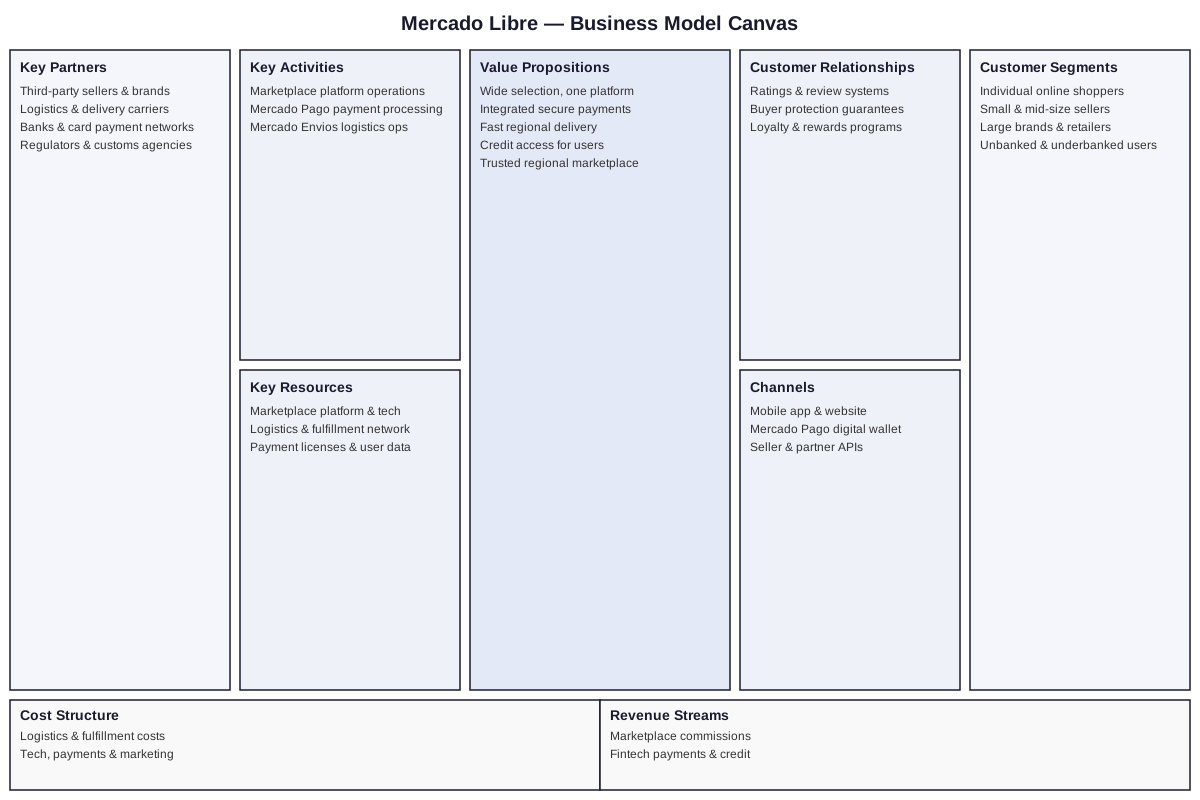
Key Partners
Mercado Libre depends on millions of third-party sellers and brands who list inventory across the platform, plus logistics carriers that move packages through Mercado Envios. Banks and card networks support Mercado Pago's payment rails, while local carriers and postal operators fill last-mile delivery gaps outside company-owned hubs. Regional regulators and customs authorities also matter, given the company's cross-border logistics expansion into markets like the United States.
Key Activities
Core activities center on operating the marketplace platform itself: matching buyers and sellers, ranking listings and processing millions of daily transactions. Mercado Pago requires continuous payment processing, fraud monitoring and credit underwriting, while Mercado Envios demands warehouse operations, route planning and last-mile delivery coordination across several countries. The company also invests in advertising tools that let sellers pay for better placement.
Key Resources
The marketplace platform and its search and ranking technology form the company's core resource, alongside the physical logistics network of fulfillment centers and distribution hubs built since 2013. Payment licenses across multiple countries let Mercado Pago operate as a regulated financial provider rather than a simple checkout button. Seller and buyer transaction data further sharpen credit decisions and product recommendations.
Value Propositions
For buyers, Mercado Libre offers a wide selection across categories in one trusted destination, backed by integrated payments and delivery that is often faster than regional alternatives. For sellers, the platform provides built-in demand, logistics and financing that would otherwise require separate vendors and years of infrastructure investment. Underbanked shoppers gain access to credit and digital payments that many banks do not extend directly.
Customer Relationships
Ratings and review systems let buyers and sellers build trust with each other rather than with the platform alone. Buyer protection guarantees cover disputed or undelivered orders, reducing the risk of a first purchase from an unfamiliar seller. Loyalty programs tied to Mercado Pago usage reward repeat activity across both shopping and financial services.
Channels
Most transactions run through the Mercado Libre mobile app and website, which serve as the primary storefront across its markets. Mercado Pago functions as a separate digital wallet channel, extending payments beyond marketplace purchases into everyday bill pay and transfers. Seller and partner APIs let third-party systems plug directly into listings, inventory and payment flows.
Customer Segments
Individual online shoppers across Latin America make up the largest segment, drawn by selection and delivery speed. Small and mid-size sellers use the platform as their primary sales channel, while larger brands and retailers treat it as one distribution channel among several. A separate and growing segment includes unbanked and underbanked users who rely on Mercado Pago for basic financial services.
Cost Structure
Logistics and fulfillment represent a major and growing cost line as the company expands warehouse capacity and last-mile delivery across new markets. Technology development, payment processing and marketing, including seller-facing advertising tools, make up the remaining core cost base. Credit losses tied to Mercado Credito add a financial-services cost dimension most pure marketplaces do not carry.
Revenue Streams
Marketplace commissions on completed sales remain a foundational revenue source, charged as a percentage of each transaction. Fintech services, including payment processing fees, interest on consumer and merchant credit and asset management, now contribute a large and rising share of total revenue. Advertising fees from sellers seeking better placement round out the mix.
- 1Marketplaces Now Generate Most Global E-Commerce Sales
- 2Take Rate Formula And Marketplace Commission Structure Explained
- 3Amazon Marketplace Seller Aggregators Raised Billions In Funding
- 4Strategies For Two-Sided Markets And Network Effects
- 5MercadoLibre Annual Report On Fintech And Commerce Revenue
- 6Agentic Commerce Favors Composable API Infrastructure
Marketplace-centric models are not a shortcut or a passing trend. They are a structural response to rising customer acquisition costs and the capital intensity of building commerce infrastructure alone. Sellers who understand the economics, commissions as variable costs, shared infrastructure, network effects, can scale faster with less risk than those building standalone stores. The tradeoff is dependency and the sellers who manage it best build assets a platform does not control: direct customer relationships, owned data and, where feasible, financial services of their own. Mercado Libre's evolution from a simple listings site into an integrated commerce and fintech company shows where the model is heading. The next phase adds modular, API-connected infrastructure that lets sellers and platforms adapt faster than they could by building everything in-house.
Citation
Cite this article
Sridharan, M. A. (2021, February 4). The Rise of Marketplace Commerce. Think Insights. https://thinkinsights.net/strategy/rise-marketplace-commerce (Accessed [[ACCESS_DATE]])
Sridharan, Mithun A. "The Rise of Marketplace Commerce." Think Insights, 4 Feb. 2021, https://thinkinsights.net/strategy/rise-marketplace-commerce. Accessed [[ACCESS_DATE]].
Mithun A. Sridharan, "The Rise of Marketplace Commerce," Think Insights, February 4, 2021, https://thinkinsights.net/strategy/rise-marketplace-commerce. Accessed [[ACCESS_DATE]].
Sridharan, M.A. (2021) 'The Rise of Marketplace Commerce', Think Insights. Available at: https://thinkinsights.net/strategy/rise-marketplace-commerce (Accessed: [[ACCESS_DATE]]).
M. A. Sridharan, "The Rise of Marketplace Commerce," Think Insights, 2021. [Online]. Available: https://thinkinsights.net/strategy/rise-marketplace-commerce. [Accessed: [[ACCESS_DATE]]].
Sridharan MA. The Rise of Marketplace Commerce. Think Insights. Published February 4, 2021. Accessed [[ACCESS_DATE]]. https://thinkinsights.net/strategy/rise-marketplace-commerce
Test Your Knowledge
The Rise of Marketplace Commerce
Challenge yourself on the concepts from this article and see how well you understood them.
Subscribers get weekly quizzes and insights — subscribe free
Sponsor this article
Partner with Think Insights
Reach 50,000+ business leaders, consultants, and strategists. Feature your brand alongside expert articles on strategy, leadership, and digital transformation.
Become a Sponsor