Redfin's Business Model


Redfin built its reputation on pairing satellite maps with real estate listings, then charging home sellers a fraction of the traditional commission. Founded in 2004 by David Eraker, Michael Dougherty and David Selinger, the Seattle company challenged an industry built on 2.5 to 3% commissions with a 1 to 1.5% brokerage fee and salaried agents. Redfin went public in 2017, later closed its unprofitable instant-buying unit RedfinNow in 2022, and shifted agent pay toward commissions through a plan called Redfin Next. On July 1, 2025, Rocket Companies completed an all-stock acquisition of Redfin valued near $1.8 billion, folding the brokerage into a broader home-buying platform that already includes Rocket Mortgage. This article examines how that model works and what changed under new ownership
What does Redfin's ownership look like after the Rocket acquisition?
Redfin operates as a wholly owned subsidiary of Rocket Companies. Rocket completed an all-stock acquisition on July 1, 2025, issuing roughly 103.4 million shares of Class A common stock to Redfin shareholders in a deal valued near $1.8 billion. Redfin no longer trades as an independent public company
Are Redfin agents employees or independent contractors?
Redfin agents work as W-2 employees rather than independent contractors, a structure that sets the company apart from most brokerages. They receive health insurance, 401[k] matching and reimbursement for marketing and mileage costs. Since 2023, the company has paid agents through a plan called Redfin Next, which sets commission splits based on whether a client came from the agent's own network or from a Redfin-generated lead
Why did Redfin shut down its instant-buying business?
Redfin closed RedfinNow, its instant home-buying unit, in November 2022 after rising interest rates made the economics of holding purchased homes unworkable. The shutdown came with a 13% reduction in the overall workforce. The company has since concentrated on brokerage and referral revenue rather than buying and reselling homes directly
A map-based disruption of real estate search
Redfin started in 2004, when David Eraker, Michael Dougherty and David Selinger set out to change how people searched for a home. Eraker left a software design career at the University of Washington, and Dougherty brought an electrical engineering background from Yale University. The two paired satellite imagery with property records to plot homes for sale directly on an interactive map, a format most listing sites of that era did not offer. Selinger joined soon after and built the data engine that powered the mapping and search tools. The approach gave buyers a visual, self-service way to browse inventory instead of relying entirely on an agent to describe available homes. Early funding came from Madrona Venture Group, followed by rounds from Vulcan Inc., Greylock and other investors that pushed total funding past $90 million before Redfin reached the public markets. Redfin went public on July 28, 2017, pricing shares at $15 and closing the first day of trading at $21.72, a market capitalization of $1.73 billion. The listing tool proved to be the entry point; the brokerage business built around it became the company's actual product.
Ownership after the Rocket Companies acquisition
Redfin no longer trades as an independent public company. Rocket Companies completed an all-stock acquisition of Redfin on July 1, 2025, issuing roughly 103.4 million shares of Class A common stock to Redfin shareholders in a transaction valued near $1.8 billion. 1 The exchange ratio and share counts appear in Rocket's regulatory filings, which set the terms at 0.7926 shares of Rocket Class A stock for each share of Redfin common stock outstanding. 2 Redfin now operates as a wholly owned subsidiary, and Rocket also finished collapsing its own dual-class share structure around the same date, simplifying the combined company's capital structure. Glenn Kelman, who led Redfin for two decades, stepped down as chief executive in January 2026 after guiding the company through the initial phase of integration with Rocket. Varun Krishna, chief executive of Rocket Companies, took over as Redfin's interim leader while the parent company searches for a permanent replacement. The deal folds a well-known consumer brokerage brand into a mortgage-heavy parent, changing who ultimately owns and directs the business.
Mission and value proposition
Redfin's stated mission has stayed consistent since its early years.
Redefine real estate in the consumer's favor
The company built this positioning around lower fees and more transparent data rather than a new physical service. Sellers pay a listing fee of roughly 1 to 1.5%, well below the 2.5 to 3% commission a typical listing agent charges elsewhere, and buyers get a searchable database of homes without needing an agent to unlock basic listing information. That combination attracted price-sensitive sellers first and buyers second, since the map-based search tool worked as a lead-generation channel long before Redfin brokered a single transaction. The value proposition depends on volume: lower fees per deal only work if the platform closes enough transactions to keep its agents busy and profitable.
Revenue: brokerage commissions, referrals and a failed detour into house-flipping
Redfin earns most of its revenue from brokerage commissions on home sales, charging sellers roughly 1 to 1.5% of the sale price. A second stream comes from referral fees, since Redfin routes buyers and sellers who don't fit its direct-agent model to partner brokerages and earns a fee for each referral. For nearly a decade, the company also ran RedfinNow, an instant-buying unit that purchased homes directly from sellers and resold them for a profit. Rising interest rates and falling resale margins made that inventory-heavy model unprofitable, and Redfin closed RedfinNow in November 2022, cutting 13% of its overall workforce in the process. 3 The exit left brokerage commissions and referral fees as the company's two core revenue sources, a narrower but steadier base than the instant-buying experiment offered.
The employee-agent model that sets Redfin apart
Most residential real estate agents in the United States work as independent contractors, covering their own expenses and splitting commissions with a brokerage deal by deal. Redfin agents work as W-2 employees instead, receiving health insurance, 401[k] matching and reimbursement for marketing, mileage and continuing education costs. That structure historically paid agents a base salary plus bonuses tied to closed transactions, which reduced the pressure to close a poor-fit deal just to earn a paycheck. The company began phasing out the salary-heavy model in 2023 with a plan called Redfin Next, which pays agents through commission splits ranging from about 40% to 75%, depending on whether the client came through the agent's own referral or through a lead Redfin generated. 4 Top-performing agents under the new plan earned an average of $338,100 in 2024 and 2025, an increase of 20% from the prior year, and the typical Redfin agent earned about 1.75 times the income of agents at other brokerages. 5 The shift traded a steadier paycheck for higher upside, betting that commission incentives would keep productive agents from leaving for contractor-style competitors.
Business model canvas: partners, resources and channels
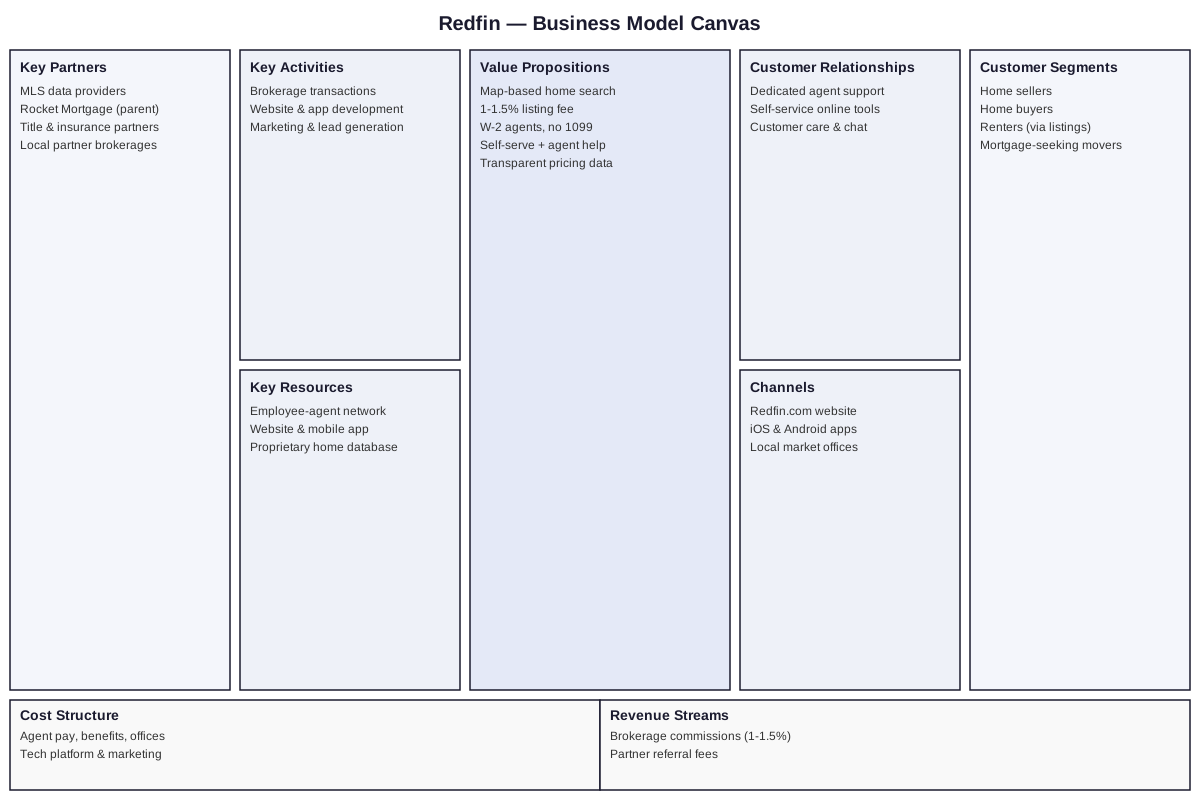
Redfin's key partners now include mortgage, title and insurance providers under the Rocket Companies umbrella, alongside the multiple listing services [MLS] that supply the property data feeding its search tool. Its key resources are the employee-agent workforce, the website and mobile app that draw tens of millions of monthly visitors, and the database of home values and neighborhood data the company has compiled since 2004. Channels run through the Redfin.com website, iOS and Android apps, and local offices in the metropolitan markets the company serves directly. Customer relationships combine self-service tools, such as home value estimates and tour scheduling, with a dedicated agent for buyers and sellers who want hands-on support through closing. The customer segments split cleanly into home sellers seeking a lower commission and home buyers who want a searchable, map-based alternative to working exclusively through an agent's private listings.
Cost structure and the competitive field
Redfin's costs concentrate in three areas: agent compensation and benefits, technology development for the website, app and data infrastructure, and marketing spent to keep traffic flowing to Redfin.com. Local offices and agent training add a smaller but recurring cost, particularly as the company expands the Redfin Next pay plan into new markets. Competition comes from several directions. Zillow remains the most-visited real estate website in the country and monetizes through advertising and agent referrals rather than direct brokerage, while Compass and eXp Realty compete for agents and listings using their own technology-forward brokerage models. Opendoor still runs the instant-buying business Redfin abandoned in 2022. Each competitor validates a different piece of the model Redfin built, whether listing data, agent recruiting or instant offers, without any single rival replicating the full combination.
What the Rocket integration means going forward
Rocket Companies bought Redfin to connect a brokerage with tens of millions of monthly visitors to a mortgage business that already originates loans at scale, aiming to convert home searches into mortgage applications under one roof. Kelman described the logic of the deal candidly before he departed, noting that Redfin needed capital and scale a standalone public brokerage could not generate on its own during a prolonged housing slowdown. 6 The company's leadership has already changed once since the deal closed, and a permanent chief executive has yet to be named as of mid-2026. Whether the combination works depends on execution the market has not yet had time to judge, including cross-selling mortgages to Redfin's home shoppers, keeping the employee-agent model intact, and integrating two large technology stacks without slowing either business down. The next few years will show whether pairing a brokerage with a mortgage lender under one roof strengthens Redfin's original pitch to consumers or dilutes it.
Redfin's arc shows how far a technology idea can carry a brokerage before the underlying economics of real estate reassert themselves. Cheap search and low commissions won market share, and RedfinNow showed how quickly a capital-intensive bet on home inventory can turn against a company when interest rates move. The employee-agent model gave Redfin a service edge that contractors at rival brokerages could not easily match, and it became the asset Rocket Companies valued most when it agreed to buy the company in 2025. Under Rocket, Redfin now sits alongside a mortgage lender with a much larger balance sheet, giving the brokerage access to capital and cross-selling opportunities it lacked as a standalone public company. Leadership has already changed hands, and the next phase depends on whether the two businesses integrate without diluting what made Redfin's agent model distinctive
Citation
Cite this article
Sridharan, M. A. (2023, September 11). Redfin's Business Model. Think Insights. https://thinkinsights.net/strategy/redfins-business-model (Accessed [[ACCESS_DATE]])
Sridharan, Mithun A. "Redfin's Business Model." Think Insights, 11 Sep. 2023, https://thinkinsights.net/strategy/redfins-business-model. Accessed [[ACCESS_DATE]].
Mithun A. Sridharan, "Redfin's Business Model," Think Insights, September 11, 2023, https://thinkinsights.net/strategy/redfins-business-model. Accessed [[ACCESS_DATE]].
Sridharan, M.A. (2023) 'Redfin's Business Model', Think Insights. Available at: https://thinkinsights.net/strategy/redfins-business-model (Accessed: [[ACCESS_DATE]]).
M. A. Sridharan, "Redfin's Business Model," Think Insights, 2023. [Online]. Available: https://thinkinsights.net/strategy/redfins-business-model. [Accessed: [[ACCESS_DATE]]].
Sridharan MA. Redfin's Business Model. Think Insights. Published September 11, 2023. Accessed [[ACCESS_DATE]]. https://thinkinsights.net/strategy/redfins-business-model
Test Your Knowledge
Redfin's Business Model
Challenge yourself on the concepts from this article and see how well you understood them.
Subscribers get weekly quizzes and insights — subscribe free
Sponsor this article
Partner with Think Insights
Reach 50,000+ business leaders, consultants, and strategists. Feature your brand alongside expert articles on strategy, leadership, and digital transformation.
Become a Sponsor