Prospect Theory


Traditionally, economists built models under the assumption that people are rational decision makers. This means people take into account the various available alternatives before making decisions. In economists' terms, people weigh the costs and benefits before arriving at decisions to maximize their utility.
Who developed Prospect Theory?
Daniel Kahneman and Amos Tversky proposed Prospect Theory in 1979, challenging the traditional economic assumption that people make rational decisions.
What is loss aversion?
Loss aversion is the tendency for people to feel the pain of losses more strongly than the pleasure of equivalent gains, leading to risk-seeking behavior to avoid losses.
What is the isolation effect?
The isolation effect occurs when people ignore common elements shared by different options and focus only on what differs, simplifying decisions but sometimes causing errors.
How does Prospect Theory explain insurance purchases?
People pay fixed premiums to avoid the uncertainty of large financial losses, reflecting their willingness to take a small certain loss to prevent a potentially larger one.
Where is Prospect Theory applied?
Prospect Theory is applied in areas including managerial decision-making, consumer behavior, investing, and marketing to explain choices that deviate from purely rational models.
However, this general conception changed in 1979 when psychologists Daniel Kahneman and Amos Tversky proposed a theory that suggested that people are not efficient decision makers. People often make errors in weighing the costs and benefits of the different alternatives. This theory came to be known as the Prospect Theory and describes how people compare options and make choices, which many a times, are influenced by their own biases. According to the theory, people make errors because they are misguided by their biases, especially when it comes to potential losses.
Experiment
Kahneman and Tversky conducted an experiment to demonstrate their theory. In this experiment, they created two scenarios with two options each for their participants – Scene 1
A) 100% chance of winning $3000. B) 80% chance of winning $4000 and 20% chance of gaining nothing.
Scene 2
A) 100% chance of losing $3000. B) 80% chance of losing $4000 and 20% chance of losing nothing.
Rationality
According to traditional economics, 'rational' participants should choose option B in scene 1; the benefits ($4000) are more. With option A in scene 2, the costs ($3000) are less. However the case was different. In scene 1, participants decided to opt for option A, being very cautious about their assured gain of $3000 and in the process even forgoing a potential gain of additional $1000 from option B. However, in scene 2, the same cautious participants decided to gamble with their luck and opted for option B. In this case they were ready to undertake the risk of losing $4000 since there was a 20% chance of losing nothing.
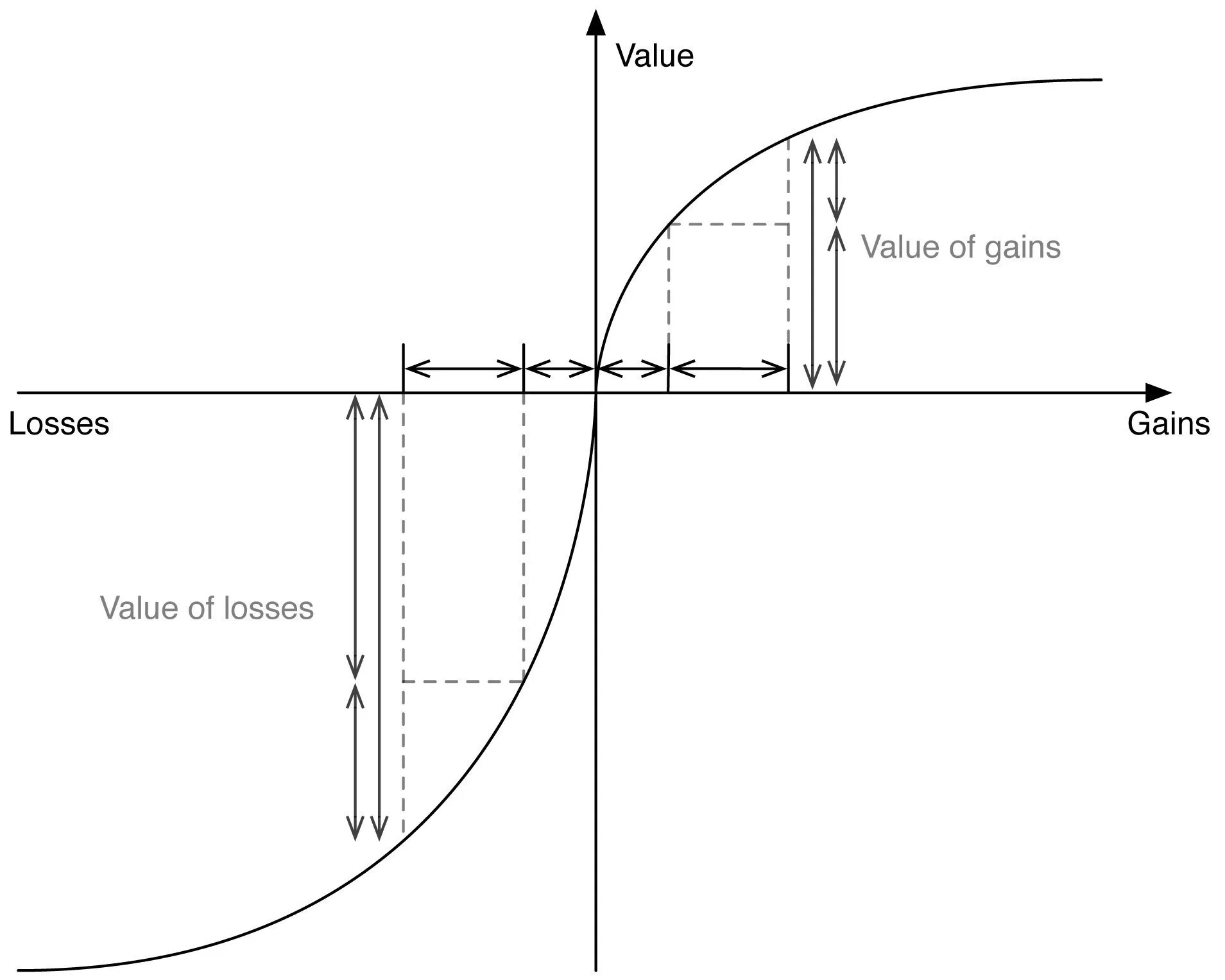
loss aversion
This simple experiment artfully exposed three flaws in human rationality:
- If given a choice, people would prefer avoiding fixed economic losses for acquiring gains even though the chances of losing are minuscule.
- While making decisions, people often disregard the common elements of different alternatives and focus only on what differs. This is done in an attempt to simplify the decision-making process by reducing our cognitive load (although it may lead to miscalculations/wrong decision making). This is also known as the isolation effect. In the above experiment, note, that the face values are the same, so the participant's gain or loss is equal in numeric value. Hence, logically, the satisfaction derived from a gain of $3000 should be equal to the dissatisfaction from a loss of $3000 (in absolute terms). However this is not the case as mentioned next.
- Losses are [psychologically] more painful than gains (even when the absolute value is same). As a result, people would go to a greater extent (e.g. taking more risks) to avoid losses than to receive gain. People refused to opt for a gain of winning $4000 as it accompanied a 20% chance of winning nothing. However they gladly accepted the option of undertaking a risk of $4000 loss since there was 20% of avoiding any loss.
Applications of prospect theory
Prospect theory helps us to understand a few puzzling decisions that are taking place around. For instance, it helps to explain why people take out insurance policies1. The basic idea is that you pay a regular, fixed premium to an insurance company in hopes that if, one day, something goes wrong, you have a plan B to fall back upon. In this case, the insured has no way of predicting the future so he is willing to gamble and pay a fixed amount. Just like the participants of Kahneman and Tversky's, the insured are taking a risk when faced by the chances for suffering financial losses: they are willing to pay a small and definite amount so that in case of an unexpected event, they are protected from an indefinite financial burden. This highlights the people's aversion to losses; the fear of loss forces people to take risks in hopes of reducing their chances of facing losses. Prospect theory finds its application in diverse areas such as managerial decision-making, consumer behavior, investing2 and marketing only to name a few.
Prospect Theory has practical relevance in finance, policy, and marketing. Recognizing these cognitive biases can help individuals and organizations design better choices and anticipate irrational but predictable human behavior.
Citation
Cite this article
Sridharan, M. A. (2018, May 9). Prospect Theory. Think Insights. https://thinkinsights.net/strategy/prospect-theory (Accessed [[ACCESS_DATE]])
Sridharan, Mithun A. "Prospect Theory." Think Insights, 9 May 2018, https://thinkinsights.net/strategy/prospect-theory. Accessed [[ACCESS_DATE]].
Mithun A. Sridharan, "Prospect Theory," Think Insights, May 9, 2018, https://thinkinsights.net/strategy/prospect-theory. Accessed [[ACCESS_DATE]].
Sridharan, M.A. (2018) 'Prospect Theory', Think Insights. Available at: https://thinkinsights.net/strategy/prospect-theory (Accessed: [[ACCESS_DATE]]).
M. A. Sridharan, "Prospect Theory," Think Insights, 2018. [Online]. Available: https://thinkinsights.net/strategy/prospect-theory. [Accessed: [[ACCESS_DATE]]].
Sridharan MA. Prospect Theory. Think Insights. Published May 9, 2018. Accessed [[ACCESS_DATE]]. https://thinkinsights.net/strategy/prospect-theory
Test Your Knowledge
Prospect Theory
Challenge yourself on the concepts from this article and see how well you understood them.
Subscribers get weekly quizzes and insights — subscribe free
Sponsor this article
Partner with Think Insights
Reach 50,000+ business leaders, consultants, and strategists. Feature your brand alongside expert articles on strategy, leadership, and digital transformation.
Become a Sponsor