Product-Market Intelligence


Most organizations make portfolio and market decisions with partial information. Product leaders optimize individual offerings, regional managers chase local opportunities, and research and development teams pursue innovation agendas that often evolve independently from commercial realities. The Product-Market Intelligence Framework resolves this fragmentation by forcing all three dimensions—current product status, market opportunity, and innovation initiatives—into a single, regional matrix. When you view the entire portfolio against your major markets and overlay strategic and operational priorities, misalignments become visible and investable opportunities become explicit. The practical recommendation is straightforward: build and maintain a product-market matrix that captures reality at every intersection, use it as the primary lens for resource allocation decisions, and treat it as a living strategic dashboard rather than a one-off workshop artifact. Executives should insist that investment discussions reference this integrated view instead of isolated reports. When you do this consistently, you will uncover where product performance already supports growth, where markets deserve entry or expansion, and where research and development should redirect effort to reinforce high-potential combinations instead of subsidizing low-viability bets. For leadership teams that manage multi-product portfolios across regions, the decision is binary. Either you continue to rely on fragmented data and intuition, or you institutionalize a structured framework that shows, in one view, where product strength, regional demand, and innovation capacity truly converge. The Product-Market Intelligence Framework is that structure; the rest of this article explains how to design it, populate it, and use it as the backbone of your portfolio and market strategy.
How does this framework improve portfolio decisions?
The Product-Market Intelligence Framework compels leaders to evaluate product performance, regional opportunities, and R&D commitments together, so investment choices move from defending individual initiatives to selecting the highest-impact product-market combinations.
When is this framework most useful?
It is most valuable when organizations manage multiple products across several regions, face recurring resource allocation debates, and need an integrated view to decide which combinations deserve expansion, consolidation, or exit.
What outcomes should leaders expect?
Leadership teams can expect more coherent regional strategies, better aligned research and development roadmaps, and clearer trade-offs when reallocating resources, because every decision is grounded in a shared, visual representation of the portfolio and markets.
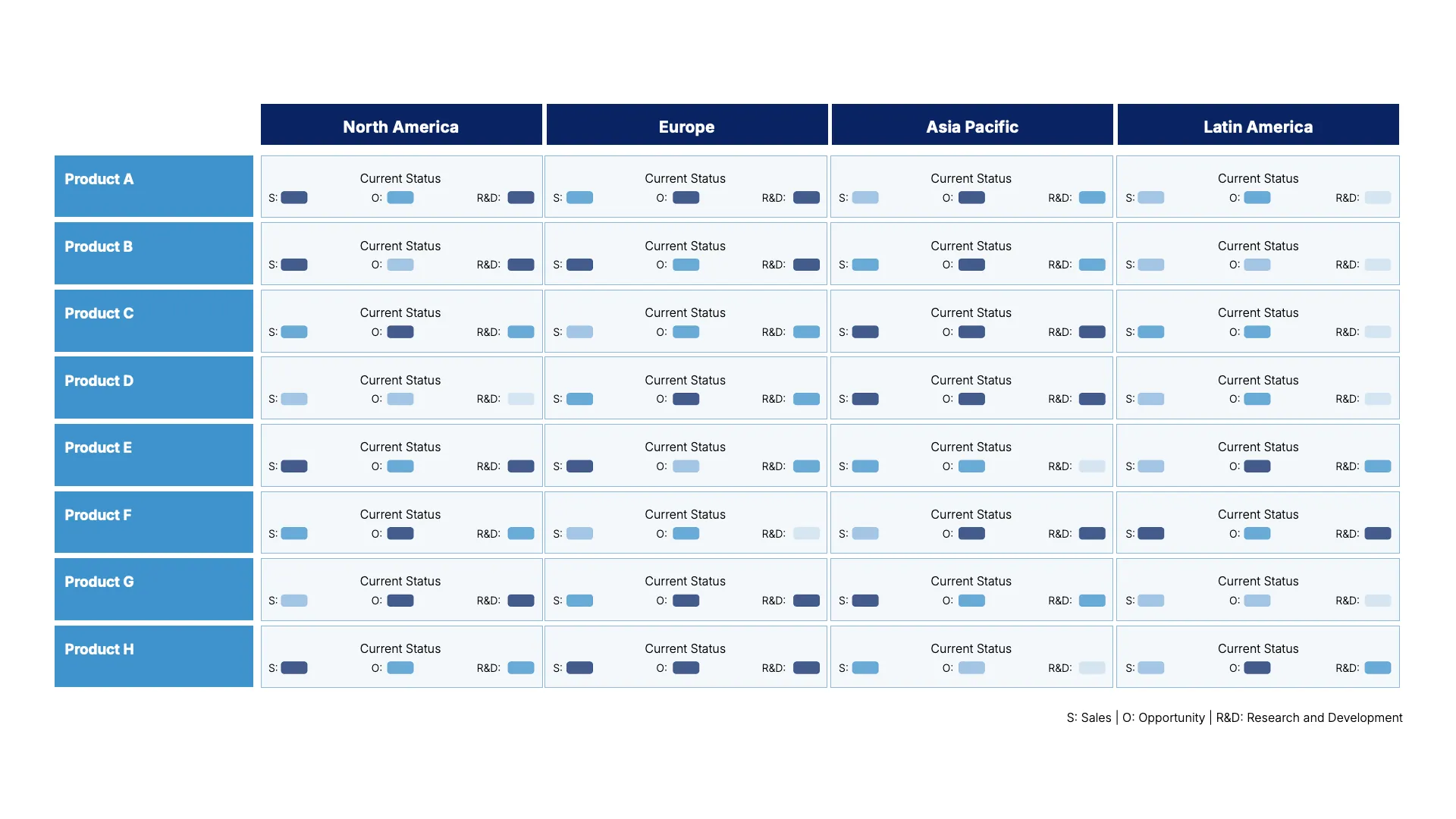
The Product-Market Intelligence Framework maps your entire product portfolio against your key regional markets so that current status, strategic potential, operational moves, and research and development initiatives are visible in one place. In practice, this matrix becomes the reference point for portfolio discussions because it reveals patterns that are impossible to see when you look at product, region, and innovation data in isolation. Instead of debating individual reports, executives can interrogate the intersections where performance, opportunity, and innovation either reinforce each other or stand misaligned.
At its core, the framework is not a complex analytical model but a structured way of organizing information. By arranging products as rows and regions as columns, and then annotating each cell with status, strategic opportunities, operational opportunities, and research and development work, you create a tangible artifact that shows how the organization is actually deployed across markets. The discipline lies in keeping the entries honest and updating them regularly so that the matrix reflects reality rather than aspiration.
Because the framework is visual and compact, it lends itself to executive conversations. Leaders can scan the matrix to identify dense clusters of activity or notable gaps and then drill down into specific cells that require decisions. This combination of breadth and specificity is what makes the Product-Market Intelligence Framework useful in real leadership settings rather than just in theoretical discussions.
The problem with fragmented strategy
Most leadership teams already have the data they need, but they experience it as a series of disconnected views. Product dashboards emphasize revenue, margin, and pipeline; regional reports highlight market share, competitive moves, and regulatory developments; research and development roadmaps describe features, platforms, and technical milestones. Each view has merit, yet none tells the full story of where the company is winning or losing across product-market combinations.
This fragmentation shows up in resource allocation meetings. The vice president of product may argue for increased investment in a high-performing product based on global metrics, while a regional director advocates for localized features across the entire portfolio to capture emerging demand. In parallel, the research and development leader defends their roadmap with references to technical differentiation and long-term capability building.
When these perspectives collide without a shared framework, decisions depend heavily on influence and narrative rather than on integrated evidence. The deeper strategic question—where product performance, regional opportunity, and innovation effort converge to create outsized impact—remains unanswered. The Product-Market Intelligence Framework exists to bring that question to the center of the conversation and give teams a structured way to answer it.
How the framework is structured
The framework uses a matrix with products as rows and regions as columns, but the design choice that matters is what you capture within each cell. For every product-market intersection, the matrix records four elements: current status, strategic opportunities, operational opportunities, and research and development activity. Taken together, these elements describe both how the organization is performing and how it intends to improve or expand that specific combination.
Current status is a fact-based assessment of where the product stands in that region today. You might describe the product as a market leader with strong revenue and share, a growth offering gaining traction, a mature line plateauing, or an underperformer that is struggling to find its place. The goal is to avoid spin and acknowledge reality so that decisions build on a truthful baseline.
Strategic opportunities capture the longer-term potential in each cell. Here you consider moves such as market share expansion, entry into adjacent segments, competitive displacement, partnership formation, or repositioning. These opportunities are not guaranteed outcomes but hypotheses about where the product-region combination could go if you commit resources and focus. The matrix makes these hypotheses explicit so teams can compare them across cells.
Operational opportunities focus on near-term levers that can improve performance without changing the fundamental strategic direction. Examples include pricing adjustments, channel development, sales enablement initiatives, customer success programs, or targeted marketing campaigns. Recording these operational plays within the matrix clarifies which execution moves are in progress and where gaps remain.
Finally, research and development initiatives document the innovation work associated with each product-market combination. This may involve feature development, localization, compliance updates, platform improvements, or technical integrations. By explicitly tying research and development to specific cells rather than treating it as a generic stream, you can see whether innovation is supporting high-potential opportunities or drifting toward low-impact areas.
Why integrated visibility changes decisions
Once the matrix is populated across all products and regions, its value becomes apparent when leaders step back and look at the entire picture. The first insight often relates to portfolio-market alignment. It becomes easy to spot products that have strong positions in certain regions but no presence or weak performance elsewhere. Those gaps may signal untapped expansion opportunities or deliberate focus choices that should be revisited.
Research and development patterns stand out as well. By scanning the matrix for cells with significant innovation activity, teams can see whether they are concentrating resources in markets that offer meaningful upside or distributing effort across combinations with limited growth potential. If the matrix shows heavy research and development investment in mature markets with modest opportunities while high-growth regions receive little attention, that misalignment becomes hard to ignore.
Regional strategy coherence is another emergent pattern. Columns that show multiple products with clear strategic and operational opportunities, supported by research and development initiatives, indicate a well-formed regional play. In contrast, columns populated by scattered cells without consistent opportunity or innovation narratives suggest a fragmented approach. Recognizing this difference helps executives decide whether a region deserves a unified strategy or a reconfiguration of the product mix.
The matrix also makes strategic trade-offs explicit. When resources are constrained, leadership teams must decide which product-market combinations receive additional investment and which are maintained or reduced. Instead of arguing from isolated reports, teams can compare cells side by side. For instance, they can weigh the merits of supporting a strong product in a region with proven demand against funding a more speculative entry in a new market. The framework does not make the decision, but it ensures that the decision is informed by a comprehensive view.
From matrix to portfolio action
In consulting engagements and internal strategy work, the Product-Market Intelligence Framework becomes a practical sequence of steps rather than an abstract concept. The process typically begins with a collaborative session where product leaders, regional managers, and research and development heads jointly populate the matrix based on their collective knowledge. The first iteration is rarely perfect, but it establishes a baseline view that everyone can critique and improve.
Over the following weeks, debates naturally emerge around the entries in specific cells. Participants ask why multiple research and development initiatives exist in markets where current status is weak and strategic opportunity is limited, or why a flagship product in a core region receives minimal innovation despite strong performance. These questions force teams to confront implicit assumptions and legacy decisions that have persisted without scrutiny.
As these conversations progress, leadership teams identify a small number of product-market combinations where current strength, future potential, and innovation capacity align. These become prioritized focus areas for investment. Resources are reallocated to reinforce those cells, roadmaps are adjusted, and regional plans are reshaped to support the chosen bets. The matrix acts as a visual record of these choices and as a checkpoint for subsequent review.
Importantly, the framework is most effective when it becomes a recurring practice. Quarterly or semiannual updates keep current status accurate, refine strategic and operational opportunities based on new information, and track research and development initiatives as they move from planned to in progress to completed. Over time, the matrix evolves into a living strategic dashboard that anchors portfolio and market discussions rather than a static artifact from a single workshop.
Designing the matrix for your context
Although the core idea of the Product-Market Intelligence Framework is stable, its implementation should reflect the specific context of your organization. The choice of products as rows and regions as columns is a starting point; you can adapt the dimensions to match business lines, customer segments, or other relevant groupings when appropriate. The key is to preserve the discipline of capturing current status, strategic opportunities, operational opportunities, and research and development initiatives for each intersection.
When defining products, avoid excessively granular entries that turn the matrix into a catalog rather than a strategic tool. Group offerings into meaningful clusters that reflect how leadership teams actually make investment decisions, such as product families, platforms, or major solutions. Likewise, select regional definitions that align with how the organization plans and reports, whether that means continents, macro regions, or priority countries.
You can also choose how much quantitative detail to include in each cell. Some organizations prefer to annotate current status with metrics such as revenue, growth rate, or market share, while others keep the entries qualitative and rely on separate dashboards for detailed figures. A pragmatic approach is to capture directional information in the matrix—such as high, medium, or low performance or opportunity—and use supporting analytics when comparisons require precision. This keeps the matrix readable while preserving analytical rigor.
In certain cases, teams add an additional layer of information to the matrix, such as risk indicators or capability constraints, to highlight factors that might limit the realization of opportunities. For example, a product-market combination may show strong demand and a compelling opportunity but face regulatory barriers or distribution challenges that require separate attention. Recording these constraints alongside opportunities ensures that decisions remain grounded.
Using the framework in executive conversations
The real test of the Product-Market Intelligence Framework is whether it changes how executives talk about the portfolio and markets. In effective usage, the matrix becomes the starting slide in resource allocation meetings and strategic reviews. Rather than jumping directly into product presentations or regional updates, leaders first examine the portfolio across the matrix to identify which cells warrant deeper discussion.
One practical technique is to ask each senior leader to highlight the three product-market combinations they believe deserve incremental investment and the three they would recommend scaling back. When these preferences are plotted onto the matrix, areas of consensus and divergence become visible. The discussion then centers on understanding why certain cells attract support or skepticism and whether the evidence in the matrix justifies those positions.
The framework also supports scenario-based thinking. Executives can explore questions such as what happens if the organization decides to prioritize a particular region for growth or if it chooses to consolidate the product portfolio around fewer platforms. By adjusting which cells carry strategic and operational opportunities and which cells maintain or reduce research and development activity, teams can visualize the implications of different strategic paths before committing.
Because the matrix is explicit, it helps to counter the tendency for pet projects or legacy initiatives to persist without alignment to current priorities. When a cell shows modest current status, limited opportunity, and continuing research and development investment, leaders can ask whether that combination still deserves a place in the portfolio. Decisions to exit or phase down such combinations become easier when the case is visible in a structured format rather than buried in technical or regional narratives.
Aligning research and development with market realities
One of the most powerful uses of the Product-Market Intelligence Framework is to align research and development roadmaps with market and portfolio priorities. In many organizations, innovation initiatives are planned based on technology trajectories, platform visions, or customer feedback from limited markets. The matrix challenges this by asking where each research and development effort lands in product-market terms and what opportunity it is meant to unlock.
By mapping initiatives to specific cells, teams can compare the innovation portfolio against the opportunity landscape. If research and development is heavily concentrated in products and regions with low strategic potential, leadership must decide whether to redirect effort toward combinations with higher upside. Conversely, if high-opportunity cells show little or no innovation activity, that absence becomes a prompt to explore new initiatives or partnerships.
The framework also clarifies how different types of innovation work together. Some initiatives strengthen existing positions in strong markets, such as incremental features or localization enhancements. Others enable entry into new segments or regions, such as compliance adaptations or platform integrations. By viewing these efforts alongside current status and opportunities, executives can ensure that the innovation agenda supports both defensive and offensive plays in a balanced manner.
Ultimately, aligning research and development with market realities is not about reducing innovation ambition but about directing it where the organization can capture tangible value. The Product-Market Intelligence Framework provides the structure needed to make those choices with confidence, especially in environments where innovation budgets are sizable but finite.
Getting started pragmatically
Organizations do not need perfect data or a fully centralized analytics capability to benefit from the Product-Market Intelligence Framework. A pragmatic starting point is to convene key stakeholders—product leaders, regional managers, and research and development heads—and draft the initial matrix based on their combined expertise and accessible information. Any gaps identified during this exercise become signals for where additional analysis or market research is required.
In the early stages, it is useful to treat the matrix as a conversation tool rather than a formal report. Encourage participants to challenge entries, propose alternative opportunity assessments, and suggest new operational or innovation moves for specific cells. This collaborative refinement process helps ensure that the matrix reflects shared understanding rather than a single viewpoint.
Once the matrix reaches a reasonable level of completeness, leadership can begin using it as the lens for portfolio decisions. Start by selecting a small number of high-potential product-market combinations for focused investment and experiment with aligning research and development and regional resources accordingly. Track outcomes over time and adjust entries in the matrix as results and conditions evolve.
As confidence in the framework grows, you can formalize its role in governance processes. For example, you might require that major investment proposals reference the relevant cells in the matrix or that quarterly business reviews include updates on changes in current status and opportunities. Over time, this embeds the Product-Market Intelligence Framework into the organization’s strategic rhythm.
Strategic clarity rarely emerges from more data alone; it emerges from seeing familiar data in a more integrated and decision-ready form. The Product-Market Intelligence Framework gives executive teams a single canvas on which product performance, regional dynamics, and research and development efforts are visible together. When leaders regularly review this matrix, they can recognize not only where the organization is winning but also where success depends on rebalancing investments, exiting low-potential combinations, and systematically backing high-impact intersections. The most powerful outcome is not the matrix itself but the discipline it creates. Portfolio conversations move away from defending individual products or regional agendas and toward comparing alternatives with shared context. R&D roadmaps become anchored in explicit product-market priorities instead of abstract technology pushes. Regional strategies become more coherent because they reflect a deliberately chosen mix of offerings rather than a historical accumulation of initiatives. This framework will not replace the need for detailed analytics, market research, or product-level decision making. It does something simpler and more foundational: it ensures that those activities are interpreted through a structure that reveals patterns, trade-offs, and gaps that are otherwise invisible. For executive teams willing to maintain it as a living dashboard, the Product-Market Intelligence Framework becomes a practical mechanism to align growth ambitions, innovation pipelines, and regional plays into a single, navigable strategic landscape.
Citation
Cite this article
Sridharan, M. A. (2026, June 13). Product-Market Intelligence. Think Insights. https://thinkinsights.net/strategy/product-market-intelligence (Accessed [[ACCESS_DATE]])
Sridharan, Mithun A. "Product-Market Intelligence." Think Insights, 13 June 2026, https://thinkinsights.net/strategy/product-market-intelligence. Accessed [[ACCESS_DATE]].
Mithun A. Sridharan, "Product-Market Intelligence," Think Insights, June 13, 2026, https://thinkinsights.net/strategy/product-market-intelligence. Accessed [[ACCESS_DATE]].
Sridharan, M.A. (2026) 'Product-Market Intelligence', Think Insights. Available at: https://thinkinsights.net/strategy/product-market-intelligence (Accessed: [[ACCESS_DATE]]).
M. A. Sridharan, "Product-Market Intelligence," Think Insights, 2026. [Online]. Available: https://thinkinsights.net/strategy/product-market-intelligence. [Accessed: [[ACCESS_DATE]]].
Sridharan MA. Product-Market Intelligence. Think Insights. Published June 13, 2026. Accessed [[ACCESS_DATE]]. https://thinkinsights.net/strategy/product-market-intelligence
Sponsor this article
Partner with Think Insights
Reach 50,000+ business leaders, consultants, and strategists. Feature your brand alongside expert articles on strategy, leadership, and digital transformation.
Become a Sponsor