No-KYC Crypto Casino Model


No-KYC crypto casinos generated an estimated eighty-one billion dollars in gross gaming revenue in 2024, nearly five times the 2022 total and they got there by replacing document-heavy sign-up with a tiered identity model rather than skipping verification altogether. The label oversells what happens in practice. Stake.com, the largest crypto-native operator and this article's illustrative example, lets players deposit and wager with minimal friction but still asks for identity checks once withdrawals or risk signals cross a threshold. That design choice reshapes the rest of the business: settlement clears in seconds instead of days, marketing runs through streamer partnerships instead of television budgets and yield on stablecoin float becomes a real revenue line. The sections below trace the business model canvas end to end, using Stake.com to ground each block.
What does no KYC mean at a crypto casino
It means identity checks move later in the customer journey rather than disappearing. Sign-up and small deposits ask for little more than a wallet connection, but withdrawals above a set size, or a wallet flagged by on-chain risk screening, trigger a full verification request before funds release.
Why do crypto casinos scale faster than licensed operators
They settle deposits and payouts in seconds instead of days, carry a thinner payment and compliance cost stack and acquire players through streamer partnerships and token rewards rather than fixed media budgets. Those three factors compound into a faster revenue curve than card-and-wire operators can match.
Is Stake.com actually free of identity verification
No. Stake.com allows low-friction play at small stakes but requires verification once a player crosses a withdrawal threshold or trips an internal risk signal, consistent with its Curacao license obligations and the banking relationships that keep the platform operating.
Why the Category Outgrew Its Reputation
Crypto-native gambling has moved from a curiosity on message boards to a line item that strategy teams at licensed operators now track. Gross gaming revenue from cryptocurrency-funded platforms reached an estimated eighty-one billion dollars across 2024, roughly five times the 2022 figure and the operators behind that growth run offshore licenses, short onboarding flows and treasury books denominated in stablecoins rather than bank deposits. Stake.com sits at the center of that shift: founded by Ed Craven and Bijan Tehrani, it grew from a niche dice game into what Forbes describes as the largest crypto-backed casino in the world, generating close to 4.7 billion dollars of gross revenue in 2024 alone.1 The scale is large enough that reading the business through a lean canvas, rather than through the "no KYC" tagline that follows it around, gives a far clearer picture of why it compounds.
What "No KYC" Actually Means
The phrase attached to this category oversells the product. Most sizable operators run a tiered identity model: friction stays low at sign-up and at small deposit sizes, then a full verification request appears once a player crosses a withdrawal threshold or trips a risk signal tied to wallet behavior. Stake.com, which operates under a Curacao gaming license through Medium Rare N.V. and blocks access from the United States, United Kingdom and several other regulated markets, follows that same pattern rather than skipping verification outright.2 The tiered approach is the load-bearing assumption behind almost every block of the canvas that follows, because it lets the operator serve a global audience at speed while still holding a line against outright anonymity.
The competitive advantage sits in compressing legitimate friction, not in evading it
The Speed and Custody Edge
The headline value proposition is a deposit and withdrawal cycle measured in seconds rather than days, paired with a wallet flow that gives players visible control over their own funds. A card deposit at a licensed European operator clears an authorization step in forty to ninety seconds and the matching payout can take one to five business days to land through the card network. Stablecoin deposits at a crypto-native operator clear in five to thirty seconds on the busiest networks and every game runs on a provably fair model, a cryptographic method that pairs a hashed server seed with a player-supplied client seed and a sequential nonce so any user can verify a result after the fact.3 That verification path carries the trust load that a licence stamp carries at a regulated operator, without asking the player to take the house's word for it.
Distribution Through Creators, Not Casinos
Distribution at a crypto-native operator looks closer to a creator-economy business than a traditional casino marketing plan. Stake's growth accelerated once it began paying streamers to broadcast live sessions on Twitch, a move that reportedly helped push its revenue from roughly 100 million dollars to 2 billion dollars in two years and its sponsorship portfolio now spans the UFC octagon, a Formula 1 livery and Premier League shirt deals.4 The second channel is a native-token rewards loop that turns loyal players into unpaid marketers through rakeback and tournament entries funded by play. Search rounds out the mix, aimed at long-tail intent around payment methods and game libraries. The combination costs less per acquired player than the television and stadium-signage budgets that licensed operators still rely on.
The Economics Behind the Curve
Revenue at a crypto-native operator arrives through layers that a licensed operator cannot fully replicate. The house edge remains the base layer, running from roughly one percent on player-friendly table games to four or five percent on higher-volatility slots, much the same as at a regulated casino. The added layer is float: operators hold a large share of player liability in stablecoins and rotate part of it through tokenized short-duration instruments, turning idle balances into a yield line, a shift that mirrors the broader move of stablecoin flows into mainstream payment rails projected to reach 56.6 trillion dollars by 2030.5 Cost sits on the other side of that ledger at a fraction of the legacy stack, since network fees replace card-scheme interchange and a single Curacao license replaces a patchwork of state-by-state approvals. Together, the two sides produce a margin wide enough to fund rakeback and sponsorship spending that a house-edge-only model could not support.
Risk, Compliance and the Trade-Offs Nobody Skips
Lower-friction onboarding raises the odds that a self-excluded player finds a way back into the funnel and that puts more weight on responsible-play tooling than a licensed operator carries. Better-run operators respond with configurable deposit limits, session-time alerts, self-exclusion flows and reality-check prompts, layered on top of on-chain analytics that score incoming wallets against sanctions lists and mixer exposure before funds ever settle.6 Anti-money-laundering controls at an operator like Stake.com sit at the intersection of Curacao's gaming ordinance, the laws of whichever markets it chooses to serve and internal escalation rules that pause a withdrawal the moment a flow looks suspicious. None of that removes the underlying tension between speed and scrutiny, but it keeps the tension manageable rather than ignored.
Where the Structural Advantage Actually Sits
The moats separating crypto-native operators from licensed brands are easier to see once the canvas is filled in. Settlement speed paired with a wide deposit menu is hard to replicate inside a card-and-wire stack and the visibility of provably fair mechanics gives players a verification path their licensed counterparts cannot offer. Creator and sponsorship relationships carry trust that travels with the personality rather than the brand and treasury yield funds rakeback that a fiat-only competitor would have to pull straight from house-edge margin. None of these advantages is permanent on its own, since licensed operators can copy pieces of the playbook over time, but together they explain the pace at which the category has compounded since 2022.
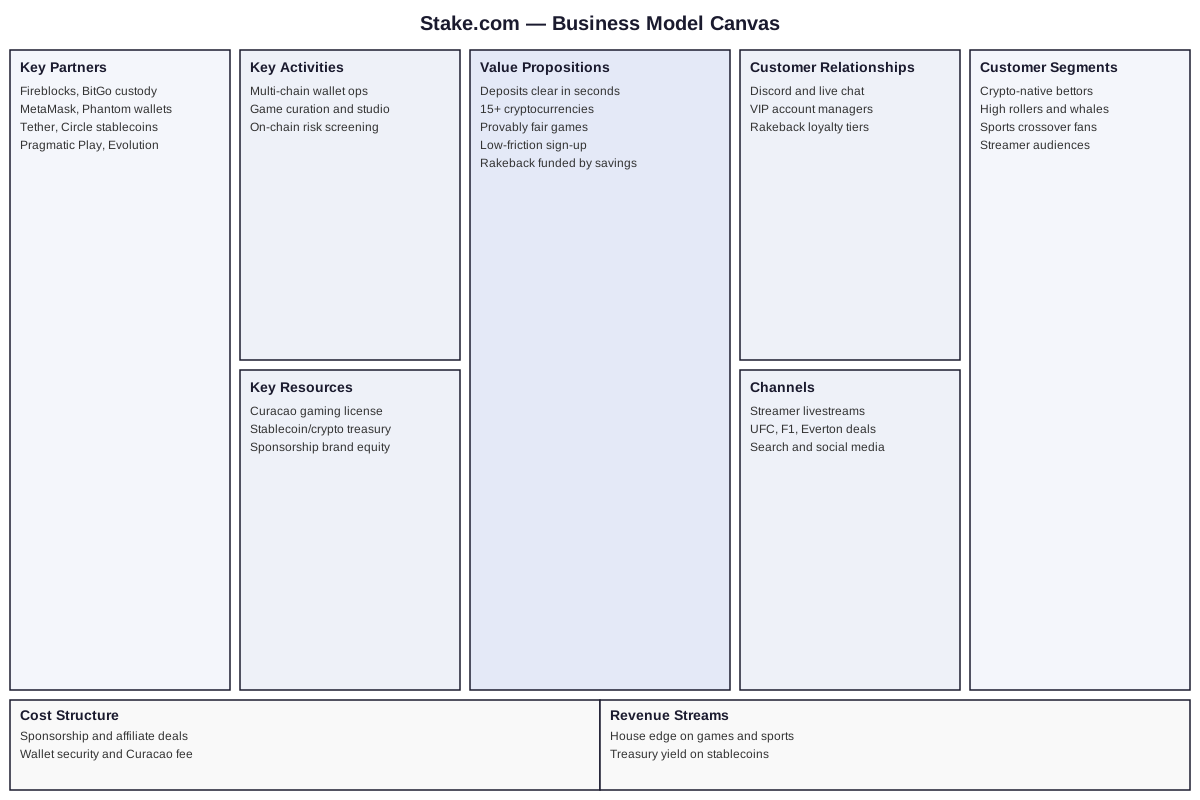
Key Partners
Stake.com's partner base reads as a fintech-and-creator hybrid rather than a traditional casino supplier list. Wallet infrastructure runs through custody vendors such as Fireblocks and BitGo alongside self-custody integrations with MetaMask, Phantom and WalletConnect for the deposit flow. Stablecoin issuers including Tether and Circle sit behind treasury operations, while game content comes from suppliers such as Pragmatic Play, Evolution and Hacksaw alongside an in-house Stake Originals studio. Sponsorship partners, including UFC, Formula 1's Sauber team and Everton Football Club, round out a partner column built for reach as much as for infrastructure.
Key Activities
The activities absorbing most of Stake.com's headcount sit behind the interface rather than on it. Wallet engineering covers reconciling hot, warm and cold tiers across more than a dozen supported networks, with on-chain screening scoring incoming wallets before deposits settle. Game curation runs in parallel, licensing third-party catalogues while shipping originals through its in-house studio. A third stream, sponsorship and affiliate management, coordinates streamer deals and sports partnerships that drive most new-player volume.
Key Resources
The Curacao gaming license held through Medium Rare N.V. is the single resource that makes the rest of the model legal to run at global scale. A proprietary game engine behind Stake Originals gives the platform content it does not have to license, while treasury reserves in stablecoins and crypto assets fund both operations and yield generation. Brand equity built through UFC, Formula 1 and Premier League sponsorships functions as a resource in its own right, lowering the cost of every subsequent acquisition campaign.
Value Propositions
Stake.com's core promise is a deposit and withdrawal cycle measured in seconds rather than days, backed by support for more than a dozen cryptocurrencies. Provably fair game mechanics let any player verify a result rather than trust a licence stamp. Low-friction sign-up removes the document upload that slows entry at licensed rivals and savings from a thinner fee stack fund rakeback and loyalty rewards that a fiat-only competitor cannot match without cutting into margin.
Customer Relationships
Stake.com builds relationships through community channels first: Discord servers and live chat inside Twitch and Kick streams keep players engaged between sessions. High-value players get dedicated VIP account managers who handle deposits, withdrawals and bespoke bonus offers. A tiered rakeback and loyalty program rewards volume with cash-back and tournament entries, giving regular players a reason to consolidate play on one platform rather than split it across competitors.
Channels
Streamer livestreams on Twitch, Kick and YouTube remain the dominant acquisition channel, with tracked referral codes routing viewers straight into sign-up. Sports and entertainment sponsorships, including the UFC octagon, a Formula 1 livery and Premier League shirt deals, build brand recognition well beyond the crypto-native audience. Paid and organic search capture long-tail intent from players comparing payment methods and game libraries, rounding out a channel mix that costs less per acquisition than television or stadium advertising.
Customer Segments
The platform's core segment is the crypto-native player who already holds assets across several networks and expects a casino to treat tokens as first-class deposits. A second segment consists of high rollers and whales drawn by rakeback and VIP treatment scaled to volume. A third segment crosses over from sports betting during major tournaments, moving between casino and sportsbook products inside the same wallet. A fourth segment follows sponsored creators and arrives through the streaming audience those partnerships build.
Cost Structure
Sponsorship and affiliate deals, many structured on revenue share rather than fixed fees, form the largest variable cost and scale with the volume they generate. Game-supplier royalties follow a similar revenue-share structure tied to actual play. Wallet security, on-chain monitoring and the Curacao license fee cover compliance and infrastructure at a fraction of the cost a multi-jurisdiction licensed operator carries. Fixed technology and engineering payroll rounds out the structure, kept lean relative to the volume the platform processes.
Revenue Streams
House edge across casino games and sportsbook wagers remains the base revenue line, consistent with the mechanics of any regulated operator. Yield earned on stablecoin and crypto float held against player balances adds a second, steadier income stream that scales with deposits rather than wagering volume. Appreciation on native crypto reserves held on the balance sheet contributes a third, more volatile layer tied to broader market cycles.
The no-KYC label describes a friction tier, not a permanent exemption. Stake.com and its larger peers ask for full verification once a withdrawal or behavior pattern trips a threshold, which lets them defend the banking relationships and Curacao license that keep the platform running across most markets outside the United States, United Kingdom and other tightly regulated jurisdictions. What sets the category apart is not the absence of compliance but the sequencing of it: wallet behavior and on-chain analytics handle the early screening that a passport scan handles at a licensed operator. That sequencing, paired with faster settlement, a thinner fee stack and a creator-led acquisition engine, explains why crypto-native operators compound revenue faster than licensed iGaming brands. The trade-off is real and manageable rather than fatal and operators that keep responsible-play tooling in step with growth should keep the advantage.
Citation
Cite this article
Sridharan, M. A. (2021, March 22). No-KYC Crypto Casino Model. Think Insights. https://thinkinsights.net/strategy/no-kyc-crypto-casino-model (Accessed [[ACCESS_DATE]])
Sridharan, Mithun A. "No-KYC Crypto Casino Model." Think Insights, 22 Mar. 2021, https://thinkinsights.net/strategy/no-kyc-crypto-casino-model. Accessed [[ACCESS_DATE]].
Mithun A. Sridharan, "No-KYC Crypto Casino Model," Think Insights, March 22, 2021, https://thinkinsights.net/strategy/no-kyc-crypto-casino-model. Accessed [[ACCESS_DATE]].
Sridharan, M.A. (2021) 'No-KYC Crypto Casino Model', Think Insights. Available at: https://thinkinsights.net/strategy/no-kyc-crypto-casino-model (Accessed: [[ACCESS_DATE]]).
M. A. Sridharan, "No-KYC Crypto Casino Model," Think Insights, 2021. [Online]. Available: https://thinkinsights.net/strategy/no-kyc-crypto-casino-model. [Accessed: [[ACCESS_DATE]]].
Sridharan MA. No-KYC Crypto Casino Model. Think Insights. Published March 22, 2021. Accessed [[ACCESS_DATE]]. https://thinkinsights.net/strategy/no-kyc-crypto-casino-model
Test Your Knowledge
No-KYC Crypto Casino Model
Challenge yourself on the concepts from this article and see how well you understood them.
Subscribers get weekly quizzes and insights — subscribe free
Sponsor this article
Partner with Think Insights
Reach 50,000+ business leaders, consultants, and strategists. Feature your brand alongside expert articles on strategy, leadership, and digital transformation.
Become a Sponsor