Multi-sided Platform Business Model


Airbnb does not own a single hotel room, yet it moves billions of dollars in bookings every year by connecting travelers with people who have space to rent. That is the core logic of the multisided platform business model: a company creates value not by producing goods or services itself, but by lowering the cost and friction of matching two or more groups who need each other. Uber, Visa, YouTube and eBay all follow the same pattern, even though their industries look nothing alike. This article explains how multisided platforms generate value, why network effects determine which platforms dominate, how they price access across different sides of the market and what makes most platform launches fail before they reach scale
Is a multisided platform the same as a marketplace?
Most marketplaces qualify as multisided platforms, but not every multisided platform looks like a marketplace. A marketplace typically involves a direct purchase, such as a buyer paying a seller for goods. A multisided platform can also connect groups that never exchange money with each other directly, as YouTube does when viewers watch content for free while advertisers pay to reach that same audience. The common thread is that the platform coordinates two or more distinct groups without fully controlling either one.
Why do companies choose a platform model instead of building a product?
Companies choose the platform model when the larger opportunity lies in reducing the cost of matching and coordinating between groups, rather than manufacturing or delivering one product themselves. Airbnb could have built and operated hotels, but that path would have demanded years of construction and heavy capital. Instead, it built software that lets existing property owners list space and reach travelers directly, growing supply and demand at the same time without owning any real estate.
Can a single-sided business become a multisided platform later?
Yes, and several large companies made that shift deliberately once they secured a strong base of users on one side. Amazon started as a retailer selling its own inventory, then opened a marketplace to third-party sellers and later added advertising, turning a single-sided retail business into a multisided platform with sellers, buyers and advertisers all present. The move tends to work once a company already commands enough attention from one group to make joining worthwhile for the next group it adds.
What Defines a Multisided Platform
A multisided platform is a business that creates value primarily by enabling direct interactions between two or more distinct groups of customers, rather than by producing a product or service on its own account. Visa does not lend money or operate stores; it connects cardholders, merchants and issuing banks around a single payment network. Uber does not own vehicles; it connects riders who need transport with drivers who have a car and spare time. The defining feature of this model is that the platform's core asset is the connection itself, and each group joins because the other group is already present or expected to arrive soon.1
This distinguishes multisided platforms from vertically integrated companies, which produce and sell their own goods, and from resellers, which buy inventory and sell it at a markup. A platform instead earns its position by making it easier, cheaper or safer for two groups to transact than any alternative arrangement would allow. Its revenue depends less on what it manufactures and more on how well it manages the interests of every side it serves.
Two-Sided and Multisided Variants
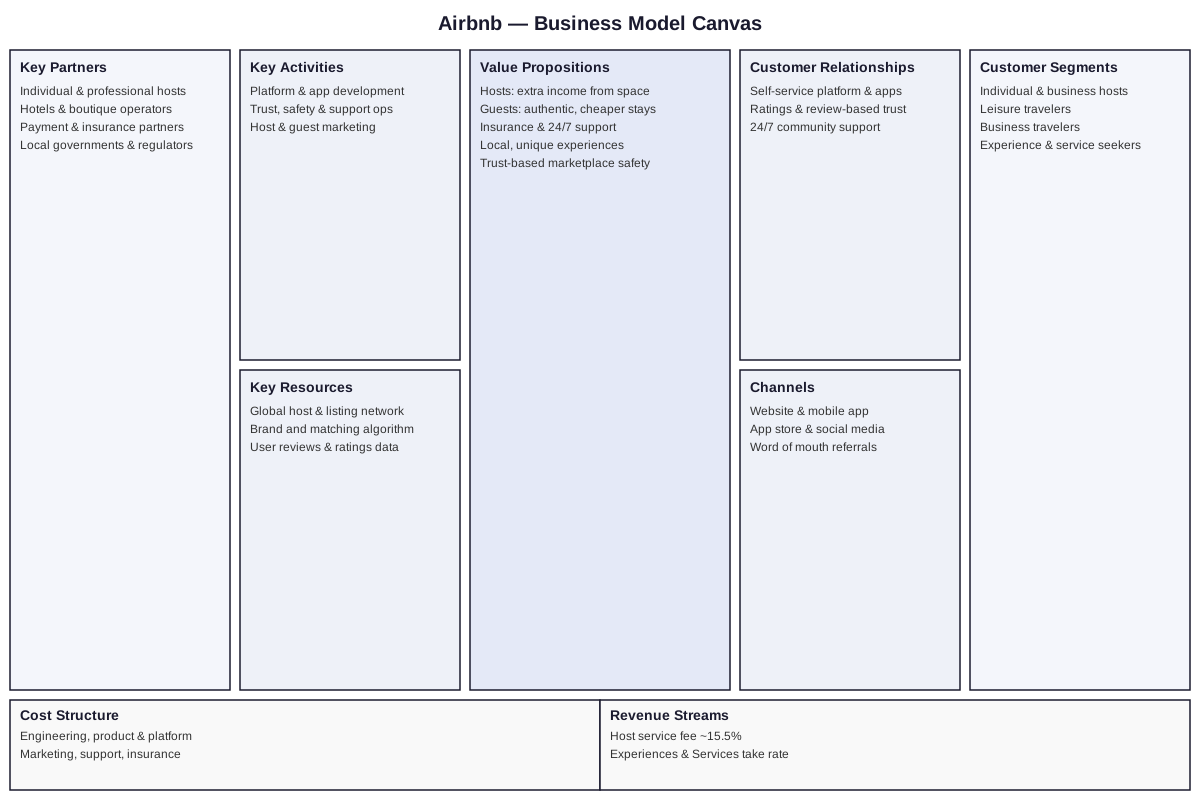
Most platforms operate with exactly two sides. eBay connects buyers and sellers, Uber connects riders and drivers, and Airbnb connects guests and hosts. These businesses are often called two-sided platforms because they sit between one supply-side group and one demand-side group, with no third group required for the core transaction. Airbnb illustrates the pattern clearly: a host lists a spare room or an entire apartment, a traveler searches and books it, and Airbnb charges a service fee to both sides for handling payment, identity verification and dispute resolution.
Some platforms coordinate more than two groups. Facebook connects users, advertisers, app developers and content creators within one ecosystem, and each group experiences the platform in a different way. Users make up the largest group by far and pay nothing to participate, while advertisers form a smaller group that funds the entire business by paying to reach those same users. YouTube runs a similar structure: viewers watch content for free, creators upload videos and earn a share of advertising revenue, and advertisers pay for placement in front of an audience they never contact directly. The Wikipedia entry on two-sided markets describes this asymmetry as one of the defining traits of platform economics, since the side that pays and the side that consumes are frequently not the same group.2
How Multisided Platforms Create Value
A multisided platform earns its keep by acting as a matchmaker rather than a producer. It does not manufacture the apartments listed on Airbnb, the cars used on Uber or the videos uploaded to YouTube, and it does not need to invest in that inventory to profit from its use. The platform's job is to make itself relevant enough that both sides show up in sufficient numbers, because a matchmaker with only one side present has nothing to sell. If Uber had built an app that few riders trusted, drivers would find no fares waiting, and the supply side would disappear along with the demand.
Value creation on a platform generally happens in two ways. The first is facilitating exchange directly: new sellers can list products with a modest upfront investment, largely avoiding the cost of independent advertising, while buyers gain the convenience of shopping or booking from anywhere with lower search costs. The second is providing a shared environment where one side generates content or activity that draws in the other side, as social platforms do when user posts create the material that advertisers later pay to reach. In both cases, the platform captures value from coordination rather than from ownership of the underlying assets.
Network Effects Determine Winners
Network effects explain why platform markets often tip toward one or two dominant players rather than splitting evenly across many competitors. A same-side, or direct, network effect occurs when more participants on one side make the platform more valuable to others on that identical side, the way a growing user base makes a social network like Instagram more interesting to existing users. A cross-side, or indirect, network effect occurs when growth on one side increases value for a different side, as more available drivers make Uber more attractive to riders, and more riders in turn make driving for Uber more worthwhile.3
Cross-side effects are the more common pattern in commercial platforms, because supply without demand is worthless and demand without adequate supply drives users away just as fast. A ride-hailing app with plenty of drivers and few riders wastes driver time; one with plenty of riders and few drivers frustrates passengers with long waits. Getting both sides growing together, rather than optimizing one side in isolation, is the operational discipline that separates platforms that scale from those that stall.
Pricing Strategy Across Sides
Multisided platforms rarely charge every side the same amount, because the willingness to pay and the value contributed differ by group. A platform frequently subsidizes the side that is harder to attract or that generates the most value for the other side, then recovers margin from the side more willing to pay for access. Google exemplifies this logic in search advertising: a business can appear in results for free, but it pays for enhanced placement at the top of the page, while the searcher using Google never pays anything directly.
Research on platform pricing published through ScienceDirect notes that optimal pricing in multisided markets depends on modeling both the direct effects within a side and the indirect effects across sides simultaneously, rather than pricing each side as an isolated market.4 A platform that prices too aggressively on the side it needs most risks losing the participants that give the entire network its value, even if that pricing looks rational when viewed one side at a time.
Common Revenue Models
Transaction fees represent the most widely used revenue model among multisided platforms, charged either as a fixed amount or as a percentage of the value exchanged. This fee is frequently invisible to the end customer, folded into the price shown at checkout on most e-commerce platforms rather than itemized separately. Access fees form a second model, common among dating platforms and professional networks, where a participant pays simply to join or to unlock the ability to contact others on the platform.
A third model charges for enhanced access rather than basic access, letting participants use the platform for free while paying extra for greater visibility or priority. Advertising-funded platforms combine elements of all three: the audience-facing side often pays nothing, while advertisers pay transaction-like fees tied to impressions, clicks or placement. Choosing among these models, or blending them, depends on which side generates the platform's core value and which side has the greatest willingness to pay for access to it.
Why Most Platforms Fail
Despite the visibility of successful examples, most attempts to launch a multisided platform do not survive long enough to reach a self-sustaining scale. The central obstacle is the chicken-and-egg problem: a platform needs sellers to attract buyers and needs buyers to attract sellers, and building both sides from zero simultaneously is far harder than building a single-sided business where one obvious customer group exists. Harvard Business Review research on platform strategy identifies clustering, disintermediation risk and multi-homing, meaning participants using several competing platforms at once, as recurring reasons why platforms that achieve early traction still fail to convert it into a durable position.5
Even after the initial user base forms, engagement demands constant attention. A platform with no transactions generates no revenue, regardless of how many people signed up during a launch campaign, so the company must keep acquiring and retaining participants on every side rather than treating growth as a one-time achievement.
Building and Scaling a Platform Today
Airbnb's growth path shows how a multisided platform moves from a niche idea to a global business without ever owning the assets it lists. It started by convincing a small number of hosts in one city to list spare rooms, then used that limited supply to attract enough travelers to prove demand existed, before expanding city by city rather than attempting global scale immediately. Trust mechanisms, including identity verification, guest and host reviews and payment protection, did as much to enable growth as the underlying search and booking technology, because neither side would transact confidently with strangers without them. Research from MIT Sloan on multisided platforms points to trust and reduced transaction costs as the underlying reasons users stay once a platform earns their business, meaning platforms that let trust erode lose participants faster than they can replace them.6
The lesson generalizes well beyond travel. A company evaluating a platform model should identify which side is scarcer and design the initial strategy around winning that side first, since the more abundant side will typically follow once genuine value exists on the platform. It should also budget for the operational cost of trust, verification and dispute resolution as a core expense, not an afterthought, because those functions are what let two strangers transact through a platform rather than through a relationship they built independently.
The multisided platform model rewards companies that solve a coordination problem better than the open market can solve it alone. Airbnb, Uber and Visa built durable businesses by making it cheaper and safer for two groups to find each other than any other arrangement could manage. None of them make money by owning inventory; they make money by owning the relationship between the sides of a market. That distinction matters for any executive weighing whether to build a platform rather than a product. The businesses that succeed treat liquidity, trust and cross-side pricing as the central strategic problem, not as a byproduct of growth. Companies still guessing at product-market fit on one side, while ignoring what the other side needs, tend to join the long list of platforms that never reached a self-sustaining scale
Citation
Cite this article
Sridharan, M. A. (2024, December 23). Multi-sided Platform Business Model. Think Insights. https://thinkinsights.net/strategy/multi-sided-platform-business-model (Accessed [[ACCESS_DATE]])
Sridharan, Mithun A. "Multi-sided Platform Business Model." Think Insights, 23 Dec. 2024, https://thinkinsights.net/strategy/multi-sided-platform-business-model. Accessed [[ACCESS_DATE]].
Mithun A. Sridharan, "Multi-sided Platform Business Model," Think Insights, December 23, 2024, https://thinkinsights.net/strategy/multi-sided-platform-business-model. Accessed [[ACCESS_DATE]].
Sridharan, M.A. (2024) 'Multi-sided Platform Business Model', Think Insights. Available at: https://thinkinsights.net/strategy/multi-sided-platform-business-model (Accessed: [[ACCESS_DATE]]).
M. A. Sridharan, "Multi-sided Platform Business Model," Think Insights, 2024. [Online]. Available: https://thinkinsights.net/strategy/multi-sided-platform-business-model. [Accessed: [[ACCESS_DATE]]].
Sridharan MA. Multi-sided Platform Business Model. Think Insights. Published December 23, 2024. Accessed [[ACCESS_DATE]]. https://thinkinsights.net/strategy/multi-sided-platform-business-model
Test Your Knowledge
Multi-sided Platform Business Model
Challenge yourself on the concepts from this article and see how well you understood them.
Subscribers get weekly quizzes and insights — subscribe free
Sponsor this article
Partner with Think Insights
Reach 50,000+ business leaders, consultants, and strategists. Feature your brand alongside expert articles on strategy, leadership, and digital transformation.
Become a Sponsor