Mindmap


Legend has it that in the summer of 1994, as the production of Toy Story was wrapping up, four Pixar creatives went to lunch to brainstorm ideas for new projects. They sketched on napkins and teased out ideas for what would become Wall-E, Monsters, Inc., A Bug's Life, and Finding Nemo.
What is a mind map?
A mind map is a diagram that visually links a central idea to related concepts using lines, symbols, colors, and images, creating a web of relationships.
Who created the concept of mind mapping?
Tony Buzan, a UK consultant and researcher, introduced the mind map concept in his 1972 book Use Your Head, originally to aid note-taking and idea capture.
How can consultants use mind maps in projects?
Consultants use mind maps to capture assumptions, decompose complex activities, outline strategic goals, communicate processes visually, and keep stakeholders aligned on project objectives and deliverables.
What software can be used to create mind maps?
Tools such as FreeMind allow users to create mind maps with minimal effort, enabling filtering, sorting, and grouping of linked information.
In what scenarios are mind maps most useful?
Mind maps are useful during brainstorming sessions, scope management, stakeholder mapping, team structure visualization, and tracking project goals, milestones, and status updates throughout a project lifecycle.
People have been using their mind maps for more than 40 years. Tony Buzan, a renowned UK consultant and researcher, presented the concept of mindmap in his book, Use Your Head in 1972. Initially, the concept was mainly to facilitate notes taking and idea capturing. Since then, the concept has been improved and popularized among businesses. Today, many business managers create and use visual maps to plan projects and structure their ideas.
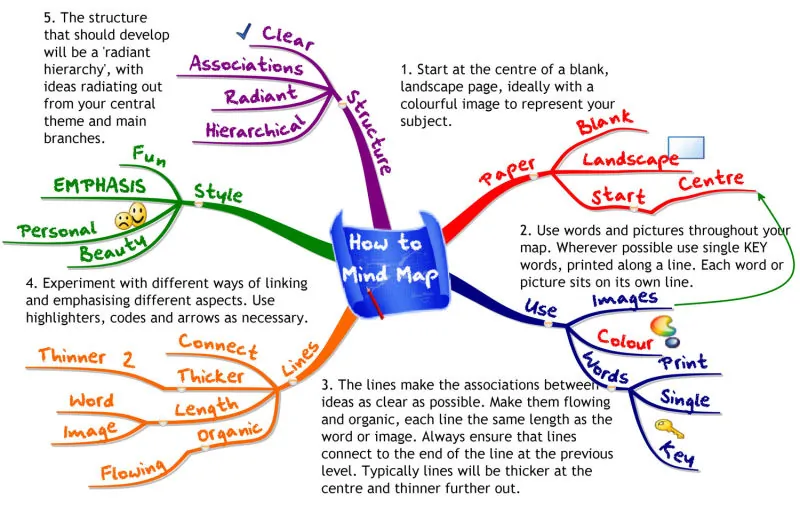
What is a Mindmap?
Mindmap is a data visualization technique to graphically establish connections between several ideas or pieces of information. This technique involves writing down each idea and then linking this idea to other related pieces by lines or curves. This results in a web of relationships. By analyzing & shifting these relationships, the consultant can figure out the best course of action & the expected outcomes. Using mind maps, consultants can capture, classify, analyze and visualize complex ideas and concepts. All mindmaps have some commonalities. They have a natural organizational structure that radiates from the center and use lines, symbols, words, color and images according to simple, brain-friendly concepts. Hence, mind mapping converts monotonous information into colorful, memorable & highly organized diagram that is in-line with brain's natural workings.
Application examples
For example, a you can visualize clients' purchase process by creating a sales funnel mind map that identifies the factors that impact lead generation, conversion and revenues. You can capture any assumptions, quotes, estimates, recommendations, guidelines, and other ideas that emerged from workshops & visually summarize this information. Team members and leaders can collaborate enrich the Mind Maps by adding notes, records and other important details. With Mind Mapping software, such as FreeMind, you can create mind maps and pictures with a few mouse clicks. You can also decompose complex activities into smaller linked maps that you can filter, sort and group. Using a mind map as a visual communication tool, you can break down even complex processes right in front of your client's eyes and help them see how things are connected. You can outline strategic goals as well as the steps needed to get there. By presenting everything visually that's easy to comprehend, you can actively engage non-technical project stakeholders. Likewise, a project plan in the shape of a mind map shows project goals, milestones and deliverables at a glance, ensuring that everybody is absolutely clear on what needs to be done. You can regularly update the map with project status updates through to completion. This will keep the client engaged throughout the project.
Additional scenarios
Here are more scenarios where Mind Maps could be of immense help:
- Capturing ideas during brainstorming sessions
- Updating new scope items during the project lifecycle
- Review, refine, agree and improve project objectives and goals
- Design a visual representation of stakeholder relationships
- Mind Map the team structure with details on roles and responsibilities
- Add notes and records to enrich your project map with additional information
Most consultants don't sketch the next great animated movie characters on napkins. But, we all need a way to tease out our ideas, think through concepts & put them into a usable format. Lists, outlines & notes certainly help. But, they don't always lend themselves to radical innovation, learning, or problem-solving. Mind mapping is a visual way to manage complex engagements, structure projects, and create documentation that is easy to understand. Correspondingly, it's a valuable tool that is ideal for engaging with stakeholders and managing expectations.
Citation
Cite this article
Sridharan, M. A. (2018, May 26). Mindmap. Think Insights. https://thinkinsights.net/strategy/mindmap (Accessed [[ACCESS_DATE]])
Sridharan, Mithun A. "Mindmap." Think Insights, 26 May 2018, https://thinkinsights.net/strategy/mindmap. Accessed [[ACCESS_DATE]].
Mithun A. Sridharan, "Mindmap," Think Insights, May 26, 2018, https://thinkinsights.net/strategy/mindmap. Accessed [[ACCESS_DATE]].
Sridharan, M.A. (2018) 'Mindmap', Think Insights. Available at: https://thinkinsights.net/strategy/mindmap (Accessed: [[ACCESS_DATE]]).
M. A. Sridharan, "Mindmap," Think Insights, 2018. [Online]. Available: https://thinkinsights.net/strategy/mindmap. [Accessed: [[ACCESS_DATE]]].
Sridharan MA. Mindmap. Think Insights. Published May 26, 2018. Accessed [[ACCESS_DATE]]. https://thinkinsights.net/strategy/mindmap
Test Your Knowledge
Mindmap
Challenge yourself on the concepts from this article and see how well you understood them.
Subscribers get weekly quizzes and insights — subscribe free
Sponsor this article
Partner with Think Insights
Reach 50,000+ business leaders, consultants, and strategists. Feature your brand alongside expert articles on strategy, leadership, and digital transformation.
Become a Sponsor